
Seoul is home to all three "SKY" universities and most of the Korean institutions known abroad: ten of the 14 Korean universities we profile in detail teach in the capital. In the QS World University Rankings 2027, Seoul National University leads (38th), followed by Yonsei (42nd) and Korea University (52nd); SKKU is 108th and Hanyang 155th. Studying here costs more than in the regions: average tuition in the capital region in 2026 is $6,057 a year versus $4,848 elsewhere in Korea, and rent near leading universities is several times the cost of a dorm.
Below: a table of Seoul universities with campuses and rankings, the student neighbourhoods, a budget, 2027 application windows and part-time work rules. If you have not yet decided that Seoul is right for you, start with our guide to universities in South Korea. Facts were checked against official sources on 23 September 2026; dollar amounts use ECB rates of 29 September 2026.
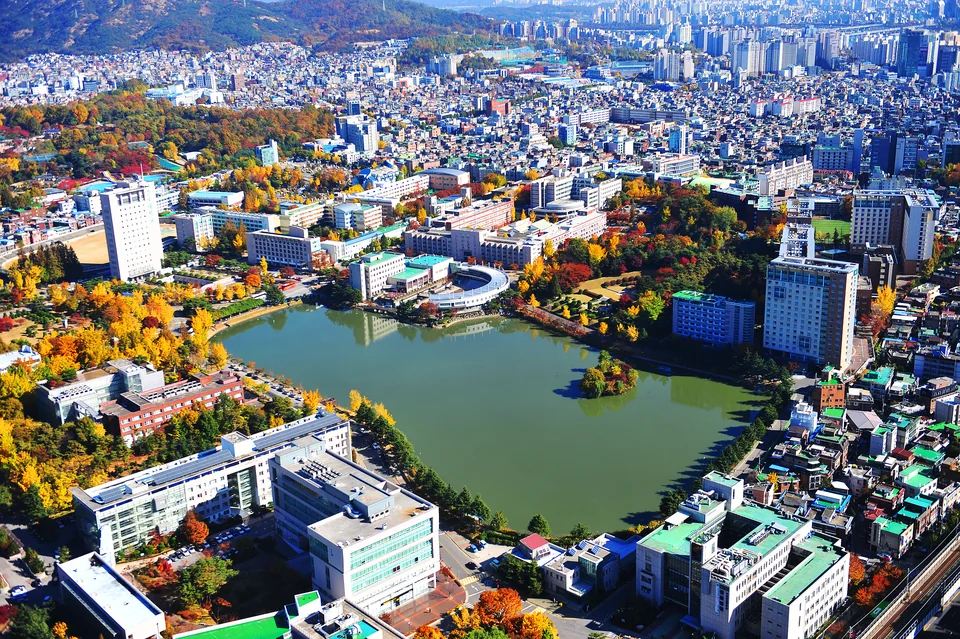
Seoul universities at a glance
| University | Seoul district | Second campus outside Seoul | QS 2027 | IEQAS | What to check |
|---|---|---|---|---|---|
| Seoul National University (SNU) | Gwanak | — | 38 | Yes | TOPIK 3 or English, fee by college |
| Yonsei University | Seodaemun (Sinchon) | International Campus in Incheon, Wonju campus | 42 | Yes | Korean track or English-taught UIC |
| Korea University | Seongbuk (Anam) | Sejong | 52 | Excellent | Where your programme is taught |
| Sungkyunkwan University (SKKU) | Jongno (Myeongnyun) | Suwon: natural sciences and engineering | 108 | Excellent | Seoul or Suwon |
| Hanyang University | Seongdong (Wangsimni) | ERICA in Ansan | 155 | Excellent | Seoul or ERICA |
| Kyung Hee University | Dongdaemun (Hoegi) | Global Campus in Yongin | 309 | Excellent | Which campus the programme lists |
| Chung-Ang University | Dongjak (Heukseok) | Anseong | 432 | Excellent | Campus, practical tests |
| Ewha Womans University | Seodaemun (Sinchon) | — | 488 | Excellent | Undergraduate admission for women only |
| Sogang University | Mapo (Sinchon) | — | 494 | Yes | Language requirements |
| HUFS | Dongdaemun (Imun) | Global Campus in Yongin | — | Yes | Language programmes, campus |
A dash in the QS column means we did not find a verified position. IEQAS is the certification Korea's education and justice ministries give to institutions that manage international students well; "excellent" is a separate list of 39 institutions with extra visa benefits. All ten universities are certified for March 2026 to February 2030.
The main trap: many "Seoul" universities teach outside Seoul
Half of the universities in the table run faculties outside the city. SKKU teaches natural sciences and engineering in Suwon; Hanyang has ERICA in Ansan; Kyung Hee and HUFS have Global campuses in Yongin; Chung-Ang has Anseong; Korea University has Sejong; Yonsei has Wonju and Incheon. The official certification list names such campuses separately, for example "고려대학교(세종)" or "한양대학교(ERICA)".
- Housing and commuting. Suwon and Ansan are on the subway network, but the trip from central Seoul usually takes an hour or more; Sejong and Wonju mean a train or intercity bus.
- Internships. Companies and events cluster in Seoul and are harder to reach from outlying campuses.
- Admissions. The university name is shared, but competition, requirements and sometimes fees differ by campus.
Before applying, find the campus column (campus or 캠퍼스) for each programme in the admission guidelines.
Where students live
| Area | Universities | What to know |
|---|---|---|
| Sinchon and nearby (Seodaemun, Mapo) | Yonsei, Ewha, Sogang | Seoul's densest student area; many cafés and small flats, high housing demand |
| Anam (Seongbuk) | Korea University | Campus and student quarter side by side, many small flats and goshiwon rooms |
| Hoegi and Imun (Dongdaemun) | Kyung Hee, HUFS | Eastern Seoul, usually cheaper than Sinchon |
| Gwanak | SNU | Hillside campus; students tend to live near the subway stations below |
| Wangsimni (Seongdong) | Hanyang | Major transport hub, easy access to central Seoul and Gangnam |
| Heukseok (Dongjak) | Chung-Ang | South of the Han River, close to Gwanak |
| Myeongnyun (Jongno) | SKKU humanities campus | Historic centre; students look for rooms in nearby blocks |
There are four main housing types. University dormitories are cheapest: about $164 a month on average nationally for a shared room. A goshiwon (고시원) is a tiny room with shared kitchen or bathroom, usually without a large deposit. A one-room flat or officetel is a studio with a deposit (보증금) plus monthly rent: near ten major Seoul universities rent averages about $439 a month plus $56 in utilities. A hasuk (하숙) boarding house with meals is less common. Contracts, deposits and scam prevention are covered in student housing in Korea.
What studying in Seoul costs
| Item | Benchmark | Source |
|---|---|---|
| Average tuition, capital region | $6,057 a year (KRW 8,270,000) | Ministry of Education, 2026 |
| SNU, College of Humanities | $1,789 per semester (KRW 2,442,000) | SNU admission guidelines, 2026 fees |
| SNU, College of Engineering | $2,196 per semester (KRW 2,998,000) | Same |
| SNU, College of Fine Arts | $2,676 per semester (KRW 3,653,000) | Same |
| Yonsei, humanities colleges | $3,337 per semester (KRW 4,556,000) | Yonsei 2026 fees for international students, from the second semester |
| Yonsei, College of Engineering | $4,397 per semester (KRW 6,004,000) | Same |
| Yonsei, English-taught UIC | $6,007 per semester (KRW 8,202,000) | Same |
| Financial proof at Yonsei | Bank balance of $16,260 (KRW 22,000,000) | Yonsei guidelines, spring 2027 |
| Dormitory | About $164 a month | NIIED 2026 guidebook (2024 data) |
| Rent near major universities | About $495 a month with utilities, plus deposit | NIIED 2026 guidebook (2024 data) |
| Food, transport, phone, leisure | About $366 a month | NIIED 2026 guidebook |
| Health insurance | About $56 a month (KRW 76,390) | KAIST's 2026 budget; NIIED gives $106 as the average foreigner's premium, and the student rate is lower |
For comparison, Pusan National University asks for $11,820 (KRW 16,000,000) for spring 2027, $4,430 (KRW 6,000,000) less than Yonsei. SNU stands out among Seoul universities as a national institution: a semester in its humanities college costs almost half as much as at Yonsei.
A realistic monthly budget in Seoul, excluding tuition, is roughly $590 in a dorm and about $920 in a rented flat (sum of the rows above, before deposit and flights). A full calculation is in the cost of studying in Korea.
How to choose a Seoul university
- Decide on language. Yonsei Underwood International College and selected programmes elsewhere teach in English; Korean-taught options are broader but usually need TOPIK 3 or higher. See the TOPIK exam guide.
- Filter by field, not rank. SNU and Korea University are comprehensive; Hanyang and SKKU run large engineering portfolios; HUFS specialises in languages and area studies; Chung-Ang and Kyung Hee have media and arts faculties.
- Check the campus of each programme (see above).
- Compare price and financial proof. A private Seoul university with rented housing versus SNU with a dorm can differ by thousands of dollars a year.
- Check the calendar. Windows are short and fall in different months, so build a list with staggered deadlines.
- Keep a backup outside Seoul. For science and engineering, KAIST in Daejeon or POSTECH in Pohang; for lower costs with Korean, Pusan National University. For applied programmes near the capital, Kyungbok University in Namyangju and Pocheon (Gyeonggi Province) is a junior college with 2–3-year programmes.
Applying to Seoul universities: 2027 windows
The spring semester starts in March and the autumn semester in September. Each university runs its own admissions, and windows are often open for less than a month.
| University and intake | Application window | Fee |
|---|---|---|
| SNU, undergraduate, spring 2027 | 6–9 July 2026 | $52 (KRW 70,000) |
| Yonsei UIC, spring 2027, round 1 | 26 August to 22 September 2026; documents by 2 October | $110 (KRW 150,000) |
| Yonsei, Korean track, spring 2027 | 1–17 September 2026, documents by post by 30 September | $150 (KRW 200,000); $170 (KRW 230,000) for medicine, dentistry and pharmacy |
| GKS 2027, embassy track (all universities) | 15–30 September 2026 | — |
Seoul universities ask for a similar core file: apostilled and translated diploma and transcripts, language certificate, essay or study plan, citizenship documents for you and both parents, and a bank statement. For spring 2027, SNU accepted TOPIK 3, completion of level 4 at a Korean university language centre, TOEFL iBT 80 or IELTS 6.0. Step-by-step: applying to Korean universities, bachelor's in Korea, master's in Korea.
The university decides on admission. The D-2 visa is issued by the Korean consulate; for Russian citizens the fee is $80, and applicants admitted to certified universities do not need to add a bank statement or certified diploma at the consulate. See the D-2 student visa guide.
Preparation plan: the year before you start
For the March 2028 or September 2027 semester, count back from the application window rather than from the first day of classes.
| When | What to do |
|---|---|
| 12–14 months before applying | Pick four to six Seoul programmes plus one or two outside Seoul; check language and campus for each |
| 9–12 months before | Book TOPIK or IELTS/TOEFL; if you have no Korean yet, start now (GKS, for example, allots a full year to language) |
| 6–9 months before | Order the apostille and translations, gather your parents' citizenship documents, set up the account for financial proof |
| 3–6 months before | Write the essay or study plan, secure recommendations; for GKS, prepare a separate file for September |
| Application window | Submit the online form, pay the fee, send originals by the university's deadline |
| After admission | Pay tuition, apply for a dorm, receive the Certificate of Admission and the D-2 visa |
The main risk is SNU's spring window, which lasted four days in 2026. If your documents are not ready in advance, the next chance comes six months later.
Scholarships for Seoul
The government GKS covers study at participating universities, including those in Seoul, and pays $10,640 (KRW 14,400,000) a year during the degree. Housing and insurance come out of that allowance, so it stretches less in Seoul than in the regions. Embassy-track quotas for 2027 include 3 places for Russia (one general, one for regional universities, one for overseas Koreans) and 4 for Kazakhstan; embassy applications run from 15 to 30 September 2026. See the GKS guide.
University scholarships usually reduce tuition by 30–100% based on grades and Korean. Amounts and renewal rules are in each university's notice; count a scholarship in your financial proof only after an official award.
Part-time work and careers in Seoul
Seoul has the most student jobs, but the rules are national. On a D-2 visa, work needs immigration permission for a specific employer. First- and second-year bachelor's students without TOPIK 3 may work up to 10 hours a week; with TOPIK 3, up to 25 hours on weekdays and without limit at weekends and in vacations. Third- and fourth-year students need TOPIK 4 for the same 25 hours. The 2026 minimum wage is $7.6 (KRW 10,320) an hour. Details: working while studying in Korea.
After graduation, the D-10 job-seeker visa is granted for up to a year at a time and up to three years in total since 29 October 2025. For internships and interviews, a Seoul campus close to company offices is a real advantage.
Common mistakes
- Confusing brand and campus. The programme may be in Suwon, Ansan, Yongin or Sejong.
- Budgeting rent from tourist listings. Student housing needs a deposit, which belongs in the first month's budget.
- Applying only to universities with the same deadline. One rejection round can cost a semester.
- Skipping the IEQAS check. It changes the visa file.
- Counting on part-time income in the first semester. Without TOPIK 3, hours are few and the permit is separate.
Universities in and around Seoul
- Seoul National University
- Yonsei University
- Korea University
- Sungkyunkwan University
- Hanyang University
- Kyung Hee University
- Chung-Ang University
- Ewha Womans University
- Sogang University
- HUFS
- Kyungbok University, Gyeonggi Province near Seoul
Outside the capital: KAIST (Daejeon), POSTECH (Pohang), Pusan National University (Busan). For a country overview, see studying in South Korea; if you are still choosing a country, compare China or Korea for studying.
FAQ
Inside Korea, the best known are the SKY universities: Seoul National University, Korea University and Yonsei, ranked 38th, 52nd and 42nd in QS 2027. For engineering, SKKU and Hanyang are also worth a look.
Average tuition in the capital region was $6,057 a year in 2026, and SNU, as a national university, charges less. Living costs excluding tuition are roughly $590 a month in a dorm and about $920 in a rented flat, plus a deposit if you rent.
Yes. Yonsei Underwood International College teaches entirely in English, and other universities offer individual English-taught programmes. SNU accepts an English certificate as proof of language, but many of its programmes are taught in Korean.
Near your campus: Sinchon for Yonsei, Ewha and Sogang; Anam for Korea University; Hoegi for Kyung Hee and HUFS. It is easier to start in a dorm and look for a flat once you arrive.
Yes, though English-taught programmes are limited. Without Korean at the start, choose an English track or conditional admission through a university language centre, then take TOPIK.
For spring, in the summer and early autumn of the previous year (SNU took spring 2027 applications on 6–9 July 2026); for autumn, in winter and spring. Start preparing 10–12 months ahead.
Sources
- Korean Ministry of Education: tuition from the April 2026 disclosure
- Ministry of Justice and Ministry of Education: IEQAS results, 12 Feb 2026 (PDF)
- Korea JoongAng Daily: Korean universities in QS World University Rankings 2027
- Seoul National University: international admissions
- Yonsei UIC: international first-year admission
- Yonsei University: spring 2027 international admissions guide (PDF)
- Yonsei University: 2026 undergraduate fees for international students (PDF)
- Pusan National University: spring 2027 undergraduate admissions
- KAIST: cost of attendance
- NIIED: 2026 guidebook for international students (PDF, hosted by KECLA)
- Study in Korea (NIIED): 2027 GKS undergraduate notice
- Korean Consulate General in St Petersburg: D-2 study visa
- easylaw.go.kr: part-time work for international students
- Ministry of Justice: D-10 changes, 27 Oct 2025 (PDF)
- Minimum Wage Commission of Korea
- Kyungbok University: campuses
Dollar amounts use ECB reference rates of 29 September 2026 (€1 = $1.1355 = KRW 1,537; $1 ≈ KRW 1,353), rounded. NIIED guidebook figures are shown in dollars as published.
During the free initial consultation, we clarify your goal, profile, timing, and budget and identify the next realistic step. Apply
Next steps
- Bachelor's Degrees in Korea: How to Apply After High School and What It Costs
- TOPIK Exam Guide 2026–2027: Levels, Scores, Test Dates and Where to Sit It
- Seoul National University (SNU)
- KAIST (Korea Advanced Institute of Science and Technology)
- Kyungbok University
- Studying in South Korea for international applicants
