
Ewha Womans University is a private research university in Seoul that grew out of a girls' school founded in 1886. Its undergraduate programmes and its General Graduate School admit women only, while the Ewha Language Center teaches Korean to both men and women. International freshmen do not need a Korean certificate to be admitted: they build their Korean during a compulsory first year at HOKMA College. Tuition runs from $3,430 to $4,750 per semester depending on the college (KRW 4.64–6.43 million at Fall 2026 rates).
| At a glance | Details |
|---|---|
| Location | Seodaemun-gu, Seoul; the College of Medicine is on the Magok campus |
| Founded | 1886 as Ewha Haktang; university status since 1946 |
| Who can apply | undergraduate and General Graduate School: women only; language centre: everyone |
| Size | 15 colleges, 81 departments, 16 graduate schools; 23,124 students including 2,468 international (1 April 2026) |
| Rankings | QS World University Rankings 2027: =488; THE World University Rankings 2026: 501–600 |
| Undergraduate tuition | $3,400–4,710 per semester (KRW 4.64–6.43 million); first year at HOKMA about $4,620 (KRW 6.31 million) |
| Language for freshman entry | none required, except English for International Studies |
| Spring 2027 intake | online applications ran 2 September – 8 October 2026 and are closed; the next intake is Fall 2027 |
| Housing | $650–2,450 for the Spring 2027 semester (123 nights), meals not included |
| Korean courses (D-4 visa) | $1,350 (KRW 1.85 million) per 10-week term from Winter 2026 |
Who Ewha suits, and who should look elsewhere
Ewha fits a woman who wants a large research university in central Seoul and is prepared to reach TOPIK level 3 within her first year. It is strongest in the humanities, social sciences, psychology, education, design and music. It also has engineering and AI colleges, but applicants who care only about engineering or IT will find a wider choice at co-educational technical universities.
| Advantages | Limitations and risks |
|---|---|
| No language certificate is needed for freshman entry: Korean is taught in year one | TOPIK 3 is needed to start the major, TOPIK 4 to graduate |
| International Studies is taught fully in English | Most other majors are taught mainly in Korean |
| ISS F4 and F2 scholarships cover tuition for 4 or 2 years | All scholarships are competitive and decided by a university committee |
| On-campus housing with priority for new international students | Priority housing lasts one year at most |
| Own language centre whose levels count towards admission and scholarships | Men can study only at the language centre, not in degree programmes |
If you want a co-educational university in Seoul, compare Ewha with Yonsei University, Korea University and Sogang University, which is in the neighbouring district. For English-taught engineering, look at POSTECH and KAIST. A wider overview is in our guide to universities in Seoul.
Programmes, and where English is used
Undergraduate study is organised by college. International applicants choose a specific major when they apply. The Spring 2027 catalogue lists 11 colleges, and almost all freshmen spend their first year at HOKMA College of General Education.
- Liberal Arts: Korean, Chinese, French, German and English language and literature, history, philosophy, Christian studies.
- Social Sciences: political science and international relations, public administration, economics, sociology, social welfare, psychology, communication and media, library and information science.
- Natural Sciences: mathematics, statistics, physics, chemistry and nanoscience, life sciences.
- Engineering: electronics and semiconductors, food science and technology, chemical engineering and materials science, architecture (5 years), environmental science, energy systems, mechanical and biomedical engineering.
- Artificial Intelligence: computer science, cyber security, AI and data science.
- Business, Music, Art & Design, Nursing, Kinesiology & Sports Studies, fashion and content.
Only the Division of International Studies at Scranton College (International Studies and Global Korean Studies) teaches all major courses in English, and even there some compulsory general-education courses are in Korean. In other majors the share of English-taught courses depends on the department, and Korean-taught courses usually dominate.
The HOKMA first year
Since 2025 almost all freshmen (except International Studies and Nursing) spend at least two semesters in the Global Scholars Program at HOKMA College, taking Korean and foundation courses. They move into their major after two semesters once they reach TOPIK 3 or an equivalent level; without it, access to major courses is restricted.
Graduate study
The General Graduate School offers master's, doctoral and combined programmes across almost all departments, from linguistics and art history to economics, nanoscience and medicine. Professional schools such as the Graduate School of International Studies (GSIS), the Graduate School of Translation & Interpretation (GSTI) and the business school admit students through their own guides, so their conditions, including the rules on gender, must be checked in each school's documents.
How to apply: a timeline for applicants from abroad
The plan below is written for a school leaver from Russia, Kazakhstan or another CIS country, but it works for any international applicant. The Spring 2027 round has closed, so the realistic targets are Fall 2027 or Spring 2028.
- 8–10 months before the start: check eligibility. You and both parents must hold non-Korean nationality only. Any former Korean nationality in the family must be renounced before the application period opens.
- 6–8 months before: choose the major. Check whether it requires a portfolio or an audition: music, art, design and sports applicants submit extra materials separately.
- 4–6 months before: documents and translations. Diploma or expected-graduation certificate, transcripts for all high-school years, passports of the applicant and both parents, and a birth certificate as proof of the family relationship. Documents not in Korean or English need a notarised translation into one of them.
- Application window: online form and fee. Everything is uploaded as PDF at isa.ewha.ac.kr. The personal statement is typed into the form itself. The fee is $110 (KRW 150,000), and the application counts only once it is paid.
- About a month after the window closes: preliminary decision. Original documents must then arrive within about two weeks, and school documents issued abroad must carry an apostille.
- Final decision and payment. Scholarships are announced together with final admission. The university then sends instructions on tuition payment, proof of funds and visa documents.
- D-2 student visa. After payment Ewha issues the Certificate of Admission, which you use to apply for a student visa at a Korean consulate. The consulate, not the university, decides on the visa. See our student visa guide.
In the personal statement the committee sees your motives and plans rather than your grades, so write it for the specific major: why this field, what you have already done towards it and how Ewha fits your next step.
Deadlines for Spring and Fall 2027
| Step | Spring 2027 (March) | Fall intake (September) |
|---|---|---|
| Online application and fee | 2 September, 13:00 – 8 October 2026, 17:00 KST | Fall 2025 cycle: 5 March – 7 April; the Fall 2027 guide is published in spring 2027 |
| Preliminary decision | 13 November 2026 | Fall 2025 cycle: 2 May |
| Original documents with apostille | 16–27 November 2026 | Fall 2025 cycle: 6–16 May |
| TOPIK certificate from applicants who applied with a pending result (transfer and graduate) | 10–11 December 2026 | — |
| Final decision and scholarships | 18 December 2026 | Fall 2025 cycle: 13 June |
| Tuition payment | January 2027 | July |
For transfer and graduate applicants, who need TOPIK 4, the Spring 2027 round accepted results up to the 108th TOPIK (18 October 2026) and the 15th TOPIK IBT (24 October 2026). Applicants sitting the test on those dates select "TOPIK 취득예정" in the form and email the result after preliminary admission. Freshmen do not need a certificate to be admitted, but ISS TOPIK scholarships are awarded only on a score that already exists at the time of application.
Language requirements
| Programme | Requirement at application |
|---|---|
| Freshman entry (except International Studies) | none; Global Scholars Program in year one with TOPIK 3 as the target |
| International Studies and Global Korean Studies | TOEFL iBT 80 (4.0 on the new scale for tests from 21 January 2026), IELTS 6.0, New TEPS 326, or a high school taught entirely in English |
| Transfer to year 2 or 3, graduate study | one of: TOPIK 4; level 4 at a Korean university language institute; TOEFL iBT 80 (4.0), IELTS 6.0, New TEPS 326; or previous study entirely in Korean or English |
IELTS Indicator and TOEFL Home Edition are accepted; combined TOEFL MyBest scores are not. Every undergraduate except International Studies students must obtain TOPIK 4 before graduating, even if she was admitted on an English score. Our TOPIK guide explains the test levels and preparation.
Documents and legalisation
Scans are enough during the application window: originals in Korean or English, or notarised translations. Legalisation is needed after preliminary admission, and Ewha does not extend deadlines because of apostille delays.
- School diploma and transcripts with an apostille. Russia, Kazakhstan, Uzbekistan, Kyrgyzstan, Tajikistan, Armenia and Belarus are on the Hague Convention list in Ewha's guide, so consular legalisation is not needed. The apostille goes on the original and the notary certifies the translation.
- Passports of the applicant and both parents. If the parents are divorced or one has died, supporting documents and a guardianship document are required.
- Proof of family relationship: for most CIS citizens, a birth certificate with translation.
- Bank balance certificate in the applicant's or a parent's name showing at least $14,780 (KRW 20 million), issued on or after 8 January 2027 for the spring intake. It is submitted after admission, for the visa.
- Personal statement in Korean or English, typed into the application form.
- Scholarship application (Form 4), only if you are applying for Ewha scholarships.
A school leaver who does not yet have a diploma submits an expected-graduation certificate. The final apostilled diploma must reach the university no later than one month before the semester starts.
How much Ewha costs
Tuition
The figures below are Fall 2026 rates quoted in the Spring 2027 guide; the university warns that they may change.
| Programme | First semester or first year | From year two or semester two |
|---|---|---|
| Undergraduate: humanities, social sciences, business, International Studies | HOKMA first year about $4,660 (KRW 6.31 million) per semester, including the admission fee | $3,430–4,110 (KRW 4.64–5.56 million) |
| Undergraduate: natural sciences, engineering, AI, nursing | as above | $4,090–4,590 (KRW 5.53–6.21 million) |
| Undergraduate: music, art & design, fashion and content | as above | $4,630–4,750 (KRW 6.27–6.43 million) |
| Graduate: humanities and social sciences | $5,450 (KRW 7.38 million) | $4,690 (KRW 6.35 million) |
| Graduate: sciences and engineering | $6,200–7,100 (KRW 8.39–9.61 million) | $5,440–6,340 (KRW 7.36–8.58 million) |
| Graduate: medicine | $7,800 (KRW 10.56 million) | $7,040 (KRW 9.53 million) |
Nursing and International Studies freshmen, who do not go through HOKMA, pay $3,760–4,090 (KRW 5.09–5.53 million) in the first semester including the admission fee.
Housing and living costs
| Item | Amount |
|---|---|
| E-House, Spring 2027 (123 nights) | from $1,010 (KRW 1.37 million) for a quad to $1,630 (KRW 2.21 million) for a single |
| I-House | $1,460 (KRW 1.98 million) for a double; $1,830–2,480 (KRW 2.47–3.35 million) for a single |
| Hanwoori House | $660–940 (KRW 0.89–1.27 million) |
| National Health Insurance for D-2 holders | about $59 (KRW 79,320) per month at 2026 rates |
| Minimum bank balance for the visa | $14,780 (KRW 20 million) |
Housing rates are based on the 2026 academic year and may rise. Meals are not included: a meal plan is bought separately. A Seoul budget is built from housing, food, transport, phone and insurance; our guide to the cost of studying in Korea shows how to add it up.
Tuition is paid by bank transfer to the university's account. Families paying from Russia should check in advance that their bank can transfer money to Korea in the required currency, and keep the payment records, which are also useful for the visa.
Do not plan your first-year budget around a part-time job. D-2 students may work only with permission from the immigration service, and the permitted hours depend on the year of study and Korean level. See our guide to working while studying in Korea.
Scholarships: GKS and Ewha awards
Global Korea Scholarship (GKS)
For 2027 undergraduate entry Ewha is a Type A university in the Embassy Track: you apply through the Korean embassy in your country and list up to three universities, at least one of which must be a regional (Type B) university. Ewha is not part of the 2027 undergraduate University Track, which covers only the UIC programmes and a short list of regional universities and colleges. GKS covers tuition in full (NIIED pays up to $3,690 (KRW 5 million) per semester and the university covers the rest), pays airfare and a Korean language year, and provides $10,640 (KRW 14.4 million) a year during degree study. For graduate study, Ewha also took part in the 2026 GKS-G University Track, where applicants apply directly to the university. Details are in our GKS guide.
Ewha awards for new students
| Scholarship | Eligibility | Benefit |
|---|---|---|
| EGPP (Ewha Global Partnership Program) | applicants from countries on the OECD DAC list of ODA recipients | full tuition and admission fee, housing, monthly stipend; up to 8 semesters for undergraduates |
| ISS F4 | top-scoring freshman applicants | full tuition for 4 years |
| ISS F2 | top-scoring undergraduate or graduate applicants | full tuition for 2 years |
| ISS TOPIK 4 / 5 / 6 | undergraduate applicants with a valid TOPIK at application | partial, half or full first-semester tuition |
| ELC Excellence in Korean Language | at least three semesters at Ewha's language centre, including level 5 | partial first-semester tuition |
The DAC list includes Kazakhstan, Uzbekistan, Kyrgyzstan, Tajikistan, Turkmenistan, Armenia, Azerbaijan, Georgia, Belarus and Moldova, but not Russia, so Russian citizens cannot apply for EGPP. Every Ewha scholarship requires Form 4 during the application window, and awards are kept only with a minimum GPA. Ewha's committee decides every award; StudyU has no influence on it. More funding options are collected in our overview of scholarships for studying abroad.
Korean courses at the Ewha Language Center (D-4 visa)
If you want to learn Korean first and apply later, the language centre runs an intensive programme open to men and women who have finished high school.
| Item | Korean Intensive Program |
|---|---|
| Length | 10 weeks, 200 hours; four terms a year |
| Schedule | Mon–Fri, 09:10–13:00; levels 1–6; about 15 students per class |
| Fees from Winter 2026 | $1,370 (KRW 1.85 million) + application fee $89 (KRW 120,000) + textbooks $52–59 (KRW 70,000–80,000) |
| Spring 2027 | classes 5 March – 18 May 2027; registration 7 December 2026 – 26 January 2027 |
| Summer 2027 | classes 3 June – 12 August 2027; registration 8 March – 27 April 2027 |
| D-4 funds | bank statement in the student's or a parent's name with at least $7,390 (KRW 10 million) when registering for two terms |
For a D-4 visa, original documents must reach the centre at least two weeks before the tuition deadline, and registration may close early if demand is high. Students who complete levels 4–6 can transfer up to 6 credits if they enter an Ewha degree within a year, and three semesters including level 5 qualify for the ELC Excellence scholarship. Our guide to Korean language programmes compares schools.
Where to live: campus residences
Three residences serve international students: E-House, I-House and Hanwoori House. Rooms range from single to quad and are furnished; floors have shared kitchens, laundry, a gym and study rooms, and each building has a cafeteria. New undergraduates admitted through international admissions apply in the general housing period and get priority. Graduate students can request priority placement through the International Student Affairs Team (ISAT) in their first semester, but places may run out. Priority housing lasts at most one year; after that you compete in the general round or rent privately. Our student housing guide covers deposits and contracts in Seoul.
Strengths and weaknesses for applicants from Russia and the CIS
What works in your favour:
- No Korean certificate is needed for freshman entry, which is unusual for a Seoul university of this level.
- Apostilled documents from CIS countries are accepted without consular legalisation.
- Applicants from Central Asia, Armenia, Azerbaijan, Georgia, Belarus and Moldova may be eligible for EGPP.
What makes it harder:
- Spring applications close in early October, so 2027 school leavers realistically target the Fall intake.
- EGPP is not open to Russian citizens, who are left with ISS awards and GKS.
- Paying tuition and showing funds from Russia requires a legal banking route arranged in advance.
- The visa requires at least $14,780 (KRW 20 million) in the bank, and the statement must be recent.
Common mistakes
- Applying for spring in November. By then the spring round is at the decision stage: the window closed on 8 October 2026.
- Assuming English covers every programme. Only International Studies and Global Korean Studies are fully English-taught.
- Leaving TOPIK to the last moment. A score obtained after the window cannot be used for an ISS TOPIK scholarship.
- Postponing the apostille. After the preliminary decision there are only about two weeks to deliver originals.
- Confusing the language centre with degree programmes. Men can study at the ELC, but Ewha will not admit them to a bachelor's degree.
Where classes take place
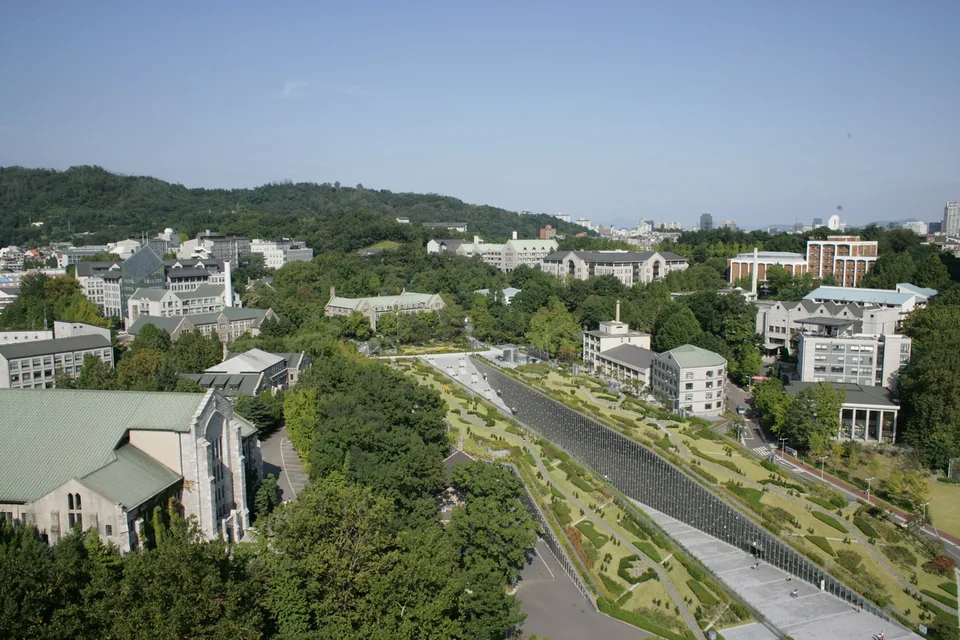
The main campus is in Seodaemun-gu in north-west central Seoul, next to Ewha Womans University station (Line 2) and the Sinchon student district, and covers about 55 hectares. Its best-known building, the Ewha Campus Complex (ECC), was completed in 2008 and houses teaching, study and leisure space. The College of Medicine is on the Magok campus in Gangseo-gu, and the university runs the Mokdong and Seoul hospitals.
Rankings
| Ranking | Position |
|---|---|
| QS World University Rankings 2027 | =488 |
| QS Asia University Rankings 2026 | 69 |
| THE World University Rankings 2026 | 501–600 |
| THE 2026 by subject: psychology | 176–200 |
| THE 2026 by subject: education | 251–300 |
When choosing a major, the overall ranking matters less than whether the department offers courses in a language you can follow and what it requires to move on from HOKMA.
Checklist before you apply
- You and both parents hold only foreign nationality, as shown by passports and a birth certificate.
- You have chosen the major and know whether it needs a portfolio, an audition or an English certificate.
- Your diploma and transcripts are apostilled or already at the apostille office: after the preliminary decision you will have about two weeks.
- $14,780 (KRW 20 million) will be in the account by January (spring) or summer (fall), and your bank can transfer money to Korea.
- If you are counting on an ISS TOPIK or ELC Excellence scholarship, the certificate is in hand before the window opens.
- The personal statement is written for your major and the scholarship form (Form 4) is ready.
FAQ
Does Ewha admit men?
Not to undergraduate programmes or the General Graduate School: the international admissions guide states that only female applicants are accepted. Men can study Korean at the Ewha Language Center. Professional graduate schools publish separate guides, so their rules have to be checked individually.
Do I need Korean to start a bachelor's degree?
No, except that International Studies requires English. During the first year you study in the Global Scholars Program and need TOPIK 3 to start your major and TOPIK 4 to graduate.
How much does Ewha cost?
At Fall 2026 rates the first year costs about $4,620 per semester (KRW 6.31 million), then $3,400–4,710 per semester depending on the college. Campus housing adds $650–2,450 per semester without meals.
When can I apply for Fall 2027?
Ewha publishes the Fall 2027 guide in spring 2027. In the Fall 2025 cycle, applications ran from 5 March to 7 April and final results came on 13 June.
Can I study at Ewha for free?
EGPP (for DAC-list countries, which do not include Russia), ISS F4 and F2, and GKS can cover full tuition. All are competitive, so they should not be built into the budget in advance.
Can I apply after 11 years of school?
Ewha's international guide requires only completion of high school (for Spring 2027, by February 2027) and sets no separate 12-year rule. A Russian school certificate is submitted with an apostille and notarised translation, and the committee may ask for additional documents during review.
How can StudyU help?
Under a service agreement we help choose the major, check requirements, prepare the personal statement and documents, and support the application and visa stages. Ewha decides on admission and scholarships; the Korean consulate decides on the visa.
Sources
- Spring 2027 Admissions Guide for International Applicants (isa.ewha.ac.kr, PDF)
- Fall 2025 General Plan (isa.ewha.ac.kr, PDF)
- Ewha at a Glance: statistics as of 1 April 2026
- Ewha history
- Ewha Language Center: Intensive Program, schedule and fees
- Ewha Language Center: tuition increase notice
- 2027 GKS-U Application Guidelines (Study in Korea)
- 2027 GKS-U University Track list (Study in Korea)
- OECD DAC List of ODA Recipients
- QS World University Rankings: Ewha Womans University
- THE World University Rankings: Ewha Womans University
Dollar amounts use ECB reference rates of 29 September 2026 (about KRW 1,353 per $1) and are rounded.
For admissions at other Korean universities and how they differ, see studying in South Korea. If you want to know whether Ewha fits you and which intake you can realistically make, send an application.
During the free initial consultation, we clarify your goal, profile, timing, and budget and identify the next realistic step.
Next steps
- TOPIK Exam Guide 2026–2027: Levels, Scores, Test Dates and Where to Sit It
- Working While Studying in Korea 2026: D-2 Part-Time Hours, Permits and Pay
- GKS Scholarship Korea: Quotas, Eligibility and Deadlines for 2027
- Cost of Studying in Korea 2026: Tuition per Semester, Living Costs and a First-Year Budget
- Scholarships abroad 2026: where international students study for free
- Studying in South Korea for international applicants
