
POSTECH is a small research university of science and engineering in Pohang, south-eastern Korea, founded in 1986. It opened a separate International Admissions track for undergraduates with the Fall 2026 intake, and from 2027 it admits international students twice a year. Everyone admitted through this track has tuition fully waived and receives $370 (KRW 500,000) a month towards living costs. Teaching is in English, so Korean is not needed for admission, but an English test score is mandatory.
| At a glance | Details |
|---|---|
| Location | Pohang, North Gyeongsang Province |
| Founded | 1986 |
| Size | about 370 freshmen a year; 5.1 undergraduates per faculty member (April 2026) |
| Rankings | QS World University Rankings 2027: 106; THE World University Rankings 2026: =141 |
| Language of instruction | English for foundation and major courses; the campus is declared bilingual |
| Undergraduate tuition | about $2,040 (KRW 2.79 million) per semester, fully waived for International Admissions students |
| Undergraduate scholarship | full tuition for up to 8 semesters + $370 (KRW 500,000) a month + airfare reimbursement up to $1,830 (KRW 2.5 million) |
| Fall 2027 intake | applications in March–April 2027; the guidelines appear in January 2027 |
| Graduate study | $7,770 (KRW 10.61 million) a year; most students work as teaching or research assistants (TA/RA), which covers tuition and housing |
| D-4 language courses | none: Korean is taught only to enrolled POSTECH students |
Who POSTECH suits, and who should look elsewhere
POSTECH is designed for students who are serious about science and engineering: mathematics, physics, chemistry, biology, materials, mechanical and electrical engineering, computer science. It is a research university with small classes, and selection rests on strength in mathematics and the sciences. There are no humanities, economics or creative programmes.
| Advantages | Limitations and risks |
|---|---|
| Undergraduate study is effectively free for international students with a GPA of 3.0/4.3 or higher | No humanities, business or medical programmes |
| The whole degree is in English; Korean is not needed for admission | A strong mathematics and science profile is essential |
| Monthly allowance and airfare reimbursement | Pohang is a small city, far from Seoul |
| The major is chosen after three semesters, not at application | No transfer admission |
| Strong graduate school with paid assistant positions | No language institute with a D-4 programme |
If Seoul and a wider choice of majors matter to you, compare POSTECH with KAIST and Seoul National University. Other strong universities are collected in our overview of universities in Korea for international students.
Undergraduate and graduate programmes
Bachelor's: no major at entry
All freshmen enter the Mueunjae School of Undergraduate Studies without a declared major. For the first three semesters they explore fields and take core science courses, then choose a major at the end of the third semester with no restrictions. There are 11 majors:
- mathematics;
- physics;
- chemistry;
- life sciences;
- materials science and engineering;
- mechanical engineering;
- industrial and management engineering;
- electrical engineering;
- computer science and engineering;
- chemical engineering;
- convergence IT engineering (from the 2027 intake the department becomes the Department of Biomedical Engineering).
The Department of Semiconductor Engineering does not admit international students.
Master's and doctoral study
The General Graduate School admits international students to master's, doctoral and integrated programmes. They include materials science, mechanical, electrical and chemical engineering, computer science, biological and bioengineering programmes, environmental science, advanced nuclear engineering, convergence engineering and the Institute of Artificial Intelligence. The Graduate Institute of Ferrous and Eco Materials Technology (GIFT), which covers metallurgy and "green" materials, has its own guide for international applicants.
How to apply for a bachelor's degree: a plan for Fall 2027
The track is called International Admissions. It is open to applicants who, together with both parents, have held no Korean citizenship at least since the applicant entered high school.
- September–December 2026: English. There is no minimum score, but POSTECH recommends IELTS 6.5, TOEFL iBT 83 (4.0 or higher on the new scale), TEPS 327 or TOEIC 800. The test must be taken within two years of the application deadline.
- December 2026 – February 2027: build your file. Transcripts for all high-school years and, optionally, SAT, AP, IB, A-level or national exam results, olympiad and project certificates.
- January 2027: guidelines. POSTECH publishes the Fall rules on adm-iu.postech.ac.kr.
- March–April 2027: application. The form is completed and documents uploaded on the Study in Korea portal (studyinkorea.go.kr). The fee is KRW 60,000 or $60. One teacher sends the recommendation letter directly to the admissions office by email.
- After the preliminary decision: originals by post. The school certificate, transcripts and documents on nationality and family relationship are sent to Pohang with an apostille. In the spring round this took about three weeks.
- Final decision, registration and D-2 visa. POSTECH issues the Certificate of Admission and a scholarship certificate, which replaces a bank statement for the visa. The Korean consulate decides on the visa; the steps are in our student visa guide.
Selection is based on documents only, with no exam. The committee looks at the level of and results in mathematics and science, English and the school you attended. It also assesses interest in science, attitude to study and teamwork.
The essay: four questions
The personal statement is written in the online form in English (recommended) or Korean. The Spring 2027 guide asked four questions:
- your goals, what you have already done towards them and why POSTECH — up to 500 words;
- your most meaningful experience in a STEM project — up to 200 words;
- working in a team with people of different views or backgrounds — up to 200 words;
- special circumstances that help explain your path (optional) — up to 300 words.
Avoid turning the answers into a CV: each one should show a concrete episode, what you did and what you learned from it.
Deadlines for Spring and Fall 2027
| Step | Spring 2027 (bachelor's) | Fall 2027 (bachelor's) |
|---|---|---|
| Online application | 25 August – 2 September 2026 (closed) | March–April 2027 |
| Recommendation letter | by 3 September 2026 | during the application period |
| Preliminary decision | 18 November 2026 | in the January 2027 guidelines |
| Apostilled originals | must arrive by 8 December 2026 | in the guidelines |
| Final decision | 17 December 2026 | in the guidelines |
| Semester start | 22 February 2027 | September 2027 |
International applicants to the General Graduate School apply in two rounds. In the 2026/27 cycle, round one ran from 24 February to 3 April 2026 (for Fall 2026 or Spring 2027) and round two from 6 July to 11 September 2026 (for Spring 2027). The next cycle is expected to follow the same pattern from February 2027.
Documents
| Required | Optional |
|---|---|
| Application form and essays on the Study in Korea portal | SAT, ACT, AP, IB, A-level or national exam results |
| One recommendation letter (from an academic adviser, homeroom teacher, or mathematics or science teacher) | awards, olympiads, volunteering, clubs |
| IELTS Academic, TOEFL iBT, TEPS or TOEIC L&R score | High School Profile |
| Academic History Record form | TOPIK (no minimum level) |
| School certificate or expected-graduation certificate; transcripts for all years | explanatory statement on gaps in education |
| Documents on the nationality of the applicant and parents and on the family relationship | |
| Checklist and consent to document verification |
IELTS General Training, IELTS Indicator, IELTS One Skill Retake, TOEFL Essentials, TOEFL Home Edition and MyBest Scores are not accepted. You can apply without an English score only if you attended a school taught in English and can prove it with an official letter, or hold citizenship of one of seven English-speaking countries. All documents must be in English or Korean; others need a notarised translation. GED certificates, home schooling and distance learning are not accepted, and there is no transfer admission.
How much POSTECH costs
Bachelor's: what the university covers
POSTECH publishes a cost-of-attendance estimate for 2026. It shows how much a student admitted through International Admissions still pays.
| Item (2026) | Per year | Who pays |
|---|---|---|
| Tuition | $4,090 (KRW 5.58 million) | fully waived with a GPA of 3.0/4.3 or higher |
| RC residence, double room, 4 months per semester | $1,030 (KRW 1.4 million) | student |
| National Health Insurance for D-2 holders | $700 (KRW 951,840), $60 (KRW 79,320) a month | student |
| Meals: 3 a day at $4 (KRW 5,000) | $4,010 (KRW 5.48 million) | student |
| Phone | $260 (KRW 360,000) | student |
| Living allowance | $4,390 (KRW 6 million): $370 (KRW 500,000) × 12 months | university |
| Left for the student to pay | about $1,600 (KRW 2.19 million) a year, $135 (KRW 182,237) a month | student |
In the first semester of 2026 tuition was $2,160 (KRW 2.92 million) and was also waived in full. The estimate excludes textbooks, transport, personal expenses and housing during vacations; bedding can be rented for about $37 (KRW 50,000) a semester. POSTECH reimburses the trip to Korea once, up to $1,830 (KRW 2.5 million), if you have not lived in Korea during the six months before the semester starts.
Graduate study
| Item (university estimate, January 2026) | Amount |
|---|---|
| Tuition | $7,770 (KRW 10.61 million) a year |
| Residence for single students | $1,650 (KRW 2.25 million) a year |
| Apartment for single students | $1,630–4,100 (KRW 2.23–5.6 million) a year |
| Apartment for married students | $2,280 (KRW 3.11 million) a year |
| Matriculation fee (once) | $660 (KRW 898,000) |
| Housing deposit (once) | $185–665 (KRW 250,000–900,000) |
For most graduate students a TA or RA position with their adviser is mandatory. According to POSTECH, it covers tuition and the residence fee and provides a living allowance, but the rules depend on the department. New international graduate students also receive a settlement allowance and partial airfare support. The POSTECH guide converts dollars at the January 2026 rate, so rely on the amounts in won.
Scholarships: GKS and POSTECH awards
What an International Admissions undergraduate receives
- Tuition waiver from the first semester, renewed each semester for up to 8 semesters with a GPA of 3.0/4.3 or higher.
- Pathfinder Voucher: $8,060 (KRW 11 million) after the third semester for personal development and self-directed projects.
- Arrival Scholarship: one-off reimbursement of airfare and travel within Korea up to $1,830 (KRW 2.5 million).
- Living allowance: $370 (KRW 500,000) a month all year, including vacations.
- Korean proficiency award: $220 (KRW 300,000) for TOPIK 4 or higher.
- On-campus work during the semester.
No separate application is needed: the awards are assigned at admission. The university decides on renewal under its own rules.
Global Korea Scholarship (GKS)
For undergraduate study POSTECH takes part only in the GKS Embassy Track, as a Type A university. You cannot apply to GKS and to POSTECH International Admissions at the same time: such applications are disqualified. At graduate level POSTECH takes part in both tracks; in 2026 the GKS-G University Track accepted applications from 10 February to 25 March. Graduate students in science and engineering can also look at the K-GKS programme of North Gyeongsang Province. Our GKS guide explains the competition.
Other graduate scholarships
- POSCO Global Scholarship from the POSCO TJ Park Foundation covers tuition and pays a monthly allowance. Students apply after admission, and only citizens of countries on the foundation's list are eligible.
- Ruth Satter Scholarship: $3,660 (KRW 5 million) a year for newly admitted female graduate students from Asian countries, for up to one year in a master's and up to two years in a doctorate; three awards a year.
Korean language: is there a D-4 programme?
POSTECH has no language institute with a D-4 visa programme. Its Institute of Culture and Language (PICL) teaches Korean only to POSTECH undergraduates and graduate students and also runs English programmes. Korean is not required for admission, but it helps with daily life in Pohang and with internships at Korean companies. If you want to study Korean in Korea first, choose another university's language school; our guide to Korean language programmes compares them.
Where you live and what the campus is like
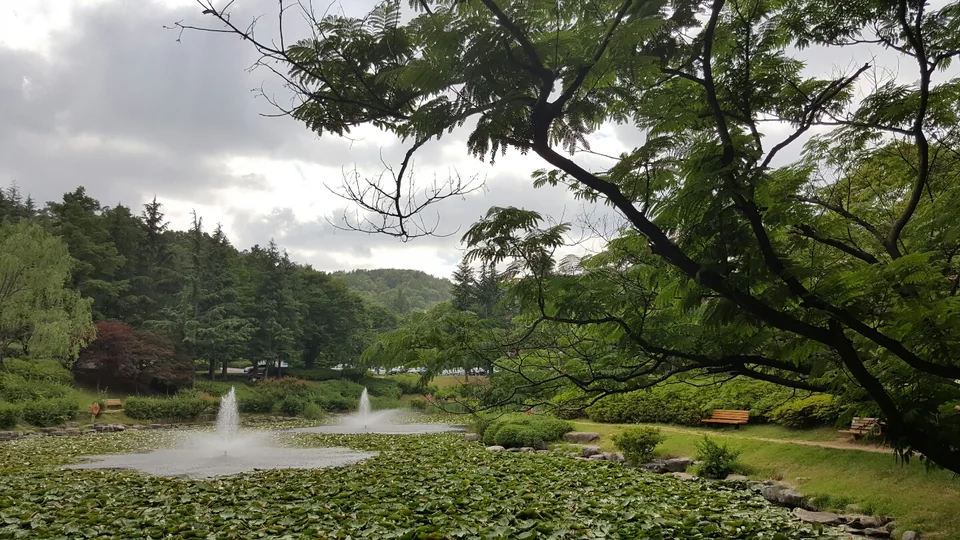
The POSTECH campus is in Nam-gu, Pohang: teaching buildings, laboratories, the library and residences are on one site. Undergraduates live in the Residential College (RC) residences; in the 2026 estimate a double room costs $130 (KRW 175,000) a month during the semester. Graduate students are offered residences and apartments, including family housing. The university has 148 partner institutions in 38 countries.
Strengths and weaknesses for applicants from Russia and the CIS
Advantages:
- Teaching is in English: a CIS school leaver with strong mathematics does not have to spend a year on Korean first.
- The university covers tuition and a large part of living costs, which removes the problem of transferring large sums.
- The scholarship certificate replaces a bank statement for the visa.
Drawbacks:
- The track is new, there are no admission statistics, and the decision is made on documents alone.
- It is harder for the committee to compare CIS school grades with AP or A-level programmes. Olympiads, a specialised mathematics class and the SAT help show your level.
- The apostille on the school certificate and family documents should be obtained early: after the preliminary decision there are about three weeks.
Working while studying
POSTECH offers International Admissions undergraduates paid on-campus work during the semester (On-Campus Work-Study). Off-campus work on a D-2 visa requires permission from the immigration service, and the permitted hours depend on the year of study and Korean level. Graduate students usually work as TAs or RAs for their adviser. The general rules are in our guide to working while studying in Korea.
Common mistakes
- Applying to both GKS and International Admissions. A double application disqualifies both.
- Submitting IELTS General or TOEFL Home Edition. POSTECH does not accept them.
- Assuming the teacher will send the recommendation "at some point". The letter is accepted only from the recommender's email and on time: for Spring 2027, by 3 September, one day after the application form closed.
- Planning a transfer into year two. POSTECH admits international students to the first year only.
- Forgetting that the scholarship depends on grades. With a GPA below 3.0/4.3 the tuition waiver is not renewed.
Checklist before you apply
- Neither you nor your parents have held Korean citizenship since you entered high school, and you are not applying to GKS at the same time.
- You have IELTS Academic, TOEFL iBT (not Home Edition), TEPS or TOEIC L&R taken within two years of the deadline; aim for IELTS 6.5 or TOEFL iBT 83.
- Transcripts for all high-school years are ready, along with evidence of strong mathematics and science: a specialised class, olympiads, SAT or AP.
- A mathematics or science teacher or your homeroom teacher has agreed to send the recommendation from their own email on time.
- The school certificate and family documents are already at the apostille office: after the preliminary decision you have about three weeks to deliver originals.
- Drafts of all four essays are ready before the application opens in March 2027.
Rankings
| Ranking | Position |
|---|---|
| QS World University Rankings 2027 | 106 (102 in 2026) |
| QS Asia University Rankings 2026 | 18 |
| THE World University Rankings 2026 | =141 |
| THE 2026 by subject: engineering | 69 |
| QS 2026 by subject (as reported by POSTECH) | materials science 26, physics and astronomy 52, mechanical engineering 57, chemical engineering 57, chemistry 58 |
FAQ
Can I study at POSTECH for free?
Yes, if you are admitted through International Admissions: tuition is waived for up to 8 semesters with a GPA of 3.0/4.3 or higher. On top of that the university pays $370 (KRW 500,000) a month towards living costs. The student pays for meals, housing and insurance, and according to the 2026 estimate about $1,600 a year remains after the allowance.
Do I need Korean to apply?
No. You may attach a TOPIK score, but there is no minimum level. An English score is mandatory; the recommended level is IELTS 6.5 or TOEFL iBT 83.
When do I apply for Fall 2027?
In March–April 2027 through the Study in Korea portal. POSTECH will publish the guidelines with exact dates in January 2027.
Can I apply after 11 years of school?
For International Admissions POSTECH requires graduation from a state-recognised high school (by February 2027 for the Spring 2027 intake) and sets no separate 12-year rule; the committee considers your country's education system and school calendar. The 12-year rule (at least 11.5 years) applies to a different track, for overseas Koreans and foreigners educated entirely abroad. A Russian school certificate is submitted with an apostille and transcripts.
Does POSTECH have Korean language courses?
Korean is taught only to POSTECH students. The university does not run a D-4 visa programme.
How can StudyU help?
Under a service agreement we assess your profile, prepare the essays and documents, and support the application and visa stages. POSTECH decides on admission and scholarships; the Korean consulate decides on the visa.
Sources
- Undergraduate Admissions Guideline, Spring 2027 (adm-iu.postech.ac.kr)
- Cost of Attendance 2026 (adm-iu.postech.ac.kr)
- Graduate Admissions Guide for International Students, Fall 2026 and Spring 2027
- POSTECH at a Glance
- POSTECH Institute of Culture and Language (PICL)
- 2027 GKS-U Application Guidelines (Study in Korea)
- QS World University Rankings: POSTECH
- THE World University Rankings: POSTECH
Dollar amounts use ECB reference rates of 23 and 29 September 2026 (about KRW 1,365 and 1,353 per $1) and are rounded.
For Korean higher education and other universities, see studying in South Korea. If you want to know how well your profile fits POSTECH, send an application.
During the free initial consultation, we clarify your goal, profile, timing, and budget and identify the next realistic step.
Next steps
- Working While Studying in Korea 2026: D-2 Part-Time Hours, Permits and Pay
- GKS Scholarship Korea: Quotas, Eligibility and Deadlines for 2027
- Korea D-2 Student Visa 2026: Documents, Proof of Funds and How to Apply
- Universities in South Korea for International Students: Types, 2026 Costs and How to Choose
- Studying in South Korea for international applicants
- KAIST (Korea Advanced Institute of Science and Technology)
