KAIST (Korea Advanced Institute of Science and Technology)
- Study profile
- KAIST (Korea Advanced Institute of Science and Technology) is a public science and technology university in Daejeon, founded in 1971.
Seoul National University (SNU) is a public university whose main Gwanak campus sits in southern Seoul. International students do not sit Korea's national entrance exam: they apply through SNU's separate International Admissions, which the university also calls its Global Talent track, with documents, essays, a reference and a language certificate. Classes start twice a year, in March and September.
Spring 2027 applications are closed: they ran from 6 to 9 July 2026, preliminary results come on 16 October and final results on 20 November 2026. The next open intake is fall 2027. SNU has not published that guide yet; in the last fall cycle the online application was open for just three days, 3–5 March 2026.
Undergraduate tuition in the 2026 academic year ran from $1,820 (KRW 2,442,000) a semester in the humanities and social sciences to $2,240 (KRW 2,998,000) in engineering. Language is the real constraint: SNU accepts applications with an English certificate but does not promise English-taught degrees. Some admitted students sit a Korean test that can restrict course choice, and SNU tells applicants to ask the department about English-taught courses.
SNU suits you if you:
Look elsewhere if you:
See how SNU compares with its neighbours in our guide to universities in Seoul.
Type I is for applicants who, like both parents, hold no Korean citizenship — the usual route for international families. Type II is for applicants who completed their entire schooling, elementary to high school, abroad, including overseas Koreans; SNU advises applicants with two foreign parents to use Type I, because Type II needs documents such as an entry and exit record.
You may submit one application for one program per cycle; after paying the fee you cannot change type or program. Fine arts, music and physical education also require a portfolio sent directly to the department.
| Area | Colleges and programs |
|---|---|
| SNU College | Liberal Studies — a broad start with a major chosen later |
| Humanities and social sciences | College of Humanities; College of Social Sciences: political science and international relations, economics, sociology, psychology, geography and more |
| Sciences and engineering | College of Natural Sciences; College of Engineering; College of Agriculture and Life Sciences |
| Business | College of Business Administration |
| Health | College of Nursing, College of Pharmacy, College of Veterinary Medicine; the College of Medicine moves to an integrated six-year program from 2027 |
| Arts and education | College of Fine Arts, College of Music, College of Education, College of Human Ecology |
| Transdisciplinary | School of Transdisciplinary Innovations |
Graduate study. Master's and doctoral applicants use a separate international graduate admission with the same baseline language minimum, though some programs ask for more (TOPIK 6 for Business Administration); spring 2027 applications ran from 6 to 9 July 2026 with a $67 (KRW 90,000) fee. The College of Business Administration teaches mainly in Korean, while the Global Public Administration major is taught in English.
School completion. Type I requires a government-recognised high school completed by 28 February 2027 for spring entry. There is no twelve-year rule in Type I, so an 11-year school certificate from Russia, Kazakhstan or another CIS country qualifies. If final-semester grades are not out yet, submit the latest transcript.
One language, Korean or English. Korean: TOPIK 3, or level 4 at a Korean university language centre. English: TOEFL iBT 80 (4.0 for tests from 21 January 2026), IELTS Academic 6.0 or TEPS 269. Scores must be no more than two years old at the deadline; TOEFL MyBest and Home Edition, IELTS Online and One Skill Retake are accepted, TOEFL ITP and IELTS Indicator are not.
Standardized tests are optional. You may add national exit or entrance exams, the SAT, A-levels or IB; they strengthen a file but do not replace the language certificate.
Written parts. The personal statement and study plan has a 4,000-byte limit (about 800 English words); the teacher's recommendation, uploaded by the teacher after you pay, has 3,000 bytes. Neither may name your parents' or relatives' names or jobs.
Parents. Type I needs copies of both parents' passports and a document proving the relationship, such as a birth certificate with a notarised translation.
SNU will publish fall 2027 dates in a new guide. Until then, plan on the last cycle: apply in early March, results by late June.
| Step | Spring 2027 (in progress) | Fall 2026 (last cycle) |
|---|---|---|
| Online application | 6–9 Jul 2026, until 17:00 KST | 3–5 Mar 2026 |
| Teacher recommendation | by 10 Jul 2026 | by 6 Mar 2026 |
| Preliminary results | 16 Oct 2026 | 21 May 2026 |
| Originals by post | 16 Oct – 3 Nov 2026 | after the preliminary decision |
| Final results | 20 Nov 2026 | 26 Jun 2026 |
| Registration and payment | Dec 2026 – Feb 2027 | Jul – Aug 2026 |
Spring 2027 applicants see their preliminary result on 16 October and then have less than three weeks to post apostilled originals. The Korean test for some admitted students is scheduled for February 2027.
During the application period you upload scans: the form, statement and study plan, language certificate, transcript, (expected) graduation certificate, your passport, your parents' passports, a birth certificate, and optionally test results and a school profile. Documents in languages other than Korean or English need a notarised translation.
After the preliminary decision you post the original transcript and diploma with an apostille or Korean consular authentication; copies of apostilled documents are not accepted. SNU recommends getting the apostille early and even lets you upload apostilled files when applying.
Offers are revoked if originals arrive late, if you pay tuition at two universities or if you remain enrolled elsewhere when the SNU semester starts.
SNU publishes first-semester tuition by college. The figures below are for the 2026 academic year and may change; a full year costs roughly twice as much. The caveat matters most for medicine: from 2027 the College of Medicine admits to an integrated six-year program, and SNU warns that fees may differ from the 2026 structure, in which the first two years cost $2,290 (KRW 3,072,000) a semester.
| Area | Per semester |
|---|---|
| Humanities, economics, political science, business | $1,820 (KRW 2,442,000) |
| Mathematics | $1,830 (KRW 2,450,000) |
| Psychology, anthropology, geography | $2,000 (KRW 2,679,000) |
| Natural sciences, nursing, SNU College | $2,220 (KRW 2,975,000) |
| Engineering | $2,240 (KRW 2,998,000) |
| Fine arts | $2,730 (KRW 3,653,000) |
| School of Transdisciplinary Innovations | $2,760 (KRW 3,700,000) |
| Music | $2,930 (KRW 3,916,000) |
| Pharmacy | $3,350 (KRW 4,481,000) |
| Medicine, years 3–6 under the 2026 structure | $3,760 (KRW 5,038,000) |
Graduate first-semester tuition in 2026 was $2,450 (KRW 3,278,000) in the humanities, social sciences and law, $2,970 (KRW 3,971,000) in the natural sciences and $2,990 (KRW 3,997,000) in engineering.
SNU does not publish a living-cost budget, but for the visa it asks for at least $14,940 (KRW 20,000,000), the amount it treats as a year of tuition and living. The undergraduate application fee is $52 (KRW 70,000) and is non-refundable.
SNU Global Talent Scholarship. Awarded to strong international students admitted through the Global Talent track, with no separate application. Places are few: SNU lists one award of a full tuition waiver for eight semesters plus $745 (KRW 1,000,000) a month, three of the same for two semesters, and twenty one-semester tuition waivers. Numbers may change, and renewal needs a minimum GPA.
Global Korea Scholarship (GKS). Each country has embassy-track quotas; for the 2027 undergraduate program Russia has three (general, regional R-GKS, and overseas Koreans and adoptees). SNU is a Type A university; general applicants list up to three universities, at least one of them Type B (regional). Online embassy-track applications for 2027 ran on the Study in Korea site from 15 to 30 September 2026 and are now closed; the embassy runs the first selection round. Applicants must be under 25 and have at least 80% average or top-20% rank. Scholars spend a year on Korean unless they hold TOPIK 5–6, then receive $895 (KRW 1,200,000) a month, tuition and airfare.
Later on. Self-funded students in years 2–4 with an average of 80 or more can apply for GKS support of about $4,480 (KRW 6,000,000) a year. Graduate applicants can tick the Graduate Scholarship for Foreign Students (GSFS): up to four semesters of tuition and a monthly stipend for Type I applicants with no previous study in Korea. Some donor scholarships are limited to OECD DAC aid-recipient countries, a list Russia is not on.
You need a D-2 student visa (D-2-2 for a bachelor's). SNU first issues a Certificate of Admission approved by Korea's Ministry of Justice; you then apply at a Korean embassy or consulate with the application form, the certificate, a 3.5 × 4.5 cm photo, a copy of SNU's business registration, your latest academic certificate and proof of at least $14,940 (KRW 20,000,000). The amount can be higher if tuition is higher, consulates may ask for more, and the consulate decides.
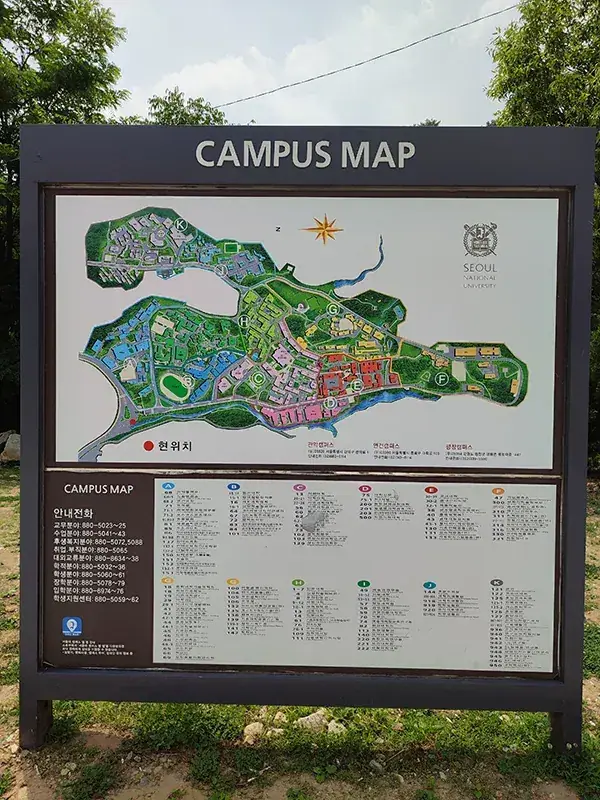
The Gwanak Residence Halls sit by the campus's rear gate; both enrolled and newly admitted students — undergraduate and graduate — can apply, with fees on the dormitory website. Married graduate students can apply for the 39-room Family Residence Halls.
To apply you need one certificate: TOPIK 3, or TOEFL iBT 80 (4.0 on the new scale), IELTS 6.0 or TEPS 269. After admission some students sit a Korean test that can restrict course choice, and not every department offers English-taught courses.
In the 2026 academic year a bachelor's semester cost $1,820 (KRW 2,442,000) in the humanities and $2,240 (KRW 2,998,000) in engineering; medicine fees for the 2027 intake may change with the move to a six-year program. For the visa SNU asks for at least $14,940 (KRW 20,000,000) to cover a year of study and living.
SNU has not published the fall 2027 guide yet. In the last cycle fall applications ran from 3 to 5 March 2026, so have your language score, translations and apostille ready by February.
Yes, through International Admissions Type I if neither you nor your parents hold Korean citizenship. SNU requires a government-recognised high school and does not accept GED, home-schooling or fully online schooling; Type I has no twelve-year rule.
Yes, the Global Talent Scholarship, decided at admission without a separate application. It is very limited: one eight-semester award with $745 (KRW 1,000,000) a month, three two-semester awards and twenty one-semester tuition waivers.
Yes, through the Korean embassy: Russia has three undergraduate places for 2027. SNU is a Type A university, so the list must include at least one Type B regional university; the 2027 round closed on 30 September 2026.
No. Each cycle allows one application to one program, duplicates are disqualified, and the program cannot be changed after the fee is paid.
SNU states a minimum of $14,940 (KRW 20,000,000), a year of tuition and living, and more if tuition is higher. The Korean consulate sets the final document list and decides on the visa.
Planning for SNU's fall 2027 intake?
Under an agreement with StudyU we plan your language test, translations and apostille around SNU's short application window, help you fit the statement and study plan into SNU's limits and prepare the application; SNU decides on admission and the Global Talent Scholarship, NIIED on GKS, and a Korean consulate on the D-2 visa.
Other universities — studying in South Korea: KAIST (Korea Advanced Institute of Science and Technology) · Kyungbok University. All options are on the page studying in South Korea.
During the free initial consultation, we clarify your goal, profile, timing, and budget and identify the next realistic step. A personal strategy, requirement checks, selection of agreed options, document preparation, applications, and support are provided under an agreement with StudyU.
Write to us
Leave a request and we'll get in touch.
StudyU is an ICEF Accredited Trusted Agency (#7302). Our consultants are students and graduates of universities in the countries they help you apply to. About StudyU
For your first enquiry, a contact detail and your question are enough. Do not send passport details or document scans through this form. If documents are needed for your application, we will explain why and how to send them. How we process personal data
Compare your options — we'll help you check the requirements and prepare an agreed route.