
Korea University ranks third in Korea in the QS World University Rankings 2027, at 52nd in the world (up from 61st), and shares 156th place in the THE World University Rankings 2026. International students apply through a dedicated round: a Korean-taught major, the English-taught International Studies track, or an undeclared first year. In 2026 a semester cost about $4,248 (₩5,800,000) in the humanities and social sciences and about $5,640 (₩7,700,000) in engineering. The spring 2027 round has closed; the next one is fall 2027, with applications in March 2027.
| At a glance | Details |
|---|---|
| Campus | Anam (Seongbuk-gu, Seoul); the university also has a campus in Sejong |
| Rankings | QS 2027: 52; THE 2026: =156 |
| Students | 24,043, about 14% international (THE data) |
| International rounds | International Undergraduate Admission I (major) and II (Global Open Major) |
| Intakes | spring (March) and fall (September) |
| Tuition per semester, 2026 | about $4,248–5,713 (₩5,800,000–7,800,000) depending on field |
| Application fee | $110 (₩150,000); art and design $146 (₩200,000) |
| Language proof | TOPIK, a language centre certificate, TOEFL iBT or IELTS Academic |
| Language centre | Korean Language Center: $1,318 (₩1,800,000) per 10 weeks |
Who Korea University suits, and who should look elsewhere
Korea University is a large research university where international students can apply to almost any college, from business to medicine. Year one is in Seoul, unlike at Yonsei, where international freshmen spend their first year in Incheon. Your workload depends directly on your Korean: with TOPIK 3 or lower, two semesters go on language with no major courses. And if you have not settled on a major, two formats let you choose later.
| Good fit | Consider alternatives |
|---|---|
| Applicants with TOPIK 4–5 who want to start their major straight away | Students with no Korean at all: two semesters will go on language |
| Undecided students: University College and Global Open Major | Students who want a wide choice of English-taught bachelor's majors: only one is fully in English |
| Future economists, lawyers, political scientists and media students | Tight budgets: a humanities semester costs less at Yonsei |
| Students who want to live and study in Seoul from year one | Engineers who put engineering rankings first: compare Hanyang and Sungkyunkwan |
Programmes: Korean-taught majors, the English track and an undeclared first year
International Undergraduate Admission I: choose a major
You choose a first major (required) and a second (optional). The spring 2027 round covered business administration; Korean, English, German, French, Chinese, Japanese, Spanish and Russian language and literature; philosophy, history, sociology and linguistics; political science and international relations, economics, statistics and public administration; mathematics, physics, chemistry and earth sciences; chemical, materials, mechanical and electrical engineering, architecture and industrial management; computer science, data science and artificial intelligence; medicine, nursing, education, art and design, media and communication, psychology, biomedical engineering and more.
Several options deserve a closer look:
- International Studies (English Track) at the College of International Studies: taught in English, English proof required.
- Global Korean Studies, also in the College of International Studies.
- Global Entertainment in the College of Media and Communication, open to international students only.
- School of Interdisciplinary Studies: an open major, with your main programme chosen later from any department.
- University College: a year of general studies, intensive Korean and an "incubating" programme, after which you choose one of 46 departments.
There are no seat quotas per major; an admissions committee decides after a holistic document review. International students may take no more than 10% of places in the College of Education.
International Undergraduate Admission II: Global Open Major
Year one is spent in the College of International Studies on general education and Korean. From year two students are assigned a major in the humanities, social sciences, natural sciences, art and design or engineering. The condition is strict: to be assigned the major you actually want, you need TOPIK 5 (for Korean-taught majors) or IELTS 7.0 / TOEFL iBT 100 (for English-taught ones). Global Open Major admits international students only. You can apply to Admission I (first choice only) and Admission II at the same time, paying two fees.
Master's degrees
At graduate level, the Graduate School of International Studies teaches in English. See our guide to master's degrees in Korea.
How to apply to Korea University, step by step
You and your parents must hold non-Korean citizenship; dual Korean citizenship rules you out. If the family renounced Korean citizenship, the foreign citizenship must predate your entry to high school, with official documents to prove it. If the custodial parent has married a Korean citizen, you cannot apply as an international student.
The guidelines ask for regular primary and secondary schooling equivalent to Korean grades 1 to 12. GED, homeschooling and online schooling are not accepted. Because the wording is "equivalent to grades 1 to 12", graduates of an 11-year system should get a written answer from the admissions office on how their certificate will be treated before paying the fee.
- October to February: language. Take TOPIK or TOEFL iBT / IELTS Academic; the score must be under two years old on the application date. KU's online Korean level test is discontinued from 2027, so there is no way to apply without a document.
- January to February: documents. Apostilles on your diploma and transcript, notarised translations, proof of family relationship.
- March: online application. The form, Statement of Purpose and PDF scans (up to 40 MB) are uploaded to Uwayapply, where you also pay the fee.
- March to early April: post the originals. They must reach the International Education Team by the deadline and match the uploaded PDFs.
- June: results. Published only on the OIA website, with no individual notice. Scholarship decisions come at the same time.
- July: payment and visa. After payment and your final documents and bank certificate arrive, the university issues the Certificate of Admission for the D-2 student visa; see our student visa guide.
Application deadlines: spring and fall
| Step | Spring 2027 | Fall 2027 |
|---|---|---|
| Online application and uploads | 3–31 August 2026 | March 2027 (dates TBA) |
| Originals by post (arrival) | by 7 September 2026 | March 2027 |
| Results | 27 November 2026 | June 2027 |
| Payment and registration | January 2027 | July 2027 |
| Korean pre-programme for admitted students | late December 2026 – mid-January 2027 | — |
Spring 2027 closed on 31 August 2026. If you are reading this in the autumn, the realistic plan is to have TOPIK or IELTS by February and apply for fall 2027.
Korean and English requirements
You can apply with one of the following:
- TOPIK or TOPIK iBT (trial tests are not accepted);
- a level certificate from KU's Korean Language Center or from another university language centre certified under IEQAS, Korea's quality assurance system for international education;
- an intermediate-level King Sejong Institute certificate (not online) or SKA;
- TOEFL iBT or IELTS Academic (TOEFL My Best Scores and IELTS Indicator are not accepted);
- a school letter confirming that your whole secondary education was in Korean or English.
Your Korean level shapes year one:
| Level at admission | Compulsory Korean | Major courses |
|---|---|---|
| TOPIK 5+ (or KLC level 5) | none | no restrictions |
| TOPIK 4 | one semester | up to 6 major credits per semester |
| TOPIK 3 or lower, King Sejong or SKA certificate | two semesters | no major courses |
Intensive Korean earns 3–6 elective credits, and some departments exempt students with strong English. English proof is compulsory for International Studies (English Track). See our TOPIK guide.
Documents and apostille
- printed online form, Statement of Purpose, consent to data use and citizenship statement, all generated on the portal;
- copies of the photo pages of your and your parents' passports;
- proof of family relationship, such as a birth certificate, with a notarised translation;
- language certificate;
- high school transcript by semester or year, showing the grading scale, with an apostille or consular legalisation;
- diploma or certificate of expected graduation, with an apostille;
- for art and design, a portfolio (up to 10 A4 pieces) and a statement of verification;
- optionally up to 10 extra documents: SAT, IB, A-levels, olympiads, school profile.
Special cases (a parent's death, divorce, single-parent families, adoption) need extra proof listed in the guidelines. Anything not in Korean or English must be translated and notarised; personal translations are rejected. If your name is spelled differently across documents, it is up to you to prove they refer to the same person.
Russia and every CIS country except Turkmenistan are parties to the Apostille Convention, so documents are apostilled in the issuing country. Turkmen documents need legalisation at the Korean embassy.
What studying and living at Korea University costs
Tuition, 2026, per semester
| Field | Tuition |
|---|---|
| Humanities and social sciences | about $4,248 (₩5,800,000) |
| Natural sciences | about $4,907 (₩6,700,000) |
| Engineering | about $5,640 (₩7,700,000) |
| Art | about $5,713 (₩7,800,000) |
| School of Interdisciplinary Studies, Global Open Major, University College | about $5,640 (₩7,700,000) |
| Miscellaneous fees | about $22 (₩30,000), optional |
The university publishes rounded figures that may change. Note that the open formats (University College, Global Open Major, School of Interdisciplinary Studies) are billed at the engineering rate even if you later choose a humanities major.
Part of the application fee is refunded: under Korea's Higher Education Act, what is left after admissions costs is shared among applicants, minus bank charges.
Housing
On the Anam campus, three buildings house more than 700 international students: CJ International House (suites sharing showers and toilets), Anam Global House (406 beds in singles, doubles and triples, each room with a shower) and Anam Dormitory II (68 beds in triples, men only). All buildings have shared kitchens, laundry, a gym and furniture; CJ International House does not provide bedding. Places are not guaranteed, and accepting a room requires an advance payment. Rates are published by the Anam Dormitory office (dorm.korea.ac.kr) when applications open.
Off campus, students rent goshiwon rooms (small rooms with shared kitchens and laundry, among the cheapest options), rooms in share houses, studios that require a deposit, or homestays. See our student housing guide.
Living costs
The government benchmark: an undergraduate GKS scholar receives $10,547 (₩14,400,000) a year, about $879 (₩1,200,000) a month, for housing, food, insurance and everything else. Budget more if you rent a studio in Seongbuk-gu rather than living in a dormitory. A line-by-line budget is in our guide to the cost of studying in Korea.
Scholarships: GKS and university awards
Korea University admission scholarships are awarded automatically from your admission results; there is no separate application, and decisions arrive with the results.
| Scholarship | For | Benefit | Renewal |
|---|---|---|---|
| Anam Global | top admitted student in each track | full tuition, 8 semesters | 12 credits and GPA 3.5 each semester |
| KU STEM | top students in science, technology, engineering and mathematics | full tuition, 4 semesters | 12 credits and GPA 3.5 |
| Global Leader A | applicants with the highest results | full tuition, 4 semesters | 12 credits and GPA 3.5 |
| Global Leader B | applicants with high results | 50% of tuition, 4 semesters | 12 credits and GPA 3.0 |
| KU Global Friends | strong applicants from Africa, South America and developing countries | full tuition, 4 semesters | 12 credits and GPA 3.0 |
| Bright Futures B | holders of their own government's scholarship with strong results | $732 (₩1,000,000) per semester, 8 semesters | 12 credits and GPA 3.0 |
| Challenge C | KU KLC graduates | $366 (₩500,000) for level 6, $220 (₩300,000) for level 5, once | — |
GKS in 2027. Korea University takes part in the GKS-U embassy track as a Type A university (applicants choose up to three universities, at least one of them a regional Type B). In 2027 the university track for bachelor's degrees covers only the University-Industry Cooperation programme at 10 universities, and Korea University is not among them. Embassy applications run from 15 to 30 September 2026. See our GKS guide.
Korean Language Center and the D-4 visa
KU's Korean Language Center (KLC) is the route for students who do not speak Korean yet. Terms last 10 weeks, four times a year, over six levels plus a top-level course, with up to 14 students per class. There is a general course (morning or afternoon) and an academic course for future university students that adds presentations, discussion, writing and TOPIK preparation.
| Item | Details |
|---|---|
| Admission fee | $88 (₩120,000), non-refundable |
| Tuition per term | $1,318 (₩1,800,000), textbooks extra |
| Winter 2026/27 | apply 7 September – 28 October 2026; classes 11 December – 25 February |
| Spring 2027 | apply 7 December 2026 – 22 January 2027; classes 18 March – 31 May |
| Summer 2027 | apply 8 March – 23 April; classes 16 June – 26 August |
| Fall 2027 | apply 7 June – 23 July; classes 10 September – 26 November |
For the D-4 language-study visa, original documents must reach KLC at least two weeks before the application deadline. You need an apostilled diploma and an original bank certificate showing at least $7,324 (₩10,000,000), issued within one month of applying. Nationals of the 21 countries on the Korean Ministry of Justice list, including Kazakhstan, Kyrgyzstan and Uzbekistan, must also show that their parents fund their studies: birth certificate, parents' passport copies, and employment and income certificates. Finishing KLC level 5 or 6 earns the one-off Challenge C scholarship after admission. Compare options in Korean language programmes in Korea.
Where you study: the Anam campus
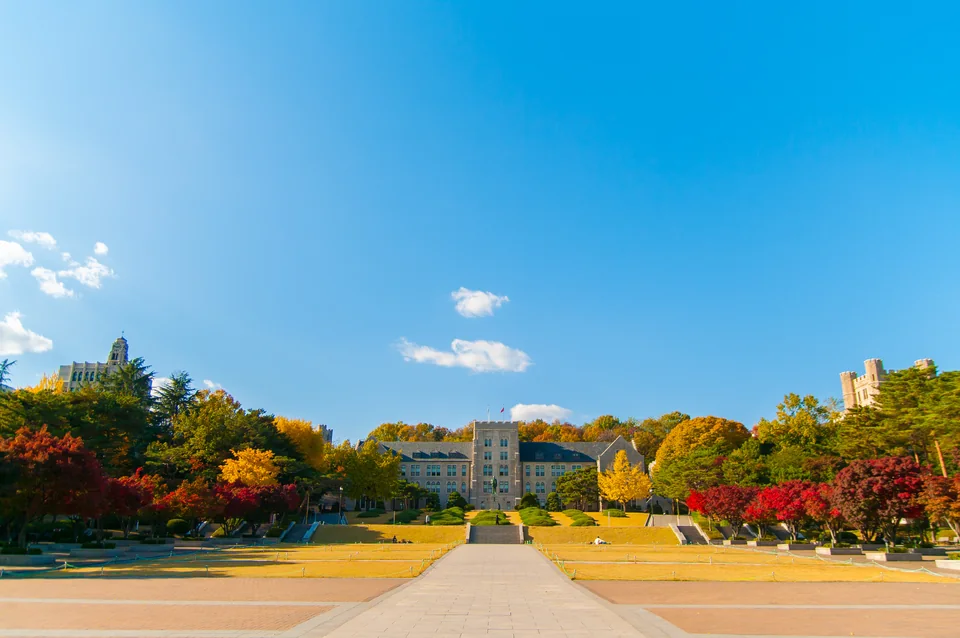
The Anam campus is in Seongbuk-gu in north-east Seoul. It holds almost all colleges, the central library, the international dormitories and the Korean Language Center. The Sejong campus operates separately; this profile and its requirements cover the Seoul campus.
Where Korea University stands in rankings
In QS 2027 Korea University rose from 61st to 52nd, its best result ever and third in Korea after Seoul National University and Yonsei. In THE 2026 it shares 156th place. The gap has a reason: according to QS, Korean universities climbed on employer reputation and internationalisation, while THE puts more weight on research and citations. To judge a major, check the curriculum and the English-taught courses in the course catalogue at sugang.korea.ac.kr, where they are marked (English).
Notes for applicants from Russia and Central Asia
- Timing. The spring round closes in August, so school leavers usually find the fall round with March applications easier to hit.
- Payment. Tuition goes to a virtual account at a Korean bank; bank transfers, Alipay and UnionPay are accepted. Applicants from Russia should arrange a legal transfer route well in advance.
- Kazakhstan, Uzbekistan, Kyrgyzstan. A D-4 visa for KLC courses requires an extra file on parents' employment and income; prepare it together with the bank certificate. Uzbek citizens must enrol for four terms at once, and their bank statement must come from a Korean bank in Uzbekistan with the balance held for at least three months.
Mistakes to avoid
- Counting on the KU online Korean test. It no longer exists from 2027; without TOPIK, a certificate or TOEFL/IELTS your application will not be accepted.
- Taking TOPIK too early. Scores over two years old on the application date do not count.
- Choosing Global Open Major without a language plan. Without TOPIK 5 or IELTS 7.0 you may not be assigned the major you want.
- Uploading one thing and posting another. A mismatch between PDFs and originals is grounds for rejection.
- Sending a transcript without a grading scale. It must show the maximum grade.
- Budgeting without the language year. With TOPIK 3 you pay tuition for two semesters without access to major courses.
Checklist before you apply
- Round chosen (Admission I, Admission II or both) and, for an 11-year system, a written answer on how your certificate is treated.
- A language document less than two years old on the application date.
- Diploma and graded transcripts apostilled and notarially translated; parents' passports and proof of family relationship ready.
- A budget that allows for a possible language year, the $5,640 (₩7.7 million) open-format rate and a legal payment route.
FAQ
Can I get into Korea University without Korean?
Yes, by proving English with TOEFL iBT or IELTS Academic. But most majors are taught in Korean, and with TOPIK 3 or lower you face two semesters of compulsory Korean without major courses. International Studies (English Track) is taught entirely in English.
How much does Korea University cost?
In 2026 a semester cost about $4,248 (₩5,800,000) in the humanities and social sciences, $4,907 (₩6,700,000) in the natural sciences, $5,640 (₩7,700,000) in engineering and $5,713 (₩7,800,000) in art. University College and Global Open Major are billed at the engineering rate.
When should I apply?
For spring, in August of the previous year (3–31 August 2026 for spring 2027); for fall, in March of the same year. Spring results come out in late November, fall results in June.
Do I need an apostille?
Yes. Foreign diplomas and transcripts are accepted only with an apostille or legalisation at a Korean embassy. If you do not have the apostille when you apply, you must send it by the post-admission deadline or the offer is cancelled.
What scholarships are available?
At admission: Anam Global (full tuition for 8 semesters), KU STEM, KU Global Friends and Global Leader A (full tuition for 4 semesters), Global Leader B (50%), Bright Futures B and Challenge C for KLC graduates, all awarded automatically from admission results. The government GKS is available through the embassy track.
Can StudyU help me apply to Korea University?
Under a service agreement we help you choose a round and major, check language and document requirements, prepare your Uwayapply file, and plan language study and the visa. Korea University decides on admission and scholarships, the Korean consulate on the visa, and the Anam Dormitory office on housing.
Sources
- Korea University OIA: Admission Guide, spring and fall 2027 dates
- Korea University: Spring 2027 Undergraduate Application Guide for International Students (PDF)
- Korea University OIA: Tuition (2026)
- Korea University OIA: KU Scholarships
- Korea University Global Service Center: Accommodation
- Korea University KLC: Regular Program, schedule and fees
- Korea University KLC: Application Procedure
- NIIED: 2027 GKS-U Application Guidelines (Study in Korea)
- THE World University Rankings 2026: Korea University
- Korea JoongAng Daily on the QS World University Rankings 2027
Dollar amounts use the ECB reference rates of 23 September 2026 (€1 = $1.1411 and €1 = ₩1,558.00, so $1 ≈ ₩1,365). For other universities, see studying in South Korea and universities in Seoul. Help deciding whether Korea University fits your plans is provided under an agreement with StudyU; to start, send us a request.
During the free initial consultation, we clarify your goal, profile, timing, and budget and identify the next realistic step.
