
A bachelor's degree in Korea takes four years (medicine and veterinary medicine take longer). The academic year starts in March, with a second intake in September. International students are admitted through a separate process, without Korea's national exam (suneung): universities decide on your school record, a language score, a personal statement with study plan and a recommendation. Most programmes are taught in Korean, where the usual minimum is TOPIK level 3; fully English-taught study is available at KAIST, for example, which asks for TOEFL iBT 83 or IELTS 6.5. In 2026 average tuition was $3,113 a year at national and public universities and $6,029 at private ones.
For school leavers from abroad three questions decide the plan: will the department accept your school certificate, can you get a language score in time, and does your graduation date fit the intake rules. KAIST's fall 2027 rounds are open to students still in their final school year, while SNU's spring 2027 intake required graduation by 28 February 2027.
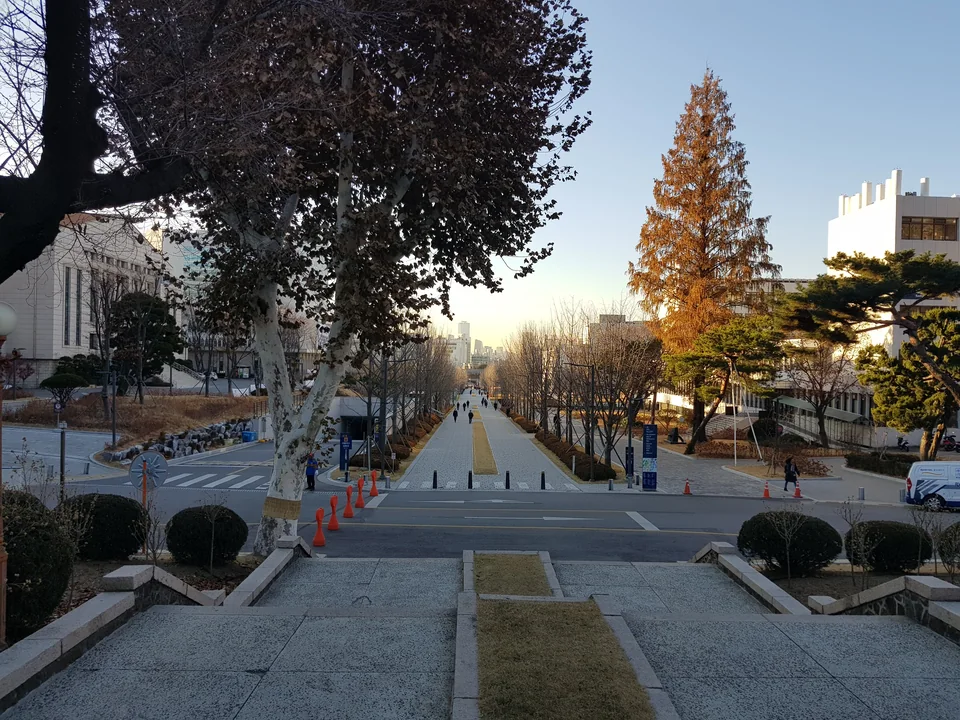
Bachelor's in Korea at a glance
| Item | Current rule | Source |
|---|---|---|
| Length | 4 years, 8 semesters; medicine and veterinary medicine longer | University websites |
| Start | March (spring) or September (fall) | University websites |
| Language | Korean-taught: usually TOPIK 3; English-taught: TOEFL or IELTS | SNU, KAIST rules |
| Exams | Usually no written entrance exam for international students; interviews, portfolios and auditions in some fields | SNU rules |
| Average tuition | $5,325 (KRW 7,270,300) a year across four-year universities, 2026 | Korean Ministry of Education |
| Example fee | SNU: $1,789–2,196 (KRW 2,442,000–2,998,000) per semester in most colleges | SNU 2026 tuition table |
| Scholarships | GKS for undergraduates, KAIST scholarship for admitted international students, university discounts for language and grades | NIIED, KAIST |
| Visa | D-2; maximum stay for a bachelor's programme is 6 years from admission | Study in Korea |
Dollar figures use the ECB reference rates of 23 September 2026 (about KRW 1,365 per US dollar) and are rounded.
Who a Korean bachelor's suits
It works best in three cases. First, a student strong in maths and English aiming for engineering, IT or science and ready for an English-taught programme such as KAIST. Second, a school leaver who already studies Korean and can reach TOPIK 3–4 before applying. Third, a high achiever on a limited budget whose grades qualify for GKS.
It is harder for someone drawn only by Korean culture and not ready to learn the language. Law, education, medicine and most humanities are taught in Korean, and even on an English track housing, doctors, banking and part-time work require Korean.
Another option is a junior college (associate degree, 2–3 years). This is not a bachelor's: graduates can continue at a university later. The 2027 GKS includes associate programmes, for example at Kyungbok University.
When you can apply if you finish school in 2027
Korean universities check that you graduate before the semester starts. For a student graduating in June 2027:
| Option | Graduation condition | Application window | Works for a June 2027 graduate |
|---|---|---|---|
| KAIST, fall 2027, early round | Graduate by 31 August 2027 | 22 September – 22 October 2026 | Yes, apply during the final school year |
| KAIST, fall 2027, regular round | Same | 10 November 2026 – 14 January 2027 | Yes, apply during the final school year |
| SNU, spring 2027 | Graduate by 28 February 2027 | 6–9 July 2026 (closed) | No |
| Yonsei, fall intake (2026 cycle as reference) | Diploma by August of the entry year | 10–26 March 2026 | Yes, if fall 2027 dates are similar |
| GKS undergraduate 2027 | Graduate by 31 December 2026 | 15–30 September 2026 | No; aim for the 2028 cycle |
| Yonsei language institute | Final diploma by the application deadline; provisional certificates not accepted | Fall 2027: 7 June – 16 July 2027 | Yes, after graduation |
Sources: KAIST timeline and 2027 admissions guide, SNU, Yonsei, 2027 GKS-U guidelines, Yonsei KLI.
So for a final-year student in autumn 2026, realistic 2027 targets are KAIST and fall intakes that open in spring. A 2027 graduate can only enter GKS in the next cycle; if it follows this year's pattern, the call will open in September 2027 for a March 2028 start with a language year.
Is an 11-year school certificate enough?
The "12 years of schooling" rule is often repeated, but neither SNU's and KAIST's 2027 rules nor Yonsei's fall 2026 rules contain it. These universities require completed secondary education by the start of the semester. SNU does not accept GED, homeschooling or online-only schooling. Yonsei states that it evaluates foreign high school completion considering each country's school system. GKS undergraduate also requires only high school graduation and an 80% average.
In practice an 11-year certificate (common in Russia, Kazakhstan and some other countries) does not close the door by itself, but the department decides. The simple procedure:
- Find the eligibility section in the admissions guide.
- Email the international admissions office with your country, school type, graduation year, 11 years of schooling and your chosen programme.
- Keep the written answer and attach it if the university allows additional documents.
If the department requires 12 years, the options are a year at a university at home and applying with that transcript, or a language year in Korea that at least gives you TOPIK and time.
Korean-taught or English-taught
| Korean track | English track | |
|---|---|---|
| Where | Most programmes at SNU, Yonsei, Korea University and regional universities | KAIST; selected programmes and colleges elsewhere |
| Language at entry | TOPIK 3 or completion of level 4 at a Korean university language centre (SNU rule) | TOEFL iBT 83 (4.5 from 21 Jan 2026) or IELTS 6.5 at KAIST |
| After admission | At Yonsei, two semesters in the foundation division with intensive Korean and TOPIK 3 required to enter a major; at SNU some admitted students sit an internal Korean test in February | Teaching in English, Korean as a subject |
| Pros | Wider choice, easier part-time work, better job prospects in Korea | You can start without Korean |
| Cons | A year or more of language study before applying | Fewer programmes; daily life and internships still in Korean |
SNU accepts English scores for admission (TOEFL iBT 80, IELTS 6.0, TEPS 269), but most of its undergraduate courses are taught in Korean; the admissions office refers questions about English courses to each department. Scores must be no more than two years old at the deadline: for spring 2027, taken on or after 9 July 2024.
See our TOPIK guide and our guide to Korean language programmes.
What goes into a bachelor's application
SNU's spring 2027 file is typical:
- Application form online; name and date of birth must match all documents.
- Personal statement and study plan in one text of up to 4,000 bytes, about 800 English words, without naming parents or their jobs.
- Recommendation through the university's online system, up to 3,000 bytes; the recommender gets a link once you pay the fee.
- Language evidence: a score report, a standardized test result, or proof that your whole high school curriculum was taught in Korean or English.
- Transcript and diploma (or certificate of expected graduation with the date); originals with apostille after the preliminary decision.
- Proof of nationality for you and both parents, plus a birth certificate or other proof of the parent-child relationship.
- School-leaving or entrance exam results (A-levels, SAT, IB, national exams): optional at SNU, and predicted grades can be uploaded.
KAIST requires standardized test results: SAT, ACT, AP, IB, A-levels or national school-leaving or university entrance exams. If your national exams happen only at the end of the final year, ask KAIST in advance what it accepts instead. SNU adds portfolios and auditions for arts and practical tests for sport.
The essays matter more than applicants expect. Committees want a line from your school achievements to the chosen major and your plans after graduation; "I love Korean dramas" works against you.
What a bachelor's costs
| Item | Amount | Scope |
|---|---|---|
| Average tuition, national and public | $3,113 (KRW 4,250,000) a year | All students, 2026 |
| Average tuition, private | $6,029 (KRW 8,231,500) a year | All students, 2026 |
| Average tuition, humanities | $4,712 (KRW 6,433,700) a year | All students, 2026 |
| Average tuition, engineering | $5,623 (KRW 7,677,400) a year | All students, 2026 |
| SNU, humanities and economics | $1,789 (KRW 2,442,000) per semester | 2026 rate |
| SNU, engineering | $2,196 (KRW 2,998,000) per semester | 2026 rate |
| SNU, fine arts | $2,676 (KRW 3,653,000) per semester | 2026 rate |
| Application fee | $51 (KRW 70,000) at SNU, $110 (KRW 150,000) at Yonsei, $80 at KAIST | Per application |
Sources: Korean Ministry of Education, tuition table in SNU's spring 2027 guide.
The gap between public and private universities is almost twofold, and universities in Seoul and the capital area charge about a quarter more than regional ones on average: $6,057 against $4,848 a year. For the visa admission letter the university asks for proof of funds: Yonsei wants at least KRW 22 million ($16,113) in the student's or parents' account for new degree students. Full budgets in our guide to the cost of studying in Korea.
Scholarships for undergraduates
- GKS undergraduate (GKS-U). Covers a year of Korean, tuition (NIIED pays up to KRW 5 million per semester; the university covers the rest and the admission fee), the flight and an all-inclusive allowance of KRW 14.4 million ($10,547) a year during the degree. Age limit: under 25, born on or after 1 March 2002 for the 2027 cycle. Embassy-track quotas for 2027: Russia 3, Kazakhstan 4, Uzbekistan 3, each including one place for ethnic Koreans. See our GKS guide.
- KAIST scholarship. Admitted international undergraduates who tick the KAIST scholarship on the application get it without a separate competition: a tuition waiver for 8 semesters, KRW 350,000 ($256) a month and health insurance, subject to a GPA of at least 2.7/4.3 after the first year (KAIST).
- University discounts. Many universities reduce tuition for a TOPIK level at entry and for grades later on. Amounts change yearly, so check the scholarship page for your entry year.
First year: what to plan for
A dormitory is the easiest start; applications usually open after admission and tuition payment, on each university's own schedule. Working on a D-2 visa requires permission from the immigration service. First- and second-year students with TOPIK 3 may work up to 25 hours a week during term, those without it 10 hours (Hi Korea status manual). See student housing in Korea and working while studying in Korea.
Read university-specific rules too: Yonsei, for example, requires all students to complete Christianity courses and chapel.
Step-by-step plan for a final-year school student
- September–October. Choose the Korean or English track. If English and strong maths, prepare for KAIST's early round (to 22 October) or regular round (to 14 January).
- Autumn–winter. Take IELTS or TOEFL, or TOPIK. With no Korean on the Korean track, plan a language year.
- January–March. List the fall intakes of your universities, write the personal statement, ask a teacher for a recommendation, order transcripts.
- Spring. Apply for fall. If you need an answer about an 11-year certificate, get it before paying the fee.
- June–July. Receive your certificate, apostille it, translate it and make several certified copies.
- July–August. Tuition payment, bank certificate for the admission letter, D-2 visa, dormitory.
The overall process for all levels is described in our guide to applying to Korean universities.
Common mistakes
- Applying to SNU for spring without a finished school certificate. Graduation by 28 February rules out June graduates of the same year.
- An old language score. SNU accepts scores no older than two years at the deadline.
- Relying only on GKS. Country quotas are a handful of places and results arrive in January. A parallel self-funded application or KAIST protects your year.
- No spare originals. Documents sent to universities are not returned, and you will need authenticated copies for the visa.
- Choosing by ranking without checking the teaching language. An English programme name on a website does not mean all courses are in English.
How StudyU helps
Only the initial consultation is free; the link is at the end of this guide. Shortlisting universities for your certificate and language, queries about 11-year schooling, document preparation and application support are provided under an agreement with StudyU. Admission is decided by the university, the visa by the Korean consulate, and GKS by the embassy, university and NIIED. See our Korea country page and profiles of SNU and KAIST.
FAQ
You can apply: SNU, KAIST and Yonsei require completed secondary education without a separate 12-year rule in their current guides. The department decides, so get a written answer before paying. If 12 years are required, a year at a university at home or a language year in Korea are the alternatives.
Yes. KAIST teaches in English and admits with TOEFL iBT 83 or IELTS 6.5. At most other universities the bachelor's is taught in Korean even if you apply with an English score, so check course languages with the department.
Usually level 3. SNU accepts TOPIK 3 or completion of level 4 at a Korean university language centre. At Yonsei, TOPIK 3 is needed to move from the first-year division into a major.
On average $3,113 at public and $6,029 at private universities in 2026. At SNU a semester costs $1,789–2,196 in most colleges. Housing, insurance and travel come on top.
Yes, through GKS or KAIST. GKS covers everything but has very few places per country. KAIST waives tuition for admitted international undergraduates who select its scholarship on the application and pays KRW 350,000 a month.
Usually no written exam for international students. Interviews, portfolios and auditions happen in some fields, and KAIST requires standardized test results such as SAT or national exams.
The D-10-1 job-seeker status exists for this. A graduate of a Korean university switching from D-2 to D-10-1 for the first time is exempt from the points test and receives up to one year; extensions are assessed on points. The status is meant for finding a job that qualifies for a professional E-1 to E-7 visa. Details are in the D-10 section of our master's guide.
Sources
- SNU spring 2027 undergraduate admissions guide and 2026 tuition table — checked 23 Sep 2026
- KAIST timeline, 2027 guide, scholarship — checked 23 Sep 2026
- Yonsei fall 2026 undergraduate guide for international students — checked 23 Sep 2026
- 2027 GKS-U application guidelines — checked 23 Sep 2026
- Study in Korea: visas and length of stay — checked 23 Sep 2026
- Hi Korea (Ministry of Justice): residence status manual, September 2026 edition — part-time work on D-2, D-10 status — checked 24 Sep 2026
- Korean Ministry of Education: 2026 average tuition — checked 23 Sep 2026
- ECB reference rates, 23 Sep 2026: €1 = $1.1411 = KRW 1,558
Next steps
- TOPIK Exam Guide 2026–2027: Levels, Scores, Test Dates and Where to Sit It
- Master's in Korea: Requirements, Application Windows and Funding for 2027
- Applying to Korean Universities in 2027: Routes, Deadlines, Documents and Costs
- Working While Studying in Korea 2026: D-2 Part-Time Hours, Permits and Pay
- Studying in South Korea for international applicants
- KAIST (Korea Advanced Institute of Science and Technology)
