
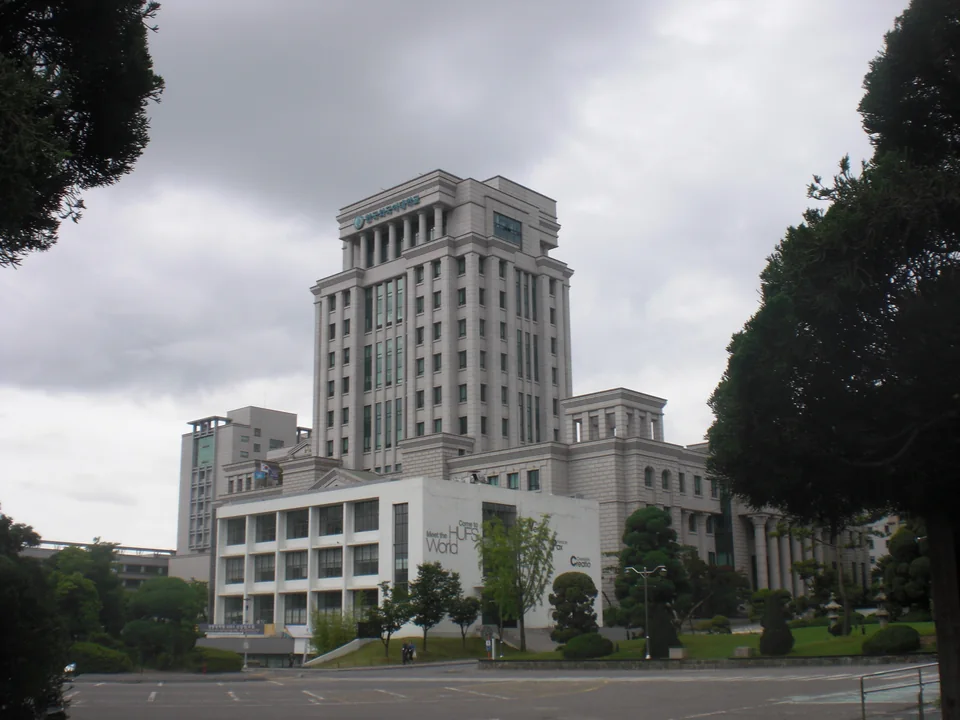
Hankuk University of Foreign Studies (HUFS) is a private university in Seoul founded in 1954. It specialises in languages and area studies: 45 languages are taught here, including Uzbek, Kazakh and Ukrainian. International applicants to bachelor's programmes can apply without a language certificate, in which case their level is assessed at the interview. A semester costs $3,150–3,950 (KRW 4.3–5.39 million at Fall 2026 rates). In spring 2027 the university opens a third campus in Songdo, with a division for international students where a scholarship covers half of tuition.
| At a glance | Details |
|---|---|
| Campuses | Seoul (Dongdaemun-gu), Global Campus (Yongin), and from March 2027 Songdo (Incheon) |
| Founded | 1954 |
| Size | 17,101 undergraduates, 2,547 graduate students; 2,173 international undergraduates from 90 countries |
| Rankings | QS World University Rankings 2027: =620; QS Asia University Rankings 2026: 134 |
| Tracks | Korean track and English track (Division of International Studies) |
| Tuition | KRW 4.3–5.39 million ($3,150–3,950) per semester; the first semester costs KRW 198,000 more |
| Spring 2027 intake | early round: 1–11 September 2026 (closed); regular round: 19 October – 20 November 2026 |
| Fall intake | main round in spring; in 2026 first results were announced on 22 June |
| Housing | Global Hall (Seoul): about KRW 1.57 million ($1,150) per semester in a double room |
| Korean courses (D-4) | Center for Korean Language and Culture (CKLC): KRW 1.6 million ($1,170) per 10 weeks |
Who HUFS suits, and who should look elsewhere
HUFS suits people building a career on languages and regions: translators, future diplomats, specialists in international trade, media and tourism. You can also study Korean as a foreign language in a division open only to international students (Division of KFL) and train as a translator. Engineering, AI and the natural sciences are available too, but mostly at the Global Campus in Yongin rather than in Seoul.
| Advantages | Limitations and risks |
|---|---|
| You can apply without TOPIK or an English certificate | Without a certificate your language is assessed at the interview, which carries 40% of the score |
| Two chances for spring: early and regular rounds | The early round is already in September |
| You can list two majors | Majors on different tracks require certificates in both languages |
| Up to a year of intensive Korean that counts for credits | The programme is compulsory below TOPIK 4 |
| Scholarships for language-centre students and for the Global Campus | The main scholarships cover one semester |
| Songdo: 50% of tuition and an allowance | Songdo has no residence |
For a broader English-taught offer in Seoul, compare HUFS with Sogang University and Kyung Hee University. For a lower-cost Korean-taught option, look at Pusan National University.
Programmes and where they are taught
Seoul Campus
The language and humanities colleges are here: English Linguistics and Language Technology (ELLT), English literature, French, German, Russian, Spanish, Italian, Portuguese, Dutch, Scandinavian languages, Malay-Indonesian, Thai, Vietnamese, Hindi, Arabic, Turkish and Azerbaijani, Persian, Mongolian, Chinese and Japanese. Seoul also hosts:
- social sciences: political science and diplomacy, public administration, media and communication;
- economics, business, international economics and law;
- education (international students cannot choose it as their only major);
- the College of AI Convergence: language and AI, social science and AI;
- the Division of International Studies, the only fully English-taught programme;
- the Division of KFL: teaching Korean as a foreign language and translation from Korean, for international students only.
From the March 2027 intake ELLT moves from the English track to the Korean track.
Global Campus (Yongin)
The Global Campus offers philosophy, history, linguistics and cognitive science, English for international conferences, Central Asian studies, Central and Eastern European studies (Polish, Romanian, Czech and Slovak, Hungarian, South Slavic, Greek and Bulgarian, Ukrainian), African studies, plus Global Business & Technology, international finance, natural sciences (mathematics, statistics, electronic physics, environmental science, bioscience and biotechnology, chemistry), engineering (computer engineering, AI and robotics, semiconductors, industrial management), biomedical engineering, convergence studies, digital content, tourism, sports industry, finance and AI, and climate change.
Songdo Campus (from March 2027)
Two divisions open here: the Division of Open Majors for International Students, where students start without a major and choose one later, and the Division of Global Biosciences & Business. For Open Majors freshmen, the university has announced a 50% tuition scholarship and an allowance of KRW 1.2 million ($880) per semester until they choose a major, for no more than two years. The university will announce the exact conditions separately.
Language requirements
A language certificate is optional for bachelor's admission. Without one, your language is assessed at the interview, so a certificate improves your chances.
| Track | Accepted |
|---|---|
| Korean (all departments except International Studies) | TOPIK 3 (including TOPIK IBT); CKLC HUFS level 3; level 3 at another university's IEQAS-accredited language centre; Intermediate 1 at a King Sejong Institute |
| English (International Studies) | TOEFL iBT 3.5 on the new scale (59 for score reports issued before 20 January 2026); IELTS 5.5 |
TOEFL MyBest and Home Edition are accepted, TOEFL ITP is not; IELTS Online is accepted, IELTS Indicator is not. International Studies graduates must obtain TOPIK 3 before graduating.
Intensive Korean after admission
Freshmen who need to improve their Korean take the Intensive Korean Language Program for up to a year. It is 15 weeks and 300 hours per semester, designed by CKLC, and the courses count as general-education credits. Students with TOPIK 4 or higher, International Studies students and all transfer students are exempt.
How to apply: a plan for Spring 2027
- Before 19 October 2026: choose your majors. You can list a first and a second major from different departments. An international applicant cannot list education twice: the second major must be from another college.
- 19 October – 20 November: application on uwayapply.com; the fee is KRW 158,000 ($120). After payment the data cannot be changed.
- In the same period: originals. The printed application and documents go by registered post or are handed in at the Office of International Admissions and Management (OIAM).
- 14 December: list of applicants invited to interview. The interview is held online on 19 December 2026.
- 4 January 2027: final results. Tuition is paid from 4 to 15 January at any Woori Bank branch or by transfer from abroad.
- 4–29 January 2027: request the Certificate of Admission (CoA) for the D-2 visa. It requires a bank statement in the applicant's or a parent's name showing at least KRW 20 million ($14,650), issued no more than 30 days before the visa application. The consulate decides on the visa; see our student visa guide.
How the score is calculated
| Component | Points |
|---|---|
| Document review (essay and study plan, grades, exams, recommendations) | 30 |
| Language certificate | 30 |
| Interview | 40 |
There are no quotas: students are selected on academic level, ability and language. If you are accepted to both majors, you are enrolled in the first one.
Deadlines for spring and fall
| Step | Early round, Spring 2027 | Regular round, Spring 2027 |
|---|---|---|
| Application and documents | 1–11 September 2026 (closed) | 19 October – 20 November 2026 |
| Interview list | 12 October 2026 | 14 December 2026 |
| Online interview | 17 October 2026 | 19 December 2026 |
| Final results | 30 October 2026 | 4 January 2027 |
| Tuition payment | 4–15 January 2027 | 4–15 January 2027 |
HUFS runs its fall (September) intake in spring: in the 2026 cycle the first-stage results of the main round were announced on 22 June. The new Fall 2027 guide will appear in spring 2027.
English-taught master's programmes (IMBA, MET for media, entertainment and technology, and TESOL) accept applications in two rounds: 1 September – 2 October and 26 October – 27 November 2026. Other master's programmes are run by the general graduate school, which publishes its own notices on gra.hufs.ac.kr.
Documents
- Application form and Personal Statement & Study Plan in Korean (Korean track) or English (English track); a second major needs a separate study plan on the HUFS template.
- School certificate (or expected-graduation certificate) and transcripts with a notarised translation and an apostille (or consular legalisation).
- Language certificate, optional.
- Copies of the passports of the applicant and both parents, plus a Korean residence card if you have one.
- Proof of family relationship: a birth certificate or another official document. If there are complications with one parent's documents (divorce, death, remarriage), government-issued certificates are required.
- Financial form and consent to document verification from the Uway portal.
- Recommendation letters, optional, in a sealed envelope.
All documents must be issued within one year before the application. If the apostille cannot be obtained in time, it may be submitted after the results are announced, but this is an exception for unavoidable circumstances, not the rule.
How much HUFS costs
Tuition (Fall 2026, per semester)
| Programmes | First semester | Later semesters |
|---|---|---|
| Seoul Campus (except AI Convergence), humanities and national strategic languages colleges at the Global Campus, Open Majors in Songdo | KRW 4.5 million ($3,290) | KRW 4.3 million ($3,150) |
| Business and economics and natural sciences at the Global Campus, climate change | KRW 5.13 million ($3,760) | KRW 4.93 million ($3,610) |
| Biomedical engineering, Global Biosciences & Business, convergence studies | KRW 5.34 million ($3,910) | KRW 5.14 million ($3,770) |
| Culture and technology (digital content, tourism, sports) | KRW 5.36 million ($3,930) | KRW 5.16 million ($3,780) |
| Engineering, AI Convergence (both campuses) | KRW 5.59 million ($4,100) | KRW 5.39 million ($3,950) |
A student fee of KRW 21,000 is added each semester. If the rate rises by the time you pay, you pay the difference.
Residences and other costs
| Item | Amount |
|---|---|
| Global Hall (Seoul), double room, semester of about 16 weeks | KRW 1.3 million + KRW 268,800 maintenance ≈ $1,150; deposit KRW 100,000 |
| Global Hall, room for a 10-week CKLC term | KRW 1.72 million ($1,260) including the deposit |
| National Health Insurance for D-2 holders | about KRW 79,320 ($60) per month at 2026 rates |
Seoul Campus students can live only in Global Hall, Global Campus students only in HUFS Dorm. The Songdo campus has no residence of its own, and every residence requires a chest X-ray certificate (tuberculosis test). The HUFS language centre points to studio rentals near the Seoul Campus at about KRW 550,000 ($400) a month, but with a deposit of around KRW 10 million ($7,320). Our guide to the cost of studying in Korea covers a full-year budget, and the student housing guide covers renting. If you pay from Russia, use a bank that officially transfers money to Korea and keep the confirmations for the visa.
Scholarships: GKS and HUFS awards
Global Korea Scholarship (GKS)
For 2027 undergraduate entry HUFS is a Type A university in the GKS Embassy Track: you apply through the Korean embassy and list up to three universities, at least one of which must be a regional (Type B) university. HUFS is not in the undergraduate University Track. GKS covers tuition in full, pays airfare and a Korean language year, and provides KRW 14.4 million a year during degree study. In 2026 HUFS also admitted master's scholars through the GKS-G University Track. Details are in our GKS guide.
Scholarships for freshmen
No separate application is needed: scholarships are assigned at admission, and two cannot be combined.
| Scholarship | Condition | Benefit |
|---|---|---|
| President | top 5% by admission score, up to 10 students | full tuition for 1 semester |
| Vice President | top 10%, up to 10 students | half tuition for 1 semester |
| Dean of OIA | top 20%, up to 10 students | KRW 1 million ($730) |
| HUFS Global A | two or more semesters at CKLC or the FLTTC centre | KRW 1.7 million ($1,250), the cost of a CKLC term |
| HUFS Global B | two semesters at CKLC and TOPIK 5+, or two semesters at FLTTC and TOEFL 5.5 / IELTS 7.0–7.5 | half tuition for 1 year |
| Global Campus | admission score of 80 or higher | 30% of tuition for 4 years (2–3 years for transfers) |
| Songdo | Open Majors freshmen | 50% of tuition + KRW 1.2 million per semester, up to 4 semesters |
| Language Excellence A / B / C | TOPIK 6, TOEFL 6.0 or IELTS 8.0 / TOPIK 5, TOEFL 5.5 or IELTS 7.0–7.5 / TOPIK 4 | full / half / 30% of tuition for 1 semester |
Continuing students can receive KRW 700,000 to 1 million for a GPA of 3.5 or higher, KRW 100,000 for a new TOPIK 4+, KRW 300,000–500,000 for IELTS 7.0 or TOEFL 5.5, and reimbursement of the TOPIK fee (KRW 55,000, up to twice). The university decides on all scholarships.
Center for Korean Language and Culture (CKLC, D-4 visa)
| Item | Regular course |
|---|---|
| Format | 10 weeks, about 200 hours, 9:00–13:00; 6 levels; 12–15 students per class |
| Fee | KRW 1.6 million ($1,170) per term + KRW 100,000 application fee + KRW 30,000 insurance |
| Spring 2027 | classes 4 March – 18 May 2027; applications 1 December 2026 – 29 January 2027 |
| Summer 2027 | classes 3 June – 12 August 2027; applications 4 March – 30 April 2027 |
| Fall 2027 | classes 2 September – 17 November 2027; applications 3 June – 30 July 2027 |
| D-4 funds | at least $10,000 in the student's or a parent's account, held for at least 6 months or backed by a 6-month transaction history |
For citizens of some countries (including those on the list of countries with a high tuberculosis risk) applications close about two weeks earlier. Citizens of Uzbekistan can submit a bank statement only from a Korean bank with a branch in Uzbekistan. Besides the general course, the centre runs a Korean translation and interpretation programme. Two CKLC terms qualify you for the HUFS Global A or B scholarship on admission, and level 3 meets the Korean-track language requirement. Our guide to Korean language programmes compares schools.
Strengths and weaknesses for applicants from Russia and the CIS
Advantages:
- You can apply without a certificate and improve your Korean in the first year.
- The Division of KFL and translation is convenient for those who want to work as translators with Russian or Central Asian languages.
- The Global Campus teaches Central Asian and Eastern European studies, and the university teaches Uzbek, Kazakh and Ukrainian.
- The CKLC route gives a discount on admission.
Drawbacks:
- The visa requires KRW 20 million in the bank, more than at Pusan.
- The interview carries 40%: without preparation and decent Korean it is easy to lose points.
- Engineering and the natural sciences are in Yongin, not in Seoul.
Working while studying
Seoul is expensive, but a part-time job should not be built into your first-year budget. On a D-2 visa you may work only with permission from the immigration service, and the permitted hours depend on your year of study and Korean level. At HUFS, where many freshmen take intensive Korean, work is usually a second-year question. See our guide to working while studying in Korea.
Common mistakes
- Confusing campuses. A major with a similar name may be taught in Seoul or in Yongin, and your residence depends on the campus.
- Choosing two majors in different languages while submitting a certificate for only one. The interview for the second major will then be held in its language.
- Assuming Songdo comes with housing. There is no separate residence there.
- Planning on the early round after it has closed. It closed on 11 September 2026.
- Using a QQ, iCloud or Outlook email address. The university warns that its messages may not reach them.
Checklist before you apply
- Your first and second majors are chosen, and you know which campus each is taught on: Seoul, Yongin or Songdo.
- If the majors are on different tracks, you have certificates in both languages; otherwise the interview for the second major will be in its language.
- Your school certificate and transcripts are translated, notarised and apostilled, and all documents were issued within one year before the application.
- The essay and study plan are written in the language of the track, with a separate plan on the HUFS template for the second major.
- You are ready for an online interview in Korean or English: it carries 40% of the final score.
- KRW 20 million ($14,650) will be in the account by January 2027, and the email address in your form is not on QQ, iCloud or Outlook.
Rankings
| Ranking | Position |
|---|---|
| QS World University Rankings 2027 | =620 |
| QS Asia University Rankings 2026 | 134 |
For HUFS the rankings say less than its specialisation: the university is strong in languages and area studies, while in engineering and science it competes with technical universities.
FAQ
Do I need TOPIK to apply to HUFS?
No, the certificate is optional: without one, your language is assessed at the interview. With TOPIK 3 or higher you receive the language points in advance, and with TOPIK 4 you also get a scholarship and an exemption from intensive Korean.
How much does HUFS cost?
At Fall 2026 rates, from KRW 4.3 million ($3,150) per semester in the humanities to KRW 5.39 million ($3,950) in engineering, with the first semester KRW 198,000 higher. A place in Global Hall costs about $1,150 per semester.
When do I apply for Spring 2027?
The regular round runs from 19 October to 20 November 2026. Final results are announced on 4 January 2027.
Can I study at HUFS in English?
The Division of International Studies in Seoul is taught entirely in English. You need TOEFL iBT 3.5 (59 on the old scale) or IELTS 5.5, and TOPIK 3 before graduating.
What is the Songdo campus?
A new campus opening in March 2027. It will host the Division of Open Majors for international students and Global Biosciences & Business, and the university has announced a 50% scholarship and an allowance of KRW 1.2 million per semester for Open Majors freshmen.
How much do Korean courses at HUFS cost?
At CKLC, KRW 1.6 million ($1,170) per 10-week term plus a KRW 100,000 application fee. A D-4 visa requires at least $10,000 in the account.
How can StudyU help?
Under a service agreement we help choose majors and a campus, prepare the essay, documents and interview, and support the application and visa stages. HUFS decides on admission and scholarships; the Korean consulate decides on the visa.
Sources
- 2027 Spring General International Undergraduate Admissions Guide (PDF)
- HUFS International Admissions (international.hufs.ac.kr)
- About HUFS
- 2027 Spring International Graduate Admission Guide (IMBA, MET, TESOL)
- CKLC: regular course, fees and calendar
- CKLC: housing
- Global Hall: residence fees
- 2027 GKS-U Application Guidelines (Study in Korea)
- QS World University Rankings: HUFS
Dollar amounts use ECB reference rates of 23 September 2026 (about KRW 1,365 per $1) and are rounded to $10.
For other universities and study routes, see studying in South Korea. If you want help choosing a HUFS major and campus, send an application.
During the free initial consultation, we clarify your goal, profile, timing, and budget and identify the next realistic step.
Next steps
- Working While Studying in Korea 2026: D-2 Part-Time Hours, Permits and Pay
- GKS Scholarship Korea: Quotas, Eligibility and Deadlines for 2027
- Cost of Studying in Korea 2026: Tuition per Semester, Living Costs and a First-Year Budget
- Korea D-2 Student Visa 2026: Documents, Proof of Funds and How to Apply
- Studying in South Korea for international applicants
- Korean Language Programmes in Korea: University Institutes, Fees and the D-4 Visa for 2027
