
The University of Valencia is a large public university on Spain's Mediterranean coast whose history begins in 1499. It offers around 60 bachelor's degrees and more than a hundred official master's programmes. Students from outside the EU who are not resident in Spain pay double the EU price under the Valencian fees decree, yet even at that rate a 60-credit bachelor's year costs $1,750–2,460 (€1,534.80–2,160) and a typical master's about $4,840 (€4,240.80). Bachelor's places are allocated through one pre-registration (preinscripció) for the region's five public universities: in 2026 it ran from 15 June to 3 July, and applicants from foreign education systems could apply until 7 July even with incomplete documents.
| At a glance | Details |
|---|---|
| Location | Valencia; campuses at Blasco Ibáñez, Tarongers, Burjassot-Paterna and Ontinyent, plus the historic La Nau building |
| Founded | 1499 (city statutes), papal bull 1501, royal privilege 1502 |
| Rankings | QS World University Rankings 2027: =449; THE World University Rankings 2026: 501–600; ARWU 2026: 301–400 |
| Languages | Valencian (Catalan) and Spanish; some groups and programmes in English |
| Bachelor's, 60 credits, non-EU non-resident | $1,750–2,460 (€1,534.80–2,160) depending on the degree's price band |
| Non-professional master's, 60 credits | $4,840 (€4,240.80) non-EU; $2,420 (€2,120.40) EU |
| Bachelor's admission | Generalitat Valenciana preinscripció; 15 June – 3 July in 2026, until 7 July with a foreign school diploma; first allocation 10 July |
| Master's admission | phase 1: 30 Mar – 21 Apr 2026; phase 2: 25 May – 16 Jun 2026; extra phase: 22–31 Jul and 24 Aug – 2 Sep 2026 |
| International students | about 7,500 according to UV's QS profile |
Who UV suits, and who should look elsewhere
| Strengths | Limitations |
|---|---|
| Low fees even after the non-EU doubling | Most programmes are taught in Valencian and Spanish |
| Broad choice: medicine, physics, chemistry, psychology, law, economics, translation | Almost no university aid for first-year students from outside the EU |
| International Business bachelor's with an English-taught group | Entry to the English group depends on a level test |
| Master's entry without degree homologation, in three phases | Phase 1 requires a non-refundable $340 (€300) advance |
| Valencia is cheaper than Barcelona or Madrid: a room in a shared flat costs $400–510 (€350–450) | Sciences are on the suburban Burjassot-Paterna campus, so choose housing accordingly |
UV suits students ready to study in Spanish who want a wide choice of subjects on a moderate budget. If you need a bachelor's entirely in English in a big city, compare it with Pompeu Fabra University; if you want to spend even less, look at Granada and Salamanca. Our overview of universities in Spain for international students maps the wider options.
Programmes and what you can study in English
UV's catalogue lists around 60 bachelor's degrees (grau), about fifteen internal double degrees and a set of international double degrees, grouped into engineering, arts and humanities, sciences, health sciences, and social and legal sciences.
Bachelor's degrees
The main English-taught option is International Business / Negocis Internacionals in the Faculty of Economics: 240 credits, 150 places and two teaching groups. Group A is taught in English and group B in Spanish, and you need to pass a level test to join group A. All students take 18 credits of languages; group A adds a second foreign language. International Business, like economics, business administration, law, physics and chemistry, has international double degrees with partner universities abroad.
Other degrees include medicine, dentistry, pharmacy, psychology, physiotherapy, physics, mathematics, chemistry, biotechnology, data science, engineering (computing, telecommunications, chemical, multimedia), law, criminology, economics, business administration, journalism, translation and philologies. The language of each group is shown at enrolment, and a single degree can have a Valencian group and a Spanish group.
Master's degrees
UV lists about 108 official master's programmes. Programmes taught fully or partly in English include Advanced Materials, Migration Studies, the Erasmus Mundus master in Work, Organizational and Personnel Psychology (WOP‑P) and the Erasmus Mundus master in Theoretical Chemistry and Computational Modelling. Each programme page states its language. The iMBA in international business management has its own price. For the national picture, see our guide to master's degrees in Spain.
How to apply for a bachelor's with a non-EU school diploma
UV describes five steps for applicants from education systems outside the EU:
- Homologation. The Spanish Ministry of Education recognises your diploma as equivalent to the Spanish Bachillerato; you can apply online or through a consulate.
- UNEDasiss accreditation. UNEDasiss, run by Spain's distance university UNED, evaluates foreign records and, for non-EU applicants, awards an access score between 5 and 6 based on your homologated marks. You can request it with proof that homologation is pending.
- PCE exams. The Specific Competence Tests are subject exams run by UNEDasiss; you choose 4–6 subjects. The four best results, multiplied by 0.1, raise your access score towards 10, and two subjects weighted 0.1 or 0.2 for your chosen degree add up to 4 more, for a maximum of 14.
- Preinscripció. One application covers all five public universities in the Valencian Community, submitted on the regional portal; places go to applicants in order of score.
- Enrolment. Admitted students receive a text message and enrol online at an assigned date and time.
Without the PCE, your score stays at 5–6, which is not enough for popular degrees. Before applying, check the regional list of degrees with special conditions, which sets extra requirements such as languages for some programmes. Our guide to applying to Spanish universities explains the national route, and our article on Spanish university after 11 years of school covers applicants from 11-year school systems.
Deadlines for 2027/28
The region and UNEDasiss publish the 2027 calendars in spring. Use the 2026 dates as a guide:
| Stage | 2026 dates | Set by |
|---|---|---|
| UNEDasiss accreditation | 4 February – 1 December | UNEDasiss |
| PCE registration, May session | 16 March – 28 April | UNEDasiss |
| PCE exams in Spain | 25–29 May | UNEDasiss |
| Preinscripció for Valencian public universities | 15 June – 3 July, until 14:00; foreign school diplomas until 7 July, 14:00 | Generalitat Valenciana |
| First allocation | 10 July, followed by seven more | Generalitat Valenciana |
| PCE registration, September session | 1–22 July | UNEDasiss |
Allow at least three months for homologation and accreditation. UNEDasiss has up to three months to decide, though complete, paid files are usually resolved in about three weeks, and it advises applying at least six weeks before pre-registration closes. If you are admitted on a provisional accreditation, the final one must follow within a month of being issued; in the 2026 intake, students who have not submitted it by 16 October will be removed from enrolment.
Language requirements: Valencian, Spanish and English
UV's official languages are Valencian (the regional standard of Catalan) and Spanish. You do not need a Valencian certificate to be admitted, but some groups are taught only in Valencian, so choose Spanish-taught groups when you enrol if you do not speak it. Studying in Spanish realistically requires B2. The English group of International Business requires a level test, and master's language rules are set on each programme page; the secondary-teacher training master, for example, asks applicants from non-Spanish-speaking countries for C1 Spanish. UV's language policy service offers courses, conversation groups and tests in Valencian and Spanish.
Master's admission at UV
Master's programmes recruit in three phases. The 2026 calendar was:
| Phase | Applications | Results | What matters |
|---|---|---|---|
| Phase 1 | 30 March – 21 April | 18 May | only for applicants who already hold their degree; 30–70% of places; $340 (€300) pre-enrolment payment by 5 June, non-refundable but credited to fees |
| Phase 2 | 25 May – 16 June | 10 July | all remaining places; degree upload by 15 July; enrolment 13–16 July |
| Extra phase | 22–31 July and 24 August – 2 September | 16 September | only programmes with vacancies; enrolment 17–21 September |
You can list up to three programmes in order of preference. If your degree comes from outside the European Higher Education Area and is not homologated, UV assesses its equivalence for $180 (€155.22). Back up your grade average on a 0–10 scale with a grade-equivalence declaration (declaración de equivalencia de nota media) made through the Spanish ministry's procedure; without it, or without an apostilled transcript, you are given an average of 5 and end up at the bottom of the ranking. Aim for phase 1: mid-May results leave almost four months for the consulate.
Tuition and living costs in Valencia
Tuition
Fees are set by Generalitat Valenciana Decree 101/2024, as amended by Decree 195/2025 of 12 December 2025. Article 6 doubles the prices for foreign students without Spanish residence, other than EU nationals, capped at the full cost of teaching. A student stay permit does not count as residence. Non-EU students who started their degree before 2024/25 finish it at the old rate.
| Level, first enrolment in a subject | EU price per credit | Non-EU non-resident price per credit | 60 credits, non-EU |
|---|---|---|---|
| Bachelor's band A (law, economics, business, International Business, philologies) | $15 (€12.79) | $29 (€25.58) | $1,750 (€1,534.80) |
| Bachelor's band B (physics, mathematics, psychology, journalism) | $16 (€14.03) | $32 (€28.06) | $1,920 (€1,683.60) |
| Bachelor's band C (biology, chemistry, engineering, data science) | $20 (€17.34) | $40 (€34.68) | $2,370 (€2,080.80) |
| Bachelor's band D (medicine, pharmacy, dentistry, nursing) | $20 (€18.00) | $41 (€36.00) | $2,460 (€2,160) |
| Non-professional master's | $40 (€35.34) | $81 (€70.68) | $4,840 (€4,240.80) |
The doubling does not apply to masters with a special price already above twice the standard master's rate; the iMBA, for example, costs $114 (€99.50) per credit for everyone. Opening a student record costs $31 (€27.34) and a bachelor's diploma $210 (€186.24). Re-enrolling in a failed subject costs about twice the first price, and a third attempt about four times as much. You can pay in one, two or eight instalments; unpaid enrolments are cancelled.
Living costs
UV's international office gives these monthly guidelines:
| Item | Amount |
|---|---|
| Room in a shared flat | $400–510 (€350–450), bills extra |
| Bills when sharing | about $60 (€50) |
| Home internet | about $51 (€45) |
| Food | about $290 (€250) |
| Lunch in a UV cafeteria | about $14 (€12) |
| Bus | under $2 (€2) per trip, under $11 (€10) for 10 trips |
| Valenbisi bike share | under $34 (€30) a year |
Based on these guidelines, we estimate $800–900 a month for a student in a shared flat, plus a rental deposit. Dollar figures use the ECB rate of 23 September 2026 (€1 = $1.1411) and are rounded. For the visa, you must show at least 100% of Spain's IPREM indicator for each month of stay: $680 (€600) in 2026. See also our overview of the cost of studying in Spain.
Scholarships and ways to cut costs
The main Spanish ministry and Generalitat Valenciana grants are designed for residents of Spain, so a first-year student on a student visa should not count on them. What realistically lowers the bill:
- Low base prices. Even the doubled rate is below the international fees of many European universities.
- Residence grants at Col·legi Major Rector Peset. UV's vice-rectorate for sustainability and cooperation offers them to students from developing countries; check the annual call for conditions and eligible countries.
- Passing first time. A second enrolment in a subject costs about twice as much, so every failed exam hits your budget.
More options are listed in our guide to scholarships in Spain; each award is decided by its funder or the university.
Housing: Rector Peset and private renting
UV runs its own Col·legi Major Rector Peset in the historic centre, on Plaça del Forn de Sant Nicolau. The restored mansion has 179 places for students and 70 for staff and researchers, with priority for UV students; you apply for a place separately, even if you also apply for a grant. Most students rent a room in a shared flat — around the Blasco Ibáñez campus, in Benimaclet, in Algirós for Tarongers, in Russafa or in El Cabanyal. Check where your classes are before signing: getting from Russafa to Burjassot-Paterna takes noticeably longer than to Blasco Ibáñez. Our guide to student housing in Spain explains how to check listings.
Spanish courses at UV
UV's Centre d'Idiomes runs Spanish courses for external learners and exchange students:
- Semester course — 60 hours per level; the winter semester runs from 21 September 2026 to 25 January 2027, with registration from 1 June to 31 October 2026 and morning, midday and evening groups.
- ELA 20 intensive — 20 hours a week, four hours a day, levels A1–B2; a $57 (€50) first-registration fee applies, and weekly prices are given on request.
- DELE preparation — for a specific exam session.
An online placement test is recommended before registering. A semester course can serve as a preparation period before the PCE; check with the consulate which visa fits a language course, as the rules differ from degree study. See our guides to Spanish language courses in Spain and the DELE and SIELE exams.
Documents and visa requirements
For a bachelor's: passport; school-leaving certificate with its transcript, apostilled and officially translated into Spanish; your homologation application or certificate; UNEDasiss accreditation with PCE results. For a master's: degree certificate and transcript, the documents listed in the master's section above, and any language certificates your programme asks for. The consulate needs apostilled, translated originals too, so order apostilles for both sets at once.
The admission letter starts the visa stage. The Spanish Consulate in Moscow asks for proof of funds of at least 100% of the IPREM indicator for each month of stay: in 2026 that is $680 (€600) a month, or $8,220 (€7,200) for 12 months, reduced if accommodation is prepaid for the whole stay. You also need a medical certificate with a Spanish translation, and adults staying over 180 days add an apostilled criminal record certificate. Applications go through the BLS visa centres two months before the course starts; once the study authorisation is approved, the consulate decides on the visa within a month. See our guide to the Spanish student visa for the full file.
Can you work while you study?
Yes, within limits. Under Spain's immigration regulation (Royal Decree 1155/2024, article 57), a higher-education study permit lets you work without a separate application, provided the job is compatible with your studies. The cap is 30 hours a week, and exceeding it is grounds for withdrawing the permit. Work is limited to the Valencian Community, plus bordering towns in neighbouring regions. Curricular internships need no extra authorisation. Do not plan to fund tuition from a part-time job: a full course load in Spanish leaves few spare hours. More in our guide to working while studying in Spain.
Pros and cons for applicants from outside the EU
Pros
- Among the lowest fees of Spain's large universities: law or economics costs about $1,750 a year even at the non-EU rate.
- One application covers five public universities, so you can put UV first and the Technical University of Valencia (UPV) as a fallback.
- Master's entry without degree homologation, with an early phase that leaves time for the visa.
Cons
- Valencian-only groups: careless enrolment can land you in lectures you cannot follow.
- Without the PCE your score stays at 5–6, too low for popular degrees.
- Documents must be apostilled and officially translated into Spanish, visa appointments go through the consulate's visa centre two months before the course, and fee payments must use banking channels accepted in Spain.
Mistakes to avoid
- Budgeting on EU prices. Non-EU per-credit prices are double, and a student visa does not change that.
- Skipping the PCE. Accreditation alone gives 5–6 points, far below cut-offs for popular degrees.
- Waiting for master's phase 2. Results on 10 July and the degree upload by 15 July leave little time for the visa.
- Not sending the grade-equivalence declaration. Without it you are given an average of 5.
- Choosing a group without checking its language. Check each group's language when you enrol.
Campuses and La Nau
- Blasco Ibáñez — the main city campus along the avenue of the same name, home to medical and psychology students, historians, linguists, philosophers and future teachers, nurses and physiotherapists.
- Tarongers — in the north-east of the city, next to the Technical University: law, economics and social sciences.
- Burjassot-Paterna — the suburban science campus: physics, chemistry, biology, mathematics, pharmacy, the science park and IFIC, the particle physics institute run jointly by UV and Spain's research council CSIC.
- Ontinyent — a small campus in the south of Valencia province with its own programmes.
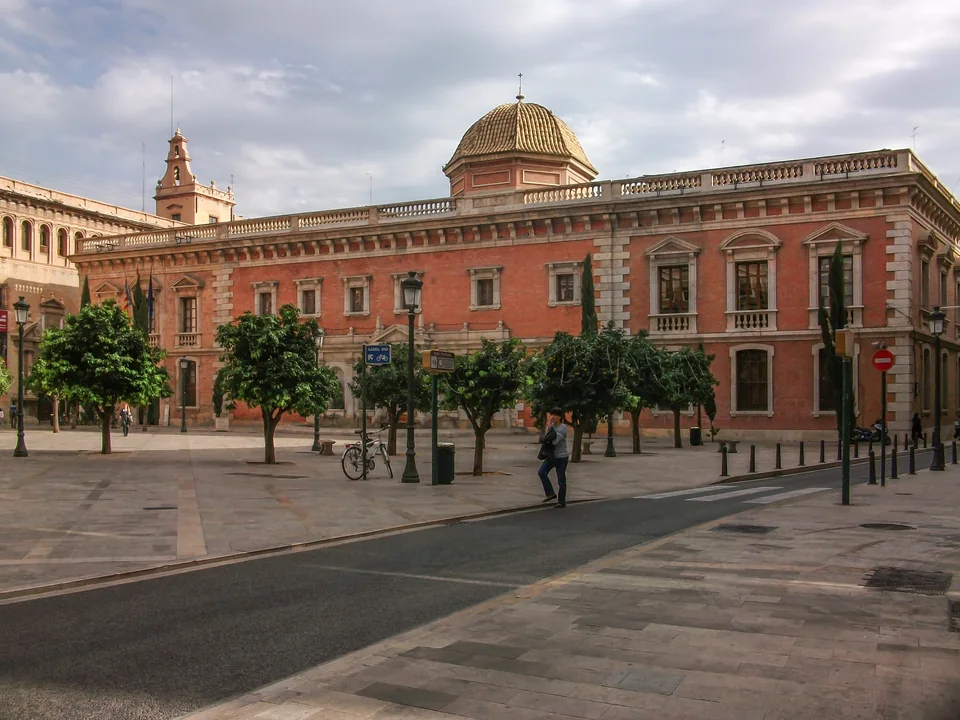
- La Nau — the historic university building on Carrer de la Universitat in the centre, used for exhibitions, concerts and ceremonies.
Rankings
| Ranking | Position |
|---|---|
| QS World University Rankings 2027 | =449 |
| THE World University Rankings 2026 | 501–600 |
| ShanghaiRanking ARWU 2026 | 301–400 (tied 4th–7th in Spain with Granada, the Autonomous University of Madrid and the University of the Basque Country) |
UV performs best in publication-driven rankings, which reward physics, chemistry and biomedicine. For choosing a degree, last year's cut-off mark and the course plan are more useful.
FAQ
How much does a UV bachelor's degree cost for a non-EU student?
Without Spanish residence you pay the doubled rate: for 60 first-enrolment credits, from $1,750 (€1,534.80) in law and economics to $2,460 (€2,160) in medicine and pharmacy, plus small fees; holding a student stay permit does not change this.
Do I need Valencian?
Not for admission, but some groups are taught only in Valencian, so choose Spanish-taught groups when you enrol. Studying in Spanish requires at least B2.
Does UV teach in English?
At bachelor's level, group A of International Business is taught in English and requires a level test. At master's level, programmes such as Advanced Materials, Migration Studies and two Erasmus Mundus masters are taught in English; each programme page states the language.
How do I apply with a non-EU school diploma?
You need homologation from the Spanish Ministry of Education, UNEDasiss accreditation and, in practice, the PCE exams, followed by the Generalitat Valenciana preinscripció, which applicants with foreign school diplomas could submit from 15 June to 7 July in 2026.
Do I need to homologate my degree for a master's?
No. UV checks equivalence itself for $180 (€155.22). Provide the grade-equivalence declaration, otherwise you are given an average of 5.
How much money do I need to live in Valencia?
UV's guidelines put a room in a shared flat at $400–510 (€350–450) a month, food at about $290 (€250) and bus travel under $11 (€10) for 10 trips. We estimate $800–900 a month in total, plus a deposit.
How does UV differ from the Technical University of Valencia (UPV)?
UPV is a technical university focused on engineering, architecture and fine arts, while UV is a comprehensive university with medicine, sciences, humanities and social sciences. Both charge prices under the same Valencian decree, including the non-EU doubling, and both fill places through the same preinscripció. In the 2026 tables UV ranks higher: THE 501–600 against 601–800 for UPV, and ARWU 301–400 against 401–500.
Can StudyU help with UV?
Under a service agreement we shortlist programmes, plan homologation, UNEDasiss and the PCE, prepare documents, submit the preinscripció or master's application and support the visa stage. Admission is decided by the university and the regional allocation system, homologation by the Spanish Ministry of Education and the visa by the Spanish consulate.
Sources
- UV: admission with a non-EU school diploma
- Generalitat Valenciana: 2026 preinscripció
- UV: bachelor's fees and exemptions
- Generalitat Valenciana Decree 101/2024 on public prices, art. 6 (DOGV)
- Decree 195/2025 amending Annex I (PDF on UV site)
- UV: master's pre-registration instructions
- UV: master's entry requirements
- UV: bachelor's catalogue
- UV: International Business
- UV: official master's catalogue
- UV: Col·legi Major Rector Peset
- UV: practical information and costs for international students
- UV Centre d'Idiomes: Spanish courses
- UV: history
- UNEDasiss: key dates 2026
- Spanish Consulate in Moscow: student visa
- QS World University Rankings
- THE World University Rankings 2026
- ShanghaiRanking ARWU 2026
- Royal Decree 1155/2024, immigration regulation, art. 57 (BOE)
- Exchange rate: ECB, 23 September 2026, €1 = $1.1411
Data checked on 24 September 2026. For an overview of Spain's universities, see study in Spain. If you want to know whether UV fits your plans and how to meet the 2027 deadlines, send an enquiry.
During the free initial consultation, we clarify your goal, profile, timing, and budget and identify the next realistic step.
Next steps
- DELE and SIELE Spanish Exams: 2026–2027 Dates, Fees and the Level You Need to Study in Spain
- Master's Degree in Spain: Admission with a Non-EU Degree and 2027 Costs
- Studying in Spain After 11 Years of School: How to Apply with a Russian Certificate in 2027
- Applying to Spanish Universities: A Step-by-Step Plan for Non-EU Applicants in 2027
- Studying in Spain for international applicants
- Working While Studying in Spain in 2026: 30 Hours a Week Without a Separate Permit, Pay, Internships and Tax
