
To start a Spanish master's you usually do not need to get your bachelor's degree recognised in advance: the law lets the university itself check the level of a degree from outside the European Higher Education Area (EHEA). The key decision is which document you will receive. An official Máster Universitario is in the state register and leads to a Spanish doctorate; a university's "own" master's or a business-school programme does not. A year of an official master's at a Madrid public university costs a non-EU student without residence about $5,730 (€5,044); at UPC in Catalonia about $3,070 (€2,700); private programmes in our examples start at about $22,260 (€19,600) for the course. Applications for September 2027 open in several rounds from late January, and the first round is the one to aim for.
Below: the difference between master's types, how universities check a non-EU degree, documents and language, deadlines, costs and where funding can come from.
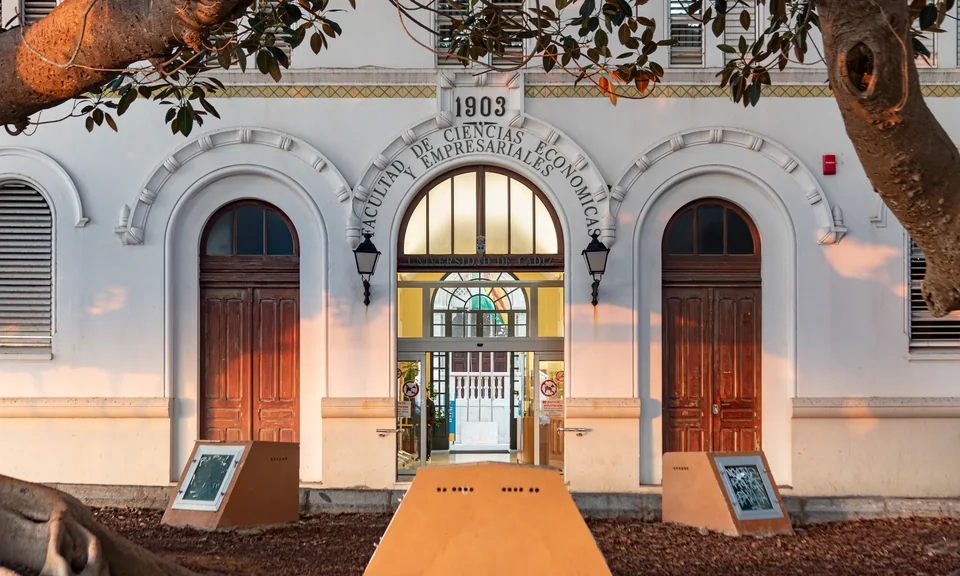
Master's in Spain at a glance
| Item | How it works | Example from an official source |
|---|---|---|
| Length | 60, 90 or 120 ECTS, one to two years | Royal Decree 822/2021, article 17 |
| Thesis | Trabajo de Fin de Máster, 6–30 ECTS, defended in public | Same article |
| Entry with a non-EHEA degree | No homologation; the university checks the level | Article 18 of the same decree |
| Recognition for a profession | Homologación by the Ministry, fee $190 (€166.50) | Ministry of Science's Valida-TE portal |
| Deadlines | Several rounds: late January to late May, plus September | UCM, 2026–27 intake |
| Public fees | Per credit; non-EU non-residents pay a higher rate | UCM: $95 (€84.07) instead of $50 (€45.02) per credit |
| Language | Spanish or English; the programme sets the level | UC3M: more than 30 official master's taught in English or bilingually |
| Work | Up to 30 hours a week without a separate permit | Royal Decree 1155/2024, article 57 |
Máster Universitario, own-degree master's and MBA: what you are buying
The word "máster" covers programmes with very different legal status, and the name alone does not tell you which.
| Máster Universitario (official) | Máster de Formación Permanente and other títulos propios | MBA and business-school programmes | |
|---|---|---|---|
| Approved by | State verification, entry in the RUCT register | The university under its own rules | The school; status varies |
| Spanish doctorate | Gives access | No automatic access | Depends on the programme's status |
| Price | Regional rate at public universities | Set by the university | Set by the school |
| Best for | Doctorate plans, public-sector jobs, recognition at home | Applied specialisation and industry networks | Experienced professionals with a budget for the whole course |
Royal Decree 822/2021 forbids universities from naming their own programmes in a way that could be confused with official ones, and a lifelong-learning master's must be called Máster de Formación Permanente. An official programme may also be called an MBA: at UC3M it is the Máster Universitario en Administración de Empresas — MBA. Check the status in RUCT and the degree title in the programme description, not the word "master" on the brochure.
Do you need to get your degree recognised?
For admission, usually not. Article 18 of Royal Decree 822/2021 admits graduates of non-EHEA systems to a Máster Universitario without homologation. The university itself checks that your degree is equivalent in level to a Spanish grado and gives access to master's studies in the issuing country. This check is valid only for studying that master's and does not replace recognition for other purposes.
Complutense shows how it works in practice. The level check (comprobación del nivel de formación) is done only for admitted applicants and requires:
- the degree certificate with an apostille;
- the transcript with an apostille, showing the length of studies, subjects, grades, the final average and total hours;
- an official Spanish translation, done after the apostille has been placed on the original;
- a letter confirming that the degree gives access to master's studies in the issuing country, written by your university or using UCM's template;
- your passport.
If the level-check decision is not uploaded in time, UCM cancels the admission. For Russian graduates there is an extra nuance: Russia formally remains in the EHEA, but its representation rights have been suspended since April 2022. Ask the admissions office of each programme which group it places your degree in and which documents it expects.
When recognition is needed. If the master's leads to a regulated profession — health psychologist, secondary-school teacher, certain engineering professions — or you intend to practise one, the degree is recognised by the Ministry of Science through the Valida-TE portal for a fee of $190 (€166.50). For academic purposes such as public-sector competitions there is a declaración de equivalencia, which confirms the level of a degree that lasted at least three years. The professions of lawyer (abogado) and court representative (procurador) cannot be obtained through homologation, so foreign law graduates should study the conditions of the Abogacía master's before applying.
What admissions committees look at
Admission rules are written by each university and often by each programme. Five things usually matter:
- Degree profile. The programme lists which bachelor's fields it accepts. For a related field the university may add bridging courses of up to 20% of the master's load.
- Grade average. Usually the heaviest factor. Universities convert foreign grades under their own rules, so report your grades exactly as they appear in your transcript.
- Language. DELE or SIELE at the required level for Spanish-taught programmes; IELTS, TOEFL or Cambridge for English-taught ones. The minimum is on the programme page.
- Motivation letter and CV. Decisive when strong applications outnumber places.
- References, portfolio, interview — for some programmes.
If you have not yet graduated, the decree allows universities to enrol you conditionally when only your final project and no more than 9 further credits remain; the master's diploma is issued only after the bachelor's. The rule is written for students of a Spanish grado; whether a university applies it to graduates of foreign programmes is set in its regulations or confirmed by admissions.
When to apply
There is no national portal for master's programmes: each university or regional system runs its own. UCM's 2026–27 calendar shows the typical pattern:
| Round | Applications | Results | Enrolment |
|---|---|---|---|
| First | 28 January – 20 February | From 23 March | 29 May – 5 June |
| Second | 27 April – 22 May | From 17 June | 17–26 June |
| Extraordinary, only programmes with places left | 1–4 September | From 11 September | 11–18 September |
For an international applicant the first round matters most: the answer comes in March, leaving time for the level check, the visa and housing. The September round leaves very little time for a visa. Private universities and business schools follow their own calendars. Universities publish 2027–28 dates in winter, so treat this table as a guide.
How much a master's in Spain costs
At public universities the region sets the price per credit. Madrid's Decree 43/2022 requires public universities in the region to charge foreign students over 18 without residence the third-attempt rate for ordinary master's and the fourth-attempt rate for master's leading to regulated professions. A study permit does not count as residence.
| Programme | What is included | Amount |
|---|---|---|
| UCM, ordinary official master's, non-EU non-resident | Tuition for 60 ECTS, 2026–27 | $5,730 (€5,044.20) |
| UCM, same programme for EU citizens or residents | Tuition for 60 ECTS | $3,070 (€2,701.20) |
| UCM, General Health Psychology, non-EU non-resident | Price of one credit at the fourth-attempt rate | $190 (€169.21) per credit |
| UPC, Catalonia, any official master's, non-EU non-resident | Tuition for 60 ECTS at $50 (€45) per credit, 2026–27 | $3,070 (€2,700); UPC's estimate with fees is $3,630 (€3,200) |
| University of Navarra, Big Data Science | Whole programme, 60 ECTS, 2026–27 | $22,260 (€19,600.20) |
| University of Navarra, Industrial Engineering | Whole programme, 90 ECTS, 2026–27 | $31,470 (€27,715.50) |
UCM also charges $6.95 (€6.11) for administration and $30 (€27.54) to open a student file. For the visa you must show 100% of the IPREM index for each month — currently $680 (€600) a month, or $8,180 (€7,200) a year. Budget separately for apostilles, sworn translation and the language test. City living costs are in Cost of Studying in Spain and housing in Student Housing in Spain.
Scholarships and discounts
- Erasmus Mundus. Joint master's run by several European universities, often with a Spanish partner. The best-ranked applicants worldwide can receive full scholarships covering participation costs and contributing to living costs. Each programme publishes its own deadlines and conditions — check them early, as they may differ from Spanish university calendars.
- Private-university discounts. Business schools and private universities reduce fees for academic merit and early application; each publishes its own conditions.
- State becas. Under the Aliens Act, adult non-EU nationals get access to them on equal terms with Spaniards only with resident status, and a study permit (estancia) does not count as residence. Leave them out of your budget.
More in Scholarships in Spain.
Master's taught in English
There are far more English-taught options at master's level than at bachelor's level. At public UC3M, programmes in English include finance, marketing, economics, statistics for data science, aerospace and telecommunications engineering and, at the law school, the Máster Universitario en Abogacía Internacional. UC3M's bilingual master's also require Spanish. Private universities and business schools teach almost everything in English. How to tell a fully English programme from a partly English one is covered in English-Taught Degrees in Spain.
Working during and after your studies
A study permit for higher education automatically allows employed or self-employed work of up to 30 hours a week, as long as it is compatible with your studies. You may work in the autonomous community that issued the permit and in neighbouring localities of adjacent regions. Internships that are part of the curriculum need no separate permit.
After graduating with at least a bachelor-level qualification you can apply for a residence permit to look for work or start a business for up to 24 months, with no extension. The online application is filed within 60 days before the study permit expires or 90 days after; once you find a job you must apply for the corresponding work authorisation. Options after graduation are covered in Working While Studying in Spain and Student Visa for Spain.
Plan for a September 2027 start
- September–November 2026. Shortlist 4–6 programmes, check each in RUCT, note profile, language and document requirements. Take IELTS, TOEFL or DELE if needed.
- October–December 2026. Apostille your degree and transcript, order translations, draft the motivation letter, ask for references. Apply to Erasmus Mundus if a programme fits.
- Late January – February 2027. Apply in the first round of public universities.
- March–April 2027. Receive decisions, choose, pay a deposit if required. Apply in the second round if needed.
- May–June 2027. Complete the level check if the university requires it and enrol.
- June–July 2027. Apply for the study visa about two months before classes start and find housing.
- September 2027. Arrive, apply for the foreigner identity card (TIE), start classes.
Common mistakes
- Choosing a título propio while planning a doctorate. It does not automatically open a Spanish doctorate. Check RUCT before paying.
- Budgeting with EU fees. In Madrid a non-EU non-resident pays almost twice as much for an ordinary master's and the top rate for professional ones.
- Confusing the level check with homologation. The university check is enough to study; working in a regulated profession needs Ministry homologation. Different procedures, different timelines.
- Translating before the apostille. UCM requires the apostille on the original and the translation made afterwards.
- Waiting for September. Only programmes with places left take part, and there is very little time for a visa.
- Not checking course languages. A "bilingual" programme also requires Spanish, and in Catalonia some classes may be in Catalan.
What StudyU does
Only the initial consultation is free. Shortlisting programmes, checking status and requirements, preparing documents and the motivation letter, submitting applications and the visa file are provided under an agreement with StudyU. The university decides on admission and the level check, the Ministry on homologation and the Spanish consulate on the visa. For a country overview see Study in Spain; if business programmes interest you, look at EU Business School Barcelona and GBSB Global Business School and note which diploma each programme awards.
FAQ
Yes, as long as the degree is at least equivalent in level to a Spanish grado and gives access to master's studies in Russia. The university checks this on admission using the diploma, the transcript with hours and a letter confirming access to master's studies.
For an official master's, usually not — the university's level check is enough. Recognition through the Ministry of Science is needed if the master's or your future job involves a regulated profession. The fee is $190 (€166.50).
One to two years: 60, 90 or 120 ECTS. Most programmes are 60 credits and one academic year, including the thesis.
About $5,730 (€5,044) for 60 credits at a Madrid public university and about $3,070 (€2,700) at UPC in Catalonia. Private programmes in our examples start at $22,260 (€19,600.20) for the course. Add living costs and at least $8,180 (€7,200) a year that you must show for the visa.
Yes, in English-taught programmes, most common in business, economics, engineering and data science. Spanish still helps with work, internships and daily life.
During studies the permit covers the official length of the programme and allows up to 30 hours of work a week. After graduation you can apply for a permit to look for work or start a business for up to 24 months, with no extension; the immigration authorities decide.
Yes. You apply to each university separately and there is usually no limit. Aim for the first round and remember that each university has its own document list.
Sources
- Royal Decree 822/2021: articles 17, 18, 36, 37 — checked 24.09.2026
- UCM: 2026–27 master's fees, 2026–27 deadlines, level check for non-EHEA degrees, application documents — checked 24.09.2026
- UPC: 2026–27 master's fees; Catalonia: credit prices — checked 24.09.2026
- University of Navarra: 2026–27 master's fees — checked 24.09.2026
- UC3M: master's taught in English and bilingually — checked 24.09.2026
- Ministry of Science: Valida-TE portal and fee, homologation for regulated professions, declaration of equivalence — checked 24.09.2026
- EHEA: status of Russia and Belarus — checked 24.09.2026
- Erasmus Mundus Joint Masters — checked 24.09.2026
- Law 14/2013, additional provision 17 — checked 24.09.2026
- Spanish Consulate in Moscow: study visa; Royal Decree 1155/2024; Organic Law 4/2000, article 9; IPREM (BOE-A-2022-22128) — checked 24.09.2026
- Exchange rate: ECB reference rate of 29.09.2026, €1 = $1.1355
Next steps
- English-Taught Degrees in Spain: Where to Study Without Spanish and What It Costs in 2027
- Working While Studying in Spain in 2026: 30 Hours a Week Without a Separate Permit, Pay, Internships and Tax
- Scholarships in Spain for International Students in 2026: What Is Actually Open to Non-EU Applicants
- Cost of Studying in Spain in 2026/27: Public Credit Prices, Non-EU Surcharges, Private Universities and Living Costs
- Studying in Spain for international applicants
- EU Business School (Barcelona)
