
Spanish public universities charge per ECTS credit, and each region sets its own price. As a result, the same degree costs a non-EU student about $860 (€757) a year in Andalusia, about $2,040 (€1,800) in Catalonia and about $7,750–9,300 (€6,823–8,186) in Madrid, where public universities charge non-resident foreigners the "fourth enrolment" rate. A private university costs roughly $15,900–23,160 (€14,000–20,400) for the first year, and living costs run from about $800 to $1,370 (€700–1,200) a month depending on the city. For the student visa you only have to show $680 (€600) per month of stay, but that is the consulate's minimum, not a realistic budget.
This guide explains how public fees are calculated, which regions charge more to non-residents, what private universities cost, housing and first-month expenses, four sample budgets and legal ways to spend less. Figures were checked against university websites, regional decrees and official tariffs on 24 September 2026. For an overview of study routes see studying in Spain.
Dollar amounts use the ECB reference rate of 29 September 2026 (€1 = $1.1355) and are rounded. Visa fees charged in roubles follow the Moscow consulate fee table in force from 1 July 2026 and use the Bank of Russia rate of 24 September 2026 ($1 = ₽84.40).
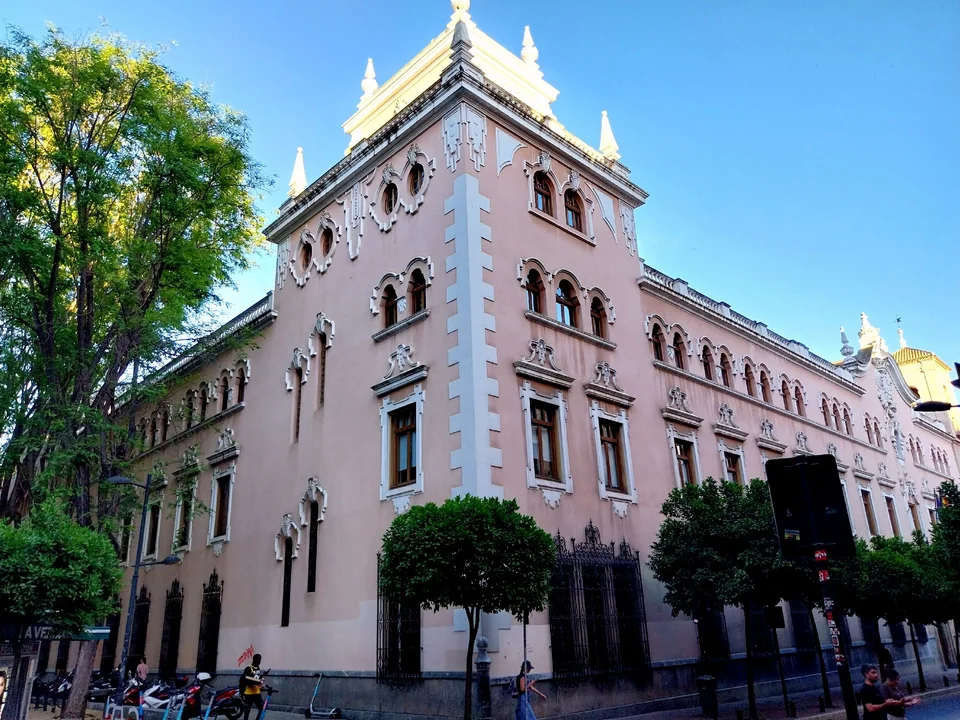
At a glance: what a year in Spain costs
| Route | Tuition per year | Living costs, 12 months | Key point |
|---|---|---|---|
| Bachelor's (grado) at a public university in Andalusia | ≈ $864 (€757 for 60 credits) | ≈ $9,540–12,260 (€8,400–10,800) | One regional rate for everyone, but universities may raise it for non-EEA non-residents |
| Bachelor's at a public university in Catalonia | ≈ $2,040 (€1,800) for non-EU students | ≈ $13,630–16,350 (€12,000–14,400) in Barcelona | $34 (€30) per credit instead of $20 (€17.69) |
| Bachelor's at a public university in Madrid | ≈ $7,750–9,300 (€6,823–8,186) for non-EU non-residents | ≈ $13,630–16,350 (€12,000–14,400) | Fourth-enrolment rate under Madrid's price decree |
| Official master's at a public university | ≈ $930–5,730 (€820–5,044) for 60 credits | As above | Cheapest in Andalusia, most expensive for non-residents in Madrid |
| Private university | ≈ $15,780–23,160 (€13,900–20,400) for year one at the University of Navarra | ≈ $9,600–12,300 in Pamplona | Fixed price regardless of residence status |
| Business and hospitality schools | From ≈ $9,400 a year to ≈ $131,000 for a full programme | Depends on campus | Compare semester-by-semester and the whole route |
Living costs follow the European Commission's estimate: $1,140–1,360 (€1,000–1,200) a month in Madrid and Barcelona and $795–1,020 (€700–900) in smaller cities. One-off first-year costs are listed separately below.
How public university fees are calculated
The formula is simple: price per ECTS credit × the number of credits you enrol in that year. A full academic year is 60 credits; a four-year bachelor's is 240. Small administrative charges come on top. At Complutense (UCM), for example, opening your student file costs $31 (€27.54) in the first year and the secretariat fee is $7 (€6.11) a year; Andalusian universities charge $67 (€59.10) to open a file.
Three things drive the credit price:
- Region. Each autonomous community publishes its own price decree, so Complutense and Granada follow different tables.
- Field of study. In Madrid a credit in medicine or biology costs more than one in law or journalism: $23 (€20.68) versus $19 (€16.92) on first enrolment.
- Attempt number. A matrícula is an enrolment in a course. If you fail and re-enrol, the credit gets more expensive. At UCM a group-3 credit costs $19 (€16.92) the first time, $45 (€40.02) the second, $93 (€82.30) the third and $130 (€113.71) from the fourth.
Taking half the courses to save money does not work for international students. Spain's Immigration Regulation treats a programme as full-time only if the student is enrolled in at least 90% of the year's credits, and universities set their own full-time minimums (48 credits a year at UCM).
You rarely have to pay the whole amount at once: UCM lets students split payment into eight instalments when enrolling in June–July, or five to six in September–October. But the visa rules require proof that you have already paid the enrolment fee or deposit the institution asks for.
Why non-EU students often pay more: the "non-resident" rule
The trap in Spanish pricing is the word residente. For regional price decrees you are a non-resident even with a student visa and a TIE card, because a study permit in Spain is a stay (estancia), not residence. UCM states explicitly on its fees page that a student stay authorisation is not equivalent to resident status.
| Region | Base credit price, first enrolment | Non-EU students without residence | Basis |
|---|---|---|---|
| Madrid (UCM and other public universities) | $19–23 (€16.92–20.68) | Fourth-enrolment price: $130–155 (€113.71–136.44) per credit | Madrid Decree 43/2022, art. 8; UCM 2026/27 fees page |
| Catalonia (decree prices; example: UPC's fees page) | $20 (€17.69) | $34 (€30.00) per credit | Catalan Decree 96/2026; UPC 2026/27 fees page |
| Andalusia (Granada, Seville, Málaga and others) | $14 (€12.62) | Same rate, but the university may raise it up to 100% of the cost of teaching | Andalusian Decree 98/2023, art. 3 |
| Galicia (example: an inter-university master's at Santiago de Compostela) | $16 (€13.93) | $20 (€17.41) per credit | Inter-university master's table on the UCM website |
In practice, a law student from outside the EU pays $7,750 (€6,822.60) for 60 credits at UCM, while a Spanish or Italian classmate pays $1,150 (€1,015.20). In Barcelona the gap is smaller: $2,040 (€1,800) versus $1,210 (€1,061.40). Andalusia allows but does not oblige universities to charge non-residents more, so check the precios públicos page of your university for the relevant year.
If you already hold a Spanish residence permit on another basis, you usually pay the local rate. Prove it before enrolment, not after the invoice arrives.
Master's degrees: official, "habilitante" and university-own titles
- Máster universitario is an official state degree, priced by the region. Habilitante master's that lead to regulated professions (lawyer, secondary teacher, health psychologist, engineer) are usually cheaper.
- Título propio is a university's own qualification; the university sets the price and it is not an official state degree. It can cost several times more than an official master's at the same university.
| University | Official master's, first enrolment | Non-EU non-residents | 60 credits for a non-resident |
|---|---|---|---|
| Complutense (Madrid) | $51 (€45.02) per credit | $95 (€84.07) (third-enrolment rate) | ≈ $5,730 (€5,044) |
| UPC (Barcelona) | $22 (€19.37) (non-habilitante), $20 (€17.69) (habilitante) | $51 (€45) | ≈ $3,070 (€2,700); UPC estimates about $3,630 (€3,200) including fees |
| Andalusian public universities | $16 (€13.68) (non-habilitante), $14 (€12.62) (habilitante) | University decides | ≈ $930 (€820.80) at the base rate |
UPC estimates a 90-credit master's at about $5,220 (€4,600) and a 120-credit one at $6,930 (€6,100) for non-EU students. For choosing between programme types see our guide to master's degrees in Spain.
Private universities and business schools
Private universities set their own prices and residence status does not matter. Compare specific programmes:
| Programme | University | First year 2026/27 |
|---|---|---|
| Medicine | University of Navarra (Pamplona) | ≈ $23,278 (€20,400, €340 per credit) |
| Business administration with international tracks | University of Navarra | ≈ $21,860 (€19,250.40) |
| Engineering (Tecnun) | University of Navarra | ≈ $18,570 (€16,350) |
| Law | University of Navarra | ≈ $18,050 (€15,900) |
| Nursing | University of Navarra | ≈ $16,920 (€14,900.40) |
| Audiovisual communication | University of Navarra | ≈ $15,780 (€13,900.80) |
Navarra gives 5% off for paying the full first year in advance (by 10 February in the 2026 cycle) and 16% for a matrícula de honor (top grade) in the final school year; for international applicants the school must certify that the student's average is in the top 5% of the class.
Business and hospitality schools price by semester, often with internships and mandatory housing. Les Roches Marbella's official 2026 tariff for the BSc in Global Hospitality Management is $27,240 (€23,990) for the first semester alone and $130,300 (€114,750) for the full route. See our profiles of EU Business School Barcelona, GBSB Global Business School and Les Roches Marbella, and our comparison of public and private universities in Spain.
Living costs by city
The European Commission estimates student costs at $1,140–1,360 (€1,000–1,200) a month in Madrid and Barcelona and $795–1,020 (€700–900) in smaller cities. Housing takes more than half.
| City | Room in a shared flat, average asking rent | One-bedroom flat | Youth transport pass |
|---|---|---|---|
| Barcelona | ≈ $680 (€600) | — | T-jove: $52 (€45.50) for 90 days, under 30 |
| Madrid | ≈ $625 (€550) | ≈ $1,450 (€1,277) | Abono Joven: $11 (€10) for 30 days, under 26 |
| Málaga, Bilbao | ≈ $510 (€450) | — | Local fares |
| Valencia | ≈ $430 (€380) | ≈ $1,350 (€1,185) | Local fares |
| Seville | ≈ $420 (€370) | ≈ $970 (€853) | Local fares |
| Granada | ≈ $320–455 (€280–400) on the UGR housing portal | — | Local fares |
| Spain average | ≈ $485 (€425) | ≈ $1,120 (€984) | — |
Room and flat prices are Idealista averages for Q2 2026 listings; Granada is the range of listings on the University of Granada's official housing portal on 24 September 2026. University colegios mayores cost more but include meals: a full-board place at UCM costs $1,230 (€1,081.70) a month for UCM students. More in our guide to student housing in Spain.
On top of rent, budget for food, phone, study materials and health insurance if not prepaid. Insurance is a visa requirement, so get a quote before you apply.
One-off first-year costs
| Item | Amount | When |
|---|---|---|
| National student visa fee (Moscow) | ₽7,547 (≈ $89) | At the visa centre |
| BLS visa centre service fee | ₽1,233 (≈ $15) | At the visa centre |
| Translation certified by the consulate | ₽2,698 (≈ $32) per page | Before applying, if not using a sworn translator |
| Foreigner identity card (TIE), fee 790-012 | $18 (€16.08) | Within a month of arrival |
| Rental deposit (fianza) | 1 month for a housing lease, 2 months for a fixed-term (seasonal) lease | On signing |
| Colegio mayor reservation at UCM | $510 (€450), deducted from the first bill | June–July |
| Opening a student file | $31–67 (€27.54–59.10) | First enrolment |
Add flights, recognition of your school or university qualification and, for bachelor's applicants, UNEDasiss accreditation and subject exams.
How much money to show for the visa, and why that is not your budget
You must prove means of support equal to 100% of IPREM for each month of stay. IPREM is a Spanish reference index used for benefits and thresholds. In 2026 it is $680 (€600) a month: the figure was set by the 2023 budget and has not changed since.
| Who | Per month | For 12 months |
|---|---|---|
| Student | $680 (€600) | $8,180 (€7,200) |
| First family member | +$510 (€450) | +$6,130 (€5,400) |
| Each additional member | +$340 (€300) | +$4,090 (€3,600) |
Two rules people miss:
- Money earmarked for tuition does not count. If you hold $11,360 (€10,000) and $7,750 (€6,823) goes to UCM, only $3,610 (€3,177) counts towards the visa.
- If accommodation is prepaid for the whole stay, the required amount can be reduced, provided you show the contract and proof of payment.
The consular minimum is $680 (€600) a month; real life in Madrid costs $1,140–1,360 (€1,000–1,200). Details on documents are in our guide to the Spanish student visa.
Four sample first-year budgets
Estimates for 2026/27 without scholarships or part-time work. Living costs cover 12 months, because leases are often annual and travelling home for summer also costs money; subtract two months if you will leave and can rent for ten.
| Scenario | Tuition | Living | One-off costs | Total |
|---|---|---|---|---|
| Grado at an Andalusian public university (e.g. Granada), base rate | ≈ $930 (€816 incl. file fee) | ≈ $9,600–12,300 | ≈ $1,000–1,500 | ≈ $11,500–14,700 |
| Master's at UPC Barcelona, 60 credits | ≈ $3,650 (≈ €3,200 incl. fees) | ≈ $13,700–16,400 | ≈ $1,200–2,000 | ≈ $18,500–22,000 |
| Grado at UCM, non-EU non-resident | ≈ $7,820–9,380 (incl. admin fees) | ≈ $13,700–16,400 | ≈ $1,200–2,000 | ≈ $22,700–27,800 |
| Law at the University of Navarra | ≈ $18,050 (€15,900) | ≈ $9,600–12,300 | ≈ $1,000–1,500 | ≈ $28,700–31,900 |
Legal ways to spend less
- Choose the region, not just the university. The same degree can cost a non-resident several times less in Andalusia or Catalonia than in Madrid.
- Pass first time. Second enrolment costs 2.4 times more in Madrid and twice as much in Andalusia.
- Ask about Andalusia's 99% rebate. Decree 98/2023 gives Andalusian public university students a 99% discount next year on credits passed at the first attempt. The decree does not restrict it by nationality, but confirm with your university that it applies to non-resident students.
- Compare full board with a room. A $1,230 (€1,081.70) full-board colegio may be close to a $625 (€550) room plus food and bills.
- Buy the youth pass. $11 (€10) a month in Madrid (under 26), $52 (€45.50) per quarter in Barcelona (under 30).
- Work part-time. University students may work up to 30 hours a week without a separate permit. The Regulation counts a valid employment contract or a firm job offer towards visa funds, but not the hope of finding work after arrival, and the Moscow consulate's checklist asks for bank documents — so keep the first year's money in the bank. See working while studying in Spain.
- Scholarships. Spain's national grants are for residents; for most non-EU students the realistic options are university awards, Erasmus Mundus and doctoral fellowships. See scholarships in Spain.
Paying tuition from Russia
Universities take bank transfers or card payments through their own systems. Russian-issued cards do not work abroad, so plan the payment route before enrolment; legal options are covered in How to pay for studies abroad from Russia. Once in Spain with a TIE, students can open a local bank account.
Common mistakes
- Using a "Spain average" without checking the non-resident rate in your region.
- Budgeting at the $680 (€600) visa minimum.
- Counting tuition money towards the visa amount.
- Planning part-time enrolment to save money: the visa needs at least 90% of the year's credits.
- Confusing an official master's with a título propio of a similar name.
- Comparing a private school's semester price with a university's annual price.
- Forgetting that deposit, first rent and a reservation fee all fall in July–September.
FAQ
At a public university, from about $860 (€757) a year in Andalusia at the base rate to about $7,750–9,300 (€6,823–8,186) in Madrid, where non-EU non-residents pay the fourth-enrolment rate. In Catalonia it is about $2,040 (€1,800) for 60 credits. The first year at a private university costs about $15,900–23,300.
There are no free public programmes for foreigners without residence. Tuition can approach zero with an Erasmus Mundus scholarship, a doctoral contract, or Andalusia's rebate from the second year if your university applies it. Living costs remain.
Madrid Decree 43/2022 requires public universities to charge foreigners over 18 without resident status the fourth-enrolment rate for bachelor's degrees and the third-enrolment rate for ordinary master's. A student stay permit does not count as residence.
According to the European Commission, $1,140–1,360 (€1,000–1,200) in Madrid and Barcelona and $795–1,020 (€700–900) in smaller cities. A room in a shared flat averages $485 (€425) nationally and $680 (€600) in Barcelona.
$680 (€600) for each month of stay ($8,180 (€7,200) a year), plus $510 (€450) a month for the first family member and $340 (€300) for each additional one. Tuition money is excluded.
Not necessarily. You must prove payment of the enrolment fee or deposit the institution requires. Public universities often allow instalments; private ones usually require a seat deposit.
Regions review credit prices every year, although Madrid and Andalusia have kept their decrees unchanged for several years; repeat enrolments are what gets expensive. Private universities usually raise fees annually, so ask whether the price is fixed for the whole degree.
Sources
- UCM: bachelor's fees 2026/27, master's fees 2026/27 and payment options — checked 24.09.2026
- UPC: bachelor's fees, master's fees and Catalan Decree 96/2026 — checked 24.09.2026
- Andalusian Decree 98/2023 (BOJA 84) — arts. 3 and 12; linked from UGR's bachelor's page; checked 24.09.2026
- University of Navarra: first-year prices 2026/27 and discounts — checked 24.09.2026
- Les Roches: tuition fees — 2026 BSc tariff, as recorded in the StudyU profile
- European Commission, Study in Europe: Spain — checked 24.09.2026
- Idealista: room, studio and one-bedroom rents, Q2 2026 — checked 24.09.2026
- UCM colegios mayores 2026/27 and University of Granada housing portal — checked 24.09.2026
- CRTM: Abono Joven and ATM Barcelona: T-jove — checked 24.09.2026
- Royal Decree 1155/2024, Immigration Regulation — arts. 35, 52.2, 53; checked 24.09.2026
- Law 31/2022, additional provision 90 — IPREM $680 (€600); iprem.com.es, linked by the Spanish consulate in Moscow, for the 2026 value; checked 24.09.2026
- Spanish Consulate in Moscow: fee table from 01.07.2026, BLS Moscow: national study visa and service fee and Police fee form 790-012 — checked 24.09.2026
- Urban Leases Act 29/1994, art. 36 — deposits; checked 24.09.2026
- Exchange rates: ECB, 29.09.2026, €1 = $1.1355; Bank of Russia, 24.09.2026, $1 = ₽84.3969
Next steps
- Public or Private University in Spain? A 2027 Guide for International Students
- Master's Degree in Spain: Admission with a Non-EU Degree and 2027 Costs
- Working While Studying in Spain in 2026: 30 Hours a Week Without a Separate Permit, Pay, Internships and Tax
- Scholarships in Spain for International Students in 2026: What Is Actually Open to Non-EU Applicants
- How to Pay for Studies Abroad from Russia: What Works in 2026
- Studying in Spain for international applicants
