
The University of Salamanca is the oldest university still operating in Spain, founded in 1218 by King Alfonso IX of León. Today it has around 30,000 students and nine campuses in four cities of Castile and León: Salamanca, Ávila, Zamora and Béjar. For international applicants it stands out for three reasons: Castile and León charges non-EU students the same fees as Spaniards (a bachelor's credit costs $12–21, €10.41–18.45, and these prices have been rolled over unchanged into 2026/27), the university runs Cursos Internacionales, a large Spanish-language centre for foreigners, and USAL helps produce the DELE exams. Bachelor's pre-registration (preinscripción) ran from 3 June to 3 July in 2026, extended to 7 July for applicants with a foreign school diploma.
| At a glance | Details |
|---|---|
| Cities | Salamanca (main), Ávila, Zamora, Béjar; nine campuses |
| Founded | 1218 |
| Rankings | QS World University Rankings 2027: =560; THE World University Rankings 2026: 801–1000; ARWU 2026: 801–900 |
| Language of instruction | Spanish; English only in some subjects and programmes |
| Bachelor's, 2025/26 | $12–21 (€10.41–18.45) per credit by degree; $710–1,260 (€624.60–1,107) for 60 credits |
| Master's, 2025/26 | $19 (€16.34) per credit for professional masters; $30 (€26.20) otherwise, about $1,790 (€1,572) for 60 credits |
| 2026/27 prices | no new prices approved; under Decree 8/2024 the 2025/26 prices roll over |
| First-year fee refund | Castile and León refunds first-year bachelor's tuition to first-time university entrants registered as residents (empadronados) in the region; competitive by admission score; 2026/27 applications 22 Sep – 21 Oct 2026 |
| Bachelor's admission | in 2026, preinscripción ran 3 June – 3 July, and until 7 July with a foreign diploma |
| Master's admission | in 2026, a single window ran 13 April – 15 July, up to three programmes |
Who Salamanca suits, and who should look elsewhere
| Strengths | Limitations |
|---|---|
| The same fee for EU and non-EU students, among the lowest in Spain | Teaching is almost entirely in Spanish |
| A broad offer in philology, translation, law, history and biomedicine | A small city with fewer internships and part-time jobs than Madrid or Barcelona |
| Cursos Internacionales: Spanish all year, from two-week courses to full semesters | Non-EU school leavers without the PAU or PCE fall into a "non-priority" group |
| University halls and residences with meals | For a master's, a foreign degree must first pass a paid USAL assessment |
| Language year, PCE and bachelor's can all happen in one city | USAL updates its fee pages late, so check prices against regional documents |
Salamanca suits students who want to study in Spanish and are willing to spend a year on language and exams to earn a low-cost degree, especially in Spanish philology, translation, law, history, biology or pharmacy. If you need a big city and more English-taught options, compare USAL with Pompeu Fabra University and the Complutense University of Madrid; if price and a Spanish-speaking environment matter but you prefer the south, compare it with Granada. Our overview of universities in Spain for international students gives the wider picture.
Programmes
USAL teaches across every major field: humanities, sciences, health sciences, social and legal sciences, and engineering and architecture. The price bands in the fees decree show the range well:
- medicine — its own, most expensive band;
- engineering and nursing — computing, mechanical, electrical, chemical, civil and agricultural engineering, mechatronics and robotics, commercial aviation pilot, 3D interactive applications and video games;
- dentistry, physiotherapy, occupational therapy, audiology;
- biology, biotechnology, pharmacy, chemistry, geology, environmental sciences;
- psychology, translation, fine arts, education;
- business administration, economics, political science, criminology, audiovisual communication, mathematics, physics, statistics;
- law, philologies (Spanish, English, German, French, Italian, Portuguese, Arabic, classical), Asian studies, history, art history, philosophy, geography, tourism, Estudios Globales / Global Studies.
There are also double degrees (dobles titulaciones), listed in the bachelor's catalogue. Teaching is in Spanish; even for a programme with an English name such as Global Studies, check each subject's language in the course plan. The "Bachelor Degree Programs in English" run by Cursos Internacionales are semester programmes for visiting students, not a USAL bachelor's degree.
How to apply for a bachelor's with a non-EU school diploma
USAL requires a homologation certificate, meaning the Spanish Ministry of Education must recognise your diploma as equivalent to the Spanish Bachillerato; if you do not have it yet, you must at least have applied. What happens next depends on whether you took an entrance exam.
| Your situation | Access score | Allocation group |
|---|---|---|
| Passed the Spanish PAU, or hold UNEDasiss accreditation with a Bachillerato track (through the PCE) | the score on your UNED accreditation | priority |
| No PAU or PCE | the average on your homologation certificate, or 5.00 if none | non-priority: places go to the priority group first |
Admission score = access score + a × X1 + b × X2, where X1 and X2 are your two best PCE results (5 or above) weighted 0.1 or 0.2 for the chosen degree in 2026/27. This adds up to 4 points, for a maximum of 14. USAL does not count subjects from your own school system; only passed PCE subjects count.
Step-by-step plan for 2027/28
- September–November 2026. Shortlist degrees and check last year's USAL cut-off marks and the PCE weighting table. Get your diploma apostilled and officially translated into Spanish.
- By the end of 2026. Apply for homologation.
- February–April 2027. Apply for UNEDasiss accreditation and register for the PCE (16 March – 28 April in 2026; exams in Spain 25–29 May).
- June – early July 2027. Submit the online preinscripción (3 June – 3 July in 2026; until 7 July with a foreign diploma, using a separate paper form through the registry from 4 to 7 July). UNEDasiss results received between 8 and 31 July still count if you applied on time.
- July 2027. Follow the lists and enrol at once (in 2026 enrolment windows were 9–14, 20–21 and 24–27 July). If you are admitted and miss the enrolment window, you lose the place and every lower choice on your list.
Our guides to applying to Spanish universities and to Spanish university after 11 years of school cover the national route.
Deadlines for 2027/28
| Stage | 2026 dates | Set by |
|---|---|---|
| UNEDasiss accreditation | 4 February – 1 December | UNEDasiss |
| PCE registration, May session | 16 March – 28 April | UNEDasiss |
| PCE exams in Spain | 25–29 May | UNEDasiss |
| Bachelor's preinscripción | 3 June – 3 July; with a foreign diploma until 7 July | USAL (under a Castile and León resolution) |
| Admission lists and enrolment | 9–14, 20–21 and 24–27 July | USAL |
| Master's preinscripción | 13 April – 15 July | USAL |
| USAL halls and residences | applications from 8 April; allocation from 10 July | USAL halls service |
USAL publishes the 2027 dates in spring; in past years they have moved by only a few days.
Language requirements
USAL teaches in Spanish. The admission page for non-EU school leavers does not ask for a separate Spanish certificate, but following lectures, seminars and exams realistically takes B2. Master's language requirements are listed on each programme page. You can prepare locally: Cursos Internacionales runs courses at every level all year, plus an official SIELE preparation course.
Master's admission at USAL
If your degree comes from outside the European Higher Education Area and is not homologated, USAL first carries out a mandatory degree assessment (evaluación del expediente). Applications are accepted all year, but every later step depends on the outcome, so apply early.
| Step | What matters |
|---|---|
| Foreign degree assessment | fee under the prices decree: $240 (€210.97), paid by bank transfer to USAL; legalised or apostilled copies of your degree and transcript, a certificate that the degree gives access to master's study in the issuing country, and official Spanish translations; incomplete files are not processed |
| Preinscripción | 13 April – 15 July 2026, up to three programmes in order of preference; committees may consider only documents submitted by 15 July |
| Exceptions | the General Health Psychology master and the secondary-teacher training master have their own procedures, described on their pages |
| Payment | in one go or in six instalments (20%, 20%, 15%, 15%, 15%, 15%) from October to March; foreign students without a Spanish bank account pay by bank transfer |
See our guide to master's degrees in Spain for choosing a programme.
Tuition and living costs in Salamanca
Tuition
Fees at Castile and León's public universities are set by Decree 8/2024 (BOCyL, 3 June 2024), updated by Order EDU/459/2025. The decree has no separate price for non-EU students: everyone pays the same. The region has not approved new prices for 2026/27, and the decree's final provision rolls the previous prices over in that case. The University of León, which charges under the same decree, has already published its 2026/27 first-year table with identical per-credit amounts, while USAL's master's page still said on 24 September 2026 that 2026/27 prices were awaiting publication. The table shows the 2025/26 first-enrolment rates, which also apply in 2026/27.
| Band | Example degrees | Price per credit | 60 credits |
|---|---|---|---|
| A | medicine | $21 (€18.45) | $1,260 (€1,107) |
| B1 | computing, mechanical engineering, nursing | $19 (€16.90) | $1,160 (€1,014) |
| B2 | dentistry, physiotherapy | $18 (€15.58) | $1,070 (€934.80) |
| C1 | biology, pharmacy, chemistry | $17 (€14.74) | $1,010 (€884.40) |
| C2 | psychology, translation, education | $14 (€12.24) | $840 (€734.40) |
| D | business, economics, mathematics, physics | $13 (€11.30) | $770 (€678) |
| E | law, philologies, history, tourism | $12 (€10.41) | $710 (€624.60) |
| Professional master's | e.g. teacher training | $19 (€16.34) | $1,120 (€980.40) |
| Non-professional master's | most programmes | $30 (€26.20) | $1,790 (€1,572) |
Add a student record fee of $38 (€32.93) in the first year only and a student card of $14 (€12.17). A second enrolment in a subject costs about 2.5 times the first, and the minimum enrolment total is $245 (€215.80). Dollar figures use the ECB rate of 29 September 2026 (€1 = $1.1355) and are rounded.
Living costs
USAL's international office estimates basic costs for rent, transport and food at about $1,140 (€1,000) a month, depending on your type of housing: a hall with meals lowers food costs, a private flat raises them. For the visa, you must show at least 100% of Spain's IPREM indicator per month: $680 (€600) in 2026. Our guide to the cost of studying in Spain compares cities.
Scholarships and ways to cut costs
The Castile and León decree grants fee exemptions to large families, holders of ministry grants, people with disabilities and other groups, most of which require Spanish documents or residence. At the time of checking, USAL has no scholarship programme of its own for first-year international students.
The region, however, runs a first-enrolment grant. For 2026/27, Castile and León refunds the amount paid for first-year bachelor's credits to students enrolling in an official university programme for the first time, at a public university in the region, who are registered (empadronados) in a Castile and León municipality before applications close. The conditions set no nationality requirement, but you need an NIE, the Spanish foreigner identity number. Applications are open from 22 September to 21 October 2026; the budget is $14.33 million (€12.62 million), and if it falls short, applications are ranked by admission score. Administrative fees are not refunded. Whether the scheme returns for 2027/28 is not yet known; if it does, register your address in Salamanca as soon as you move in.
Other realistic savings:
- pass subjects first time, since a second enrolment costs about 2.5 times as much;
- live in a USAL hall with meals if that works out cheaper than a flat plus food;
- do your language preparation in Salamanca rather than in Madrid, where housing costs more.
External options are listed in our guide to scholarships in Spain; each award is decided by its funder or the university.
Housing: halls, residences and renting
USAL has three colegios mayores — university halls with rooms, meals and a programme of activities:
- San Bartolomé — founded in 1401, the oldest colegio mayor in Spain, next to the Miguel de Unamuno campus;
- Oviedo — founded in 1517, on the Miguel de Unamuno campus;
- Fray Luis de León — opened in 1954, housing students, researchers and staff, including short stays.
There are also two university residences: Hernán Cortés (reopened after restoration in 2008, single and double rooms) and Colegio de Cuenca on the Miguel de Unamuno campus. For 2026/27, applications opened on the CyRUS platform on 8 April 2026; international students must upload a letter from USAL or their home university confirming their place, and allocation began on 10 July. If halls are full, the private market remains; our guide to student housing in Spain explains how to check listings and contracts.
Spanish courses: Cursos Internacionales
Cursos Internacionales traces its history to 1929, when the university created a chair of Spanish for foreigners; more than 270,000 students have studied there since. It offers:
- language and culture courses of 2, 3, 4 and 10 weeks all year round, at every level, with modules you can combine;
- Programa Curricular Individualizado (PCI) — a semester in regular USAL faculties alongside Spanish students, for B2 and above;
- Bachelor Degree Programs in English — a semester combining Spanish classes with English-taught subjects;
- an official SIELE preparation course and further-education master's programmes in teaching Spanish as a foreign language.
Autumn 2026 prices: the monthly course (2–30 September) costs $910 (€795) at 3 hours a day, $1,100 (€968) at 4 hours and $1,300 (€1,139) at 5 hours; the term course (1 October – 15 December) costs $1,910 (€1,670), $2,350 (€2,062) and $2,760 (€2,420). An online placement test is due at least 10 days before the start. After registering you pay a $340 (€300) deposit, deducted from the course price; the full amount is due before classes start. According to the centre itself, USAL helped create the DELE exams in 1989 and still writes and marks them. See our guides to Spanish language courses in Spain and the DELE and SIELE exams.
Documents and visa requirements
For a bachelor's: passport; school-leaving certificate with its transcript, apostilled and officially translated into Spanish; your homologation application or certificate; UNEDasiss accreditation with PCE results. For a master's: degree certificate and transcript, the documents listed in the master's section above, and any language certificates your programme asks for. The consulate needs apostilled, translated originals too, so order apostilles for both sets at once.
The admission letter starts the visa stage. The Spanish Consulate in Moscow asks for proof of funds of at least 100% of the IPREM indicator for each month of stay: in 2026 that is $680 (€600) a month, or $8,220 (€7,200) for 12 months, reduced if accommodation is prepaid for the whole stay. You also need a medical certificate with a Spanish translation, and adults staying over 180 days add an apostilled criminal record certificate. Applications go through the BLS visa centres two months before the course starts; once the study authorisation is approved, the consulate decides on the visa within a month. See our guide to the Spanish student visa for the full file.
Can you work while you study?
Yes, within limits. Under Spain's immigration regulation (Royal Decree 1155/2024, article 57), a higher-education study permit lets you work without a separate application, provided the job is compatible with your studies. The cap is 30 hours a week, and exceeding it is grounds for withdrawing the permit. Work is limited to Castile and León, plus bordering towns in neighbouring regions. Curricular internships need no extra authorisation. Do not plan to fund tuition from a part-time job: a full course load in Spanish leaves few spare hours. More in our guide to working while studying in Spain.
Pros and cons for applicants from outside the EU
Pros
- No non-EU surcharge: a year of law or economics costs less than $800.
- You can build a single-city path — Spanish courses and the PCE in Salamanca, then a bachelor's in the same city.
- Spanish philology and translation are core subjects at a university that helps produce the DELE exams.
Cons
- Almost all teaching is in Spanish; without B2 the first year will be very hard.
- Without the PAU or PCE you are in the non-priority group, with little chance for popular degrees.
- Documents must be apostilled and officially translated into Spanish, masters add a paid degree assessment, visa appointments go through the consulate's visa centre two months before the course, and fees must be paid through banking channels accepted in Spain.
Mistakes to avoid
- Confusing Cursos Internacionales with a USAL degree. Semester programmes, including "Bachelor Degree Programs in English", do not lead to a bachelor's degree.
- Skipping the PCE. Without exams you are in the non-priority group, and the PCE is the only way to raise your score.
- Applying after 3 July without checking the rules. The extension to 7 July applies only to foreign diplomas and requires a separate form.
- Leaving the master's degree assessment to the last minute. Nothing else counts without it, and committees may consider only documents submitted by 15 July.
- Missing the enrolment window. A missed window means a lost place.
Campuses
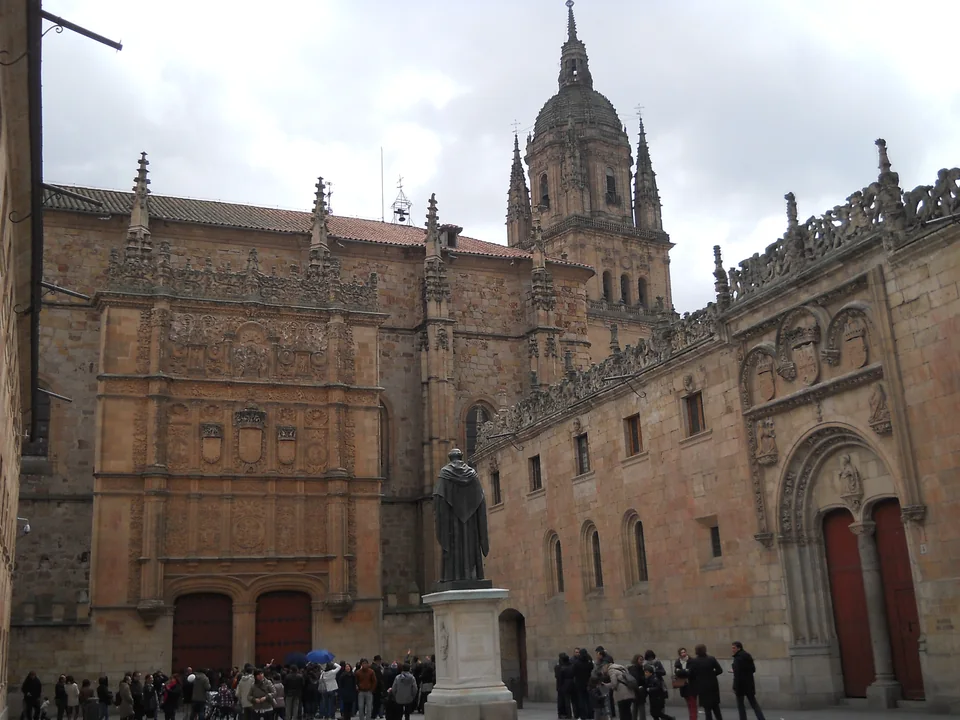
The main campus is Miguel de Unamuno in Salamanca, where the halls and residences are too. In the city centre stands the historic Escuelas Mayores building with its plateresque façade, the university's emblem, next to the rectorate on Patio de Escuelas. Beyond Salamanca, USAL has campuses and schools in Ávila, Zamora and Béjar with their own programmes, including teacher training, engineering and nursing; each programme page states where it is taught. Zamora and Béjar are cheaper places to live, but the choice of degrees is narrower.
Rankings
| Ranking | Position |
|---|---|
| QS World University Rankings 2027 | =560 |
| THE World University Rankings 2026 | 801–1000 |
| ShanghaiRanking ARWU 2026 | 801–900 |
USAL's QS profile lists about 2,900 international students. An overall ranking says little about a specific programme; last year's cut-off mark and the course plan are more useful.
FAQ
How much does the University of Salamanca cost for a non-EU student?
The same as for a Spanish student, because Castile and León has no separate non-EU price. Sixty credits cost from $710 (€624.60) in law and philology to $1,260 (€1,107) in medicine: these are the 2025/26 prices, rolled over into 2026/27.
Can I get into Salamanca without entrance exams?
Formally yes: with a homologated diploma you compete on its average. But without the PAU or PCE you are in the non-priority group and receive places only after everyone who sat the exams.
Are there programmes in English?
USAL's bachelor's degrees are taught in Spanish. Global Studies has a bilingual name, but check each subject's language in the course plan. The "Bachelor Degree Programs in English" of Cursos Internacionales are semester programmes for visiting students, not a degree.
How can I learn Spanish before applying?
Cursos Internacionales runs courses of 2, 3, 4 or 10 weeks all year at every level. From B2 you can take a PCI semester in regular faculties alongside Spanish students.
When should I apply for a master's?
Preinscripción ran from 13 April to 15 July in 2026. If your degree is from outside the EU and not homologated, start with USAL's degree assessment ($240, €210.97), which is open all year.
Where do students live in Salamanca?
In one of USAL's three colegios mayores or two residences, with applications on the CyRUS platform from April, or in a private flat. The university estimates basic living costs at about $1,140 (€1,000) a month.
Can I get my first-year fees back?
For 2026/27, yes, if you are enrolling at a public university in Castile and León for the first time and are registered as a resident in the region. The grant refunds the first-year tuition you paid; applications are open from 22 September to 21 October 2026, and funds are allocated within the budget, by admission score if needed. Conditions for 2027/28 will only be known when a new call is published.
Can StudyU help with Salamanca?
Under a service agreement we shortlist programmes and language preparation, plan homologation, UNEDasiss and the PCE, prepare documents for the preinscripción or the master's degree assessment and support the visa stage. Admission is decided by USAL, homologation by the Spanish Ministry of Education and the visa by the Spanish consulate.
Sources
- USAL: admission with a non-EU school diploma
- USAL: preinscripción with a foreign diploma, 2026/27
- USAL: 2026/27 preinscripción, admission and enrolment dates
- USAL: 2025/26 prices
- USAL: 2025/26 price summary (PDF)
- Castile and León Decree 8/2024 on public prices (BOCyL, PDF)
- Order EDU/459/2025 (BOCyL, PDF)
- USAL: master's 2026/27 — prices and payment
- USAL: foreign degree assessment for master's
- USAL: master's preinscripción
- USAL: halls, residences and dining
- USAL: 2026/27 halls and residences application guide (PDF)
- USAL: international student guide — living costs (PDF)
- USAL: history
- Cursos Internacionales USAL: studying at the university
- Cursos Internacionales USAL: language and culture courses
- Cursos Internacionales USAL: catalogue (PDF)
- UNEDasiss: key dates 2026
- Spanish Consulate in Moscow: student visa
- QS World University Rankings
- THE World University Rankings 2026
- ShanghaiRanking ARWU 2026
- University of León: 2026/27 first-year prices under the same decree (PDF)
- Junta de Castilla y León: 2026/27 first-enrolment grant
- Cursos Internacionales USAL: monthly course, September 2026
- Royal Decree 1155/2024, immigration regulation, art. 57 (BOE)
- Exchange rate: ECB, 29 September 2026, €1 = $1.1355
Data checked on 24 September 2026. For an overview of Spanish universities, see study in Spain. If you want to plan a route to Salamanca through a language year and the PCE, send an enquiry.
During the free initial consultation, we clarify your goal, profile, timing, and budget and identify the next realistic step.
Next steps
- DELE and SIELE Spanish Exams: 2026–2027 Dates, Fees and the Level You Need to Study in Spain
- Master's Degree in Spain: Admission with a Non-EU Degree and 2027 Costs
- Studying in Spain After 11 Years of School: How to Apply with a Russian Certificate in 2027
- Applying to Spanish Universities: A Step-by-Step Plan for Non-EU Applicants in 2027
- Studying in Spain for international applicants
- Working While Studying in Spain in 2026: 30 Hours a Week Without a Separate Permit, Pay, Internships and Tax
