
The Universitat Politècnica de València is a public technical university with three campuses: the main Vera campus in Valencia, plus Alcoy and Gandia. It has 11 engineering and architecture schools, a business faculty and a fine arts faculty. Non-EU students without Spanish residence pay double the base price, which is still low: about $2,360 (€2,080.80) per 60-credit year for engineering degrees in 2026/27. Entry is through a UNEDasiss accreditation and the joint admission of the Valencian Community's public universities, with an extended deadline until late July for international applicants. Teaching is in Spanish and Valencian, and graduation requires a B2 foreign-language certificate.
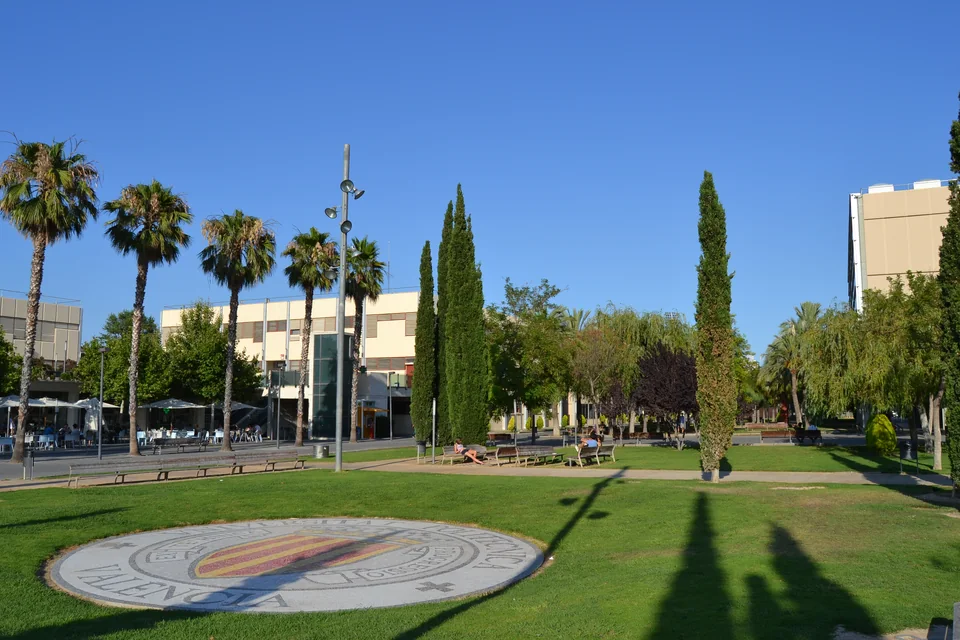
Three names are easy to confuse. UPV is the Politècnica de València. The University of Valencia (Universitat de València, UV) is a separate comprehensive university in the same city. UPV/EHU is the University of the Basque Country, unrelated to Valencia.
| At a glance | Details |
|---|---|
| Status | public technical university of the Valencian Community, teaching for over 50 years |
| Campuses | Vera (Valencia), Alcoy, Gandia |
| Schools | 11 higher technical schools, business and fine arts faculties |
| International students | 6.9% of bachelor's, 20.7% of master's and 38.4% of doctoral students |
| Bachelor's, 2026/27, non-EU non-residents | engineering and architecture: $39 (€34.68) per credit, about $2,360 (€2,080.80) per 60 credits |
| Master's, non-EU | typically $80 (€70.68) per credit, about $4,820 (€4,240.80) per 60 credits before fees |
| Bachelor's admission | Valencian joint admission from mid-June to early July; international applicants until late July |
| Rankings | QS World University Rankings 2027 top 500 for the 15th year running (according to UPV) |
Who UPV suits best
UPV is worth considering if you want engineering, architecture, agriculture or design at a public university for a fraction of Madrid's price and are ready to study in Spanish. The Vera campus is a single site inside the city, with research centres and sports facilities next to the teaching buildings.
| Advantages | Limitations |
|---|---|
| Non-EU students pay only double: an engineering year costs about $2,360 (€2,080.80), versus $8,760 (€7,714.20) in Madrid | No English-taught bachelor's programme |
| International applicants get an extended deadline, to late July | Without PCE exams, a non-EU school leaver's score is capped at 6 out of 14 |
| UPV says four PCE subjects are enough in Valencia, rather than six elsewhere | Biotechnology, mechanical, biomedical and aerospace engineering cut-offs exceed 12 |
| UPV estimates food and rent in Valencia at almost 30% below Madrid or Barcelona | A B2 foreign-language certificate is required to graduate |
| One application can cover a bachelor's plus master's pathway (PARS) | Some courses may be taught in Valencian |
If you are comparing technical universities, also look at the Universitat Politècnica de Catalunya and the Universidad Politécnica de Madrid. The Spain country guide covers the overall route.
Programmes and cut-off scores
UPV offers over 40 bachelor's and double degrees. The cut-off shown on each degree page is the score of the last student admitted in the previous cycle.
| Degree | Places | Cut-off (out of 14), degree pages as of 30.09.2026 |
|---|---|---|
| Aerospace Engineering | 75 | 13.28 |
| Mechanical Engineering | 140 | 12.59 |
| Biomedical Engineering | 120 | 12.50 |
| Biotechnology | 100 | 12.34 |
| Industrial Technologies Engineering | 135 | 11.51 |
| Chemical Engineering | 40 | 11.23 |
| Industrial Design and Product Development | 140 | 11.16 |
| Business Administration (ADE) | 135 | 10.70 |
| Data Science | 120 | 10.59 |
| Civil Engineering | 100 | 10.47 |
| Fundamentals of Architecture | 270 | 10.26 |
| Computer Engineering | 350 | 9.67 |
| Telecommunication Technologies | 130 | 9.28 |
| Building Engineering (Arquitectura Técnica) | 225 | 8.35 |
The Alcoy and Gandia campuses are smaller than Vera; each degree page shows where the programme is taught. Architecture is UPV's only five-year degree; all other bachelor's degrees take four years.
Many UPV engineering bachelor's degrees qualify graduates for Spain's regulated "technical engineer" profession, while the full engineer or architect qualification requires a matching master's. PARS pathways let you choose a bachelor's plus master's combination from the start and begin the master's with up to 30 bachelor's credits still pending. Applying to a PARS commits you to nothing, and UPV advises listing both the pathway and the standalone bachelor's.
How to apply with a school certificate from outside the EU
A school certificate from a country without an agreement with Spain goes through two steps: recognition by Spain's Ministry of Education and accreditation by UNEDasiss, the UNED service that converts foreign grades to the Spanish scale. Without extra exams, a non-EU school leaver's access score is capped at 6 out of 14, while EU or agreement-country applicants can reach 10. So PCE exams are optional only on paper: without them, degrees with cut-offs above 9 are out of reach.
UPV describes the Valencian Community as one of the easiest regions for exams: four PCE subjects are enough, whereas most regions ask for six. Its advice is to include at least two subjects weighted 0.2 for your chosen degree, since these lift your score towards 14.
UPV's suggested timeline:
| Month | Action |
|---|---|
| November | choose degrees and region, since admission rules differ by autonomous community |
| February | apply for UNEDasiss accreditation and register for the first PCE session |
| May | sit the PCE |
| Late June to early July | Valencian joint admission; apply even if the accreditation is still pending |
| Until late July | extended deadline for international applicants; admitted students enrol at the end of the month |
| September | second PCE session; the academic year starts on 1 September, classes around the 9th |
One application lets you list up to 20 degrees at the Valencian public universities in order of preference. You are admitted to the first degree your score reaches, so order your list by preference, not by last year's cut-offs. Everything is done online with scanned documents; if final papers are missing, the system asks for proof of application.
Our guides to applying to Spanish universities and bachelor's degrees in Spain explain recognition and UNEDasiss in more detail.
Teaching language and the graduation language requirement
Bachelor's teaching is mainly in Spanish and Valencian (a variety of Catalan), with the language set per group and course. UPV does not list a language certificate among its admission conditions for international applicants, but lectures without solid Spanish are very hard to follow, so aim for B2 by the start of classes. See our guide to DELE and SIELE.
To graduate, UPV requires B2 in a foreign language, certified by a body on the ACLES list, under rules adopted in 2023. For most international students that means English; get the certificate before your final year.
Tuition in 2026/27
Public prices in the region follow Generalitat Valenciana Decree 101/2024 as amended by Decree 195/2025; the rates below are those in force on 30.09.2026. Foreign students without resident status, other than EU nationals, pay double per credit. The rule applies to students who first enrolled on their degree from 2024/25 onwards.
| Price group | Credit, EU and residents | Credit, non-EU non-residents | 60 credits, non-EU |
|---|---|---|---|
| Group C: engineering, architecture, sciences | $20 (€17.34) | $39 (€34.68) | $2,360 (€2,080.80) |
| Group B | $16 (€14.03) | $32 (€28.06) | $1,910 (€1,683.60) |
| Group A: economics and business | $15 (€12.79) | $29 (€25.58) | $1,740 (€1,534.80) |
| Master's not leading to a regulated profession | $40 (€35.34) | $80 (€70.68) | $4,820 (€4,240.80) |
According to UPV, secretariat and recognition fees for a bachelor's do not exceed $230 (€200) a year. For a master's, UPV suggests adding $230–340 (€200–300) in administrative costs. Repeat enrolments in a course cost more, so passing first time saves money. See how to pay for studies abroad from Russia for legal payment routes and the cost of studying in Spain for regional comparisons.
Spanish state and regional grants are designed mainly for residents, so a student on a study visa should not build a budget on them. For international students, UPV offers support to those already enrolled and cooperation programmes; our guide to scholarships in Spain lists other options.
Master's application phases
Master's admission runs in phases, and international applicants get the earliest ones:
- phase 0: from November;
- phase 1: from March, with admissions announced in early June;
- phase 2: second half of June, results in the third week of July;
- phase 3: late July and early September, results in the second week of September.
Non-EU applicants should aim for phase 0 or 1, because a July admission may leave too little time for the visa. How to compare master's programmes is explained in our guide to master's degrees in Spain.
Housing and living in Valencia
UPV runs a housing search tool listing rooms, flats and colegios mayores. According to the university, groceries and rent in Valencia are almost 30% cheaper than in Madrid or Barcelona. The Vera campus is inside the city, so nearby neighbourhoods are within walking or cycling distance. For contracts and deposits, see our student housing guide for Spain.
Visa and work
Studies over 90 days require a national student visa from the Spanish consulate for your place of residence; in Moscow, applications go through BLS visa centres at least two months before classes. The consulate checks funds of $680 (€600) per month, health insurance and, for adults staying over 180 days, an apostilled criminal record certificate. The full list is in our Spain student visa guide. The student permit allows up to 30 hours of work a week, and UPV notes it also allows paid internships.
Common mistakes
- Confusing UPV, the University of Valencia and UPV/EHU. Each has its own programmes and rules; the Basque UPV/EHU admits through another region.
- Applying without PCE. Without the exams, a non-EU school leaver scores no more than 6 out of 14.
- Waiting for the accreditation before applying. Apply on time regardless and upload documents later.
- Listing "safe" degrees first. You are placed in the first degree your score reaches, and the rest of the list is no longer considered.
- Forgetting the B2 graduation requirement. Without a foreign-language certificate, no degree is issued even after passing every course.
Step-by-step plan for 2027/28
- Autumn 2026: shortlist UPV degrees and Valencian back-ups; apply for recognition of your school certificate.
- February 2027: UNEDasiss accreditation and registration for the May PCE session in four subjects.
- May 2027: PCE; keep working on B2 Spanish.
- Late June to July 2027: apply through the Valencian joint admission, using the international extension if needed.
- Late July 2027: enrol in courses and start the visa application at once.
- September 2027: arrival, TIE foreigner card within a month, start of classes.
Shortlisting, document checks and application support are provided under an agreement with StudyU. Places are allocated by the Valencian joint admission, recognition is decided by the Spanish Ministry of Education and visas by the consulate.
FAQ
How much does UPV cost for international students?
In 2026/27, non-EU students without residence pay $39 (€34.68) per credit for engineering and architecture, about $2,360 (€2,080.80) for 60 credits. Business and economics cost less, about $1,740 (€1,534.80).
What is the difference between UPV and the University of Valencia?
They are two separate public universities in the same city. UPV is technical: engineering, architecture, fine arts and business. The University of Valencia is a comprehensive university with medicine, law, languages and sciences.
Are PCE exams compulsory for UPV?
Formally no, but without them a non-EU school leaver's access score is capped at 6 out of 14, too low for most degrees. UPV recommends four subjects, two of them weighted 0.2.
Can I study at UPV in English?
There is no English-taught bachelor's programme: the main languages are Spanish and Valencian, with some English-taught courses in curricula. English is more common in master's programmes; the language is listed for each programme and course.
When should international students apply to UPV?
The Valencian joint admission runs from mid-June to the first week of July, extended to late July for international applicants. Complete the UNEDasiss accreditation and first PCE session between February and May of the same year.
Do I need English to graduate from UPV?
You need a B2 certificate in a foreign language recognised by ACLES. Without it the bachelor's degree is not issued, so get an English certificate before your final year.
Sources
- UPV: international bachelor's admission — UNEDasiss, four PCE subjects, score cap of 6 without PCE, timeline, up to 20 degrees, PARS, double price; checked 30.09.2026
- UPV: international admission calendars — bachelor's and master's; checked 30.09.2026
- UPV: living in Spain, housing, visa — checked 30.09.2026
- UPV degree pages: Aerospace Engineering, Computer Engineering, Industrial Technologies, Biomedical Engineering, Data Science — places and cut-offs; checked 30.09.2026
- UPV: the institution and schools and faculties — campuses, international shares; checked 30.09.2026
- UPV: rankings — checked 30.09.2026
- UPV: B2 foreign-language requirement for graduation — checked 30.09.2026
- Generalitat Valenciana Decree 195/2025, price annex to Decree 101/2024 (PDF) and Decree 101/2024 (DOGV) — credit prices, doubling for non-EU non-residents; checked 30.09.2026
- Student visa at the Consulate General of Spain in Moscow — checked 30.09.2026
- Royal Decree 1155/2024 (BOE) — students may work up to 30 hours a week; checked 30.09.2026
- We converted euros to dollars at the ECB rate of 29.09.2026: €1 = $1.1355 (ECB)
During the free initial consultation, we clarify your goal, profile, timing, and budget and identify the next realistic step. Apply
Next steps
- Universitat Politècnica de Catalunya (UPC BarcelonaTech): Admission and Fees
- Universidad Politécnica de Madrid (UPM): Admission, Fees and Schools
- Studying in Spain for international applicants
- University of Valencia (Universitat de València, UV)
- Applying to Spanish Universities: A Step-by-Step Plan for Non-EU Applicants in 2027
- DELE and SIELE Spanish Exams: 2026–2027 Dates, Fees and the Level You Need to Study in Spain
