
The University of Milano-Bicocca (UniMiB) is Milan's second state university, founded in 1998 on the former Pirelli industrial site in the Bicocca district. International students with a foreign qualification who live abroad pay a fixed fee by country group: in 2026/27, $460–580 (€406–506) a year for group 1 countries, $1,260–1,490 (€1,106–1,306) for group 2 and $3,650–4,340 (€3,196–3,806) for group 3, all charges included. English-taught programmes cover data science, physics, sustainability economics, psychology and medicine, and every applicant to these programmes is automatically considered for the Bicocca International Scholarship: 100 awards of $11,410 (€10,000) a year plus a fee waiver, up to five per programme. The first application window opens in early November.
| At a glance | Details |
|---|---|
| Location | Milan (Bicocca district); medical hub in Monza |
| Founded | 1998 |
| Rankings | QS World University Rankings 2027: 544; THE World University Rankings 2026: 401–500 |
| Fee for international students (2026/27) | fixed by country group: $460–4,340 (€406–3,806) incl. charges |
| Windows (2026/27 cycle) | unlimited-place programmes: 7 Nov 2025 – 16 Jan 2026 and 16 Mar – 16 Apr 2026; limited-place: 10 Feb – 31 Mar 2026 |
| Funding | Bicocca International Scholarship $11,410 (€10,000) + waiver; regional DSU up to $8,470 (€7,419) |
| Housing | subsidised residence places at $290 (€256) a month for DSU-eligible students; AbitaMI support service |
Who Milano-Bicocca suits, and who should look elsewhere
| Pros | Cons and risks |
|---|---|
| Group 1 countries pay $460–580 a year, all charges included | Group 3 countries pay up to $4,340 |
| $11,410 scholarship + waiver with no separate application | Up to five awards per programme — strong competition |
| Modern campus on the former Pirelli site | Residence places only through the DSU competition |
| First window opens in November | Only the early windows are open to visa applicants |
| Joint AI bachelor's with the University of Milan and Pavia | Young university, lower overall rankings |
Milano-Bicocca suits applicants who want to study data, physics, sustainability economics or psychology in Milan on a controlled budget. For engineering in Milan, see the Politecnico di Milano; for a broader, older state university, compare the University of Milan (La Statale). All options are compared in our guide to universities in Milan.
Which programmes are taught in English
English-taught programmes in the university catalogue include:
Bachelor's: Artificial Intelligence (a joint degree of Milano-Bicocca, the University of Milan and Pavia); Economics and Science for Environmental Sustainability; Physical Sciences for Innovative Technologies.
Master's:
| Area | Programmes |
|---|---|
| Data and AI | Data Science; Artificial Intelligence for Science and Technology; Human-Centered Artificial Intelligence |
| Physics and materials | Astrophysics and Space Physics; Materials Science and Nanotechnology |
| Economics | International Economics; Economics and Technologies for Sustainability |
| Life and earth sciences | Marine Sciences; Optometry and Vision Science |
| Psychology | Applied Experimental Psychological Sciences |
Medicine: Medicine and Surgery in English, with a national admission test; see our guide to medicine in Italy in English.
The scholarship programme allocates five awards per English-taught programme and 100 in total, so the full list is longer than the selection above; see apply.unimib.it.
How to apply to Milano-Bicocca through Apply.UNIMIB
Since 2025/26, applicants with foreign qualifications use the Apply.UNIMIB platform (DreamApply). For non-EU applicants living abroad in the 2026/27 cycle:
- From November — unlimited-place programmes. Call 1: 7 Nov 2025 – 16 Jan 2026; call 2: 16 Mar – 16 Apr 2026. Calls 3 and 4 (May–September) were only for EU citizens and non-EU residents of Italy.
- From February — limited-place programmes. One window for non-EU applicants abroad: 10 Feb – 31 Mar 2026.
- Documents by the window's close. Additional documents cannot be added after a call closes (applying on the last day leaves no room), and receipts for CIMEA verification and comparability requests must be uploaded by then.
- By 31 July (2026/27 cycle): Universitaly and certificates. Universitaly pre-enrolment, school diploma and English certificate (or Italian certificate / TOLC ITA for Italian-taught programmes) by 31 July; bachelor's degree for master's applicants by 31 August.
- Visa and arrival. Visa students must arrive by 31 January 2027; originals are checked by 28 February 2027. Pre-enrolment does not by itself lead to a consulate appointment or a visa; the consulate decides. See our guides to the student visa and the permesso di soggiorno.
Language certificates are accepted for five years from issue.
When to apply for 2027/28
As of 23 September 2026 the 2027/28 calls had not been announced. If the pattern holds, the first call for unlimited-place programmes will open in early November 2026.
| Step | 2026/27 cycle | Guide for 2027/28 |
|---|---|---|
| Unlimited-place programmes, call 1 | 7 Nov 2025 – 16 Jan 2026 | early Nov 2026 – mid-Jan 2027 |
| Unlimited-place programmes, call 2 | 16 Mar – 16 Apr 2026 | Mar–Apr 2027 |
| Limited-place programmes | 10 Feb – 31 Mar 2026 | Feb–Mar 2027 |
| Universitaly and certificates | by 31 Jul 2026 | late July 2027 |
| Arrival of visa students | by 31 Jan 2027 | — |
Call 1 matters for the scholarship: candidates from the first call get priority.
Which documents and language certificates you need
- Bachelor's: 12 years of schooling; 11-year systems need an extra year of university or a recognised foundation course.
- Master's: a bachelor's degree with the required subjects, assessed through Apply.UNIMIB.
- Documents: a published list for bachelor's and single-cycle applicants; CIMEA certificates for enrolment.
- Language: visa applicants to English-taught programmes need a B2 English certificate from the university's accepted list; Italian-taught programmes need B2 Italian (CELI, CILS, CERT-IT, PLIDA) or the online CISIA/TOLC ITA test. Certificates are accepted for five years from issue. See our guide to Italian language certificates.
How much studying at Bicocca costs in 2026/27
For Bicocca, an "international student" is a non-Italian citizen with a foreign entry qualification who lives abroad. Such students pay a fixed amount based on their country of residence and the programme's contribution area; students already living in Italy use the standard ISEE system.
| Country group | Examples | Area A (total) | Area B (total) |
|---|---|---|---|
| 1 | Armenia, Azerbaijan, Belarus, Georgia, Kazakhstan, Kyrgyzstan, Moldova, Tajikistan, Turkmenistan, Uzbekistan, Ukraine, India, Egypt | $460 (€406) | $580 (€506) |
| 2 | Russia, Spain, Poland, Portugal, Japan, Israel | $1,260 (€1,106) | $1,490 (€1,306) |
| 3 | Germany, France, UK, USA, Canada | $3,650 (€3,196) | $4,340 (€3,806) |
Totals include the first instalment of $170 (€146, stamp duty and regional-tax advance, due 30 September) and the maximum regional-tax balance of $68 (€60), which applies to anyone without an ISEE (€0 with an ISEE up to $30,530 (€26,887.93), $34 (€30) up to $61,060 (€53,775.86)). The contribution itself is split into a second instalment (due 15 January 2027) and a third (due 14 May 2027) — for group 2, for example, $305 (€270) + $715 (€630) in area A and $375 (€330) + $875 (€770) in area B; group 1 pays it all in the second instalment. English-taught programmes in area A include Economics and Science for Environmental Sustainability, International Economics and Applied Experimental Psychological Sciences; area B includes Data Science, AI for Science and Technology, Astrophysics and Space Physics, Materials Science and Nanotechnology, Marine Sciences, Optometry and Vision Science, Physical Sciences for Innovative Technologies, Economics and Technologies for Sustainability, and medicine.
Beyond the residence tariff, the university publishes no Milan cost-of-living benchmark. Budget for a private rental with deposit, transport, health cover and the first weeks before any grant. Dollar amounts use the ECB rate of 29 September 2026 (€1 = $1.1355).
How to get the Bicocca International Scholarship or a DSU grant
Bicocca International Scholarship (2026/27)
| Parameter | Condition |
|---|---|
| Amount | $11,410 (€10,000) gross a year + fee waiver |
| Number | 100 awards, five per English-taught programme |
| Eligibility | non-Italian citizens (dual citizens welcome) with a foreign previous qualification, not resident in Italy |
| Application | none: all applicants to eligible programmes are considered automatically |
| Open-access programmes | admitted and enrolment confirmed by 15 March 2026 (2026/27 awards) |
| Limited-access programmes | complete all steps, be on the admission list and confirm in time |
| Priority | first-call applicants |
Regional DSU grant. In Lombardy, Bicocca runs the right-to-study competition itself, based on merit and income (ISEE up to $30,530 (€26,887.93) and ISPE up to $66,370 (€58,452.06)). Students whose family lives abroad upload family income and asset documents under the university's ISEE guide: by 30 September for the grant and by 20 August for housing. See our guide to ISEE parificato.
| 2026/27 parameter | Value |
|---|---|
| Grant application deadline | 30 September 2026 |
| Housing application | 7 July – 20 August 2026 |
| Off-site student, income band 1 | $8,470 (€7,419) + free lunch; total value $9,410 (€8,248) |
| Off-site, bands 2 and 3 | $7,200 (€6,343) and $5,710 (€5,028) + lunch |
| Subsidised residence fee | $290 (€256) a month, withheld from the grant: $1,740 (€1,536) for the first six months and $1,450 (€1,280) for the remaining five |
Amounts are higher for female students in STEM programmes. The off-site amount requires at least 10 months of paid accommodation (residence or lease); non-EU students who get their visa late may have a shorter lease, but the grant is then recalculated by month. You can apply from 7 July, even before enrolling. See also our scholarships in Italy guide.
Where to live: subsidised residences and private rentals
- University residences at the subsidised rate: require the same merit, income and academic-regularity conditions as the DSU grant. In 2026/27 applications ran from 7 July to 20 August, with provisional rankings by 2 September and final rankings by 18 September.
- Extra places: 68 additional beds for 2026/27 through agreements with the Aristotelico residence in Cinisello Balsamo and Casa di Pietro in Monza.
- AbitaMI Bicocca: the university's housing support service.
- Private market: the main option if you do not win a place; see our student housing guide.
Residents can use the English-language "UniMIB Residence Halls: A Student Guide".
Which mistakes to avoid when applying
- Applying on the last day of a call: additional documents are not accepted after it closes.
- Waiting for summer: May–September calls are only for EU citizens and residents of Italy.
- Missing the 15 March enrolment confirmation that open-access scholarship candidates need.
- Ignoring the programme area: Data Science and physics are area B and cost more than International Economics.
- Ordering CIMEA certificates late: request receipts are due by the call's close.
What kind of university Bicocca is
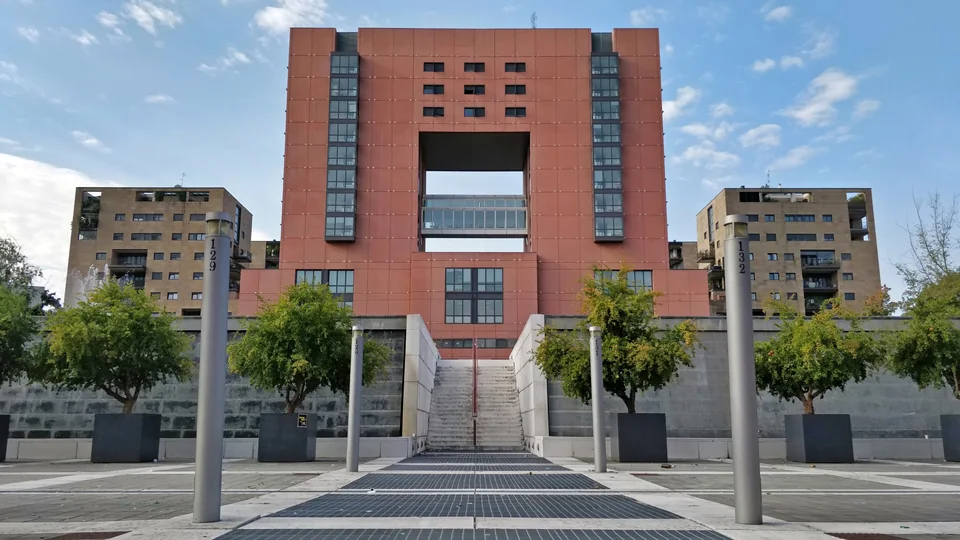
A ministerial decree established Milano-Bicocca on 10 June 1998. The former Pirelli plant became a modern complex of laboratories, teaching buildings and housing, designed as part of a district where research centres and companies sit side by side; most buildings are in the same part of the city. The Department of Medicine and Surgery has its Biomedical Hub in Monza, next to the IRCCS San Gerardo dei Tintori hospital and research centre.
The university covers seven areas: economics and statistics, education, law, medicine and surgery, psychology, sciences and sociology. Its English-taught offer focuses on data, physics, sustainability and life sciences.
Where the university stands in the rankings
| Ranking | Position |
|---|---|
| QS World University Rankings 2027 | 544 (=542 in 2026) |
| THE World University Rankings 2026 | 401–500 |
As a young university it ranks below Italy's historic institutions; compare curricula, department research and internships rather than the overall rank.
Where classes take place: Bicocca and Monza
The main campus is in the Bicocca district in north-east Milan and the medical hub is in Monza. For 2026/27 the university added residence places through agreements in Cinisello Balsamo and Monza. Check where your programme is taught before you look for housing; the university's AbitaMI Bicocca service helps with the search.
How to find internships and work after graduation
The Bicocca district was designed as an ecosystem of university, research centres and companies, so internships can be found near campus. Check whether your programme includes an internship and how many credits it carries; B1–B2 Italian widens your options. After graduating you can apply for a job-seeking permit in place of your study permit; confirm the conditions with the Questura.
FAQ
How much does Milano-Bicocca cost for international students?
It depends on your country group and programme area. In 2026/27, totals including charges are $460–580 (€406–506) for group 1, $1,260–1,490 (€1,106–1,306) for group 2 and $3,650–4,340 (€3,196–3,806) for group 3.
How do I get the Bicocca International Scholarship?
There is no separate application: apply to an eligible English-taught programme and you are considered automatically. It pays $11,410 (€10,000) gross a year plus a fee waiver, with up to five awards per programme and priority for first-call applicants. Open-access candidates must be admitted and confirm enrolment by 15 March.
When should I apply?
In 2026/27, unlimited-place programmes accepted applications from 7 November 2025 to 16 January 2026 and from 16 March to 16 April 2026; limited-place programmes from 10 February to 31 March 2026. The 2027/28 dates have not been announced.
Can I count on a place in university housing?
No. Subsidised places at $290 (€256) a month go to DSU-eligible students; others use the AbitaMI service and the private market.
What language level do I need?
For a visa to an English-taught programme, a B2 English certificate from the accepted list; for Italian-taught programmes, B2 Italian (CELI, CILS, CERT-IT, PLIDA) or TOLC ITA. Certificates must be under five years old and uploaded by 31 July.
Can I apply with 11 years of school?
You need a 12th year: a year of university at home or a recognised foundation course.
Can StudyU help?
Under a service agreement we shortlist programmes and the right call, check requirements and your fee group, and prepare documents for Apply.UNIMIB, CIMEA, Universitaly and the visa. The university decides on admission, scholarships and housing; the consulate on the visa.
Sources
- APPLY for 2026/27: Admission Calls and Deadlines
- Access for students with an international qualification
- Degree programmes by area
- Student contributions 2026/2027
- Contribution guide 2026/27 (PDF)
- Bicocca International Scholarship
- Right-to-study benefits 2026/27
- DSU call 2026/27 (PDF)
- University residences
- Our history
- QS World University Rankings: University of Milano-Bicocca
- THE World University Rankings: University of Milano-Bicocca
For more on studying in Italy, see Study in Italy. Calculating your fee and choosing the right call are provided under an agreement with StudyU; to start, send us a request.
During the free initial consultation, we clarify your goal, profile, timing, and budget and identify the next realistic step.
Next steps
- Italian Language Certificates CILS, CELI and PLIDA: Which One You Need for University and When to Sit It
- ISEE Parificato for International Students: Home-Country Documents, CAF, Timing and Tuition
- Studying Medicine in Italy in English: IMAT, Non-EU Places and the 2026/27 Rules
- Permesso di Soggiorno for Students: How to Get and Renew Your Italian Residence Permit
- Studying in Italy for international applicants
- Politecnico di Milano
