
Duke University is a private research university in Durham, North Carolina. It is 70th in the QS World University Rankings 2027, 28th in the THE World University Rankings 2026 and 48th in ARWU 2026. Undergraduates enter one of two schools, Trinity College of Arts & Sciences or the Pratt School of Engineering, through the Common App. For autumn 2027 entry the binding Early Decision deadline is 2 November 2026 and Regular Decision closes on 4 January 2027; SAT and ACT scores are optional this cycle. The estimated first-year cost of attendance for 2026–27 is $103,180–103,975. Duke meets the full demonstrated need of international students it admits with aid, but the aid request itself moves the application into a separate, more selective pool, and Duke expects to enrol only 20–25 fully funded international students a year.
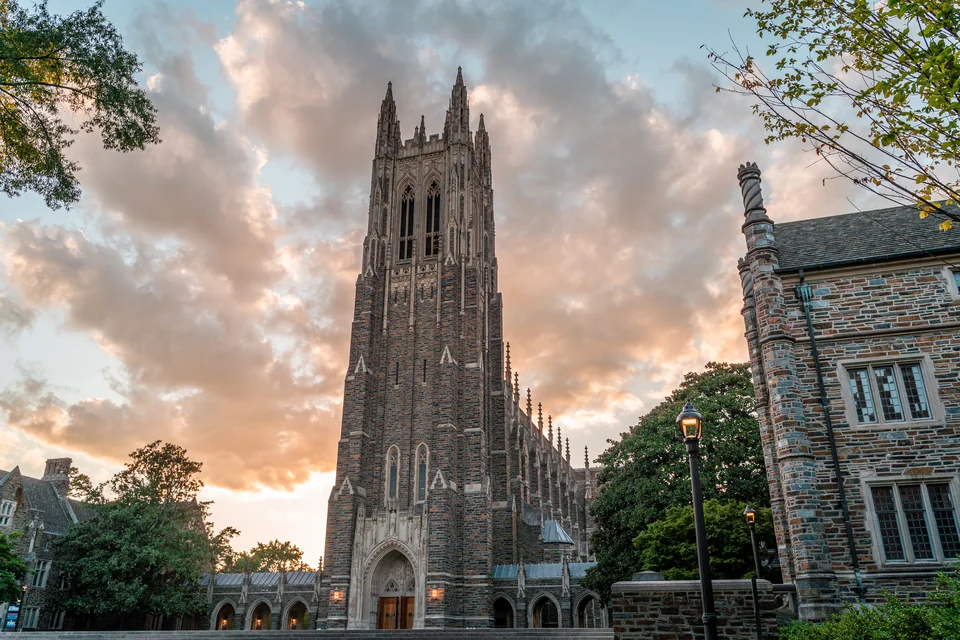
| At a glance | Details |
|---|---|
| Location | Durham, North Carolina |
| History | Duke University since 1924; it grew out of Trinity College (so named from 1859, with roots going back to 1838) |
| Students (autumn 2025) | 17,325: 6,525 undergraduates and 10,800 graduate and professional students |
| Rankings | QS 2027: 70th; THE 2026: 28th; ARWU 2026: 48th |
| Undergraduate schools | Trinity College of Arts & Sciences or Pratt School of Engineering |
| Application | Common App (QuestBridge is open only to U.S. citizens and residents) |
| Deadlines for autumn 2027 | Early Decision 2 Nov 2026; Regular Decision 4 Jan 2027 |
| Application fee | $85 |
| SAT/ACT | optional in 2026–27 |
| English | recommended, not required; expected TOEFL iBT 100, IELTS 7, Duolingo 130 |
| First-year cost of attendance, 2026–27 | $103,180–103,975, including $73,740 tuition |
| Aid for international students | only if requested in the first-year application; admission of aid applicants is need-aware |
| Admit rate (autumn 2025) | 5.2%: 2,910 offers from 55,541 applications |
| Housing | first-years live on East Campus; three years of campus residence are required |
Who Duke suits, and when to look elsewhere
| Strengths | Drawbacks and risks |
|---|---|
| You can apply without SAT or ACT scores in 2026–27 | Foreign citizens asking for aid compete in a pool whose admit rate is usually less than half the overall rate |
| Admitted aid recipients have 100% of demonstrated need met | Only 20–25 fully funded international places a year |
| Every undergraduate takes Trinity courses, and Pratt admits engineers from day one | Aid cannot be requested later if you did not ask for it at admission |
| Up to three academic pathways: majors, minors and certificates | Pratt requires high-school calculus and strongly recommends physics |
| The whole first-year class lives together on East Campus | Without aid a year costs about $104,000 before flights and insurance |
Duke makes sense if your school record is strong, your activities tell a coherent story and you have a direction such as medicine and biology, engineering and computer science, economics or public policy. If your family needs substantial aid, do not rely on Duke alone: add universities with different policies. Harvard, for instance, is need-blind for international applicants. The profiles of Penn, the University of Chicago and Caltech help you compare peers, and the study in the USA page gives the national picture.
Two undergraduate schools and eight graduate and professional schools
You choose your undergraduate school in the application.
- Trinity College of Arts & Sciences covers the humanities, natural sciences and social sciences. Every Duke undergraduate takes Trinity classes, engineers included.
- Pratt School of Engineering awards Bachelor of Science degrees in biomedical, civil, environmental and mechanical engineering and in electrical and computer engineering. First-semester students already design a solution for a real client.
Duke offers 69 majors, 59 minors and 23 certificates, and students may combine up to three of these pathways. The five most popular majors among undergraduates in autumn 2025 were computer science, economics, biology, public policy and psychology. Graduate and professional study runs through eight more schools: the Graduate School, Medicine, Nursing, Law, Divinity, the Fuqua School of Business, the Nicholas School of the Environment and the Sanford School of Public Policy.
Duke Embark lets a small group of first-years spend their first autumn at the Duke University Marine Lab in Beaufort on the North Carolina coast before joining the class in Durham in spring. You flag interest with a 150-word response; selection happens after enrolment.
How to apply to Duke from outside the United States
There is no separate application for international students. Requirements and deadlines are the same for everyone; only financial aid rules and document translation differ.
What goes into the application
- Common App and the $85 fee. Fee waivers are available for students with high financial need, endorsed by the school counsellor.
- Essays. The Common App personal essay plus two required Duke short answers of up to 250 words: why Duke, and a community that has shaped you. A third answer, chosen from three prompts, is optional and worth writing only if it adds something new.
- Recommendations. Three are required: the school counsellor and two teachers of major academic subjects, preferably from the last two years. Pratt applicants need at least one maths or science teacher. One optional personal recommendation from a mentor or employer is accepted.
- School documents. Official transcripts and the Secondary School Report, sent by the school. Translations may come from an official service, an EducationUSA adviser or a school official, and must be accompanied by the originals.
- Grades during the final year. Early Decision applicants send first-quarter grades (accepted until 20 November); all applicants send midyear grades by 15 February.
- English. A test is recommended for non-native speakers or students outside English-medium schools, not required. Expected minimums: TOEFL iBT 100, IELTS 7, Duolingo 130, PTE Academic 70, Cambridge C1 Advanced or C2 Proficiency 180. Scores other than Duolingo may be self-reported; official Duolingo reports are free.
- Interviews. Optional and not offered to everyone. Alumni in 42 countries interview online when the committee needs more information; not being interviewed does not affect the decision. International applicants may add an InitialView interview. Glimpse videos are available only to students at U.S. high schools.
Duke does not accept résumés or research abstracts; use the Additional Information section. Applicants with advanced work in cinematic arts, dance, music, photography, theatre or visual arts may submit one arts supplement through SlideRoom.
SAT and ACT in 2026–27
Duke is test-optional this cycle. Applying without scores is not a disadvantage, and the choice is yours. Scores may be self-reported; official reports are needed only if you enrol. Duke takes the highest section scores across SAT sittings and builds its own ACT superscore; the ACT science section is optional but considered for STEM applicants. The last test dates are 7 November (SAT) and 17 October (ACT) 2026 for Early Decision, and 5 December (SAT) and 12 December (ACT) 2026 for Regular Decision.
Among enrolled students in autumn 2025 who reported scores, the middle 50% scored 1510–1570 on the SAT and 34–35 on the ACT; 48% submitted the SAT and 27% the ACT. Our guide to the SAT or ACT helps you choose a test.
Early Decision or Regular Decision
| Early Decision | Regular Decision | |
|---|---|---|
| Application deadline | 2 November 2026 | 4 January 2027 |
| Aid documents | CSS Profile with the application; tax documents by 15 November | CSS Profile by 1 February 2027 |
| Decision | mid-December 2026 | late March to early April 2027 |
| Commitment | enrol if admitted and withdraw other applications | none |
| Admit rate (Class of 2029, autumn 2025) | 12.6% | 4.2% |
Early Decision is binding: you sign an agreement and lose the chance to compare offers. For an international student who needs aid this is a serious step, because the aid offer arrives together with the admission decision.
Step-by-step plan for autumn 2027
- September 2026. Choose Trinity or Pratt; decide whether you will report SAT/ACT scores; if testing, book dates before 7 November (early) or 5–12 December (regular).
- September–October. Secure three recommendations; write the personal essay and both Duke answers; ask the school to arrange translations.
- By 2 November. Early Decision: application, agreement and CSS Profile; family tax documents by 15 November.
- By 4 January 2027. Regular Decision: application and recommendations; CSS Profile by 1 February, midyear grades by 15 February.
- December or March–April. Decision and aid offer.
- Spring–summer 2027. Certificate of Financial Responsibility, Form I-20, F-1 visa and final school certificate.
Deadlines for autumn 2027 entry
| Step | Early Decision | Regular Decision |
|---|---|---|
| Application, recommendations, transcript | 2 Nov 2026 | 4 Jan 2027 |
| Last SAT / ACT | 7 Nov / 17 Oct 2026 | 5 Dec / 12 Dec 2026 |
| CSS Profile | 2 Nov 2026 (the aid office lists 3 Nov) | 1 Feb 2027 |
| Tax documents | 15 Nov 2026 | when requested after submission |
| School grades | first quarter, by 20 Nov | midyear report, by 15 Feb |
| Decision | mid-December | late March to early April |
How many applicants Duke admits
According to the Common Data Set 2025–26, Duke received 55,541 first-year applications for autumn 2025 and made 2,910 offers, a rate of 5.2%; 1,749 students enrolled. The official Class of 2029 profile gives admit rates of 12.6% in Early Decision and 4.2% in Regular Decision, and foreign citizens make up 11% of the class. Duke does not publish an admit rate for international applicants, but states that for foreign citizens seeking aid it is usually less than half the overall rate. These figures describe the competition as a whole; they say nothing about any individual applicant's prospects.
What Duke costs
| First year, 2026–27 | Amount |
|---|---|
| Tuition | $73,740 |
| Estimated fees | $3,019 |
| Engineering dues (Pratt only) | $60 |
| Housing, double room | $11,560 |
| Food | $10,469 |
| Total billed | $98,788–98,848 |
| Books and course materials | $536 |
| Personal expenses | $3,274 |
| Domestic transport | $582–1,318 |
| Estimated cost of attendance | $103,180–103,975 |
Returning students pay slightly less, $101,828–102,623, because fees and food are lower. For international students the aid office adds health insurance and a round-trip flight from the main airport in the home country to Raleigh-Durham; aid recipients are enrolled in Duke Student Medical Insurance and the charge is covered by grant. Tuition was $70,265 in 2025–26. Our guide to the cost of studying in the USA shows how to plan a four-year budget.
Financial aid for international students
For foreign citizens the key rule is that the aid decision is made once, at admission.
- You must indicate aid interest in your first-year application. If you do not, you cannot receive need-based aid in any later year.
- Applications from foreign citizens requesting aid are read in a separate, more competitive pool, regardless of how large or small the need is. The aid office expects to enrol 20–25 international students each year whose full need is met by a Duke package.
- The amount of aid depends only on the need calculation, not on the strength of the application. You submit the CSS Profile, family tax returns converted into U.S. dollars and an employer's statement in English.
- International aid renews automatically; there is no annual reapplication. International students cannot use U.S. federal loans.
- Scholarship support above tuition, books and fees is taxable in the U.S., so you will need an ITIN (tax identification number).
Duke also awards a small number of merit scholarships for which all applicants, including international ones, are considered automatically. The Karsh International Scholars Program is for international students with demonstrated need: it covers tuition, room and board, mandatory fees, remaining demonstrated need and three summers of funding for research or unpaid internships. There is no separate application; you apply to Duke and request aid. In the Common Data Set 2025–26, 215 international undergraduates received institutional aid averaging $87,841. International transfer students are not eligible for need-based aid or scholarships. Duke makes all aid decisions; our overview of financial aid for international students in the USA explains how such packages work.
Graduate, doctoral and professional study
Each school admits its own graduate students: the Graduate School, Fuqua, Pratt, Nicholas, Sanford, Law and Medicine set separate deadlines and requirements. Master's tuition for Graduate School programmes is $34,940 per semester in 2026–27 (rates are approved by the Board of Trustees each year). The Graduate School's own aid for master's students is limited to federal loans, which international students cannot use, so plan around programme scholarships or external funding.
PhD students receive five years of guaranteed funding covering a stipend, tuition, fees and health insurance premiums. The recommended first-year stipend for 2026–27 is $43,775 for 13 months from August to August. The Fuqua MBA, Law and Medicine are priced separately; in the U.S., medicine is a professional degree taken after a bachelor's. See our guides to the MBA in the USA and to medical school in the USA.
Housing: East Campus and three years in residence
All first-year students live on East Campus, a five-minute bus ride from the Gothic West Campus, with its own residence halls, dining hall, library, theatre and gym; roommates are assigned at random. Duke has a three-year residency requirement, and upper-year life is organised through QuadEx, which links residential, social and academic communities. For an international student this removes the need to rent in an unfamiliar city for the first years. A double room costs $11,560 in the 2026–27 budget. Our guide to student housing in the USA covers renting later on.
F-1 visa and work
Duke issues Form I-20 only after you accept the offer and return the Certificate of Financial Responsibility documenting your funding. Next come the SEVIS fee ($350), the visa application fee ($185) and the interview. Russian citizens book nonimmigrant visa interviews at the U.S. embassies in Warsaw or Astana, and F-1 applicants are instructed to set their social media profiles to public; the consulate decides on the visa. Our F-1 visa guide explains the process.
F-1 students may work on campus up to 20 hours a week during term. After graduation they can use 12 months of OPT, with a 24-month extension in STEM fields; see our guide to working while studying and OPT.
Advantages and obstacles for applicants from Russia and the CIS
What helps:
- SAT and ACT are optional this cycle, so the lack of a nearby test centre does not block an application;
- an English test is also optional, although it makes the file easier to read;
- a school official may translate the transcript, and no external credential evaluation is needed;
- the Karsh International Scholars Program is designed for international students with need.
What gets in the way:
- requesting aid moves the file into a pool with 20–25 fully funded places worldwide;
- the CSS Profile needs family income and asset records, collected and translated by November or February;
- the budget exceeds $103,000 a year, and payments from Russia must use legal channels only (see how to pay for studies abroad from Russia);
- Russian citizens attend visa interviews in Warsaw or Astana;
- Duke is not in the Ivy League, which sometimes needs explaining to families; our guide to Ivy League admissions explains what the label does and does not mean.
Mistakes to avoid
- Applying without the aid box ticked and planning to ask later. For international students this closes aid for all four years.
- Choosing Early Decision without a budget. The commitment is binding and the aid offer arrives with the decision.
- Sending documents yourself. Duke accepts transcripts and school reports only from the school, and translations only with originals.
- Applying to Pratt without calculus. It is required for the engineering school.
- Counting on Glimpse. It is limited to students at U.S. high schools; InitialView is the international option.
- Transferring from a university abroad in the hope of aid. International transfers receive no need-based aid, and the transfer admit rate was 6.5% in the 2025–26 cycle.
- Attaching a CV or publications. Duke does not review them; use Additional Information instead.
Duke in the rankings
| Ranking | Position |
|---|---|
| QS World University Rankings 2027 | 70 |
| THE World University Rankings 2026 | 28 |
| ARWU (Shanghai Ranking) 2026 | 48 |
The spread reflects methodology: ARWU rests almost entirely on research indicators, while QS gives heavy weight to reputation surveys and internationalisation. For an undergraduate, the choice of school and major matters more than a gap of a few dozen places.
FAQ
Can I apply to Duke straight after finishing school in Russia or Kazakhstan?
Yes. A national school-leaving certificate is accepted for first-year admission. Duke reviews all upper-school grades, course rigour and final-year progress, and the transcript can be translated by the school or an EducationUSA adviser.
Does Duke require the SAT?
Not in 2026–27. Duke is test-optional and does not treat applications without scores as weaker. If you have scores you may self-report them and send official reports after enrolling.
How much does a year at Duke cost?
For a first-year student in 2026–27 the estimate is $103,180–103,975: tuition $73,740, fees $3,019, a double room $11,560, food $10,469 and unbilled costs. International students' budgets also include health insurance and flights.
Can international students get financial aid?
Yes, if they request it in the first-year application. Duke meets the full demonstrated need of those admitted, but aid applicants are read in a more selective pool and there are only about 20–25 such places a year.
What English level does Duke expect?
No test is required. If you submit one, Duke expects TOEFL iBT 100, IELTS 7, Duolingo 130, PTE 70 or Cambridge 180.
What is the difference between Trinity and Pratt?
Trinity is the college of arts and sciences; Pratt is the engineering school. You choose in the application. Pratt requires high-school calculus and at least one recommendation from a maths or science teacher.
Does StudyU help with Duke applications?
Under a service agreement we help you choose a school and application plan, decide on testing, structure your essays and prepare CSS Profile and visa documents. The applicant writes the essays. Duke decides on admission and aid, and the U.S. consulate decides on the visa.
Sources
- Duke Admissions: Apply (2026–27 requirements and deadlines)
- Duke Admissions: Class of 2029 profile
- Duke Admissions: Majors, Minors, and More
- Duke Admissions: Pratt School of Engineering
- Duke Admissions: Your First Year
- Karsh Office of Undergraduate Financial Support: Cost of Attendance 2026–27
- Karsh Office: Awarding and Policy
- Karsh Office: International Students
- Karsh Office: Apply for Aid
- Duke OUSF: Karsh International Scholars Program
- Duke Housing and Residence Life
- Duke Graduate School: Tuition, Fees, and Ph.D. Stipend Schedule
- Duke Graduate School: Financial Support
- Duke Facts
- Duke Common Data Set 2025–26
- U.S. Embassy in Russia: Visas
- ICE: I-901 SEVIS fee
- U.S. Department of State: visa fees
- QS World University Rankings 2027
- THE World University Rankings 2026
- ShanghaiRanking ARWU 2026
All amounts are in U.S. dollars as published by Duke; figures checked on 24 September 2026. Other U.S. options are on the study in the USA page. If you would like to know which Duke school and application round fit your profile and budget, send us an application.
During the free initial consultation, we clarify your goal, profile, timing, and budget and identify the next realistic step.
Next steps
- Financial Aid for International Students in the USA: Need-Based Grants, Merit Scholarships and Assistantships
- Ivy League Admissions for International Students: The Eight Universities, Admit Rates, Costs and How to Apply for Fall 2027
- MBA in the USA: Requirements, GMAT or GRE, Costs and the STEM MBA
- Medical School in the USA for International Students: the MD Route Explained
- How to Pay for Studies Abroad from Russia: What Works in 2026
- Studying in the USA for international applicants
