
Harvard University is a private research university in Cambridge, Massachusetts, founded in 1636. It ranks 5th in the QS World University Rankings 2027 and 1st in ARWU 2026. Undergraduates are admitted only to Harvard College, and international applicants follow exactly the same process as U.S. applicants: the Common Application, a required SAT or ACT, need-blind admission and aid that meets 100% of demonstrated need. For entry in autumn 2027, the early deadline is 1 November 2026 and the regular deadline is 1 January 2027.
| At a glance | Details |
|---|---|
| Location | Cambridge, Massachusetts (Greater Boston); some schools are in Boston's Allston and Longwood areas |
| Founded | 1636 |
| Rankings | QS 2027: 5th; THE 2026: =5th; ARWU 2026: 1st |
| Schools | 13, including Harvard College (undergraduate), the Business School, the Medical School and the Law School |
| Undergraduate application | Common App, $95 fee or fee waiver; SAT or ACT required |
| Deadlines for autumn 2027 | Restrictive Early Action 1 Nov 2026; Regular Decision 1 Jan 2027 |
| Admit rate | 4.2% (47,893 applicants, 2,003 offers, Class of 2029, autumn 2025) |
| Full cost of attendance, 2026–27 | $95,134–100,134, of which tuition is $62,226 |
| Financial aid | need-blind for everyone, including international students; zero parent contribution below $100,000 income |
| Housing | first-year dorms around Harvard Yard, then one of 12 upper-level Houses |
Who Harvard suits, and when to look elsewhere
| Strengths | Drawbacks and risks |
|---|---|
| International applicants compete in one pool with no country quotas | Only about 4% of applicants receive an offer |
| Asking for aid has no effect on the admission decision | Without aid a year costs close to $100,000 including insurance |
| Aid comes as grants and meets full demonstrated need; a quarter of families pay nothing | SAT or ACT is required, which can mean travelling abroad to a test centre |
| Students choose a concentration (major) after arriving | No narrow professional bachelor's degrees: the College follows the liberal arts model |
| Undergraduates live within the College system for four years | In 2025–2026 the university has been in litigation with the federal government, including over international students |
Harvard is worth a serious look if your grades are strong across the board, you have substantial achievements outside the classroom and you can sit the SAT or ACT by November of your final school year. If you want a specialised degree from day one, or cannot afford to bet on one or two highly selective universities, build a balanced list of 8–12 institutions. Our guides to bachelor's degrees in the USA and to Ivy League admissions explain how, and the study in the USA page gives the national picture.
Harvard's schools and what you can study
Harvard has 13 schools. Only Harvard College admits undergraduates: you are admitted to the College as a whole and declare a concentration later. Engineering and computer science are taught by the John A. Paulson School of Engineering and Applied Sciences (SEAS), but its undergraduates are College students who apply through the same application.
The other schools serve graduate and professional students:
- Kenneth C. Griffin Graduate School of Arts and Sciences (GSAS): master's and PhD programmes in the humanities, social sciences and natural sciences;
- Harvard Business School (HBS): the MBA and doctoral programmes;
- Harvard Medical School (HMS) and the School of Dental Medicine (HSDM);
- Harvard Law School (HLS) and the Harvard Kennedy School (HKS);
- the T.H. Chan School of Public Health, the Graduate School of Education, the Graduate School of Design and the Divinity School;
- Harvard Extension School, which offers part-time and online study for adults.
Admission to HMS, HBS or HLS has nothing to do with the College: each school runs its own selection, deadlines and funding rules.
How to apply to Harvard College from abroad
Requirements are identical for international and U.S. applicants. Harvard says it does not need to label applicants as international or domestic; only the school paperwork differs.
What the application includes:
- The Common Application, with the personal essay and activities list, plus five required Harvard short answers of up to 150 words each: how your life experiences will help you contribute, a time you strongly disagreed with someone, activities or responsibilities that shaped you, how you hope to use a Harvard education, and three things your roommates might like to know.
- A $95 fee or a fee waiver request. If the fee is a hardship and you are applying for aid, Harvard waives it, and asking does not disadvantage you.
- The SAT or ACT. Testing is required. Only in exceptional cases, when neither test is realistically accessible (no nearby centre, no seat before the Regular Decision deadline, or unaffordable registration), may AP, IB, A-level or externally assessed national leaving exam results meet the requirement instead. You explain the reason in the application. Self-reported scores are accepted until you enrol.
- The School Report with a counsellor letter and transcript, and two teacher recommendations from different academic subjects.
- The Midyear School Report with first-semester grades of the final year. If your school does not issue midyear grades, you do not need to send it.
- The Final School Report, for admitted students only, by 1 July.
English. TOEFL, IELTS or Duolingo results are optional. You may add them, but they cannot replace the SAT or ACT.
Translations. Documents not in English need a translation. You may not translate them yourself, but you do not need a professional agency either: a translation by an English teacher, with the translator's name and relationship to you, is acceptable.
Interviews. Harvard tries to offer alumni interviews but cannot interview everyone, and not having one does not hurt your application.
Our comparison of the SAT and the ACT and the general guide to applying to US universities cover the tests and the Common App in more depth.
Step-by-step plan for autumn 2027 entry
- By October 2026. Take the SAT or ACT. For the early round Harvard would like scores by the end of October but accepts the November series; for Regular Decision scores from as late as February are possible, though earlier is better.
- September–October 2026. Ask two teachers and your counsellor for recommendations and arrange translations of your transcript.
- By 1 November 2026 (Restrictive Early Action) or by 1 January 2027 (Regular Decision), submit the Common App. Your counsellor can upload school materials up to a week later.
- At the same time, submit your financial aid application: by 1 November for the early round or by 1 February for the regular round, so that your aid estimate arrives with the decision.
- Mid-February 2027. Ask your school to send the Midyear Report.
- Mid-December 2026 or late March 2027. Decisions are released. Admitted students reply by early May; no deposit is required.
- May–August 2027. Receive the I-20, attend your F-1 visa interview and make sure the Final School Report arrives by 1 July.
Deadlines for autumn 2027 entry
| Step | Restrictive Early Action | Regular Decision |
|---|---|---|
| Common App and fee | 1 Nov 2026, 11:59 pm local time | 1 Jan 2027, 11:59 pm local time |
| SAT/ACT scores | ideally by end of October; November series accepted | November or earlier recommended; December SAT or February ACT possible |
| Financial aid application | 1 Nov 2026 | 1 Feb 2027 |
| Decision | mid-December 2026 | late March 2027 |
| Reply deadline | early May 2027 | early May 2027 |
Restrictive Early Action is non-binding: an admitted student can wait for other offers until May. The restriction covers early applications only: you may not apply under Early Decision, Early Action or Restrictive Early Action to another private U.S. institution, or to a binding early programme at a public university. Non-binding early applications to U.S. public universities and to universities outside the United States are allowed.
How many applicants Harvard admits
Harvard now releases admissions data once a year, in the autumn, after its mandatory federal reporting. For the Class of 2029 (entering autumn 2025) it received 47,893 applications and made 2,003 offers, about 4.2%; 1,675 students enrolled and 75 were admitted from the waiting list. Students whose home address was outside the United States made up 16% of the class, a figure that also includes U.S. citizens living abroad.
There are no score cut-offs, and the Admissions Committee says it does not admit by the numbers. These figures describe past competition; they cannot estimate any individual applicant's chances.
What Harvard costs
The official budget for 2026–27, before any aid:
| Item | 2026–27 |
|---|---|
| Tuition | $62,226 |
| Fees | $6,216 |
| Housing | $14,250 |
| Food | $8,942 |
| Billed costs | $91,634 |
| Personal expenses (estimate) | $2,500 |
| Books (estimate) | $1,000 |
| Travel (estimate) | $0–5,000 |
| Total | $95,134–100,134 |
| Health insurance if not covered by a family plan | $4,954 |
A year earlier the billed costs were $86,926, so the bill rose by almost $4,700 in one year. All amounts are in U.S. dollars as published by the university.
Financial aid for international students
Two principles apply to every applicant regardless of citizenship. Admission is need-blind: applying for aid never affects the decision. Aid is need-based, not merit-based, and Harvard meets 100% of each student's demonstrated need.
Reference points published by Harvard:
- families with annual income below $100,000 are expected to contribute nothing;
- with income up to $200,000, aid covers at least full tuition;
- families above $200,000 may still receive aid depending on circumstances;
- home equity and retirement assets are typically not counted, while significant other assets are;
- students contribute a standard amount from term-time or summer earnings;
- 25% of Harvard families pay nothing, and 45% of students attend tuition-free.
Aid packages include a travel allowance for international students. The Net Price Calculator on the College website gives a personal estimate. Harvard's Financial Aid Office alone decides the award.
Graduate, doctoral and professional study
Each school runs its own admissions with its own deadlines (usually from autumn to mid-winter), tests and documents.
- PhD at GSAS. All PhD students receive guaranteed funding for their first five years. The published 2026–27 tuition is $59,048 per year for years one and two, $15,352 for years three and four, then a $3,906 continuation fee; grants in the student's funding notice normally cover it.
- Master's at GSAS. Master's students pay full tuition, though some programmes offer grants. The SEAS master's in Computational Science and Engineering and in Data Science charge $67,504 for the first year.
- MBA at HBS. The 2026–27 single-student budget is $130,318, including $84,760 tuition. For the class starting in autumn 2027, Round 1 closed on 9 September 2026 and Round 2 closes on 5 January 2027. See our guide to the MBA in the USA.
- MD at HMS. Admission is very rare for international applicants without a U.S. or Canadian degree; the route is explained in our guide to medical school in the USA.
Housing: Harvard Yard and the House system
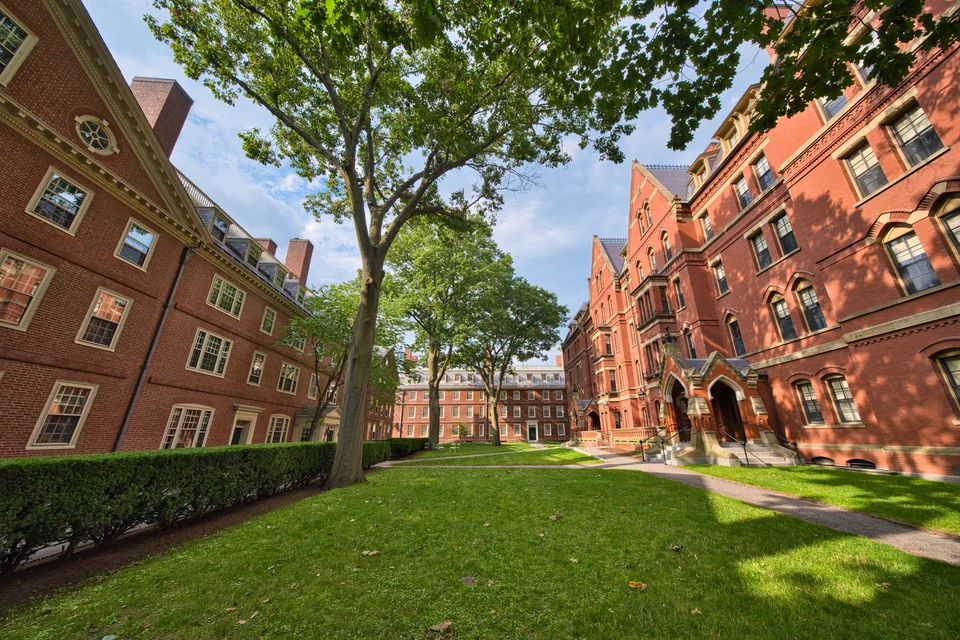
First-year students live in dorms around Harvard Yard, grouped into four Yards (Crimson, Elm, Ivy and Oak), and take most meals in Annenberg Hall. Rooms range from doubles to larger suites shared with other first-years; singles are rare. Each floor or section forms an entryway of 20–40 students with a resident proctor.
On Housing Day in the spring of their first year, students learn which of the 12 Houses they will join for the next three years. Each House has 350–500 residents and its own dining hall and community. For general costs and options see our guide to student housing in the USA.
Visas and the legal context in 2025–2026
After admission Harvard issues Form I-20, which you use to apply for an F-1 student visa. Russian nationals living in Russia schedule their interview at the U.S. Embassy in Warsaw or Astana; those resident elsewhere apply where they live. F-1 applicants are asked to set social media profiles to public. The consulate, not the university, decides on the visa.
Recent developments to be aware of:
- In 2025 the federal government tried to stop Harvard from enrolling international students (first by revoking its SEVP certification, then through a presidential proclamation restricting entry) and froze part of its federal research funding. In June 2025 a federal court in Boston issued preliminary injunctions against both measures affecting international students, and the courts also blocked the funding freeze. According to the university, as of late July 2026 the government is appealing and there is no final outcome. Admissions for autumn 2027 are running under the normal rules.
- A new DHS rule ending "duration of status" for F and J visa holders was due to take effect on 15 September 2026. On 14 September a federal court in Boston stopped it from taking effect for now; the government may appeal. The rule would cap stays at the programme end date and no more than four years without an extension, which matters most for long PhDs.
- The entry-restriction proclamation in force since 1 January 2026 does not restrict student visas for citizens of Russia or other CIS countries, and it lifted the 2025 ban on non-immigrant visas for Turkmenistan.
For the full visa process, read our guide to the F-1 student visa.
Advantages and obstacles for applicants from Russia and the CIS
What helps:
- Harvard reads each application in the context of its school and country and does not ask for a converted GPA. A Russian or Kazakh school certificate with grades for the last three years is the standard record.
- Need-blind admission and identical aid rules mean a family with a modest income by U.S. standards may receive near-full support.
- An English test is not required, although a strong TOEFL or IELTS score helps if you studied in Russian.
What makes it harder:
- The SAT and ACT are only offered at centres on the College Board and ACT lists. If none is available where you live, budget for travel abroad and leave time for a retake.
- Russian-issued bank cards cannot be used to pay Common App or test fees. Legal options are a card issued in another country in the payer's name, or a fee waiver in case of hardship.
- Aid applications require translated documents on parents' income and assets, so prepare them before November or February.
- Applicants living in Russia must travel to Warsaw or Astana for the visa interview, which adds travel, time and possible administrative processing.
Mistakes to avoid
- Assuming Harvard is test-optional. The SAT or ACT is required; AP, IB or national exams substitute only when tests are genuinely inaccessible, with an explanation.
- Translating documents yourself. Harvard does not accept self-translations.
- Applying early to several private universities. Restrictive Early Action forbids it.
- Missing the aid deadline. Aid documents follow the application calendar; otherwise your decision may arrive without an aid offer.
- Confusing tuition with total cost. $62,226 is tuition only; the unaided budget starts at $95,134.
Harvard in the rankings
| Ranking | Position |
|---|---|
| QS World University Rankings 2027 | 5 |
| THE World University Rankings 2026 | =5 |
| ARWU (Shanghai Ranking) 2026 | 1 |
Rankings reflect research strength. For an undergraduate the more useful questions are how the College is organised, which concentrations exist and what you would pay after aid. You can compare Harvard with our profiles of the University of Pennsylvania, Cornell and Duke.
FAQ
Can I apply to Harvard straight after finishing school in Russia or Kazakhstan?
Yes. You need your school record and final certificate by enrolment, recommendations, essays and an SAT or ACT score; no foundation year is required. If you have already enrolled at a university after school and earned credit, you cannot give it up to apply as a first-year student and would apply as a transfer.
How much does a year at Harvard cost?
For 2026–27 tuition is $62,226 and total billed costs with housing and food are $91,634. With personal expenses, books and travel the budget is $95,134–100,134, plus $4,954 for health insurance if you have no other coverage. Families earning under $100,000 are expected to contribute nothing.
Do I need the TOEFL or IELTS?
No. First-year applicants are not required to submit an English test, although they may. It cannot replace the SAT or ACT.
Does applying for financial aid hurt an international applicant?
No. Harvard makes admission decisions without regard to aid applications, including for foreign citizens.
What SAT score does Harvard require?
There is no minimum. The committee considers scores alongside your curriculum and the opportunities available to you.
If I apply early to Harvard, where else can I apply?
Anywhere in Regular Decision. Early applications to other private U.S. institutions and binding early programmes at public universities are not allowed, but non-binding early applications to U.S. public universities and to universities outside the United States are. If Harvard defers your early application, you may apply Early Decision II elsewhere.
Does StudyU help with Harvard applications?
Under a service agreement we help you build a university list, plan testing, prepare essays and documents, and complete aid and visa paperwork. Harvard decides on admission and aid, and a U.S. consulate decides on the visa; no one can guarantee those outcomes.
Sources
- Harvard College: First-Year Applicants
- Harvard College: Application Requirements
- Harvard College: International Applicants
- Harvard College: Admissions Statistics (Class of 2029)
- Harvard College: How Aid Works and Cost of Attendance 2026–2027
- Harvard College: Residential Life
- Harvard University: Schools
- Harvard Griffin GSAS: Funding and Aid and Cost of Attendance 2026–2027
- Harvard Business School: Cost of Attendance and Application Dates
- Harvard International Office: preliminary injunction against the SEVP revocation (20 Jun 2025) and against the 4 June proclamation (23 Jun 2025)
- Harvard International Office: Judge Blocks Elimination of Duration of Status (14 Sep 2026)
- Harvard International Office: Expanded Travel Restrictions (17 Dec 2025)
- Harvard Gazette: Garber on federal policy (July 2026)
- U.S. Embassy in Russia: Visas
- QS World University Rankings: Harvard University
- THE World University Rankings: Harvard University
- ARWU 2026
If you want to see where Harvard fits in your university list and how to divide effort between the early and regular rounds, send us an application.
During the free initial consultation, we clarify your goal, profile, timing, and budget and identify the next realistic step.
Next steps
- Bachelor's Degree in the USA: How It Works, What It Costs and How to Apply for 2027
- Ivy League Admissions for International Students: The Eight Universities, Admit Rates, Costs and How to Apply for Fall 2027
- SAT or ACT: Which Test to Take for US Admission in 2026–27
- Applying to US Universities: Step-by-Step Plan, Documents and 2027 Deadlines
- Studying in the USA for international applicants
- MBA in the USA: Requirements, GMAT or GRE, Costs and the STEM MBA
