
The University of Pennsylvania is a private Ivy League research university in Philadelphia whose history dates back to 1740. It is 15th in the QS World University Rankings 2027, 14th in the THE World University Rankings 2026 and joint 14th in the ShanghaiRanking ARWU 2026. First-year applicants apply through the Common App or the Coalition Application by 1 November 2026 (binding Early Decision) or 5 January 2027 (Regular Decision), and SAT or ACT scores are required. The full undergraduate cost of attendance for 2026–27 is $99,082. Penn meets the full demonstrated need of admitted international students with grants and work-study, but admission for international applicants is need-aware: a request for aid is considered in the admission decision. In fall 2025 Penn admitted 4.9% of all applicants and 2.5% of international applicants.
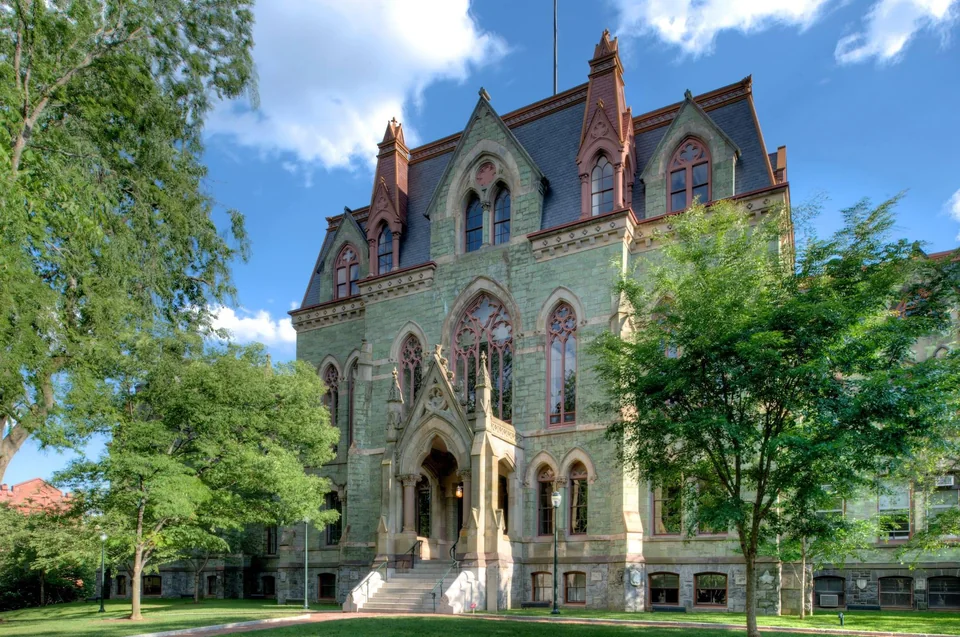
| At a glance | Details |
|---|---|
| Location | Philadelphia, Pennsylvania |
| History | since 1740 |
| Students (fall 2025) | 24,183 |
| Rankings | QS 2027: 15; THE 2026: 14; ARWU 2026: joint 14 (with UCLA) |
| Schools | 12, of which 4 admit undergraduates, plus coordinated dual-degree programmes |
| How to apply | Common App, Coalition Application or QuestBridge |
| Fall 2027 deadlines | Early Decision: 1 November 2026 (binding); Regular Decision: 5 January 2027 |
| Application fee | $75 |
| SAT/ACT | required; waivers only for genuine hardship in taking a test |
| Competitive English scores | TOEFL iBT 5+ on the new scale (100+ on the old), IELTS 7+, Duolingo 130+ |
| Undergraduate budget (2026–27) | $99,082 living on campus with a meal plan |
| Financial aid | need-based only; 100% of demonstrated need for admitted internationals, with need-aware admission |
| Selectivity | 4.9% overall (3,570 of 72,544); international applicants 2.5% (441 of 17,882) |
| Housing | every undergraduate lives in a College House for at least two years |
Who Penn suits, and when to consider alternatives
| Strengths | Limitations |
|---|---|
| Wharton admits business students at undergraduate level | One of the most selective admissions processes in the US; 2.5% for international applicants |
| Courses across all schools and coordinated dual-degree programmes | Requesting aid affects the admission decision for international applicants |
| Aid for internationals meets full demonstrated need without loans | If you do not apply for aid on entry, you cannot apply later |
| Two years in College Houses with faculty and resident advisers | SAT or ACT required, with autumn test deadlines |
| Food and housing budgeted at $20,604 a year, below NYU's $26,438 | No merit scholarships at all |
Penn suits focused applicants with a clear direction: business and finance, engineering, health and life sciences, economics or nursing. If your budget depends on aid, compare Penn with Cornell, which follows similar rules, and with universities that are need-blind for international applicants such as Harvard, MIT or Princeton. Our guide to Ivy League admissions explains the group as a whole.
Four undergraduate schools and dual-degree programmes
Penn stresses that you do not apply to "Penn" in general but to one of four undergraduate schools or a coordinated dual-degree programme. That school becomes your academic home for four years, while courses across the university stay open to you.
- College of Arts and Sciences: humanities, natural and social sciences, with the widest choice of majors.
- The Wharton School: founded in 1881 as the world's first collegiate business school; undergraduate business and finance.
- School of Engineering and Applied Science (Penn Engineering): engineering and computer science; Penn notes that it looks for preparation in mathematics and science.
- School of Nursing: nursing and health sciences.
Coordinated dual-degree programmes combine two schools: graduates earn two degrees, with a heavier workload. Penn advises choosing the school that matches both your interests and your preparation so far. The remaining eight schools — Perelman School of Medicine, Penn Carey Law, Dental Medicine, Veterinary Medicine, the Weitzman School of Design, the Graduate School of Education, Social Policy & Practice and the Annenberg School for Communication — work at graduate and professional level.
How to apply as an undergraduate
Application components
- Application form. The Common App or the Coalition Application, treated equally; QuestBridge applicants may use the QuestBridge Application instead. Submit only one per cycle.
- Fee of $75, or a fee waiver requested through the application.
- Essays. The main personal statement plus three Penn prompts: a short thank-you note to someone you have not yet thanked (150–200 words), how you will explore community at Penn (150–200 words), and a prompt from your chosen school. Penn wants these answers to explain why this university and this school.
- Recommendations. Two are required: your school counsellor and a teacher in a core subject (maths, science, history, English or a foreign language). An optional third may come from another teacher or someone in your community.
- School records. Official transcripts for all secondary grades with certified translations. Penn does not require third-party credential evaluation and asks applicants not to recalculate grades. Records must come from the school itself, not through an agent or third-party vendor.
- SAT or ACT. Required for all applicants, including international students. There is no minimum score; you may self-report and send official scores before enrolment. If you face genuine hardship, such as no available test centre, you can submit a testing waiver explaining why. If you do have scores, you must report them, and they supersede the waiver.
- English. Required unless English was your primary language of instruction for at least three years. TOEFL, IELTS and Duolingo results must come officially from the testing agency. Competitive applicants tend to have TOEFL 5 or above on the new scale (100 or above on the old) with consistent section scores, IELTS 7 or above, or Duolingo 130 or above. Scores are valid for two years and must be valid when you apply; Penn does not accept the IELTS Indicator, IELTS One Skill Retake or MyBest TOEFL.
- Early Decision Agreement, if applying early, signed by you, a parent or guardian and your counsellor.
Penn asks every applicant to certify that the application is their own work. Discussing ideas with a teacher, having someone proofread, or using a tool, including AI, to organise thoughts or check grammar is acceptable; having someone else generate the content is not. StudyU works on the same basis: we help with strategy and editing, and the applicant writes the texts. For essay structure, see our overview of applying to US universities.
Latest test dates for the 2026–27 cycle
| Test | Early Decision | Regular Decision |
|---|---|---|
| SAT | 7 November 2026 | 5 December 2026 |
| ACT | 17 October 2026 | 12 December 2026 |
These are the final sittings that can still be considered. Penn superscores the SAT across sittings and uses the ACT composite superscore; the ACT Science section is not required. See SAT or ACT to choose a test.
Early Decision or Regular Decision
| Early Decision | Regular Decision | |
|---|---|---|
| Application deadline | 1 November 2026 | 5 January 2027 |
| Decision | December 2026 | April 2027 |
| Commitment | enrol if admitted and withdraw other applications | none; offers can be compared |
| Fall 2025 applications and admits | 9,503 applications, 1,266 admitted | — |
Early Decision brings a December answer but removes the chance to compare aid packages. Penn itself points applicants who want to compare offers towards Regular Decision.
Action plan for 2026–27
- September 2026. Choose a school or dual-degree programme, decide on the application plan, take the English test and check whether you can sit the SAT or ACT before the final dates.
- September–October. Ask your counsellor and a teacher for recommendations, write your essays and order certified translations of school records.
- October. If you need aid, complete the CSS Profile (Penn's code is 2933) and prepare your family's tax documents with translations; they are due 6 November 2026 for Early Decision and 1 February 2027 for Regular Decision.
- 1 November 2026 or 5 January 2027. Submit under your chosen plan.
- December 2026 or April 2027. Decision; withdraw other applications if admitted Early Decision.
- Spring–summer 2027. Deposit, financial documents for the I-20 and the F-1 visa; final transcript in June.
Key dates for fall 2027 entry
| Stage | Early Decision | Regular Decision |
|---|---|---|
| Application | 1 November 2026 | 5 January 2027 |
| Latest SAT / ACT | November 2026 / October 2026 | December 2026 / December 2026 |
| CSS Profile and family tax documents for aid | 6 November 2026 | 1 February 2027 |
| Decision | December 2026 | April 2027 |
| Final transcript | June 2027 | June 2027 |
Master's, doctoral and professional programmes
Penn has no single graduate application: each of the twelve schools admits separately, with its own deadlines, GRE or GMAT policy, English threshold and fee. Prices vary too. Engineering master's students in 2026–27, for example, pay $8,825 per course unit, or $35,300 per semester for four course units before fees. Wharton's MBA, law and medicine cost more and are priced separately; medicine in the US is a professional degree taken after a bachelor's, with its own prerequisites. See our guides to the MBA in the USA and medical school in the USA for international students.
What Penn costs
| Undergraduate, 2026–27 | On campus with meal plan | Off campus | Living with family |
|---|---|---|---|
| Tuition | $65,670 | $65,670 | $65,670 |
| Mandatory fees | $8,308 | $8,308 | $8,308 |
| Housing | $13,644 | $12,978 | — |
| Food | $6,960 | $5,988 | $2,394 |
| Books and supplies | $1,412 | $1,412 | $1,412 |
| Transportation | $1,080 | $1,080 | $1,756 |
| Personal expenses | $2,008 | $2,008 | $2,008 |
| Total | $99,082 | $97,444 | $81,548 |
Students without insurance that works in the Philadelphia area and meets Penn's criteria are enrolled in the Penn Student Insurance Plan, whose cost is added to the budget. For comparison, tuition in 2025–26 was $63,204, so it rose by 3.9% in one year; plan for further increases. Our guide to the cost of studying in the USA covers the full budget.
Financial aid for international students
Penn awards aid on the basis of need only; there are no merit or athletic scholarships. For international applicants:
- admission is need-aware for students who are not citizens or permanent residents of the US, Canada or Mexico, because the budget for international aid is limited;
- Penn meets 100% of demonstrated need for admitted international students with grants and work-study, without loans;
- you must apply for aid through the CSS Profile at the same time as you apply for admission; students who do not apply as incoming first-years or transfers cannot receive aid later;
- part of a grant may be subject to US tax, and those taxes cannot be covered by additional grant funding;
- aided international students may receive help towards an economy flight home.
In scale: according to the Common Data Set 2025–26, 448 international undergraduates received institutional aid averaging $80,607 a year. Penn decides on every award. See our guide to financial aid for international students in the USA.
Housing: College Houses
Every Penn undergraduate lives in a College House for at least two years, alongside faculty, a house director and a team of resident advisers, with its own community and programmes. For an international first-year that means an established support network and no apartment hunt in an unfamiliar city. Many older students move to apartments in University City; the off-campus budget is $97,444 a year. General guidance is in our guide to student housing in the USA.
F-1 visa and work
Once your funding is documented, International Student and Scholar Services issues the I-20. Next come the $350 SEVIS fee, the $185 visa application fee and a consular interview; Russian nationals are directed to the US embassies in Warsaw or Astana because Moscow does not process their visas. The consular section decides on the visa. See our F-1 student visa guide.
During term, F-1 students can hold campus jobs for up to 20 hours a week, and aided students receive work-study as part of their package. After graduation, OPT allows 12 months of work, extended by 24 months for STEM fields. See our guide to working while studying and OPT.
What eases and what complicates applying from Russia and the CIS
What helps:
- no credential evaluation: a transcript with a certified translation is enough;
- admitted international students have their full demonstrated need met;
- a testing waiver is possible if you genuinely cannot sit the SAT or ACT;
- College Houses solve housing for the first two years.
What makes it harder:
- a 2.5% admit rate for international applicants, and a request for aid affects the decision;
- the SAT or ACT must be taken by October–November, and the nearest test centre may be abroad;
- the CSS Profile requires detailed, translated information on family income and assets;
- fees are billed in US dollars; payments from Russia must go through legal routes only, see our guide on how to pay for studies abroad from Russia;
- the visa interview in Warsaw or Astana is a separate trip with its own cost.
Mistakes to avoid
- Not applying for aid at the start. International students get no second chance: without an application on entry, no aid is available later.
- Applying Early Decision without a budget. The commitment rules out comparing offers.
- Sitting the SAT after the final date. November for Early Decision, December for Regular Decision.
- Hiding scores and asking for a waiver. Reported scores supersede the waiver.
- Choosing a school for its name. Penn Engineering expects maths and science preparation; Wharton expects a demonstrated interest in business.
- Letting someone else write your essays. Penn requires you to certify the application as your own work.
Checklist before you apply
- You have chosen one of the four schools or a dual-degree programme, and the school essay explains that choice.
- The SAT or ACT is taken by your plan's last date: for Early Decision, the 7 November 2026 SAT or the 17 October 2026 ACT.
- Your English test is valid on the submission date and close to TOEFL 5, IELTS 7 or Duolingo 130.
- Your counsellor and a core-subject teacher have agreed to write recommendations.
- Your school can send transcripts with certified translations and the School Report.
- If you need aid, the CSS Profile and family tax documents go in with the application; international students cannot apply later.
Admission statistics
Common Data Set 2025–26: for fall 2025 Penn received 72,544 first-year applications and admitted 3,570 (4.9%). International applicants filed 17,882 applications; 441 were admitted (2.5%) and 318 enrolled. Early Decision drew 9,503 applications with 1,266 admits. The middle 50% of enrolled first-years scored 740–770 in SAT Evidence-Based Reading and Writing, 770–800 in SAT Math and 34–35 on the ACT. These figures describe the competition; they cannot predict any individual outcome.
Rankings
| Ranking | Position |
|---|---|
| QS World University Rankings 2027 | 15 |
| THE World University Rankings 2026 | 14 |
| ShanghaiRanking ARWU 2026 | joint 14 (with UCLA) |
FAQ
Can I apply to Penn with a school-leaving certificate from outside the US?
Yes. Your secondary school certificate qualifies you for first-year entry; Penn needs a transcript with a certified translation, not a credential evaluation. You also need SAT or ACT scores, English results, essays and two recommendations.
Does Penn require the SAT?
Yes. In the 2026–27 cycle Penn requires SAT or ACT scores from all applicants, including international students. A waiver is possible only for genuine hardship, such as no available test centre.
How much does a year at Penn cost?
$99,082 for 2026–27 living on campus: tuition $65,670, fees $8,308, housing and food $20,604 plus other costs. The Penn Student Insurance Plan is added if you lack suitable coverage.
Does Penn give financial aid to international students?
Yes, based on need only. Penn meets the full demonstrated need of admitted international students with grants and work-study, but international admission is need-aware. In 2025–26, 448 international undergraduates received aid averaging $80,607.
What English level does Penn expect?
There is no minimum. Competitive applicants tend to have TOEFL 5+ on the new scale (100+ on the old), IELTS 7+ or Duolingo 130+, with consistent section scores.
What are College Houses?
Residences where every undergraduate lives for at least two years, with faculty, a house director and resident advisers.
Can StudyU help with a Penn application?
Under a service agreement we help you choose a school, plan testing, plan test dates, discuss and proofread essays and assemble CSS Profile and visa documents. As Penn requires, the applicant writes the application; the university decides on admission and aid, and the US consulate on the visa.
Sources
- Penn Admissions: First-Year Applicants
- Penn Admissions: Application Requirements
- Penn Admissions: Testing
- Penn Admissions: International Applicants
- Penn Admissions: Letters of Recommendation
- Penn Admissions: Four Undergraduate Schools
- Penn Admissions: Integrity and AI Use
- Penn SRFS: Undergraduate Cost of Attendance
- Penn SRFS: International Student Financial Aid
- Penn SRFS: International Financial Aid FAQ
- Penn SRFS: Prospective international student checklist
- Penn SRFS: SEAS Costs
- Penn College Houses
- University of Pennsylvania: Schools
- University of Pennsylvania: About
- Penn Common Data Set
- US Embassy in Russia: Visas
- QS World University Rankings 2027
- THE World University Rankings 2026
- ShanghaiRanking ARWU 2026
All amounts are in US dollars as published by Penn; figures were checked on 24 September 2026. For other US universities, see studying in the USA. Choosing the Penn school and application plan that fit your profile and budget is provided under an agreement with StudyU: to start, submit an application.
During the free initial consultation, we clarify your goal, profile, timing, and budget and identify the next realistic step.
Next steps
- Financial Aid for International Students in the USA: Need-Based Grants, Merit Scholarships and Assistantships
- Ivy League Admissions for International Students: The Eight Universities, Admit Rates, Costs and How to Apply for Fall 2027
- MBA in the USA: Requirements, GMAT or GRE, Costs and the STEM MBA
- Medical School in the USA for International Students: the MD Route Explained
- How to Pay for Studies Abroad from Russia: What Works in 2026
- Studying in the USA for international applicants
