
The University of Chicago is a private research university in the Hyde Park neighbourhood on Chicago's South Side, founded in 1890. It is 24th in the QS World University Rankings 2027, 15th in the THE World University Rankings 2026 and 9th in ARWU 2026. Undergraduates apply to the College through the Common App or the Coalition Application under one of four plans: Early Action or Early Decision I by 2 November 2026, or Early Decision II or Regular Decision by 4 January 2027. SAT and ACT scores are optional and are only used when they help the applicant. The 2026–27 cost of attendance with on-campus housing is $103,821. International students who apply for aid with their admission application and are admitted have 100% of demonstrated need met without loans.
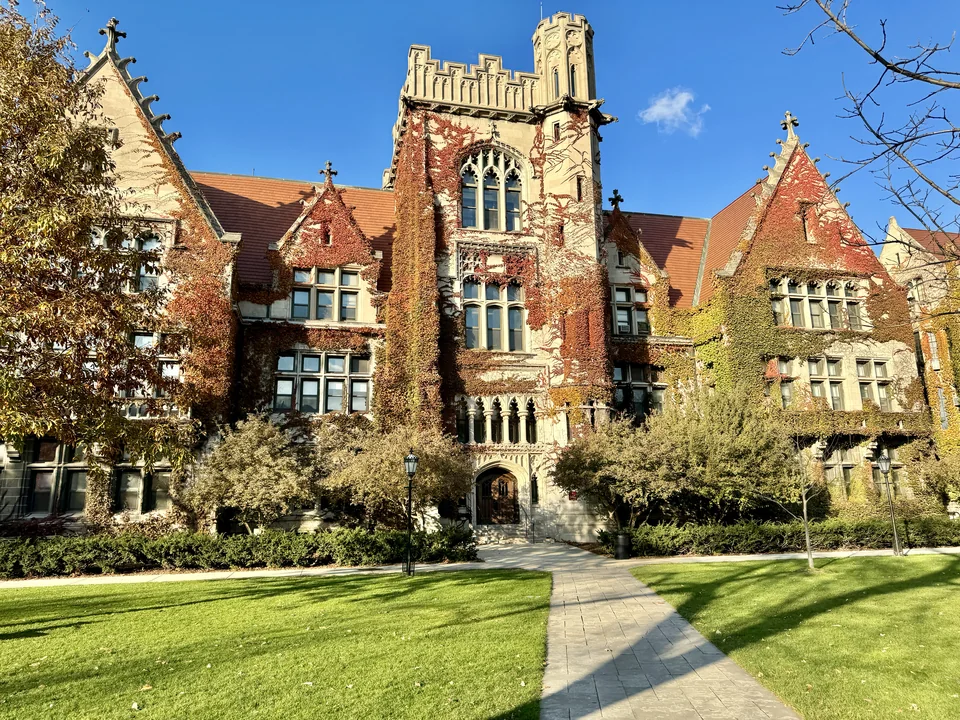
Do not confuse UChicago with the University of Illinois Chicago (UIC), a separate public university with different requirements and fees.
| At a glance | Details |
|---|---|
| Location | Hyde Park, Chicago, Illinois |
| Founded | 1890 |
| Students (autumn 2025) | 16,406, including 7,453 undergraduates |
| Rankings | QS 2027: 24th; THE 2026: 15th; ARWU 2026: 9th |
| Structure | the undergraduate College, 4 graduate divisions, 7 professional schools and the Graham School |
| Application | Common App or Coalition Application (Scoir) plus the UChicago Supplement |
| Deadlines for autumn 2027 | EA and ED I 2 Nov 2026; ED II and RD 4 Jan 2027 |
| Application fee | $90, waived for need-based aid applicants |
| SAT/ACT | optional, with a "No Harm" policy |
| English | test optional, no minimum; no ESL courses or conditional admission |
| Cost of attendance, 2026–27 | $103,821 on campus, excluding health insurance |
| Aid for international students | 100% of demonstrated need, loan-free; aid must be requested at admission |
| Admit rate (autumn 2025) | 4.5%: 2,039 offers from 45,533 applications |
| Housing | on campus for the first two years, in a system of 48 Houses |
Who UChicago suits, and when to look elsewhere
| Strengths | Drawbacks and risks |
|---|---|
| Four application plans, binding and non-binding, early and late | One of the lowest admit rates in the U.S., 4.5% |
| Tests are optional and weak scores are simply ignored | The Core takes about a third of your courses, leaving fewer for your major |
| Loan-free aid for international students, plus merit scholarships | The budget exceeds $103,800 a year before insurance and flights |
| No application fee if you apply for need-based aid | Ten-week quarters mean a fast pace and frequent exams |
| World-class economics, mathematics, physics, social sciences, law and business | You must live in university housing for the first two years |
UChicago appeals to students who enjoy arguing with texts and problems: future economists, mathematicians, physicists, data scientists, political scientists and lawyers. The university says openly that it wants to hear applicants "in their own voice", and its unusual essay prompts are the hallmark of the application. If you want to start engineering right away, compare it with Caltech; if you want a broad college model with a later choice of major, compare it with Duke, Penn and Harvard. The study in the USA page gives the wider picture.
How the university is organised
The "College" is UChicago's undergraduate division, not a separate institution. College students take the Core, a required sequence across the humanities, social sciences, natural and mathematical sciences that fills about a third of their studies. Core classes are capped at 19 students and are built around discussion of primary texts. You can declare a major at any time, even in your first quarter, and roughly a third of courses remain electives. Strong students can join 4+1 programmes that start a master's during the bachelor's.
The academic year runs in quarters: nine weeks of classes, then a reading period and a week of finals. Most students study in autumn, winter and spring, with an optional summer session.
Graduate and professional study is organised in:
- four divisions: Biological Sciences (which includes the Pritzker School of Medicine), Arts & Humanities, Physical Sciences and Social Sciences;
- seven professional schools: Chicago Booth, the Law School, the Harris School of Public Policy, the Crown Family School of Social Work, Policy, and Practice, the Divinity School, the Pritzker School of Medicine and the Pritzker School of Molecular Engineering;
- the Graham School of continuing and professional studies.
How to apply to the College from outside the United States
International students submit the same materials by the same deadlines as U.S. applicants. Applications are read in the context of the school and country where you studied, not your citizenship. The main difference: need-based aid must be requested together with the application.
What goes into the application
- Application platform. The Common App or the Coalition Application on Scoir; UChicago treats them equally. You also set up a UChicago Account to upload materials and view your decision.
- UChicago Supplement. One extended essay chosen from the university's prompts and one short essay on why you want to attend UChicago. Only UChicago sees them.
- $90 fee, waived if you apply for need-based aid.
- Two teacher evaluations from academic subjects such as mathematics, history, science, literature, foreign languages or other reading- and writing-heavy courses. Teachers may write in their own language and attach a translation. One supplemental letter from another teacher, employer or mentor is optional.
- School report and transcript, completed by the school counsellor, or by any school administrator if there is no counsellor, or by an EducationUSA mentor. Independently hired consultants may not complete the school report. Non-English documents need a certified translation and a grading scale. Self-submitted transcripts are accepted; official ones are needed only if you enrol.
- Midyear report of first-term grades by 1 February or as soon as available.
- English. UChicago admits only students with superior English, but a formal test is not required if your ability is clear from the application. Any test score can be self-reported. There is no ESL programme and no conditional admission.
- Optional video. UChicago does not interview; instead you may upload an unrehearsed, unedited two-minute video introduction. International applicants may also submit InitialView.
- Supplemental materials. Creative work, research, capstone projects, AP scores or predicted IB and A-Level results are optional and uploaded through the UChicago Account.
Do not convert your grades into a 4.0 GPA and do not send copies of certificates: list achievements in the application, and let admissions officers read your transcript in your school's own system.
SAT and ACT: the No Harm policy
Tests are optional for everyone, including international applicants. Under the No Harm policy a submitted score is used only if it helps; a score that would hurt the application is not considered. Scores may be self-reported without calculating a superscore. UChicago accepts October ACT and November SAT scores for the 2 November deadline, December SAT and ACT for Early Decision II, and January SAT and February ACT for Regular Decision.
Among students enrolled in autumn 2025 who submitted scores, the middle 50% scored 1500–1560 on the SAT and 34–35 on the ACT; 57% submitted the SAT and 25% the ACT. Our guide to the SAT or ACT helps you decide which test to take.
Four application plans
| Plan | Deadline | Decision | Reply by | Commitment |
|---|---|---|---|---|
| Early Action | 2 Nov 2026 | mid-December | 1 May 2027 | none |
| Early Decision I | 2 Nov 2026 | mid-December | mid-January 2027 | enrol if admitted |
| Early Decision II | 4 Jan 2027 | mid-February | mid-March 2027 | enrol if admitted |
| Regular Decision | 4 Jan 2027 | late March | 1 May 2027 | none |
All plans go through the same review. You may switch from Early Action to Early Decision I until 1 December, and from deferred Early Action or Regular Decision to Early Decision II until 15 January, by uploading an Early Decision agreement. For an international student who needs aid, a binding plan is a serious step because you cannot compare other offers.
Step-by-step plan for autumn 2027
- September 2026. Choose a plan; start the Supplement essays (you can work on them in the UChicago Account from 1 June); line up two teachers.
- October. If you are testing, aim for the October and November dates for the early deadline. Gather family income and asset documents.
- 2 November. Early Action or Early Decision I application; aid documents by 15 November.
- 4 January 2027. Early Decision II or Regular Decision application; aid documents by 15 January (ED II) or 15 February (RD); midyear report by 1 February.
- December–March. Decision together with the aid offer.
- Spring–summer 2027. Enrolment deposit, Form I-20, F-1 visa and final documents.
Deadlines for autumn 2027 entry
| Step | EA / ED I | ED II | RD |
|---|---|---|---|
| Application | 2 Nov 2026 | 4 Jan 2027 | 4 Jan 2027 |
| Latest test | ACT October, SAT November | SAT and ACT December | SAT January, ACT February |
| Aid documents | 15 Nov 2026 | 15 Jan 2027 | 15 Feb 2027 |
| Decision | mid-December | mid-February | late March |
If an aid deadline falls on a weekend or holiday, it moves to the next business day.
How many applicants UChicago admits
According to the Common Data Set 2025–26, UChicago received 45,533 first-year applications for autumn 2025 and made 2,039 offers, 4.5%; 1,786 students enrolled, 323 of them international. The university does not publish admit rates by plan or for international applicants. These figures describe the competition as a whole, not any individual's prospects.
What UChicago costs
| Undergraduate, 2026–27 | On campus | Off campus | Commuter |
|---|---|---|---|
| Tuition | $75,960 | $75,960 | $75,960 |
| Student services fee | $1,677 | $1,677 | $1,677 |
| UPASS transit fee | $318 | $318 | $318 |
| Food and housing | $21,414 | $18,000 | $9,000 (maintenance allowance) |
| Books and course materials | $1,800 | $1,800 | $1,800 |
| Personal expenses | $1,950 | $1,950 | $1,950 |
| Travel allowance | $702 | $702 | $702 |
| Total | $103,821 | $100,407 | $91,407 |
Students entering in 2026 also pay a $720 Class Fee in each of their first two years. Health insurance (U-SHIP) is not included. The travel allowance depends on the student's home region and is not paid out separately. The on-campus figure uses the average room cost and the unlimited meal plan. Our guide to the cost of studying in the USA helps you plan a four-year budget.
Financial aid for international students
UChicago commits to meeting 100% of demonstrated need, without loans, for admitted international students who applied for aid. The conditions:
- Apply for aid with your admission application. If you do not, you cannot apply after the decision or in later years.
- UChicago's own forms, not the CSS Profile. International applicants complete the UChicago Financial Aid Worksheet in the UChicago Account and submit proof of family income (2025 tax forms translated and converted into U.S. dollars, an employer's statement or bank statements showing salary deposits) and assets (the Asset Verification Form and account statements). The CSS Profile and FAFSA are not required.
- What the package contains. Grants and scholarships cover tuition and fees first. If need is higher, an international student stipend is paid directly to the student for housing, food and travel; direct deposit requires a U.S. bank account, otherwise it arrives as a paper check.
- Annual reapplication. Recipients submit documents again each year.
- Deadlines matter. Students who do not complete the aid application by the deadline for their plan are not eligible for need-based aid in their first year, and for international students that closes aid for later years too.
- Need-blind is not promised. For international first-year applicants UChicago says only that they go through the same contextual review as domestic applicants, the one difference being that they must apply for aid before admission. Its official pages do not promise that an aid request will not affect the decision; transfer admission is explicitly need-aware, and international transfers cannot receive need-based aid.
UChicago does publish the scale of its commitment: nearly $20 million in need-based aid has been offered to international students over the past four years, and a recent $35 million gift is dedicated to international financial aid. Packages are built on the full cost of attendance, which for this purpose includes health insurance.
All applicants, including international ones, are also considered automatically for merit scholarships. These are partial-tuition awards, either one-off or renewable; winners are notified by the end of April and others are not contacted. UChicago stresses that most aid is need-based and that merit awards should not be your funding plan. In the Common Data Set 2025–26, 269 international undergraduates received institutional aid averaging $74,765. UChicago decides on all aid; our overview of financial aid for international students in the USA explains how such packages work.
Graduate, doctoral and professional study
Graduate applications go to individual programmes, which set their own deadlines, fees, GRE or GMAT policies and English thresholds. Requirements differ even between divisions. The Biological Sciences Division asks for a TOEFL of 100 on the old scale with section minimums, or IELTS 7 in every band; Arts & Humanities asks for IELTS 7 in every band or at least 5 in each section of the new TOEFL.
Most PhD programmes guarantee funding every year until the degree is completed. Master's programmes vary: many offer merit awards and a few offer need-based aid, so budget programme by programme. Tuition is published by the Bursar, and the financial aid office's 2026–27 living estimate is $29,000 for housing and food over four quarters, or $21,750 over three. See our guides to the MBA in the USA and medical school in the USA.
Housing: the House system
All first-year students must live in university housing for their first two years. Seven residence halls are divided into 48 Houses, communities of about 80 students (60 to 100) from all years and countries. Each House has its own council, traditions and a table in one of four dining commons. Resident Heads (graduate students, faculty or staff), Resident Assistants who are usually third- or fourth-year students, and Resident Deans drawn from senior faculty live alongside students and organise dinners and outings. All first-years have an unlimited meal plan.
Before autumn, admitted students fill in a housing questionnaire, but Houses are deliberately assigned so that each one reflects the whole class. After the second year students may move off campus; the off-campus allowance in the budget is about $3,414 lower than the on-campus figure. Our guide to student housing in the USA covers renting.
F-1 visa and work
After admission UChicago issues Form I-20 once you have documented your funding. Next come the SEVIS fee ($350), the visa fee ($185) and the interview. Russian citizens book nonimmigrant visa interviews at the U.S. embassies in Warsaw or Astana, and F-1 applicants are instructed to set their social media profiles to public; the consulate decides on the visa. See our F-1 visa guide.
F-1 students may work on campus up to 20 hours a week during term and use 12 months of OPT after graduation, extendable by 24 months in STEM fields. Details are in our guide to working while studying and OPT.
Career outcomes
Career Advancement assigns each student an adviser from the first year and runs a large paid-internship programme. By its count, 98% of the Class of 2025 had an offer of employment, graduate school or another post-college opportunity by graduation: 71% of them employment and 29% graduate or professional school. In the 2026 application cycle, UChicago applicants were admitted to law school at a 90% rate and to medical school at 91%. These are past results, not a job guarantee; staying in the U.S. after OPT requires a separate work visa, which the university does not control.
Advantages and obstacles for applicants from Russia and the CIS
What helps:
- SAT, ACT and English tests are optional, and under No Harm a weak score is disregarded;
- there is no application fee if you apply for aid;
- you may self-submit your transcript and send the official one after admission;
- aid does not require the CSS Profile: you use UChicago's own worksheet and family documents.
What gets in the way:
- a 4.5% admit rate and no need-blind promise for international applicants;
- you need strong English from the start, because there is no ESL or conditional admission;
- family income and asset records must be translated and converted into dollars by 15 November, 15 January or 15 February;
- the budget exceeds $103,800 a year, and payments from Russia must use legal channels only (see how to pay for studies abroad from Russia);
- Russian citizens attend visa interviews in Warsaw or Astana.
Mistakes to avoid
- Not applying for aid at the start, or missing the document deadline. For international students aid is then closed for every year of study.
- Confusing UChicago with UIC. They are different universities with different requirements, prices and websites.
- Choosing Early Decision without a budget. A binding plan removes the chance to compare offers.
- Writing formulaic Supplement essays. The unusual prompts exist to hear your voice.
- Asking a private consultant to complete the school report. UChicago explicitly forbids it: the school or an EducationUSA mentor completes it.
- Converting grades into a GPA. UChicago reads transcripts in your school's own system.
- Treating a merit scholarship as your main funding. Awards are partial and only winners are notified.
UChicago in the rankings
| Ranking | Position |
|---|---|
| QS World University Rankings 2027 | 24 |
| THE World University Rankings 2026 | 15 |
| ARWU (Shanghai Ranking) 2026 | 9 |
UChicago's high ARWU position reflects research indicators, including Nobel laureates among alumni and faculty, while QS relies more on reputation surveys. For an applicant, whether the Core and the quarter system suit you matters more.
FAQ
Can I apply to UChicago straight after finishing school in Russia or Kazakhstan?
Yes. A national school-leaving certificate is accepted for first-year admission, and UChicago reads it in the context of your school and country. No foundation year is needed, but there is no ESL or conditional admission, so your English must be strong when you apply.
Does UChicago require the SAT?
No. Tests are optional, and under the No Harm policy a submitted score is used only in your favour.
How much does a year at UChicago cost?
$103,821 for 2026–27 on campus: tuition $75,960, fees $1,995, food and housing $21,414, plus books, personal costs and travel. Health insurance and the $720 Class Fee for new students are extra.
Can international students get financial aid?
Yes. If you apply for aid with your application and are admitted, UChicago meets your full demonstrated need without loans. International applicants are also considered automatically for partial merit scholarships.
What English level does UChicago expect?
There is no formal minimum for undergraduates, and you may skip a test if your English is evident from the application. But UChicago admits only students with superior English and offers no ESL courses.
Does UChicago interview applicants?
No. You may upload an optional two-minute video instead, and international applicants may submit InitialView.
Does StudyU help with UChicago applications?
Under a service agreement we help you choose a plan, structure the Supplement essays, plan testing and prepare family income and visa documents. UChicago does not work with agencies or give them any special status: we act as independent advisers, the applicant writes the essays and the school completes the school report. UChicago decides on admission and aid, and the U.S. consulate decides on the visa.
Sources
- UChicago College Admissions: Application (plans and 2026–27 deadlines)
- UChicago College Admissions: Required Materials
- UChicago College Admissions: Optional Materials
- UChicago College Admissions: International Applicants
- UChicago College Admissions: International Financial Aid
- UChicago College Admissions: Financial Overview
- UChicago College Admissions: Academic Principles
- UChicago College Admissions: Housing & Dining
- UChicago Financial Aid: Undergraduate Costs 2026–27
- UChicago Financial Aid: Food and Housing
- UChicago Financial Aid: Undergraduate International Aid
- UChicago Financial Aid: Graduate Cost of Attendance 2026–27
- UChicagoGRAD: Funding Your Education
- UChicagoGRAD: English Language Required Scores
- University of Chicago: Schools and Divisions
- UChicago Common Data Set 2025–26
- UChicago Career Advancement: Post-College Outcomes
- U.S. Embassy in Russia: Visas
- ICE: I-901 SEVIS fee
- U.S. Department of State: visa fees
- QS World University Rankings 2027
- THE World University Rankings 2026
- ShanghaiRanking ARWU 2026
All amounts are in U.S. dollars as published by the university; figures checked on 24 September 2026. Other U.S. options are on the study in the USA page. If you would like to know which UChicago plan fits your profile and budget, send us an application.
During the free initial consultation, we clarify your goal, profile, timing, and budget and identify the next realistic step.
Next steps
- Financial Aid for International Students in the USA: Need-Based Grants, Merit Scholarships and Assistantships
- MBA in the USA: Requirements, GMAT or GRE, Costs and the STEM MBA
- Medical School in the USA for International Students: the MD Route Explained
- Working While Studying in the USA and OPT: On-Campus Jobs, CPT, OPT and STEM OPT Under the 2026 Rules
- How to Pay for Studies Abroad from Russia: What Works in 2026
- Studying in the USA for international applicants
