
A Russian or Kazakh Attestat on its own will not get you into Cambridge: the university calls such applicants uncompetitive and expects A-levels, the IB or five AP exams at grade 5. For undergraduate entry in autumn 2027 you submit two things: a UCAS application by 15 October 2026 (6pm UK time) and the university's own form, My Cambridge Application, by 22 October, which costs $79 (£60) for applicants based outside the UK and Ireland. Offers are made only after an interview, and the main interview period is 7–18 December 2026. International students pay two fees: $40,710–93,270 (£30,798–70,554) a year to the university, fixed for the whole course, and $17,030–21,090 (£12,885–15,950) to their college. On average there are about six applications per place.
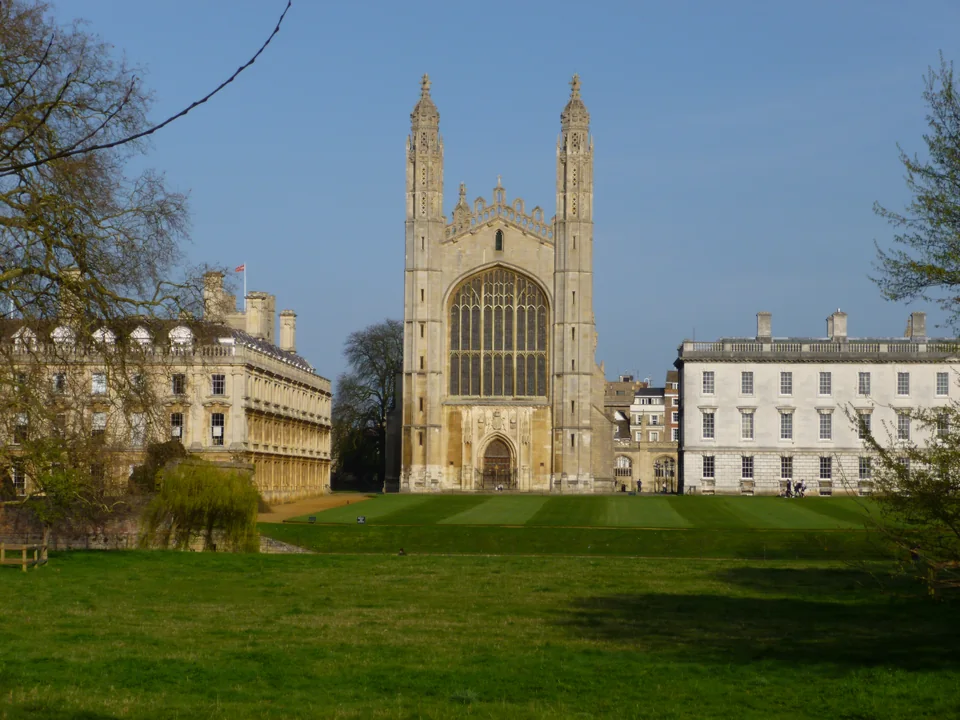
| At a glance | Details |
|---|---|
| Location | Cambridge, England, about 80 km north of London |
| Rankings | QS 2027: 6th; THE 2026: =3rd; ARWU 2026: 4th |
| Colleges | 29 colleges admit undergraduates; 31 in total |
| Deadlines for 2027 entry | UCAS 15 October 2026; My Cambridge Application and transcript 22 October 2026 |
| Tests | ESAT, TMUA, UCAT or LNAT depending on the course; STEP for Mathematics in the summer |
| Interviews | main period 7–18 December 2026; usually online for applicants based outside the UK |
| Decisions | 27 January 2027 for December interviewees |
| English | IELTS Academic 7.5 with at least 7.0 in each element |
| International fees, 2027 entry | $40,710–93,270 (£30,798–70,554) to the university, fixed for the course, plus $17,030–21,090 (£12,885–15,950) college fee |
| Living costs, 2027/28 | $15,820 (£11,970) for nine months, university estimate |
Entry with a school certificate from Russia or Kazakhstan
Cambridge states that applicants holding only the Russian Attestat will not be competitive and are unlikely to succeed. It lists suitable alternatives:
- A-levels: minimum offers of A*AA or A*A*A depending on the course;
- International Baccalaureate: 41–42 points out of 45 with 776 at Higher Level; some colleges ask for 777, and Churchill, Corpus Christi and Selwyn usually set offers above the minimum;
- five or more Advanced Placement tests at grade 5, plus an Attestat with "excellent" in every subject;
- possibly the first year of a degree at a university outside the UK; for this and the AP route, Cambridge recommends checking with your shortlisted colleges.
The same rules apply to the Kazakh Attestat, with one exception: the Nazarbayev Intellectual Schools Grade 12 Certificate is accepted when your three Higher Level grades, certified by Cambridge International, meet the A-level offer for your course.
A standalone Foundation year elsewhere may be accepted for some arts courses only, and only after your shortlisted college has reviewed the programme details. Cambridge's own Foundation Year is not an option for international students: no overseas fee is set for it. For sciences, engineering, mathematics and medicine, A-levels or the IB are the safer route; our guide to UK university entry after 11 years of school compares the options.
Colleges, faculties and the Tripos
At Cambridge, faculties and departments own the curriculum, while colleges handle daily life and small-group teaching. Academic departments are grouped into six schools: Arts and Humanities; Humanities and Social Sciences; Biological Sciences; Clinical Medicine; Physical Sciences; and Technology.
Your college matters in three ways. It selects undergraduates, so your application is assessed by a college rather than by the university as a whole. It organises supervisions, in which a supervisor works through essays and problems with two or three students. And it houses you: the 29 undergraduate colleges provide rooms for almost all students for at least three years.
You can name a college or make an open application and let the system allocate one. If your college cannot offer you a place, a strong application may go into the winter pool, where another college can pick it up; pool interviews take place in mid to late January.
The university was founded in 1209. Undergraduate degrees follow the Tripos system, divided into parts with exams at the end of each year. Most courses last three years; engineering, natural sciences, mathematics and some others last four and include an integrated master's. The year has three eight-week terms: in 2026/27, Michaelmas runs from 6 October to 4 December, Lent from 19 January to 19 March and Easter from 27 April to 18 June.
How to apply: UCAS, My Cambridge Application and tests
Two compulsory steps in October
- UCAS by 6pm on 15 October 2026. One Cambridge course plus up to four courses elsewhere, with one personal statement for all of them. Our guide to applying to UK universities explains UCAS.
- My Cambridge Application by 6pm on 22 October 2026. The form takes about an hour and asks for a photo and course-specific information. Applicants from outside the UK, Ireland, the Channel Islands and the Isle of Man pay $80 (£60) unless they qualify for a waiver. Your school transcript is due by the same date and can take weeks to obtain.
Admissions tests for 2027 entry
| Test | Cambridge courses | Dates |
|---|---|---|
| ESAT | Chemical Engineering and Biotechnology, Engineering, Natural Sciences, Veterinary Medicine | booking 20 July to 28 September 2026; test 12–16 October 2026 |
| TMUA | Computer Science, Economics, Mathematics | same as ESAT |
| UCAT | Medicine, including Graduate Medicine | for 2027 entry, registration closed on 16 September and testing on 24 September 2026 |
| LNAT | Law | registration closed on 15 September; sit by 15 October 2026 |
| STEP | Mathematics (offer condition) | May–June 2027 |
For other courses a college may set a written assessment at interview or ask for school essays; the course page tells you which.
The dates above apply to 2027 entry. If you are reading this after 15 October 2026, your realistic target is 2028 entry: the steps stay the same, and Cambridge publishes the new dates on its application dates and deadlines page.
Interviews and decisions
Most interview invitations are sent in November, some in early December. The main interview period is 7–18 December 2026, and interviews are rescheduled only in exceptional circumstances. Format depends on the college: some interview everyone online, others see UK-based applicants in person and applicants based abroad online. The interview is an academic conversation about your subject, and every offer holder has been interviewed. Cambridge recommends English at around IELTS 6.5 (no element below 6.0) at the interview stage; the admission requirement is higher.
December interviewees receive their outcome on 27 January 2027. Across all subjects, Cambridge receives about six applications per place.
Applicant calendar
| When | Step |
|---|---|
| Spring 2026 | Choose a course and college; check A-level or IB requirements |
| 20 July – 28 September 2026 | Book ESAT or TMUA; Medicine: UCAT by 16 September; Law: LNAT by 15 September |
| By 15 October 2026 | Submit UCAS |
| 12–16 October 2026 | Sit ESAT or TMUA |
| By 22 October 2026 | My Cambridge Application, transcript, $79 (£60) fee |
| 7–18 December 2026 | Interviews |
| 27 January 2027 | Decision |
| May – August 2027 | Final exams, STEP for Mathematics, English test, CAS and visa |
English requirements
If English is not your first language, you will need one of the following:
| Evidence | Requirement |
|---|---|
| IELTS Academic | 7.5 overall, at least 7.0 in each element |
| C2 Proficiency | 200 overall, at least 185 in each element |
| C1 Advanced | 193 overall, at least 185 in each element, with other evidence of English |
| School-leaving qualification with C1-level English | for example the German Abitur or Swiss Maturité with suitable English options |
You can apply before taking a test; the result then becomes an offer condition. For the visa, Cambridge confirms your English in the CAS, so IELTS for UKVI is not required. A test used for visa purposes is valid for two years from the exam date. See our guide to English tests for a UK student visa.
Undergraduate fees for international students
University fees for 2027 entry:
| Course group | Per year |
|---|---|
| Humanities and social sciences, including Economics, Law and languages | $40,710 (£30,798) |
| Mathematics | $45,420 (£34,356) |
| Architecture, Design, Geography, Music | $53,270 (£40,296) |
| Natural Sciences, Engineering, Computer Science, Management Studies, Psychological and Behavioural Sciences | $61,960 (£46,872) |
| Medicine and Veterinary Medicine | $93,270 (£70,554) |
The college fee for 2027/28 is added on top. Among undergraduate colleges it ranges from $17,030 (£12,885, Queens') to $21,090 (£15,950, Murray Edwards), and most charge $17,220–19,740 (£13,000–14,900). Trinity's headline fee is $27,900 (£21,063), but every fee-payer receives a 30% bursary, bringing it to $19,530 (£14,745). The university fee is fixed for the duration of the course. Many college fees are fixed too, although Magdalene fixes its fee only for the first three years. International students on a year abroad pay 50% of the university fee for that year.
Typical annual totals with living costs (the university's $15,860 (£11,970) for nine months and a mid-range college fee of $18,550 (£14,000)):
| Example | Per year |
|---|---|
| Economics or Law | about $75,050 (£56,768) |
| Natural Sciences or Engineering | about $96,300 (£72,842) |
| Medicine | about $127,600 (£96,524) |
Flights, visa and the health surcharge come on top.
Housing and living costs in Cambridge
The university's 2027/28 budget for a student is $1,760 (£1,330) a month: accommodation $1,170 (£880), food $340 (£255), social activities $115 (£85), personal items $99 (£75), study costs $13 (£10) and miscellaneous $33 (£25). That is $15,820 (£11,970) for nine months or $21,100 (£15,960) for twelve. The figures were calculated in May 2026 using the Bank of England's inflation forecast.
College rooms do not require a 12-month lease: minimum contracts in 2025/26 ran from 27 to 39 weeks. Some colleges charge a kitchen fixed charge of $300–345 (£225–260) a year (2025/26 figure, the latest published; confirm the current charge with your college). Cafeteria meals cost $4–13 (£3–10) and formal hall $16–33 (£12–25). More on housing across the country is in our guide to student housing in the UK.
For the visa, living funds are calculated at the UK Visas and Immigration rate, which from 30 November 2026 is $1,590 (£1,203) a month for nine months, or $14,310 (£10,827). Colleges also ask for financial guarantees.
Funding for undergraduates and postgraduates
Undergraduate. Cambridge is explicit that few full scholarships exist for international students. The main sources are:
- Cambridge Commonwealth, European and International Trust: means-tested awards you can apply for only after a college makes you an offer; the college sends the details and form.
- Partial college awards: ask the admissions office of your chosen college.
Master's and PhD. The main opportunity is Gates Cambridge, with around 70 full-cost scholarships a year for citizens of any country outside the UK. It covers the University Composition Fee, a maintenance allowance of $30,670 (£23,152) for 12 months (2026/27 rate) and academic development funding. Russian citizens are eligible on the same terms as everyone else. The international round follows your course's funding deadline, either 8 December 2026 or 6 January 2027; outcomes are sent by 8 March 2027 and panels meet on 22–23 March. You complete a Gates section within your course application. Most other university and college funds are matched to you in the application portal if you apply by the funding deadline, and some ask extra questions.
The UK government's Chevening scholarship also covers one-year Cambridge master's courses. For 2027/28, Russian citizens could apply only if they lived outside Russia; this cycle closes on 6 October 2026, and the next one is announced on chevening.org. Scholarship decisions rest with the funders. See our guide to scholarships in the UK.
Should you bet on Cambridge? Strengths and limits
| What Cambridge offers | What to accept |
|---|---|
| Small-group supervisions from the first year | Two bills, university and college; tuition alone starts above $57,000 a year |
| University fee fixed for the whole course, and college fees fixed at many colleges | International undergraduates can get only partial, mostly means-tested support |
| College accommodation for almost all students for at least three years | An interview is compulsory; no one receives an offer without one |
| Deep study of one subject through the Tripos system | Switching direction is harder than at a US liberal arts college |
| Gates Cambridge for postgraduates from any country outside the UK | You cannot apply to Oxford in the same cycle |
Cambridge works best for applicants who already know their subject, know it well beyond the school syllabus and are ready for end-of-year written exams across the whole course. If you are still choosing a subject or want to combine study with paid work, a UK university with a more flexible structure may suit you better. See study in the UK for the national picture and our guide to Oxbridge admissions for a side-by-side comparison.
Cambridge or Oxford: how applying for 2027 entry differs
| Cambridge | Oxford | |
|---|---|---|
| International fees | two fees: $40,800–93,460 (£30,798–70,554) to the university and $17,070–21,130 (£12,885–15,950) to the college; the university fee is fixed for the course | one course fee of $52,480–88,200 (£39,620–66,580), which usually rises each year |
| Extra form | My Cambridge Application by 22 October, $79 (£60) | none |
| IB | 41–42 points with 776 | usually 38–40 points; 39 with 766 for many courses |
| Interviews | 7–18 December, usually online for applicants abroad | December, online for everyone |
| Decisions | 27 January 2027 | 12 January 2027 |
You cannot apply to both in the same cycle, so choose on subject, teaching format and budget rather than ranking. See our Oxford profile for detail.
Master's degrees and PhDs
Applications for MPhil, MASt, LLM, MBA and PhD programmes go through Cambridge's postgraduate portal. Two dates matter: the funding deadline, which puts you into scholarship competitions, and the final application deadline. For example, the MPhil in Advanced Computer Science has a funding deadline of 8 December 2026 and closes to applications on 25 February 2027 for 2027/28 entry.
Since September 2025 the application fee has been $110 (£85) per master's application and $26 (£20) per applicant per year for doctoral applications, covering up to seven. Fees are listed on each course page. The university estimates that a postgraduate needs about $27,360 (£20,700) a year, or $20,520 (£15,525) for nine months, to live in Cambridge in 2027/28.
Visa, TB test and the Graduate Route
As a licensed sponsor, Cambridge issues the CAS you need for the Student visa. The visa fee is $740 (£558) and the Immigration Health Surcharge $1,030 (£776) a year. First-year fees and living funds must be held for 28 consecutive days, ending within 31 days of your application. If you live in Russia or Kazakhstan, you need a TB test at an approved clinic; residents of Kyrgyzstan must be tested in another country.
After your degree you can apply for a Graduate visa: 18 months for applications made from 1 January 2027, three years after a PhD, with a fee of $1,240 (£937). UK Visas and Immigration makes the decision. Our guides to the UK Student visa and working while studying and the Graduate Route cover the details.
Pros and cons for applicants from Russia and the CIS
Working in your favour:
- Strong school maths and physics are good preparation for TMUA and ESAT, and NIS graduates in Kazakhstan have a direct route without A-levels.
- Applicants living abroad are usually interviewed online.
- Gates Cambridge is open to Russian citizens on equal terms, unlike Oxford's Rhodes.
Working against you:
- The Attestat needs to be supplemented with A-levels, the IB or AP exams, ideally decided by Year 10.
- The $79 (£60) My Cambridge Application fee, UCAS and tests cannot be paid with Russian cards. See how to pay for studies abroad from Russia.
- Your school transcript must be uploaded by 22 October.
- Chevening is open to Russian citizens only if they live outside Russia.
Common mistakes
- Submitting UCAS but not My Cambridge Application. Without it the application is not considered.
- Missing test booking. ESAT and TMUA booking closes before the UCAS deadline (28 September in the 2027-entry cycle).
- Relying on a Foundation year. Cambridge considers one only for some arts courses and only after a college has approved it.
- Ignoring the college fee. It adds $17,030–21,090 a year.
- Confusing the funding and application deadlines for postgraduate study. Apply after the funding deadline and you miss Gates and university scholarships.
Rankings
| Ranking | Position |
|---|---|
| QS World University Rankings 2027 | 6 |
| THE World University Rankings 2026 | =3 |
| ARWU 2026 | 4 |
A high ranking does not answer whether the Tripos format suits you or whether your family can pay two fees. Compare Cambridge with Oxford, Imperial College London and the University of Edinburgh.
FAQ
Will Cambridge accept a Russian school certificate?
You can technically apply, but Cambridge says the Attestat alone is not competitive. You need A-levels, the IB, five AP exams at grade 5 with "excellent" in every Attestat subject or, possibly, a first year at a university outside the UK. Graduates of Kazakhstan's Nazarbayev Intellectual Schools can apply with the Grade 12 Certificate.
How much does a year at Cambridge cost?
In 2027/28 an international undergraduate pays the university $40,710–93,270 (£30,798–70,554) and the college $17,030–21,090 (£12,885–15,950). The university budgets $15,820 (£11,970) for nine months of living costs.
What is My Cambridge Application?
It is Cambridge's compulsory supplementary form, completed after UCAS and due by 22 October 2026. International applicants pay $79 (£60) and upload their transcript at the same time.
What English level does Cambridge require?
IELTS Academic 7.5 with at least 7.0 in each element, C2 Proficiency at 200 or C1 Advanced at 193 together with other evidence.
Where do international applicants interview?
Applicants living outside the UK are usually interviewed online. The main period is 7–18 December 2026, but the format depends on the college.
Can a Russian citizen win a Gates Cambridge Scholarship?
Yes. Gates Cambridge is open to citizens of any country outside the UK for master's and PhD study. It does not fund undergraduate degrees.
Does StudyU help with Cambridge applications?
Under a service agreement we help you choose a course and college, plan A-levels or the IB and tests, and prepare your personal statement, My Cambridge Application and visa documents. Cambridge colleges decide on admission, funders on scholarships and UK Visas and Immigration on visas.
Sources
- Cambridge: Application dates and deadlines 2027
- Cambridge: My Cambridge Application
- Cambridge: International entry requirements (Russia, Kazakhstan)
- Cambridge: Entrance requirements and English language
- Cambridge: Accepted qualifications (A-level, IB)
- Cambridge: Undergraduate tuition fees 2027-28 (PDF with college fees)
- Cambridge: International fees and costs
- Cambridge: Living costs 2027-28
- Cambridge: What to expect at your interview
- Cambridge: International financial support
- Cambridge: Application statistics
- Cambridge Postgraduate: Application fee, Living costs, Funding, MPhil in Advanced Computer Science
- Gates Cambridge: Eligibility, Timeline, The Scholarship
- Chevening: Russia
- GOV.UK: Student visa money, Immigration Health Surcharge, TB test countries, Graduate visa
- QS: University of Cambridge, THE: University of Cambridge, ARWU 2026
Dollar amounts are converted at the ECB reference rate of 29 September 2026 (£1 = $1.3247) and rounded to the nearest $10.
If you are deciding whether to apply to Cambridge with A-levels, the IB or AP exams, and which college to choose, send us a request.
During the free initial consultation, we clarify your goal, profile, timing, and budget and identify the next realistic step.
Next steps
- English Tests for the UK Student Visa in 2026: When You Need IELTS for UKVI, Which SELTs Count and Where to Take Them
- UK University After 11 Years of School: Entry Routes That Actually Work
- Oxford and Cambridge Admissions 2027: Requirements, Tests, Interviews and Costs
- Working While Studying in the UK and the Graduate Route: 20 Hours a Week, Tax, and Two Years or 18 Months After Graduation
- How to Pay for Studies Abroad from Russia: What Works in 2026
- Studying in the UK for international applicants
