
The UCAS deadline for 2027 entry to Oxford and Cambridge is 15 October 2026, 18:00 UK time — the same deadline as most medicine, dentistry and veterinary courses — and you can apply to only one of the two in a cycle. Most courses also require an admissions test in October; Cambridge adds the My Cambridge Application form by 22 October, and some Oxford courses require written work by 10 November. Shortlisted candidates are interviewed in December — mostly online for international applicants — and decisions arrive on 12 January (Oxford) and 27 January 2027 (Cambridge). A national school certificate from an 11-year system such as Russia's, Kazakhstan's or Uzbekistan's is not enough on its own: both universities expect A-levels, the IB or comparable preparation. International tuition starts at about $52,400 a year at Oxford and about $57,200 at Cambridge once the college fee is added, before living costs.
Below: what CIS school-leavers need, what to do if the 2027-entry deadlines are out of reach, how to choose between the two universities and what the degree really costs.
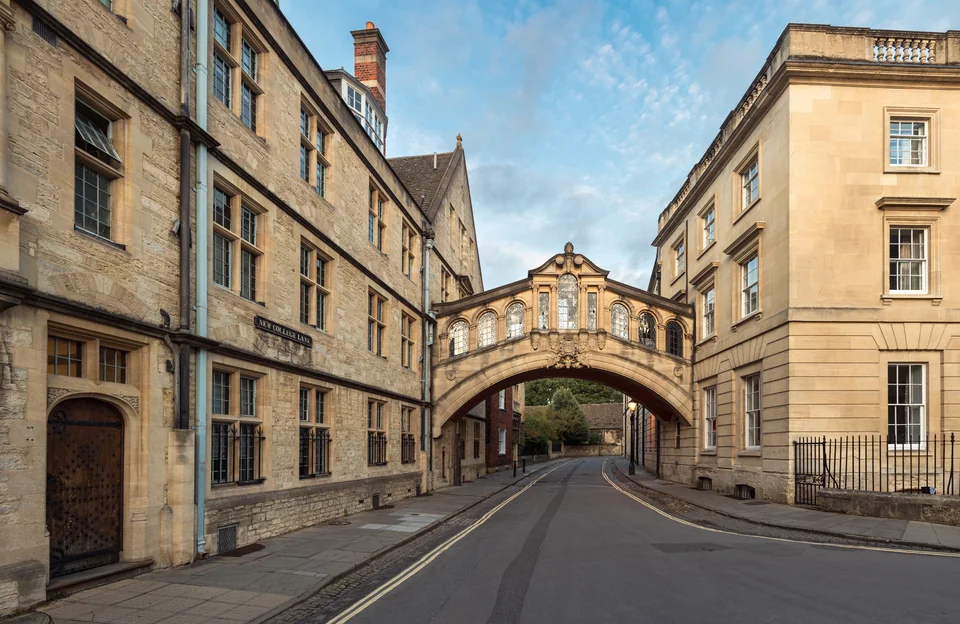
Oxford and Cambridge at a glance, 2027 entry
| Oxford | Cambridge | |
|---|---|---|
| UCAS deadline | 15 Oct 2026, 18:00 | 15 Oct 2026, 18:00 |
| Extra form | None | My Cambridge Application and transcript by 22 Oct 2026 |
| Admissions tests | ESAT, TMUA, TARA, UCAT, LNAT depending on course | ESAT, TMUA, UCAT, LNAT; college assessments for most other courses |
| ESAT/TMUA/TARA booking (2027 entry) | 20 July–28 Sept 2026 via UAT-UK; test 12–16 Oct 2026; $176 (£133) outside the UK | ESAT and TMUA — same dates and fee |
| Written work | Humanities courses, by 10 November | Set by college and course |
| Interviews | December 2026, online | 7–18 December 2026; mostly online for applicants outside the UK |
| Decisions | 12 January 2027 | 27 January 2027 (December interviewees) |
| English | IELTS Academic 7.5, at least 7.0 in each component; IELTS Online not accepted | IELTS Academic 7.5, usually 7.0 in each component |
| International tuition per year | $52,376–88,016 (£39,620–66,580), college services included | $40,714–93,270 (£30,798–70,554) + college fee $16,524–21,085 (£12,500–15,950) |
| Living costs, 9 months | $17,549–25,877 (£13,275–19,575) | $15,824 (£11,970) |
Dollar figures use the ECB reference rate of 24 September 2026 (£1 = $1.322), rounded.
Who can apply from Russia, Kazakhstan and Uzbekistan
The main barrier is the school qualification, not English or money.
- Cambridge states that applicants with the Russian Attestat alone are not competitive and are unlikely to succeed. It lists A-levels, the IB, five AP exams at grade 5 with top grades in every Attestat subject, or possibly a first year of university outside the UK. The same applies to Kazakhstan, where the Nazarbayev Intellectual Schools Grade 12 Certificate is assessed against A-level requirements.
- Oxford lists the Russian, Kazakh and Uzbek school certificates as not accepted, so applicants need further study. It recommends accepted qualifications such as A-levels or the IB rather than a first year at another university, and considers applicants currently at a university abroad only where there are strong reasons to move. A foundation year is accepted only in certain circumstances and must cover the content of any required A-levels. Oxford does not take transfer students: everyone starts in year one.
In practice, the realistic path from the CIS is A-levels or the IB in the last two school years — at an international school at home or a UK school — or an NIS certificate. A foundation year opens many UK universities, including some in the Russell Group, but for Oxford and Cambridge it is a fallback, not the main route. Compare the routes in "UK University After 11 Years of School".
Exact offer conditions are on each course page. The general level:
| Oxford | Cambridge | |
|---|---|---|
| A-level | AAA to A*A*A depending on course | Minimum A*AA or A*A*A |
| IB | 38–40 points including core, with 6s and 7s at Higher Level | 41–42 points with 776 at Higher Level; some colleges ask for 777 or more points |
Meeting these grades gets your application considered; the place itself depends on the test, written work and interviews.
English. Both universities expect IELTS Academic 7.5 with at least 7.0 in each component, or an equivalent result from their list of accepted tests. Oxford does not accept IELTS Online or TOEFL iBT tests taken from 21 January 2026, and does not combine components from different sittings. For a degree-level Student visa the university assesses your English itself, so a separate IELTS for UKVI is not needed. Book early: if there is no suitable session in your city, travel adds time and cost.
What to do if you cannot meet the 2027-entry deadlines
Oxbridge deadlines form a chain, and missing one link usually means moving your application to the next cycle. For 2027 entry:
- LNAT registration closed on 15 September 2026 and UCAT registration on 16 September; Cambridge required UCAT to be taken by 24 September;
- UAT-UK booking for the October sitting of ESAT, TMUA and TARA ran from 20 July to 28 September 2026 and late bookings are not accepted; you can sit a test only once per cycle;
- the UCAS application is due by 15 October 2026, 18:00 UK time, and cannot be sent without a completed reference.
If the test for your course was not booked in time, it is wiser to apply to Oxford or Cambridge in the 2028-entry cycle than to submit an incomplete application. A year gives you time to prepare for the test, improve your English and choose the course more precisely. You can still apply to other UK universities in the same 2027-entry cycle: the equal-consideration deadline for most courses is 13 January 2027, 18:00 UK time. UAT-UK and the universities publish next-cycle dates in advance — check them in the summer before you apply.
Oxford or Cambridge?
Start with the course, not the brand. Some exist at only one university: Philosophy, Politics and Economics (PPE), Economics and Management, History and Economics and Human Sciences at Oxford; Natural Sciences as a single broad course, Human, Social and Political Sciences, Environment, Law and Economics, and Psychological and Behavioural Sciences at Cambridge.
Then compare:
- Test: Cambridge Economics uses TMUA (a maths test); Oxford Economics and Management uses TARA (reasoning and analysis). If maths is your strength, that points to Cambridge, and vice versa.
- Written work: Oxford asks for school essays by 10 November in history, English, classics, theology and several other courses; at Cambridge, courses without a pre-registered test usually have a college assessment. If you write better than you solve timed problems, factor that in.
- Cost: at Cambridge international students pay the university and the college separately. A humanities course with college fee comes to $57,200–61,800 (£43,300–46,700) a year — above Oxford's lowest fee of $52,400 (£39,620); engineering and natural sciences come to $78,500–83,000 (£59,400–62,800). Calculate for your specific course and college.
- Teaching: Oxford's small-group sessions are tutorials, Cambridge's supervisions — similar meetings of one to three students with an academic to discuss work.
How selection works
- Choose a course and a college, or make an open application and let the university allocate you.
- Submit UCAS by 15 October with a three-question personal statement (up to 4,000 characters) and a reference.
- Sit the admissions test if your course requires one. There is no pass mark; scores are read with the rest of the application.
- Extra material: Cambridge — My Cambridge Application and transcript by 22 October; Oxford — written work by 10 November for courses that require it (history, English, classics, theology and others).
- Shortlisting: Oxford notifies candidates at the end of November or start of December; Cambridge sends most invitations in November.
- December interviews. A Cambridge college that cannot offer you a place may put you in the winter pool, with a possible further interview at another college in January.
- Decision: 12 January 2027 (Oxford), 27 January 2027 (Cambridge). Offers to international applicants are almost always conditional on final grades and English; Oxford requires the English condition to be met by 31 July of the offer year.
- Exams and enrolment: A-levels or IB in summer; Cambridge maths offers also involve STEP.
Which admissions test does your course need?
| Test | Oxford | Cambridge |
|---|---|---|
| ESAT | Biomedical Sciences, Engineering Science, Physics, Physics and Philosophy | Chemical Engineering and Biotechnology, Engineering, Natural Sciences, Veterinary Medicine |
| TMUA | Computer Science, Mathematics and joint maths courses | Computer Science, Economics, Mathematics |
| TARA | Economics and Management, PPE, History and Economics, History and Politics, Human Sciences, psychology courses | Not used |
| UCAT | Medicine | Medicine |
| LNAT | Law (Jurisprudence) | Law |
| College assessments | — | Most other courses; CSAT for Computer Science at Peterhouse and Trinity |
ESAT, TMUA and TARA are run by UAT-UK, a collaboration between Cambridge and Imperial College London, and delivered on computer at Pearson test centres worldwide. Outside the UK and Ireland a test costs $176 (£133), and you can sit it only once per cycle. Candidates receive October 2026 results in their UAT-UK account on 16 November.
What happens at the interview?
Interviews are academic conversations about your subject. Tutors give you a problem, text or data and watch how you reason, respond to prompts and revise your view when an argument fails.
- At Cambridge most candidates have one or two interviews totalling 35 minutes to an hour, some three or four. Applicants based outside the UK and Ireland are mostly interviewed online; rescheduling is possible only in exceptional circumstances.
- At Oxford all December 2026 interviews are online.
- For a Cambridge interview, English of at least IELTS 6.5 with 6.0 in each skill is recommended at the point of application.
Preparation: read beyond the syllabus and explain it in your own words, solve past test questions aloud, and do two or three mock interviews with someone who knows the subject. Check your connection and time zone in advance: interviews are scheduled in UK time.
How much does it cost?
| Item | Oxford | Cambridge |
|---|---|---|
| Tuition per year | $52,376–88,016 (£39,620–66,580); clinical medicine higher | $40,714 (£30,798) humanities, economics, law; $45,417 (£34,356) mathematics; $53,270 (£40,296) architecture, geography, music; $61,963 (£46,872) engineering, CS, natural sciences; $93,270 (£70,554) medicine |
| College fee per year | Included | $16,524–21,085 (£12,500–15,950); Trinity's nominal $27,840 (£21,063) is cut by a 30% bursary for everyone to $19,490 (£14,745) |
| Living costs | $1,950–2,875 (£1,475–2,175) per month | $1,758 (£1,330) per month |
| Fee fixed for course? | Fees usually rise annually | Yes, for overseas students |
Example: Cambridge Economics for three years at a college charging $17,200 (£13,000). Tuition plus college is $57,900 (£43,798) a year, about $173,700 over three years; the university's nine-month living estimate adds about $47,500. Total: roughly $221,000 before flights, the $738 visa, the $1,026 annual health surcharge and summer months.
Undergraduate scholarships are scarce. The Reach Oxford Scholarship covers fees, living costs and one return flight a year, but there are only 2–3 awards annually, applications open in January after an offer, and eligibility follows the OECD DAC list — Kazakhstan, Kyrgyzstan, Tajikistan and Uzbekistan are eligible, Russia is not. Cambridge's Foundation Year is designed for UK students: the fee table lists no international fee for it. See "Scholarships in the UK".
Two-year preparation plan
| When | What to do |
|---|---|
| Grades 9–10 | Switch to A-levels or the IB; pick subjects for your course (maths plus physics or chemistry for engineering and sciences) |
| Grade 10 | Read around your subject, compete in olympiads and projects, start IELTS preparation |
| Spring before the final year | Choose course and university; practise past ESAT, TMUA or TARA papers |
| June–September | Book the test (by late September), write the personal statement, secure the reference |
| October | UCAS by 15 October, test 12–16 October, My Cambridge Application by 22 October |
| November–December | Oxford written work by 10 November; interview preparation and interviews |
| January | Decision, alongside replies from your other four universities |
| Spring–summer | Final exams, IELTS at the required level, CAS, visa |
Use your other four UCAS choices for strong but more attainable courses — they are your safety net. See "Applying to UK Universities", the "University of Oxford" and "University of Cambridge" profiles, and the country overview "Study in the UK".
Common mistakes
- Applying with a national school certificate alone. Cambridge calls such applications not competitive.
- Missing the test booking. It is separate from UCAS and closes at the end of September (28 September 2026 for 2027 entry); late bookings are not accepted.
- Choosing the university rather than the course. Tests, written work, fees and even course titles differ.
- Treating the interview like an oral exam. Tutors look at how you reason, not at memorised answers.
- Spending all five UCAS choices on top-tier courses. The other four should be realistic.
- Forgetting the Cambridge college fee. It adds $16,500–21,100 a year for international students.
FAQ
No. In one UCAS cycle you can choose a course at only one of them, with a narrow exception for graduate medicine. Your other four choices can go to other universities.
Practically not with the certificate alone. Cambridge calls such applications not competitive and suggests A-levels, the IB, five top-grade APs or possibly a first year at university. Oxford recommends A-levels or the IB and does not accept transfers.
ESAT for engineering, physics and sciences; TMUA for maths, computer science and Cambridge economics; TARA for PPE, Economics and Management and several history and social-science courses at Oxford; UCAT for medicine; LNAT for law. For 2027 entry, booking for ESAT, TMUA and TARA closed on 28 September 2026 and the tests run on 12–16 October at Pearson centres. UAT-UK publishes next-cycle dates in advance.
Yes. Oxford's December 2026 interviews are all online. At Cambridge, applicants based outside the UK and Ireland are mostly interviewed online, depending on college and course.
Oxford: $52,400–88,000 (£39,620–66,580) a year for 2027 entry, including college services, with clinical medicine higher. Cambridge: $40,700–93,300 (£30,798–70,554) plus a college fee of $16,500–21,100. Living costs: about $15,800–25,900 for nine months.
Both expect IELTS Academic 7.5 with at least 7.0 in each component. Oxford does not accept IELTS Online or combine components from different sittings, and the result must be in by 31 July of the offer year even for deferred entry. For a Cambridge interview, around IELTS 6.5 (6.0 per component) at the point of application is enough.
Full undergraduate scholarships are rare. Reach Oxford is open to nationals of countries on the OECD DAC list — Kazakhstan, Kyrgyzstan, Tajikistan and Uzbekistan among them, Russia not — and the 2027-entry deadline is 26 January 2027. For other options, see "Scholarships in the UK".
Sources
- University of Cambridge: 2027 dates, international requirements, admissions assessments, interviews, English, 2027 fees, living costs
- University of Cambridge: A-level and IB requirements, 2027–28 college fees (PDF)
- University of Oxford: admissions tests, written work, guide for applicants, UK qualifications, international qualifications, English requirements, 2027 fees, living costs, Reach Oxford
- UAT-UK (ESAT, TMUA, TARA): 2027-entry dates and fees
- UCAS: 2027 dates, Oxford or Cambridge rule
- GOV.UK: Student visa, IHS
- Exchange rate: ECB reference rate, 24 September 2026 — £1 = $1.322.
During the free initial consultation, we clarify your goal, profile, timing, and budget and identify the next realistic step. Request an initial consultation.
Next steps
- UK University After 11 Years of School: Entry Routes That Actually Work
- Applying to UK Universities for 2027: A Step-by-Step Plan for International Students
- University of Oxford
- University of Cambridge
- Studying in the UK for international applicants
- Scholarships in the UK in 2026: Chevening, Gates Cambridge, Clarendon and University Awards — What Applicants from Russia, Kazakhstan and Central Asia Can Get
