
The Community of Madrid has six public universities: Complutense (UCM), the Autonomous University (UAM), Carlos III (UC3M), the Polytechnic University (UPM), Rey Juan Carlos (URJC) and the University of Alcalá (UAH). For bachelor's degrees they admit through one shared application, the Distrito Único de Madrid (single district). Large private universities such as Comillas, CEU San Pablo, Universidad Europea and Nebrija operate alongside them.
For a non-EU student, a Madrid public university costs more than, for example, UAB in Barcelona. Without Spanish residence you pay the "fourth enrolment" rate: from $7,750 (€6,823) a year for law or economics to $9,300 (€8,186) for medicine. Most programmes require Spanish at B2 or above. In return you get an almost entirely Spanish-speaking environment, the widest programme choice in the country and English-taught groups at UC3M.
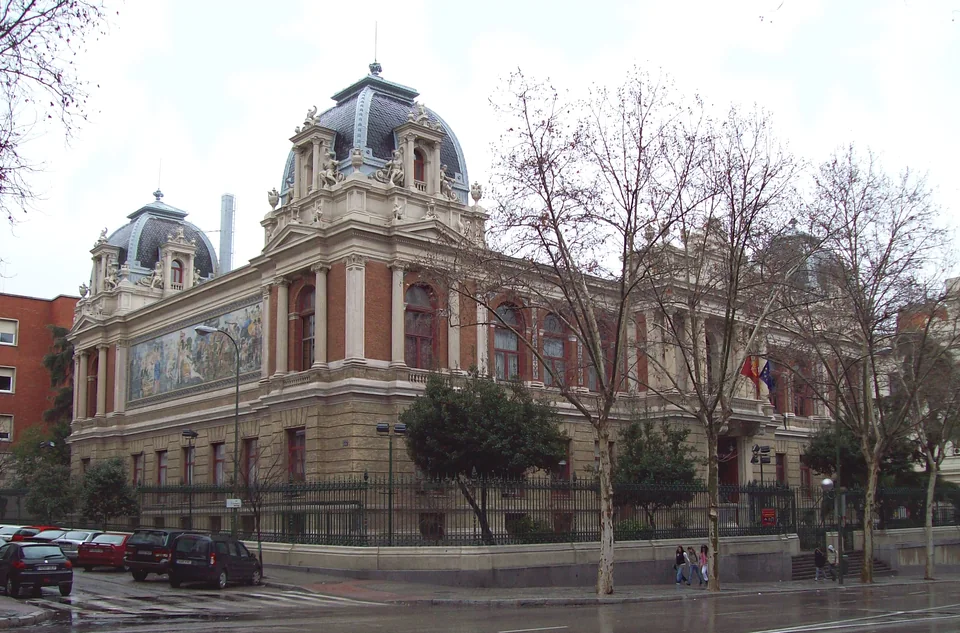
Madrid's six public universities
| University | Main campuses | Students / international share | THE 2026 | Strengths |
|---|---|---|---|---|
| Complutense (UCM) | Moncloa (Ciudad Universitaria), Somosaguas | ~58,000 / 16% | 501–600 | Medicine, pharmacy, veterinary science, psychology, law, languages; the widest choice |
| Autonomous University of Madrid (UAM) | Cantoblanco (north Madrid); medicine in the city | ~30,000 / 14% | 351–400 | Sciences, medicine, psychology, economics |
| Carlos III University (UC3M) | Getafe, Leganés, Colmenarejo, Puerta de Toledo | ~18,000 / 18% | 801–1000 | Law, economics, business, engineering; many English-taught programmes |
| Polytechnic University of Madrid (UPM) | Ciudad Universitaria, south campus, Montegancedo | ~40,000 / 16% | 1001–1200 | Aerospace, industrial and telecommunications engineering, architecture |
| Rey Juan Carlos University (URJC) | Móstoles, Alcorcón, Fuenlabrada, Aranjuez, Vicálvaro | ~39,000 / 6% | 1201–1500 | Communication, business, health, tourism; many campuses |
| University of Alcalá (UAH) | Alcalá de Henares, Guadalajara | ~16,000 / 22% | 801–1000 | Medicine, pharmacy, languages, economics |
Student numbers and international shares come from THE data and are rounded. The campus matters more than it seems: UC3M, URJC and UAH sit in separate towns of the metropolitan area, reached from central Madrid by commuter train or bus.
Private universities and business schools
Madrid has more private universities than any other region. Those best known to international students include:
- Universidad Pontificia Comillas: law and economics (ICADE), engineering (ICAI), international relations;
- Universidad CEU San Pablo: medicine, pharmacy, dentistry, law, communication;
- Universidad Europea de Madrid: medicine, dentistry, sport, business; THE puts its international share at 38%. Even at a private university medicine may be taught in Spanish: Universidad Europea teaches first-year medicine in Madrid in Spanish;
- Universidad Nebrija, Universidad Francisco de Vitoria, Universidad Camilo José Cela, ESIC: business, communication, design, psychology;
- IE University (campuses in Madrid and Segovia) and business schools with English-taught programmes.
The fee schedules the universities published in September 2026 show the price level:
| University and programme | First-year price | What it covers |
|---|---|---|
| CEU San Pablo, medicine (Spanish or bilingual group), 2026/27 | $22,140 (€19,500) + $1,930 (€1,700) enrolment fee | 60 credits at $370 (€325); one-off reservation fee of $3,750 (€3,300) on entry |
| Francisco de Vitoria, medicine in Spanish, 2026/27 | $24,790 (€21,830) | tuition; admission tests ($195, €170) and the reservation fee are paid separately |
| Comillas (ICADE), business administration | $16,390 (€14,437.66) | enrolment fee plus 9 monthly instalments |
| Comillas (ICADE), law | $17,150 (€15,105.30) | enrolment fee plus 9 monthly instalments |
Private universities select their own students, often without PCE: an interview, a test and school grades. An official degree still requires your school certificate to be recognised in Spain. Check that the degree is official (listed in the RUCT register) and that the teaching language is stated in the course plan, not just in marketing. For a full comparison see public or private universities in Spain.
Tuition at Madrid's public universities
Fees are set by a Community of Madrid decree. Non-EU students without resident status pay the price of a "fourth and subsequent enrolment" in each course. A student stay permit does not make you a resident for this purpose.
| Experimental level | Example programmes | Resident or EU national, per credit | Non-EU national, per credit | 60 credits for a non-EU student |
|---|---|---|---|---|
| 1 | Medicine, biology, chemistry, nursing, biomedical engineering | $25 (€20.68) | $155 (€136.44) | $9,300 (€8,186) |
| 2 | Computer science, physics, telecommunications, data science | $20 (€19.43) | $145 (€128.57) | $8,760 (€7,714) |
| 3 | Law, economics, business, psychology, languages, international studies | $19.20 (€16.92) | $130 (€113.71) | $7,750 (€6,823) |
Figures come from UAM's tables under the Community of Madrid's current Decree 43/2022, which binds all six public universities in the region; Moroccan nationals pay resident rates under it. The figures exclude fees, which are small: at UAM, $30 (€27.54) to open your file, $6.95 (€6.11) for administration and $1.25 (€1.12) for insurance. Double degrees are priced at the average of the two levels.
In practice, four years of business administration at a Madrid public university cost a non-EU student about $30,990 (€27,290) in tuition alone, and six years of medicine about $55,770 (€49,118). The same medicine degree at UAB in Barcelona, which charges non-EU bachelor's students no surcharge, costs about $7,230 (€6,368) in credits over six years if you pass every course first time. That difference sometimes decides the city. Not every Catalan university is that cheap, though: UPF's first year costs a non-EU student about $7,720 (€6,800).
Living costs are also high. For the visa, consulates require at least 100% of IPREM, $680 (€600) for each month of stay in 2026, but real costs are higher. Idealista's figures for the second quarter of 2026 put the average room in a shared flat in Madrid at $625 (€550) a month and a one-bedroom flat at $1,450 (€1,277). A place in a Complutense residential college (colegio mayor) with meals costs $1,230 (€1,081.70) a month in 2026/27 for UCM students, plus a $510 (€450) deposit that is credited against the first payment. See the cost of studying in Spain and student housing.
Spanish B2: Madrid's key requirement
For most programmes at Madrid's public universities, a national of a non-Spanish-speaking country who did not attend school in Spanish must prove Spanish at B2 or higher. Accepted proof:
- a DELE diploma;
- a SIELE certificate;
- an official language school (EOI) certificate;
- a certificate from the language centre of one of Madrid's six public universities;
- B2 shown on the UNEDasiss accreditation.
The first four can be attached directly to the application. Graduates of bilingual Spanish sections in schools in several countries, including Russia, who are entitled to the Spanish Bachiller, have a simplified route: UNEDasiss accreditation or a certificate from the school director. See DELE and SIELE Spanish exams for the differences and dates. If B2 is far away, UAM, for example, runs a one-year "Puente a la UAM" programme with 14 hours of intensive Spanish a week, PCE preparation and the SIELE exam; the bachelor's track costs $9,080 (€8,000) for 2026/27. See Spanish language courses in Spain.
Bachelor's admission in Madrid
- Recognition of your school certificate at Spain's Ministry of Education; while it is pending, the application receipt is enough.
- UNEDasiss accreditation with your access score; in 2026 applications opened on 4 February.
- PCE exams to raise your score above 10. Madrid's universities publish weighting tables: a subject weighted 0.2 is worth twice one weighted 0.1. UAM has already published its 2027/28 table (dated 9 June 2026).
- One application to the Distrito Único. You rank programmes from all six universities in order of preference. For applicants from non-EU systems, the 2026 window stayed open until 7 July, and missing documents were accepted until 31 July.
- Proof of B2 and payment of enrolment (matrícula) once lists are published.
Applicants with only a recognised certificate and no PAU or PCE form a separate group in Madrid ("Grupo 6") and compete only in the extraordinary round. In 2026/27 there were no places for this group in many popular programmes, including medicine at UCM. For the full process see applying to Spanish universities.
Cut-off marks 2026/27 at Madrid's public universities
Score of the last student admitted in the main round in the PAU/PCE group, on the 14-point scale.
| Programme | UCM | UAM | UC3M | UPM | UAH | URJC |
|---|---|---|---|---|---|---|
| Medicine | 13.053 | 12.950 | — | — | 12.824 | 12.889 (Alcorcón) |
| Business administration | 9.433 | 10.300 | 11.566 (Spanish/English) | — | 9.170 | — |
| Law | 8.154 | 9.880 | 11.613 | — | 8.016 | — |
| Economics | 8.886 | 9.970 | 11.508 (Spanish/English) | — | 7.895 | — |
| Psychology | 10.544 | 11.070 | — | — | 9.069 | — |
| Computer engineering | 10.492 | 10.531 | — | 9.994 | 10.483 | — |
| International relations / studies | 11.379 | 11.273 | 12.267 (English) | — | — | — |
| Aerospace engineering | — | — | 13.322 (English) | 12.432 | — | — |
URJC appears only for medicine: it has many campuses, and cut-offs for the same programme vary widely (some programmes in Aranjuez and Fuenlabrada had a cut-off of 5). Compare the specific campus.
English-taught programmes at public universities
UC3M has the most. Examples with 2026/27 cut-offs: aerospace engineering (13.322), neuroscience (13.043), international studies and business administration (13.010), business and technology (12.444), international studies (12.267) and data science (11.677). UCM teaches business administration (10.667) and economics (9.615) in English, UAM has a bilingual economics group (9.754), and UAH offers economics and international business (10.673). An English-taught programme still ranks by score. The B2 rule is written for most programmes, so ask admissions whether Spanish is required for the English-taught group you choose. See English-taught degrees in Spain.
Timeline for 2027/28
The 2027 dates will be published in spring. Based on the 2026 cycle:
| When | What to do |
|---|---|
| Autumn 2026 | Shortlist Distrito Único programmes; check campus, language and the 2027/28 PCE weighting table |
| By February 2027 | Apply for recognition of your certificate; start preparing for DELE or SIELE B2 |
| February – April 2027 | UNEDasiss application; register for the spring PCE session (until 28 April in 2026) |
| By April 2027 | Prove B2: DELE in November 2026 (register by 30 September) or on 2 April 2027 (results in about two months; Moscow ran no April session in 2026) or SIELE, with results within three weeks |
| May 2027 | PCE (25–29 May in Spain in 2026) |
| June – 7 July 2027 | Application to the Distrito Único, private universities in parallel |
| July 2027 | Admission lists (by 15 July in 2026), enrolment payment |
| July – August 2027 | Student visa: apply at least two months before classes start |
Who Madrid suits, and when to look elsewhere
| Situation | Advice |
|---|---|
| You want to study in Spanish in the capital | Madrid is the natural choice; prepare B2 and PCE |
| Tuition budget is tight | Compare with Catalonia: at UAB a bachelor's year costs about $1,210 for non-EU students too, instead of $6,800–9,300. UPF and UPC set their own, higher rates for non-resident non-EU students. See universities in Barcelona, University of Barcelona, UAB and Pompeu Fabra |
| Engineering or aerospace | UPM and UC3M |
| Economics, business or international relations in English | UC3M, English-taught groups at UCM |
| A Spanish-speaking university with lower living costs | University of Valencia, University of Granada, University of Salamanca |
| English-taught business or hospitality without PCE | Private schools: EU Business School, GBSB Global Business School, Les Roches Marbella |
For the country overview, visas and budgets see studying in Spain; for a comparison of the main universities see universities in Spain for international students.
Which mistakes to avoid
- Budgeting with the local price. The non-EU rate is six to seven times higher, and a student card does not reduce it.
- Proving B2 too late. Without DELE, SIELE or B2 on the UNEDasiss accreditation, a Spanish-taught application will not be accepted.
- Applying without PCE. "Grupo 6" rarely gets places in popular programmes.
- Ignoring the campus. UC3M, URJC and UAH are outside central Madrid, and URJC's cut-offs and programmes differ by campus.
- Assuming a private university teaches in English. The course plan states the language, and even private medicine may be taught in Spanish.
- Leaving the visa late. The consulate asks for the application two months before classes start; in Moscow you apply through BLS visa centres. See the student visa for Spain.
FAQ
Six: Complutense, the Autonomous University of Madrid, Carlos III, the Polytechnic University, Rey Juan Carlos and the University of Alcalá. They admit bachelor's students through one application to the Distrito Único de Madrid. UNED, the national distance university, is based in Madrid but is not part of the single district.
For a non-EU national without residence in 2026/27, $130 to $155 (€113.71 to €136.44) per credit, or $7,750–9,300 (€6,823–8,186) for 60 credits before fees.
For most public university programmes, yes, if you come from a non-Spanish-speaking country and did not attend school in Spanish. DELE, SIELE, an EOI or Madrid university language-centre certificate, or B2 on the UNEDasiss accreditation are accepted.
In the 2026/27 main round: UCM 13.053, UAM 12.950, URJC 12.889 and UAH 12.824 on the 14-point scale.
Yes, mostly at UC3M: engineering, data science, international studies and business. UCM teaches business administration and economics in English, and UAH offers economics and international business.
Under the 2026/27 fee schedules, medicine costs $22,140 (€19,500) a year plus an enrolment fee at CEU San Pablo and $24,790 (€21,830) at Francisco de Vitoria. Business administration at Comillas (ICADE) costs about $16,390 (€14,438) a year. Accommodation is extra.
Yes. One Distrito Único application covers all six public universities, ranked by preference. Private universities require separate applications.
Sources
- UAM — fees for international students under the Madrid decree
- UAM — credit prices by programme 2026/27
- UAM — non-EU education systems, Spanish B2 requirement
- UAM — place allocation and weighting tables 2026/27 and 2027/28
- UAM — Puente a la UAM programme 2026/27
- Madrid single district — cut-off marks 2026/27
- UCM — cut-off marks 2026/27 and access groups
- Universidad Europea — medicine degree in Madrid
- CEU San Pablo — medicine, 2026/27 prices
- Universidad Francisco de Vitoria — medicine, 2026/27 price
- Comillas — business administration (ICADE), price
- Comillas — law (ICADE), price
- UCM — residential colleges, 2026/27 prices
- UAM — other fees (file opening, administration, insurance)
- Idealista — average rents, Q2 2026
- UNEDasiss — key dates 2026
- BOE — application deadlines at public universities for 2026/27
- Instituto Cervantes — DELE dates 2026 and 2027
- Times Higher Education — World University Rankings 2026
- Consulate General of Spain in Moscow — student visa
Dollar amounts use the ECB rate of 29 September 2026 (€1 = $1.1355) and are rounded.
During the free initial consultation, we clarify your goal, profile, timing, and budget and identify the next realistic step. Apply
Next steps
- DELE and SIELE Spanish Exams: 2026–2027 Dates, Fees and the Level You Need to Study in Spain
- Public or Private University in Spain? A 2027 Guide for International Students
- English-Taught Degrees in Spain: Where to Study Without Spanish and What It Costs in 2027
- Applying to Spanish Universities: A Step-by-Step Plan for Non-EU Applicants in 2027
- Studying in Spain for international applicants
- EU Business School (Barcelona)
