
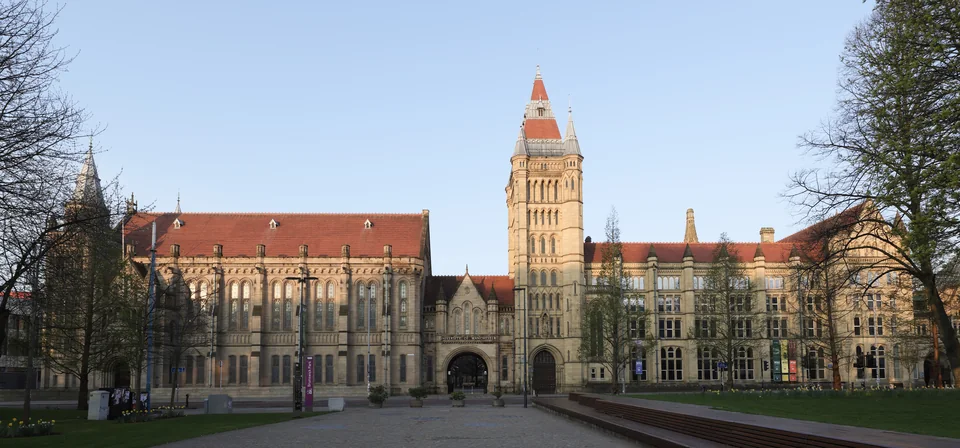
The University of Manchester is a large Russell Group research university in the centre of Manchester, ranked joint 40th in the QS World University Rankings 2027, 56th in THE 2026 and 51st in ARWU 2026. Applicants with a Russian Attestat or a Kazakh High School Diploma cannot enter Year 1 directly: they first need a foundation programme recognised by the University, A-levels or the IB. Fees for 2027 entry have not yet been set; in 2026/27 international undergraduates paid, for example, $37,540 (£28,400) a year for law and $49,970 (£37,800) for computer science. Undergraduate applications go through UCAS by 13 January 2027, or by 15 October 2026 for medicine and dentistry.
It is a different institution from Manchester Metropolitan University, which is also in Manchester but has its own requirements and fees.
| At a glance | Details |
|---|---|
| Location | Manchester, England; city-centre campus on Oxford Road |
| History | roots in 1824; the current university was formed in 2004 by merging the Victoria University of Manchester and UMIST |
| Rankings | QS 2027: 40; THE 2026: 56; ARWU 2026: 51 |
| Structure | 3 faculties: Biology, Medicine and Health; Science and Engineering; Humanities |
| Route after a Russian or Kazakh school | foundation only: the University's integrated year or INTO Manchester; Attestat of 4.0/5.0 or higher |
| International undergraduate fee, 2026/27 (examples) | from $37,540 (£28,400) for law to $49,970 (£37,800) for computer science a year; 2027 fees not yet set; later years may rise by up to 7% a year |
| Master's, 2026/27 (examples; 2027 fees not yet set) | MSc Economics and Data Science: $44,420 (£33,600); MSc Finance: $49,970 (£37,800) |
| UCAS deadlines for autumn 2027 | 15 October 2026 (medicine, dentistry); 13 January 2027 (other courses) |
| Accommodation | hall place offered to new undergraduates who apply by 31 August; $640–1,400 (£487–1,060) a month self-catered |
| Global Futures Scholarship | not open to residents of Russia, Kazakhstan or Uzbekistan for 2027 entry |
Who Manchester suits and when to look elsewhere
| Strengths | Limitations |
|---|---|
| One of the highest-ranked universities outside London, Oxford and Cambridge (QS 2027: 40th) | A Russian or Kazakh school certificate does not give direct Year 1 entry |
| Big student city with one of the most diverse student communities in the UK | The INTO foundation costs $36,350–38,330 (£27,495–28,995) in 2026/27, close to a degree year |
| Two in-house foundation routes plus INTO, which guarantees an offer if you reach the required grades | International applicants to medicine and dentistry need A-levels or the IB |
| First-year students who apply for halls by the deadline are offered a room | The flagship Global Futures Scholarship excludes our region |
| Strong engineering, materials, computer science, and the triple-accredited Alliance Manchester Business School | International fees may rise by up to 7% a year; Leeds and Sheffield fix theirs for the whole course |
Manchester makes sense if you want strong engineering, chemistry, materials science, computer science, economics, business or pharmacy and accept an extra preparation year. On a tighter budget, compare it with Leeds and Sheffield, where international fees stay the same for the whole degree and Sheffield adds an automatic $3,300 (£2,500) annual discount. The wider route into UK universities is covered on our study in the UK page and in the Russell Group guide.
Faculties and subjects
The University has three faculties, each made up of schools that set their own entry requirements.
- Science and Engineering: physics and astronomy, chemistry, mathematics, earth sciences, computer science, mechanical, aerospace, civil, chemical and electrical engineering, materials. A $530 million (£400 million) engineering building opened in 2022, and the Henry Royce Institute, the UK's national institute for advanced materials, is on campus.
- Biology, Medicine and Health: biological and biomedical sciences, medicine, dentistry, pharmacy, nursing, psychology, optometry.
- Humanities: economics, law, politics, sociology, history, languages, architecture, education, and Alliance Manchester Business School (AMBS), accredited by AACSB, AMBA and EQUIS.
The University's page for Russian applicants lists the subjects they most often choose: accounting and finance, architecture, business and management, chemical engineering, chemistry, computer science, economics, electrical engineering, materials, mathematics, mechanical and aerospace engineering, politics, and pharmacy.
Undergraduate entry with a Russian, Kazakh or Uzbek school certificate
Why the school certificate is not enough
UK secondary education lasts a year longer and ends with two years of three or four A-level subjects. Manchester therefore states that applicants with the Russian Attestat or the Kazakh High School Diploma must complete a University-recognised foundation programme first. Direct Year 1 entry is possible with A-levels or the IB and, for Kazakhstan, with the Nazarbayev Intellectual Schools (NIS) Grade 12 Certificate. Manchester has no separate page for Uzbekistan, but INTO Manchester accepts Uzbek school leavers onto its foundation, so the route is the same.
A less common option: the University considers Year 1 applicants who have completed at least two years of a Russian Specialist Diploma or Bakalavr with an average of 4 ("good") or higher. It only makes sense for students already at university.
Three foundation routes
- Integrated foundation year in science and engineering. A Year 0 on campus that leads into a four- or five-year science or engineering degree. For Russia and Kazakhstan the University asks for an overall Attestat of 4.0/5.0 with at least 4.0 in mathematics and physics, plus IELTS 6.0 with 5.5 in each component. You apply through UCAS as a separate course; applying for Year 1 as well counts as a second UCAS choice.
- Biosciences with a Foundation Year. An integrated year for biological and biomedical sciences. Applications after the Attestat are considered case by case; English is IELTS 6.5 with 6.5 in each component. The 2026/27 international fee was the full degree rate of $47,850 (£36,200).
- INTO Manchester. A partner study centre next to campus with pathways in engineering and science, computer science, humanities and social sciences (including management and law), biosciences, pharmacy and psychology. The University describes it as the only external foundation that guarantees an offer or interview if you achieve the required grades. Russian and Kazakh applicants need an Attestat of 4.0 or higher and IELTS 5.5 (5.5 in writing). Courses start in September or January and last three or four terms depending on the option; September starters must be 17 by 31 December of that year.
| Route | School grades | English | Cost of the preparation year | Leads to |
|---|---|---|---|---|
| Integrated science and engineering year | 4.0+, maths and physics 4.0+ | IELTS 6.0 (5.5 each) | the fee shown on the course page | Year 1 science or engineering |
| Biosciences with a Foundation Year | case by case | IELTS 6.5 (6.5 each) | $47,850 (£36,200) in 2026/27 | biological and biomedical degrees |
| INTO Manchester | 4.0+ | IELTS 5.5 (writing 5.5) | $36,350–38,330 (£27,495–28,995) plus fees, 2026/27 | Year 1, subject to foundation grades |
INTO prices are for 2026/27. On top of tuition, the centre charges a $360 (£275) enrolment fee, textbooks and, on some pathways, a lab fee. Students who confirm an offer by 30 November 2026 keep the 2026/27 price; after that date offers are reissued at 2027/28 prices. For background, see our guide to foundation years in the UK.
English requirements
The UK Student visa requires at least CEFR B2, but most schools ask for more. Examples from official course pages: economics needs IELTS 6.5 with no component below 6.0, computer science 6.5 in every component, and law 7.0 with at least 6.5 in each. Of the IELTS variants, Manchester accepts only IELTS Academic and IELTS for UKVI taken in person at an official centre; IELTS Online, IELTS Home and IELTS Indicator are not accepted. Other tests are also accepted, for example PTE Academic taken at a test centre (the online and home versions of PTE are not). Scores are valid for two years and must still be valid on the first day of Welcome Week. A standalone foundation requires a UKVI-approved Secure English Language Test (SELT). See our guide to English tests for the UK Student visa.
Deadlines for 2027 entry
| Stage | Date |
|---|---|
| UCAS accepts completed applications | from 1 September 2026 |
| Medicine and dentistry (A-levels or IB only) | 15 October 2026, 18:00 UK time |
| Other courses, equal consideration | 13 January 2027, 18:00 UK time |
| Late applications, if places remain | until 30 June 2027 |
| INTO Manchester start dates | 14 September 2026 or 11 January 2027 (2026/27 intake) |
Manchester's UCAS institution code is M20. The Department of Computer Science lets you hold only one offer for Year 1, so two applications there waste two of your five UCAS choices. The application itself is explained in our guide to applying to UK universities.
Timeline for 2026–2027
- Autumn 2026. Choose between the integrated year, INTO and A-levels or the IB. Check that your average reaches 4.0 and that your maths and physics grades qualify.
- By the end of 2026. Take the right version of IELTS. If you choose INTO, confirm by 30 November to keep the 2026/27 price.
- By 13 January 2027. Submit your UCAS application for an integrated year; INTO applications go directly to the centre.
- February–May 2027. Receive decisions and offer conditions, then choose your firm and insurance offers.
- By 31 August 2027. Apply for halls to keep the accommodation guarantee.
- Summer 2027. Once you meet your conditions, the University issues a CAS (Confirmation of Acceptance for Studies) for your Student visa.
Master's and PhD admission
Master's applications go directly to the University through its online form, not UCAS. Applications for 2027/28 open on 10 October 2026. Many courses have no fixed closing date, but some do, and competitive courses close when they fill.
- Russia: a four-year Bakalavr or Specialist Diploma with an average of at least 4.
- Kazakhstan: a four-year bachelor's degree with a GPA of at least 3.4/4.0, 3.7/4.33 or 4.25/5.0.
- Documents: degree certificates and transcripts with official English translations, proof of English and, for some courses, two references and a personal statement.
Fees for 2027/28 have not yet been set; as a guide, international students starting in September 2026 paid $44,420 (£33,600) for the MSc Economics and Data Science and $49,970 (£37,800) for the MSc Finance. Some courses use staged deadlines: for the MSc Economics and Data Science, stage one closes on 6 December 2026 and stage two on 1 March 2027. The business school charges an $80 (£60) application fee and, after an offer, a $3,300 (£2,500) deposit that counts towards tuition. PhD applicants submit a research proposal, and the University recommends contacting a potential supervisor first; Russian applicants are usually expected to hold a Magistr with distinction or a Kandidat nauk.
Tuition fees
Manchester has not yet published international fees for 2027 entry, so use 2026/27 as a guide. Fees are per year, and the University may raise them by up to 7% a year for later years of the course.
| Course, 2026/27 | International fee per year |
|---|---|
| LLB Law | $37,540 (£28,400) |
| BSc Economics | $43,760 (£33,100) |
| Biosciences with a Foundation Year | $47,850 (£36,200) |
| BSc Computer Science | $49,970 (£37,800) |
Tuition covers registration, teaching, supervision, examinations and graduation, plus access to the library, the Students' Union and careers and counselling services. Accommodation, food, the visa and the health surcharge are extra. See our overview of the cost of studying in the UK.
Accommodation
New undergraduates and international postgraduates receive one offer of a room in University halls if they come alone, meet their offer conditions, apply for accommodation and firmly accept an unconditional place by 31 August of the year of entry (the 2026/27 deadline; 2027/28 dates will be updated in early 2027). International students who start with the University's integrated foundation year are offered University accommodation for the whole of their studies if they apply on time. In 2025/26, 88% of students were offered a room in one of their five preferred halls.
| Option | Monthly cost | Included |
|---|---|---|
| Catered University halls | $730–1,300 (£555–982) | meals, utilities, internet, contents insurance |
| Self-catered University halls | $640–1,400 (£487–1,060); studios for master's students up to $1,660 (£1,255) | utilities, internet, contents insurance |
| Private halls | $1,140–1,340 (£860–1,010) | usually bills and internet |
| Room in a shared house | $850–940 (£645–710) | depends on the landlord |
Self-catered University halls cost $6,420–15,990 (£4,853–12,096) a year. Undergraduate hall contracts run for 41–42 weeks; private houses usually for 52. Halls are grouped in three areas: City (10 minutes' walk from campus), Victoria Park (18 minutes) and Fallowfield (about 30 minutes on foot or 15 by bus). More in our guide to student housing in the UK.
Living costs
The University's 2026/27 budget for an undergraduate (41 weeks) is $19,620 (£14,840) in catered halls or $19,870 (£15,030) self-catered. It includes accommodation of about $10,710–10,960 (£8,100–8,290), groceries of $3,300 (£2,500), transport of $930 (£700) and socialising of $1,450 (£1,100), plus phone, clothes, course materials and trips.
For the visa you must show $1,550 (£1,171) for each month of study outside London, up to nine months, which is $13,930 (£10,539), plus any unpaid first-year tuition. The money must be held for at least 28 consecutive days. Payments from Russia must use legal routes only; see how to pay for studies abroad from Russia.
Scholarships for applicants from Russia and Central Asia
- Global Futures Scholarship. For 2027 entry Manchester offers more than 350 partial awards worth over $7.9 million (£6 million) in total, but only to residents of listed countries. Russia, Kazakhstan and Uzbekistan are not on the list, so do not budget for it.
- Sport scholarships. Open to all students and cover training support, gym access and physiotherapy; they require a strong sporting record.
- Master's awards. Women in STEM, the Carbon Reduction Scholarship and course- or country-specific schemes; check each set of terms.
- Chevening. UK government scholarships for master's study. For 2027/28, Russian citizens may apply only if they live outside Russia; applications close on 6 October 2026 at 11:00 UTC. Residents of Kazakhstan and Uzbekistan apply under their own country's rules.
The University or the funding body makes every award decision. See our overview of scholarships in the UK.
Visa and work after graduation
You apply for a Student visa after receiving your CAS. The visa fee from outside the UK is $740 (£558), and the Immigration Health Surcharge is $1,030 (£776) per year of leave. You can apply up to six months before the course starts; UK Visas and Immigration makes the decision. Degree-level students may work limited hours during term. After graduating you can switch to the Graduate visa, which lasts 18 months for applications made on or after 1 January 2027. More in our guides to the UK Student visa and the Graduate route.
Pros and cons for applicants from Russia and Central Asia
What helps:
- the school-grade threshold is published and clear: 4.0/5.0 for INTO and the integrated year;
- INTO accepts IELTS 5.5 and guarantees an offer if you achieve the required grades;
- NIS graduates from Kazakhstan can enter Year 1 directly;
- halls are guaranteed if you meet the deadline;
- a large international community makes the first months easier.
What makes it harder:
- the foundation year adds $36,000–48,000 and another year of UK living costs;
- medicine and dentistry require A-levels or the IB;
- Global Futures excludes the region, and there is no automatic discount like Sheffield's;
- law requires IELTS 7.0 with at least 6.5 in each component, and computer science 6.5 in every component;
- paying pound-denominated fees from Russia needs a legal payment route planned in advance.
Mistakes to avoid
- Applying to Year 1 with only a school certificate. You need a foundation, A-levels or the IB.
- Taking IELTS Online. Manchester does not accept it, nor IELTS Indicator.
- Counting on Global Futures. It is not open to Russia, Kazakhstan or Uzbekistan for 2027.
- Applying twice to computer science. Only one application is considered and a UCAS choice is lost.
- Missing the halls deadline. The guarantee requires an application by 31 August.
- Confusing Manchester with Manchester Metropolitan. They are separate universities.
Checklist before applying
- A route is chosen (integrated year, INTO, or A-levels/IB) and the Attestat average is at least 4.0.
- For science and engineering, maths and physics grades are at least 4.
- IELTS Academic or UKVI is taken in person and will be valid on the first day of Welcome Week.
- The personal statement explains why this specific course, not just the University.
- The reference comes from a teacher who knows your work.
- The budget covers tuition, accommodation and $13,930 (£10,539) of visa maintenance funds.
- The halls application is in your calendar for summer 2027.
Rankings
| Ranking | Position |
|---|---|
| QS World University Rankings 2027 | =40 (7th in the UK) |
| THE World University Rankings 2026 | 56 |
| ARWU 2026 | 51 |
| THE Sustainability Impact Ratings 2026 | 1 |
FAQ
Can I enter the University of Manchester after 11 years of school?
Not directly into Year 1. With a Russian Attestat averaging 4.0 or more you can take the integrated science and engineering foundation year or an INTO Manchester foundation and then progress to Year 1.
How much does Manchester cost for international students?
It depends on the course: in 2026/27 law cost $37,540 (£28,400) a year, economics $43,760 (£33,100) and computer science $49,970 (£37,800). 2027 fees are not yet set, and later years may rise by up to 7% annually.
What IELTS score do I need?
5.5 for INTO, 6.0 for the integrated year, 6.5 for most degrees and 7.0 for law. Of the IELTS variants, only in-person IELTS Academic or UKVI counts; other tests on the University's list, such as test-centre PTE Academic, are also accepted.
Is the Global Futures Scholarship open to students from Russia or Kazakhstan?
Not for 2027 entry: those countries are not on the list. Sport scholarships, some master's awards and Chevening (for master's study) remain options.
How is the University of Manchester different from Manchester Metropolitan?
They are separate institutions. The University of Manchester is a Russell Group research university ranked 40th in QS 2027; Manchester Metropolitan University has its own requirements and fees.
Can I count on a room in University halls?
Yes, for new undergraduates and international postgraduates who come alone, meet their offer conditions and apply for accommodation by 31 August of the year of entry.
Can StudyU help with applying to Manchester?
Under a paid agreement we help you choose between the integrated year, INTO and other routes, plan IELTS and UCAS deadlines, and prepare your personal statement, documents and visa application. The University decides on admission, the University or funder on scholarships, and UK Visas and Immigration on the visa.
Sources
- University of Manchester: Russia entry requirements
- University of Manchester: Kazakhstan entry requirements
- University of Manchester: Information for students from Russia (rankings)
- University of Manchester: Foundation courses for international students
- INTO Manchester: International Foundation programmes
- University of Manchester: English language requirements
- University of Manchester: BSc Computer Science, 2026 entry
- University of Manchester: BSc Computer Science, 2027 entry
- University of Manchester: BSc Economics
- University of Manchester: LLB Law
- University of Manchester: Biosciences with a Foundation Year
- University of Manchester: Standard tuition fees
- University of Manchester: MSc Finance (2027 entry)
- University of Manchester: MSc Economics and Data Science (2027 entry)
- University of Manchester: How to apply for master's study
- University of Manchester: Cost of living
- University of Manchester: Accommodation guarantee
- University of Manchester: Global Futures Scholarship
- UCAS: 2027 entry dates and deadlines
- GOV.UK: Student visa money requirements
- GOV.UK: Graduate visa
- GOV.UK: Immigration Health Surcharge
- Chevening: Russia
- THE World University Rankings 2026: University of Manchester
- QS World University Rankings 2027: University of Manchester
- ShanghaiRanking ARWU 2026
- European Central Bank reference rates, 24 September 2026
Dollar amounts use the ECB cross rates of 24 and 29 September 2026 (£1 = $1.322 and $1.3247), rounded. Information checked on 24 September 2026. Other UK universities are listed on our study in the UK page. Help choosing the route into Manchester that fits your grades, English and budget is provided under an agreement with StudyU; to start, send us a request.
During the free initial consultation, we clarify your goal, profile, timing, and budget and identify the next realistic step.
Next steps
- Foundation Year in the UK: Types, Entry Requirements, Costs and Progression
- English Tests for the UK Student Visa in 2026: When You Need IELTS for UKVI, Which SELTs Count and Where to Take Them
- Working While Studying in the UK and the Graduate Route: 20 Hours a Week, Tax, and Two Years or 18 Months After Graduation
- Russell Group Universities: All 24 Members, Rankings, Fees and How International Students Get In
- How to Pay for Studies Abroad from Russia: What Works in 2026
- Studying in the UK for international applicants
