
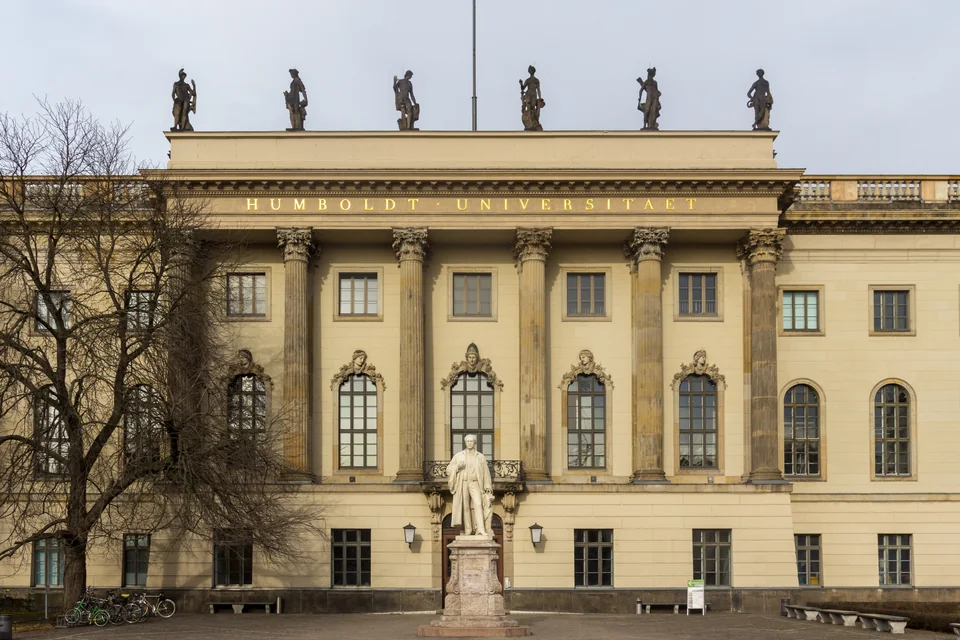
Humboldt University of Berlin (HU Berlin) is a public research university in the centre of Berlin, founded in 1810. It charges no tuition, including for non-EU students: you pay only a semester contribution, $435 (€381.80) in winter semester 2026/27. All HU bachelor's programmes are taught in German and require a C1 German certificate at the application stage, and applicants with 11 years of schooling first need a Studienkolleg or a year of university study at home. International applicants apply through uni-assist; the next window runs from 1 December 2026 to 15 January 2027 for the summer semester.
| At a glance | Details |
|---|---|
| Location | Berlin: main building on Unter den Linden, sciences at the Adlershof campus |
| Founded | 1810 |
| Students | 35,681 students and doctoral candidates (winter semester 2025/26), including 6,279 international students |
| Faculties | 8 of its own; medicine is taught at Charité, the joint medical faculty of HU and FU |
| Degree programmes | 173 |
| Ranking | THE World University Rankings 2026: 89 |
| Tuition | none |
| Semester contribution | $435 (€381.80) in winter 2026/27, of which $260 (€226.80) is a Germany-wide transport pass |
| How to apply | via uni-assist: $85 (€75) for the first programme per semester |
| Language | bachelor's in German only (C1 to apply); master's in German or English |
| Housing | Studierendenwerk Berlin halls with waiting times of at least a year |
Who Humboldt University suits, and who should look elsewhere
HU grew out of the University of Berlin conceived by Wilhelm von Humboldt around the idea of learning through research. Today it is a large comprehensive university, particularly strong in the humanities, social sciences and natural sciences. Together with Freie Universität, Technische Universität Berlin and Charité, it forms the Berlin University Alliance, which passed its first evaluation on 11 March 2026 and keeps its University of Excellence funding for 2027 to 2033.
| Good fit | Consider alternatives |
|---|---|
| Applicants who already have, or will reach, C1 German before applying | Anyone who needs an English-taught bachelor's: HU has none |
| Master's applicants in economics, geography, agricultural sciences, American or British studies | Aspiring doctors: medicine is run by Charité through a separate procedure |
| Students who want Berlin's research institutes, ministries, international organisations and start-ups | Anyone counting on a hall place in their first semester |
| Students for whom tuition-free study is decisive | Applicants who want pre-study German courses: HU does not offer them |
For English-taught science master's, compare HU with Freie Universität Berlin, which offers more of them. If you are weighing a tuition-charging option, see Heidelberg University; all Berlin options are compared in our guide to universities in Berlin.
Which programmes HU offers, including in English
HU has eight faculties of its own: Law; Life Sciences; Mathematics and Natural Sciences; Philosophy (Philosophische Fakultät); Language and Literatures; Cultural, Social and Educational Sciences; Theology; and Economics and Business. Medicine is taught by Charité, the joint medical faculty of HU and FU. The catalogue lists 173 degree programmes.
Bachelor's programmes
All HU bachelor's programmes are taught exclusively in German. For medicine, apply to Charité rather than HU.
English-taught master's programmes
According to the international programmes database and HU's catalogue, these master's programmes are taught fully or largely in English:
| Field | Programmes |
|---|---|
| Economics and business | Economics, Business Administration, Statistics (German and English), Information Systems (German and English) |
| Agriculture and environment | Agricultural Economics, Integrated Natural Resource Management, Global Change Geography |
| Languages and area studies | American Studies, British Studies, English Literatures (German and English) |
| Social sciences | Euromasters — Contemporary European Studies; GET MA — Global and European Transformations; Transatlantic Master's (with the University of North Carolina); GET MA and the Transatlantic Master's charge tuition |
| Law (fee-paying LL.M.) | Humboldt Master of Laws; International Dispute Resolution |
Some English-taught programmes, including Euromasters, GET MA and Global History, have their own deadlines and application routes through the programme coordinator. English and occasionally German requirements are set in each programme's access and admission regulations (Zugangs- und Zulassungsregelung, ZZR). Fee-paying programmes set their own amounts and payment schedules, so check the programme page before applying.
How to apply to Humboldt University as a school leaver or master's applicant
School leavers
Under anabin, school certificates from Russia, Belarus, Kazakhstan and several other countries do not give direct access to a German bachelor's degree. Your options are:
- The Studienkolleg at Freie Universität Berlin. HU has no preparatory college of its own; Berlin's universities share the one at FU. Applications run from 1 June to 15 July via uni-assist, the entrance test is in late August and classes start in early September. See our guide to the Studienkolleg in Germany.
- One year of university study at home in a related subject gives direct access to a bachelor's in the same field.
German for bachelor's programmes: two checkpoints
- At application you need a C1 certificate: Goethe-Zertifikat C1, telc C1, telc C1 Hochschule, DSH-1 or TestDaF with at least 3 in every section. Course attendance certificates are not accepted.
- Before enrolment admitted applicants are invited to sit the DSH at HU, unless they hold an exempting certificate no older than three years: TestDaF with 4 in every section, telc C1 Hochschule graded "very good" or "good", Goethe-Zertifikat C2 or DSH-2 from another university.
HU runs no pre-study German courses, so you need to reach C1 on your own, at home or at a language school in Germany. Our guide to TestDaF, DSH and Goethe exams compares the certificates.
Selection for non-EU applicants
In bachelor's programmes with restricted admission (NC), 5% of first-semester places are reserved for non-EU/EEA nationals and allocated solely by the grade average of the qualification that gives university access. You may apply for one NC programme plus one programme without restricted admission. For unrestricted programmes, HU issues admission as soon as uni-assist forwards a complete file. Master's selection does not depend on nationality.
Master's programmes
You need a completed first degree recognised in Germany, or be in the final stage of your bachelor's. German-taught programmes require C1 German by default; English-taught ones set their English level in the ZZR, and a few also require some German. uni-assist verifies IELTS, TOEFL (uni-assist institution code 2727) and Cambridge (FCE, CAE, CPE) results online if you provide the candidate details.
Step by step
- Nine to twelve months before the start: choose a programme and check its language, ZZR and deadline.
- Apply via uni-assist: upload originals or officially certified copies of every page as PDFs, with official translations (by a state-authorised translator, or a sworn translator in Germany) for documents not in German or English. The fee is $85 (€75) for the first programme and $34 (€30) for each additional one in the same semester. Our guide to applying through uni-assist explains the process.
- Forwarding to HU: once uni-assist confirms your file is complete, it passes it to HU's admissions office, which emails you instructions for tracking the decision. German missions accept the uni-assist forwarding notice as proof that you have applied, which matters if you need a prospective-student visa.
- After admission: accept your place online, upload enrolment documents and sit the DSH if required.
- Visa: with your admission letter, apply for a national D visa at the German mission responsible for your place of residence; allow six to eight weeks. Residents of Russia apply at the embassy in Moscow, which took over the tasks of the St Petersburg consulate general when it closed on 18 September 2026. See our student visa guide.
When to apply for 2027
For applicants with foreign qualifications (via uni-assist):
| Programme type | Summer semester 2027 | Winter semester (2026 cycle, for reference) |
|---|---|---|
| Bachelor's, restricted and unrestricted | 1 Dec 2026 to 15 Jan 2027 | 1 Jun to 15 Jul |
| Master's with restricted admission | 1 Dec 2026 to 15 Jan 2027 | 18 May to 14 Jun |
| Master's without restricted admission | 1 Dec 2026 to 15 Jan 2027 | 18 May to 28 Jun |
| Studienkolleg | FU Berlin schedule | FU Berlin schedule (2026: 1 Jun to 15 Jul) |
End dates are strict cut-offs. HU will publish the winter 2027/28 dates in next year's academic calendar; do not rely on last year's, because master's windows shifted by weeks between 2025 (2 to 31 May) and 2026 (18 May to 14 June). Most programmes start only in winter.
Which documents to upload to uni-assist
- school-leaving certificate or degree with transcript: originals or certified copies of every page;
- sworn translations into German or English for documents in other languages;
- for bachelor's applicants, proof of a completed university year or Studienkolleg eligibility;
- a C1 German certificate (German-taught programmes) or English proof according to the ZZR;
- for master's programmes, evidence of required modules and credits;
- for sports science, a medical certificate and a sports aptitude test result no older than two years;
- a complete CV from the start of school to the application date, with no gaps;
- a passport copy (all passports if you hold more than one citizenship).
Check uni-assist's country-specific information for documents required from your country.
What studying and living in Berlin costs
Fees paid to the university
| Item | Winter semester 2026/27 |
|---|---|
| Semester fee (Semestergebühren) | $57 (€50) |
| Student body contribution | $14 (€12) |
| Studierendenwerk contribution | $97 (€85) |
| Deutschlandsemesterticket transport pass | $260 (€226.80) |
| Transport-pass solidarity fund | $9 (€8) |
| Total | $435 (€381.80) |
In summer 2026 the contribution was $405 (€355.80); the transport pass accounts for most of the rise. You re-register (Rückmeldung) each semester by paying before the main deadline; paying during the grace period adds a $23 (€19.94) late fee. HU charges no tuition, and this applies to non-EU students too. Only a few separately funded master's programmes, such as the LL.M. degrees and GET MA, charge fees.
Living costs
For the visa you must show $1,130 (€992) a month, or $13,520 (€11,904) for the first year, through a blocked account, a formal declaration of commitment or a scholarship. That is a legal minimum, not a realistic Berlin budget, where rent is the deciding factor. Statutory student health insurance costs about $165 (€145) a month; non-EU students who are over 30 on arrival usually need private insurance. Public transport is already covered by the semester contribution.
A minimum first-year budget based on official figures is $13,584 for living costs plus about $865 (€763.60) in contributions for two semesters at 2026/27 rates, or roughly $14,455. Our blocked account guide explains how to set one up.
Which scholarships and work options are realistic
- Deutschlandstipendium at HU: $340 (€300) a month. HU awards it once a year, from the start of the summer semester, and will announce the 2027/28 application round in October 2026. Only enrolled HU students can apply, so it will not fund your first semester.
- DAAD scholarships for master's and doctoral students; check the DAAD scholarship database early, as many deadlines fall a year before the programme starts. Russia added the DAAD to its list of "undesirable organisations" in February 2026, so participation carries legal risk for Russian citizens and we do not recommend it to them.
- Part-time work: non-EU students may work 140 full days or 280 half days a year; student assistant jobs at the university do not count towards the limit.
Where to live in Berlin: halls and private housing
Halls in Berlin are run by studierendenWERK BERLIN, not by the universities. Its waiting list runs to thousands of students, and it says waiting times are at least a year. Our student housing guide covers search strategies and scams.
- Apply to the halls as soon as Berlin is on your list.
- Plan a private solution for your first semester: a room in a shared flat (WG), a sublet or a private student residence.
- You need a rental contract and address registration (Anmeldung) for your residence permit, so choose housing where the landlord allows registration.
- Be wary of listings that ask for payment before a viewing or a signed contract.
Strengths and drawbacks of HU for international applicants
| Pros | Cons |
|---|---|
| No tuition; only a semester contribution that includes a transport pass | German-only bachelor's degrees with C1 required at application |
| University of Excellence status within the Berlin University Alliance; six Clusters of Excellence with HU participation | No in-house German courses or Studienkolleg |
| English-taught master's in economics, agriculture and American studies | Hall waiting lists of a year or more |
| Capital-city internships, research institutes and international networks | Rents well above the visa minimum |
| Clear calendar and online applications via uni-assist | uni-assist fee of $86 for each first application per semester |
Applicants resident in Russia face the same constraints as for any German university: visas only through the German Embassy in Moscow, Russian bank statements not accepted as proof of funds, and no Russian bank offering a suitable blocked account. Arrange a lawful payment route for fees and rent in advance.
Mistakes to avoid when applying
- Applying without C1 German: bachelor's applications need a C1 certificate, not a course certificate.
- Looking for a Studienkolleg at HU: Berlin's Studienkolleg is run by FU, via uni-assist on FU's schedule.
- Counting on a hall place for the first semester: Berlin's queue is at least a year.
- Expecting a Deutschlandstipendium from day one: at HU only enrolled students apply, once a year.
- Confusing HU with Charité: medicine admissions go through Charité.
Checklist before you apply
- Whether anabin gives you direct access or you need a Studienkolleg.
- A C1 German certificate at application, plus a plan for DSH exemption or the DSH itself.
- Your master's ZZR: language, required modules and any German requirement.
- The deadline: several English-taught master's programmes use their own.
- A first-year budget of at least $14,455 based on official figures, plus a rent buffer.
- A hall application and a private housing plan for the first months.
Where classes take place: HU campuses in Berlin
HU teaches in three main areas. The historic centre around the main building on Unter den Linden houses law, economics and the humanities. Campus Nord in Mitte is dedicated to the life sciences. The Adlershof science and technology park in south-east Berlin hosts mathematics, physics, chemistry, computer science, geography and psychology. Public transport connects them, and a Germany-wide transport pass is included in the semester contribution.
Berlin offers what a university town cannot: hundreds of research institutes, ministries, embassies, international organisations and start-ups. The flip side is one of Germany's tightest housing markets.
Where HU stands in rankings
| Ranking | Position |
|---|---|
| THE World University Rankings 2026 | 89 |
HU quotes this position on its own facts page. One ranking line says little about a specific programme: for a master's, the curriculum, the module requirements in the ZZR and the department's research groups tell you more. As a research indicator, HU takes part in six Clusters of Excellence.
How to stay in Germany after graduation
During your studies you can work 140 full or 280 half days a year. After graduating you can obtain a residence permit to look for work for up to 18 months. Berlin is strong in IT, start-ups, consulting, policy and media; outside IT and research, employers usually expect confident German, which graduates of HU's German-taught programmes already have.
FAQ
How much does it cost to study at Humboldt University?
There is no tuition, including for non-EU students. Each semester you pay a contribution: $435 (€381.80) in winter 2026/27, most of it for the Germany-wide transport pass. For the visa you must show $13,520 (€11,904) for the first year.
Can I apply after 11 years of school?
Not directly. You need the Studienkolleg (run by FU for Berlin) or a year of university study in a related subject, and C1 German to apply for a bachelor's.
Does HU offer programmes in English?
There are no English-taught bachelor's degrees. English-taught master's programmes include Economics, Business Administration, Agricultural Economics, Integrated Natural Resource Management, Global Change Geography, American Studies, British Studies and several European studies and law programmes, some of which charge fees.
Do I need uni-assist?
Yes, if your school certificate or degree is from outside Germany. Exceptions are master's applicants who hold or are completing a German bachelor's degree and apply on that basis, plus a few master's programmes with their own procedure run through HU's portal or the programme coordinator.
What level of German do I need for a bachelor's?
C1 at application (Goethe C1, telc C1, telc C1 Hochschule, DSH-1 or TestDaF 3 in every section) and, before enrolment, the DSH at HU unless you hold an exempting certificate such as TestDaF 4 in every section or Goethe C2.
When should I apply for 2027?
For summer semester 2027: 1 December 2026 to 15 January 2027. Winter 2027/28 windows open in spring; in 2026 bachelor's applications ran from 1 June to 15 July and master's from 18 May.
Can StudyU help me apply to HU?
Under an agreement with StudyU, we shortlist programmes, check anabin and ZZR requirements, prepare your uni-assist file and plan your C1/DSH preparation, Studienkolleg, housing and visa budget. Humboldt University decides on admission, the German mission as the consular authority decides on your visa, and Studierendenwerk Berlin as the housing provider confirms hall accommodation.
Sources
- HU Berlin: Facts & Figures
- HU Berlin: Academic calendar 2026/27 (PDF)
- HU Berlin: International applicants — uni-assist and exceptions
- HU Berlin: Bachelor's requirements for international applicants
- HU Berlin: Master's requirements for international applicants
- HU Berlin: Re-registration and semester contribution
- Deutschlandstipendium at HU: application procedure
- FU Berlin: Studienkolleg dates
- uni-assist: handling fees
- studierendenWERK BERLIN: housing
- DFG: Universities of Excellence decision, March 2026
- THE World University Rankings 2026: Humboldt University of Berlin
- German Embassy Moscow: national visas and proof of funds (RU)
Dollar amounts are converted at the ECB reference rate of 29 September 2026 (€1 = $1.1355). For other universities and general admission rules, see studying in Germany. Help deciding whether HU fits your plans is provided under an agreement with StudyU — to start, submit an application.
During the free initial consultation, we clarify your goal, profile, timing, and budget and identify the next realistic step.
Next steps
- Freie Universität Berlin (FU Berlin)
- Universities in Berlin: Where to Study, What It Costs and How to Apply
- Studienkolleg in Germany: Who Needs It, How to Get In and What the FSP Exam Gives You
- German Language Tests for German Universities: TestDaF, DSH, Goethe and telc Compared (2026–2027)
- Scholarships abroad 2026: where international students study for free
- Studying in Germany for international applicants
