
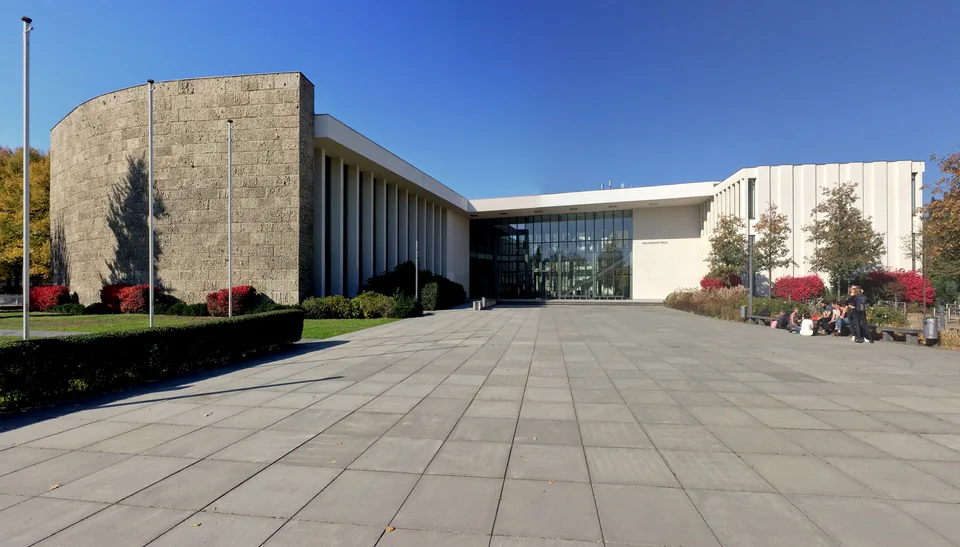
Freie Universität Berlin (FU Berlin) is a public research university in Dahlem, south-west Berlin, founded in 1948. It ranks 98th in the QS World University Rankings 2027 and charges no tuition to international students: each semester you pay only a contribution of $430 (€376.80) in winter 2026/27. FU offers more than twenty English-taught master's programmes, from data science and physics to sociology and Middle Eastern studies, and runs the Studienkolleg for all of Berlin's universities. Applicants with foreign qualifications first obtain a preliminary review documentation (VPD) from uni-assist and then apply through FU's own portal.
| At a glance | Details |
|---|---|
| Location | Berlin; main campus in Dahlem |
| Founded | 1948 |
| Students | 34,400 (winter 2024/25); international students make up 13% of bachelor's and 33% of master's students |
| Structure | 11 academic departments, 4 central institutes; medicine at Charité, shared with HU |
| Degree programmes | 180: 81 undergraduate and 99 consecutive master's |
| Rankings | QS 2027: 98; THE 2026: =113 |
| Tuition | none |
| Semester contribution | $430 (€376.80) in winter 2026/27, including a Germany-wide transport pass |
| How to apply | VPD via uni-assist ($85, €75) plus an application on the FU portal |
| Language | bachelor's in German (C1 at application); master's in German or English |
Who Freie Universität Berlin suits, and who should look elsewhere
FU was founded in 1948 in West Berlin as the city was dividing, which explains the "Free" in its name. Today it is a large comprehensive university with strong humanities, social and natural sciences and particular depth in area studies. With HU, TU Berlin and Charité it forms the Berlin University Alliance, which passed its scheduled evaluation on 11 March 2026 and keeps University of Excellence funding for 2027 to 2033. All Berlin options are compared in our guide to universities in Berlin.
| Good fit | Consider alternatives |
|---|---|
| Master's applicants in data science, bioinformatics, physics, chemistry, biology or neuroscience who need an English-taught programme | Anyone who needs an English-taught bachelor's |
| Students of area studies, history and sociology: FU is strong on Eastern Europe, the Middle East and Asia | Engineering students, who are better served by TU Berlin |
| School leavers ready for a Studienkolleg, which FU runs itself | Anyone who cannot organise private housing for the first semester |
| Students who want tuition-free study in the capital | Aspiring doctors: medicine is at Charité with separate admission |
Berlin's other large comprehensive university is Humboldt University; compare programmes directly, as FU has more English-taught science master's while HU is stronger in English-taught economics and agricultural sciences.
Which programmes FU offers, including in English
FU has 11 academic departments: Biology, Chemistry and Pharmacy; Earth Sciences; Education and Psychology; History and Cultural Studies; Law; Mathematics and Computer Science; Philosophy and Humanities; Physics; Political and Social Sciences; the School of Business and Economics; and the School of Veterinary Medicine. Central institutes include the Institute for East European Studies, the Institute for Latin American Studies, the John F. Kennedy Institute for North American Studies and the Dahlem School of Education. Medicine is taught at Charité, shared with HU.
Bachelor's programmes
Bachelor's programmes are taught in German and require C1 German at the application stage. Pharmacy and veterinary medicine have separate procedures.
English-taught master's programmes
Programmes taught fully in English include (from the international programmes database and FU's website):
| Field | Programmes | Notes |
|---|---|---|
| Data and computation | Data Science, Computational Sciences, Bioinformatics | application window mid-April to end of May |
| Natural sciences | Physics, Chemistry, Biochemistry, Biology, Biodiversity, Evolution and Ecology | Physics, Chemistry and Biochemistry also admit in summer |
| Neuroscience | Cognitive Neuroscience (MCNB) | mid-April to end of May |
| History and society | Global History, Sociology — European Societies, Archaeology of the Ancient World | winter intake |
| Area studies | Global East Asia, Interdisciplinary Studies of the Middle East, History and Societies of the Islamic World, Iranian Studies, Ottoman and Turkish Studies, Semitic Studies | some admit twice a year |
| Fee-paying programmes | Master of European and International Business; Competition and Regulatory Law; German-French Master in Public Policy & Management | continuing-education programmes with their own deadlines and fees listed on the programme page |
Each programme sets its own English level. FU's conversion table puts B2 at IELTS 5.5–6.5 or TOEFL iBT 72–94 and C1 at IELTS 7.0 or TOEFL iBT 95 and above. Note that Biology and Biodiversity, Evolution and Ecology also require A1 German at application.
How to apply to FU: VPD, the FU portal and the Studienkolleg
Step 1: VPD from uni-assist
FU now accepts applications from holders of foreign qualifications only with a uni-assist preliminary review documentation (Vorprüfungsdokumentation, VPD). You can request it year-round; it is valid for one year and costs $85 (€75). Processing usually takes four to six weeks and up to eight at peak times, so FU recommends applying at least eight weeks before its deadlines: 31 May for restricted master's programmes, 15 July and 1 September for bachelor's programmes. If you know you need a Studienkolleg, you still request the VPD for a bachelor's programme. Our guide to applying through uni-assist explains the service.
The VPD requires all school and university documents that make up your entrance qualification, with official translations by a sworn translator or authorised body if they are not in German or English.
Step 2: Application on the FU portal
Within FU's deadlines, create an account, choose your programme and upload the VPD, your documents and translations, a German certificate for German-taught programmes, and whatever your master's programme requires. For restricted programmes FU sends decisions from mid-August (bachelor's) and from late June (master's).
After 11 years of school
Under anabin, school certificates from Russia, Belarus, Kazakhstan and several other CIS countries do not give direct access to a bachelor's degree. You need either a year of related university study at home or a Studienkolleg. FU's Studienkolleg is a year of full-time classes five days a week in core subjects and German, ending with the FSP exam, which opens programmes in your subject area at all German universities. B2 German is enough to apply (DSH-1, TestDaF 3 in every section, a graded B2 certificate or onSET at B2), and you request the VPD as if for a bachelor's. Winter applications run from 1 June to 15 July; in 2026 the entrance test took place on 25 to 28 August and classes started on 7 September. Places for external FSP candidates are limited. See our guide to the Studienkolleg in Germany.
Plan for 2027
- Autumn 2026: choose a programme and check anabin, language and module requirements.
- December 2026 to March 2027: take your language exam and request the VPD.
- April to May 2027: apply on the FU portal for restricted master's programmes (the 2026 window ran from 20 April to 31 May).
- June to July 2027: apply for a bachelor's or the Studienkolleg (2026: 1 June to 15 July).
- Summer 2027: receive your decision, apply for a national D visa and arrange housing. Residents of Russia apply at the embassy in Moscow (the St Petersburg consulate general closed on 18 September 2026); see our student visa guide.
When to apply for 2027
FU has not yet published the winter 2027/28 dates. The winter 2026/27 windows below are a planning guide for 2027; check the deadlines page before you apply.
| Programme | Window (winter 2026/27) |
|---|---|
| Bachelor's with restricted admission (NC) | 1 June to 15 July |
| Bachelor's with open admission | 1 June to 1 September |
| Pharmacy and veterinary medicine, non-EU applicants (uni-assist) | 1 June to 15 July |
| Studienkolleg | 1 June to 15 July |
| Master's with restricted admission | 20 April to 31 May |
| Master's with open admission | 20 April to 15 August |
| Deutschlandstipendium | 16 July to 13 August |
What German and English you need
German
FU checks German twice for German-taught programmes.
At application you need C1, for example a C1 certificate with grades, TestDaF with 4/4/3/3, DSD II without C1 in every part, the onSET online test at C1, DSH-1, or telc C1 Hochschule graded "satisfactory" or "sufficient".
For enrolment you need a certificate no older than three years: DSH-2, telc C1 Hochschule graded at least "good", Goethe-Zertifikat C2, DSD II with C1 in all parts, the FSP from a Studienkolleg, or TestDaF 4 in every section. German philology requires TestDaF 5 in every section or DSH-3. Admitted applicants without a suitable certificate can take the DSH at FU. FU runs no DSH preparation courses; our guide to TestDaF, DSH and Goethe exams compares the options.
English
Master's English requirements are set in each programme's admission regulations (Zugangssatzung). Some English-taught master's programmes also require German: A1 for Biology and Biodiversity, Evolution and Ecology, B2 for Interdisciplinary Latin American Studies.
Which documents to prepare
- school-leaving certificate or degree with transcript (for the VPD, every document forming your entrance qualification);
- official translations into German or English;
- a VPD issued specifically for FU;
- German and/or English certificates;
- for master's programmes, whatever the programme requires: module descriptions, motivation letter, CV and sometimes references;
- for a second degree, a statement explaining your choice.
What studying and living in Berlin costs
Semester contribution
| Item | Winter 2026/27 |
|---|---|
| Studierendenwerk contribution | $95 (€85) |
| Administration fee | $55 (€50) |
| Student government (AStA) | $11.35 (€10) |
| Deutschlandsemesterticket transport pass | $260 (€226.80) |
| Social fund | $5.70 (€5) |
| Total | $430 (€376.80) |
There is no tuition, including for non-EU students; only continuing-education programmes such as MBL-FU charge fees. Pay the contribution before the re-registration deadline, or a $25 (€19.94) late fee is added.
Living in Berlin
For the visa you must show $1,130 (€992) a month, or $13,520 (€11,904) for the first year, through a blocked account, a formal declaration of commitment or a scholarship. That is a legal minimum; in Berlin, rent determines your real budget. Statutory student health insurance costs about $165 (€145) a month, and transport is already covered by the semester contribution.
A minimum first-year budget based on official figures is $13,520 for living costs, about $860 in contributions for two semesters and $85 for the VPD, or roughly $14,530. See our blocked account guide.
How to fund your studies: scholarships and part-time work
- Deutschlandstipendium at FU: $340 (€300) a month. Students of any nationality can apply. For 2026/27 FU took applications from 16 July to 13 August 2026; the next round's dates will appear on the programme page.
- DAAD scholarships for master's and doctoral students; check the DAAD scholarship database a year ahead. Russia added the DAAD to its list of "undesirable organisations" in February 2026, so participation carries legal risk for Russian citizens and we do not recommend it to them.
- Part-time work: 140 full or 280 half days a year; student assistant jobs at the university do not count towards the limit.
Where to live: halls and private housing in Berlin
Halls in Berlin are allocated by studierendenWERK BERLIN, whose waiting list runs to thousands and whose waiting times are at least a year. For the first semester you will almost certainly need a private option: a room in a shared flat (WG), a sublet or a private student residence. Make sure the landlord allows address registration (Anmeldung), which you need for your residence permit, and put your name on the hall waiting list anyway. Our student housing guide covers search channels and scams.
Dahlem is quiet and green, with libraries, museums and the botanical garden close to the lecture halls; nightlife and culture are a short ride away with the student transport pass.
Strengths and drawbacks of FU for international applicants
| Pros | Cons |
|---|---|
| No tuition and a QS 2027 top-100 place | German-only bachelor's with C1 required at application |
| Over 20 English-taught master's programmes, including data science, physics and biology | Two-stage application: VPD from uni-assist plus the FU portal, with eight weeks' lead time |
| In-house Studienkolleg shared by Berlin's universities | Hall waiting lists of a year or more |
| Strong area studies: Eastern Europe, the Middle East, Asia | High Berlin rents |
| Some master's programmes admit twice a year | 2027/28 dates not yet published; planning relies on 2026 windows |
Applicants resident in Russia face constraints that come from the visa and banking side rather than from FU: visas only via the German Embassy in Moscow, Russian bank statements not accepted as proof of funds, and no Russian bank offering a suitable blocked account.
Mistakes to avoid
- Applying on the FU portal without a VPD: applications from holders of foreign qualifications are not considered without one.
- Requesting the VPD in May for a May deadline: processing takes up to eight weeks.
- Applying to a German-taught bachelor's with B2: C1 is required at application.
- Counting on a hall place for the first semester: Berlin's queue is at least a year.
- Copying last year's dates blindly: windows change from year to year, so check FU's deadlines page before applying.
Checklist before you apply
- Whether you need a Studienkolleg or already qualify through university study at home.
- Your German level at application and a certificate that exempts you from the DSH at enrolment.
- Your master's programme's module, English and possible German requirements.
- A VPD requested at least eight weeks before your deadline.
- A first-year budget of at least $14,530 based on official figures, plus a rent buffer.
- A housing plan for your first semester.
Where you study: the Dahlem campus and Berlin
Most of FU life happens in Dahlem, a green district in south-west Berlin with villas, museums, the botanical garden and Max Planck institutes. Dahlem is sometimes called "Germany's Oxford" because research institutes have clustered there for over a century. The U-Bahn links it to central Berlin, and the Germany-wide transport pass is included in the semester contribution.
Where FU stands in rankings
| Ranking | Position |
|---|---|
| QS World University Rankings 2027 | 98, fourth in Germany after TUM, LMU and Heidelberg (German Foreign Office) |
| THE World University Rankings 2026 | =113 |
Berlin's universities are not listed individually in the Shanghai ARWU ranking. FU is strongest in the humanities and social sciences; judge a master's programme by its department's research groups.
How to stay in Germany after graduation
After graduation you can obtain a residence permit to look for work for up to 18 months. Berlin offers jobs in IT and data, research, consulting, policy and media. Graduates of English-taught master's programmes who want to stay outside IT and research should learn German alongside their studies.
FAQ
How much does it cost to study at FU Berlin?
There is no tuition, including for non-EU students. The semester contribution in winter 2026/27 is $430 (€376.80), including a Germany-wide transport pass. For the visa you must also show $13,520 (€11,904) for the first year.
Can I apply after 11 years of school?
Not directly. You need the Studienkolleg (run by FU; apply 1 June to 15 July) or a year of related university study at home.
Which FU programmes are taught in English?
Only master's programmes, including Data Science, Computational Sciences, Bioinformatics, Physics, Chemistry, Biochemistry, Biology, Cognitive Neuroscience, Global History, Sociology — European Societies and several East Asian and Middle Eastern studies programmes.
What is a VPD and why do I need it?
It is uni-assist's preliminary review of your foreign documents. FU accepts applications from holders of foreign qualifications only with a VPD, which costs $85 (€75), takes four to eight weeks and is valid for a year.
What IELTS score do I need for a master's?
It depends on the programme. FU's table equates B2 with IELTS 5.5–6.5 and C1 with IELTS 7.0 or TOEFL iBT 95 and above; the exact requirement is in the programme's admission regulations.
When should I apply for 2027?
FU has not yet published the 2027/28 dates. Based on 2026: restricted master's from 20 April to 31 May, bachelor's and Studienkolleg from 1 June to 15 July. Request your VPD eight weeks before these dates.
Can StudyU help me apply to FU?
Under an agreement with StudyU, we shortlist programmes, check anabin and master's requirements, prepare your VPD and FU portal documents, and plan the Studienkolleg, language exams, housing and visa budget. The university (FU) decides on admission, the German mission, as the consular authority, decides on your visa, and studierendenWERK BERLIN, as housing provider, confirms hall room availability.
Sources
- FU Berlin: Facts and Figures
- FU Berlin: Academic departments and central institutes
- FU Berlin: Deadlines for Applying, Registering, and Enrolling
- FU Berlin: Application with a non-German entrance qualification (VPD)
- FU Berlin: Master's applications with a foreign degree (VPD)
- FU Berlin: German language requirements
- FU Berlin: Language requirements for master's programmes
- FU Berlin: Semester fees
- FU Berlin Studienkolleg: dates
- FU Berlin: Deutschlandstipendium 2026
- uni-assist: handling fees
- studierendenWERK BERLIN: housing
- German Foreign Office on the QS World University Rankings 2027
- THE World University Rankings 2026: Free University of Berlin
- DFG: Universities of Excellence evaluation, 11 March 2026 (German)
- German Embassy Moscow: national visas and proof of funds (RU)
Dollar amounts are converted at the ECB reference rate of 29 September 2026 (€1 = $1.1355). For other universities and general admission rules, see studying in Germany. Help deciding whether FU fits your plans and when to start your VPD is provided under an agreement with StudyU — to start, submit an application.
During the free initial consultation, we clarify your goal, profile, timing, and budget and identify the next realistic step.
Next steps
- Humboldt University of Berlin (Humboldt-Universität zu Berlin)
- Universities in Berlin: Where to Study, What It Costs and How to Apply
- Applying to German Universities: uni-assist, VPD and hochschulstart Step by Step
- Studienkolleg in Germany: Who Needs It, How to Get In and What the FSP Exam Gives You
- Scholarships abroad 2026: where international students study for free
- Studying in Germany for international applicants
