
The cheapest option is a hall of residence run by a Studierendenwerk, the public student services organisation: about 197,000 places nationwide at an average of $363 (€318) a month including utilities. There are not enough places for everyone, so most newcomers rent a room in a WG (a shared flat): for winter semester 2026/27 the median room costs about $582 (€510) nationally and about $970 (€850) in Munich. Once you move in, you have two weeks to register your address (Anmeldung), which requires a confirmation from your landlord, so temporary housing without that confirmation causes trouble.
Below you will find a comparison of options, prices by city, how to apply for a hall of residence, what to check in a contract, how to register your address and how to avoid scams.
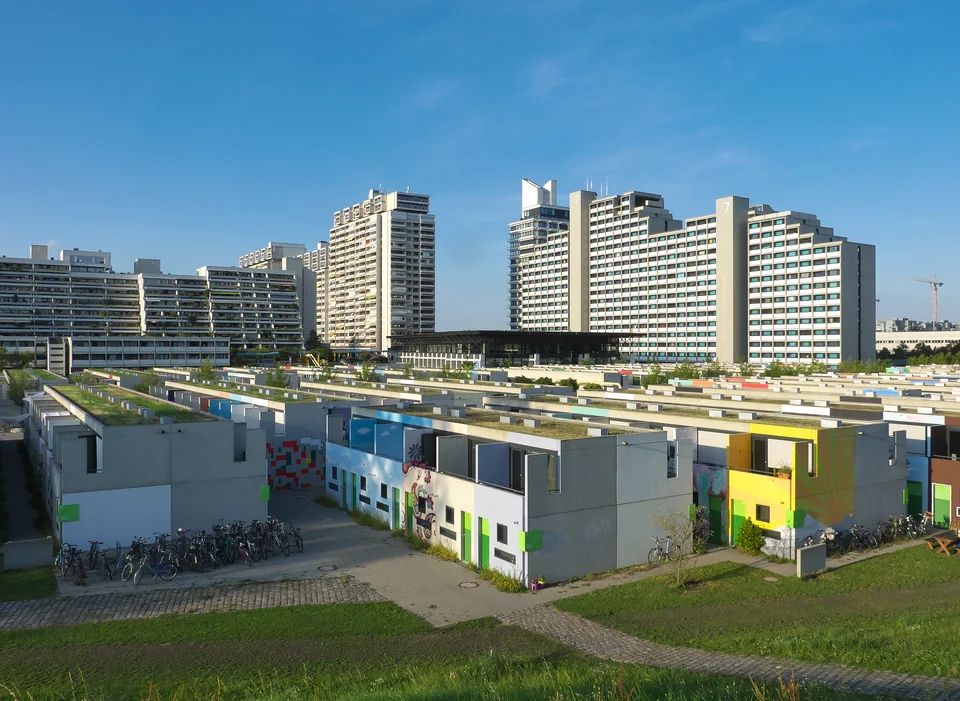
Housing options compared
| Option | Typical cost | How to get it | Best for |
|---|---|---|---|
| Studierendenwerk hall of residence | Average $363 (€318) a month, all-inclusive | Online application to your city's student services, often a waiting list | Everyone who applies early |
| Private or church-run residence, student apartments | Usually more than Studierendenwerk; set by the operator | Directly with the operator | Those who need a fixed move-in date |
| Room in a WG | National median about $582 (€510) | Listings and an interview with flatmates | Most students; fastest way into language and daily life |
| Own apartment | The most expensive; deposit up to three months' net rent | Listings, with a document package | Couples, families, students in their second year or later |
| Temporary sublet (Zwischenmiete) | Depends on the city | Listings, university notice boards | The first weeks while you search |
| Housing for help (Wohnen für Hilfe and similar) | Part or all of the rent replaced by help | Local programmes | Those willing to invest time helping hosts |
Cologne offers an example of the last option: in an inclusive house in Rodenkirchen, up to 11 students live rent-free in exchange for a few hours of help for housemates with disabilities. Such schemes are local and small, but worth asking your student services about.
What housing costs by city
The table shows median WG room prices from the Moses Mendelssohn Institute (MMI) and the WG-Gesucht portal for winter semester 2026/27, alongside Studierendenwerk data where published. The median means half of offers are cheaper and half more expensive; the "lower quartile" is the price below which only one offer in four falls.
| City | WG room, median | WG lower quartile | Studierendenwerk halls |
|---|---|---|---|
| Munich | $970 (€850) | $628 (€550) | Average rent $457 (€400.60); waiting time one to seven semesters |
| Berlin | $742 (€650) | $605 (€530) | Applications only via the residence portal |
| Hamburg | $742 (€650) | $639 (€560) | 26 residences, about 4,770 places; apply no earlier than three months ahead |
| Cologne | $730 (€640) | $616 (€540) | Longest waits for apartments and rooms close to campus |
| Frankfurt am Main | $719 (€630) | $628 (€550) | 34 residences, about 3,726 places |
| Bonn | $645 (€565) | — | — |
| Leipzig | Saxony average $424 (€372)* | — | About 5,200 rooms; room in a shared flat $245–371 (€215–325), apartment $337–496 (€295–435) |
| Germany average | $582 (€510) | — | Average rent $363 (€318) |
*MMI does not publish a separate Leipzig value; the figure is the Saxony average for summer semester 2026.
What this means:
- City choice can outweigh tuition. At the median, a room in Munich costs about $4,656 (€4,080) a year more than the national average.
- A hall of residence saves hundreds of dollars a month in big cities, but you must join the queue early.
- Visa budgets and real rents diverge. For the visa you show $1,132 (€992) a month for all living costs. In Munich the median WG room takes more than 85% of that; in Leipzig far more is left for food, transport and insurance.
If you are still choosing between universities, factor this in: studying at TU Dresden or in Marburg implies a very different budget from LMU or TUM in Munich. We compare institutions in two of the priciest cities in our guides to universities in Munich and universities in Berlin.
Studierendenwerk halls: how to apply
A Studierendenwerk (Studentenwerk in some cities) is a non-profit organisation running canteens, residences and social support for students. Each city or region has its own, with its own rules.
Who can apply. Usually students of the universities the organisation serves. In Hamburg that means students of cooperating universities; in Karlsruhe you can apply before receiving admission.
When to apply.
| City | When you can apply | How the queue works |
|---|---|---|
| Hamburg | No earlier than 3 months before moving in | The list is refreshed regularly: confirm your interest when emailed, or your application is removed |
| Karlsruhe | Up to 12 months ahead, for the first day of any month | Applications stay valid for 12 months; allocation by social criteria and date received; confirm monthly by email |
| Leipzig | Applications accepted continuously, but only with an admission letter or enrolment certificate; allocation for winter 2026/27 is under way | Offers go out in order of application date |
| Munich | Online, well in advance | Waiting times of one to seven semesters depending on the residence |
What the rent covers. Usually "warm" rent: heating, electricity, water and often internet. In Karlsruhe only the broadcasting fee, food and laundry machines are extra. Rent is collected by SEPA direct debit from a euro account in the SEPA area, so you need a German or European account before moving in.
Deposit. It depends on the rent. In Hamburg the scale runs from $456 (€400) for rooms up to $342 (€300) a month to $913 (€800) for rooms above $685 (€600).
Tips:
- Apply for several residences and accept a room in a shared flat, not only a studio: Hamburg warns that waits for studios are very long.
- Answer confirmation emails on time.
- Line up temporary housing in parallel: an offer may arrive after the semester starts.
Places are allocated by the student services organisation under its own rules; neither your university nor StudyU can guarantee one.
WG rooms: how to search
A WG (Wohngemeinschaft) is a flat where everyone has their own room and shares the kitchen and bathroom. It is the most common option for students without a hall place.
Where to look. WG-Gesucht is the largest portal for rooms; whole flats are more often listed on ImmoScout24 and Immowelt; universities and many Studierendenwerke also run free private-room services (Karlsruhe and Munich, for example).
How selection works. Flatmates usually hold a short "casting" meeting or video call. A brief message in German helps: who you are, what you study, when you arrive and for how long.
Which contract you sign. Either you join the main lease, or you sublet from the main tenant (Untermiete). In the second case, make sure the owner has approved the sublet.
Broadcasting fee. $21 (€18.36) a month per flat, not per person; one flatmate pays and the others share. Students are exempt only if they receive BAföG; otherwise exemption is possible only exceptionally, in hardship cases.
Renting your own apartment
Know the terms in listings:
- Kaltmiete: "cold" rent for the flat only.
- Nebenkosten: monthly advance payments for heating, water and waste; an annual statement may require a top-up.
- Warmmiete: both together; electricity and internet are often separate.
Deposit (Kaution). By law it may not exceed three months' net cold rent, and you may pay it in three equal monthly instalments, the first at the start of the lease.
Agent's fee. If the landlord hired the agent, the agent may not charge the tenant. Whoever commissions the agent pays.
Documents typically requested: passport and visa, proof of enrolment, proof of funds (such as a blocked-account statement), sometimes a guarantor. Newcomers have no SCHUFA record (Germany's credit bureau) or references from previous landlords, which makes the private market harder in the first year than halls or WGs.
Anmeldung: registering your address within two weeks
Anmeldung is registering your residence with the local registration office (Bürgeramt or Meldebehörde). The law gives you two weeks after moving in.
- Get the landlord's confirmation of move-in (Wohnungsgeberbestätigung). The landlord must provide it; in a sublet WG the main tenant issues it.
- Book an appointment at the Bürgeramt; in big cities, book on the day you move in.
- Bring your passport, the landlord's confirmation and the completed form.
- Receive your registration certificate (Meldebescheinigung), which you need for a bank account, residence permit extensions, a tax ID and many contracts.
A hostel, short-term rental or a friend's room without the owner's consent often cannot provide the confirmation. Plan where you will register before you move.
Avoiding rental scams
- Never transfer money before a viewing and a signed contract. "The owner is abroad and will post the keys after payment" is a classic scam.
- Check that the person may rent out the flat: the owner, a management company or a main tenant with sublet approval.
- Watch the price. A Munich room far below the lower quartile ($628, or €550) is a red flag.
- Do not send passport scans to strangers before seeing the flat and contract.
- Pay the deposit by bank transfer, never in cash without a receipt.
Timeline
| When | What to do |
|---|---|
| As soon as you pick a university | Check your city's Studierendenwerk rules: when applications open, whether admission is required |
| 3–12 months before moving (per local rules) | Apply to several residences; answer confirmation emails |
| 2–3 months before | Open a euro account; start searching WGs with short German messages |
| 1 month before | No place yet? Book temporary housing where you can register |
| First 2 weeks after moving in | Anmeldung, then bank, insurance, residence documents |
You need money for the first month (deposit, rent, transport ticket) before your blocked account starts monthly payouts. See our blocked account guide and German student visa guide.
Common mistakes
- Waiting for admission before starting the search. In many cities hall queues move over months.
- Applying only for studios in halls. Rooms in shared hall flats come faster.
- Moving where you cannot register. Without Anmeldung, bank accounts and permit extensions get difficult.
- Comparing cities only by tuition. The rent gap between Munich and Leipzig over a year can exceed a semester's fee in Baden-Württemberg.
- Transferring a deposit before a viewing. Lost money is almost impossible to recover.
- Forgetting the broadcasting fee and the annual utilities statement for your own flat.
FAQ
Studierendenwerk halls average $363 (€318) a month including utilities. In Munich the average is $457 (€400.60); in Leipzig a room in a shared hall flat costs $245–371 (€215–325).
Usually not. Halls are allocated by the Studierendenwerk or a private operator according to their own rules and queues.
As early as local rules allow: up to 12 months ahead in Karlsruhe, no earlier than 3 months ahead in Hamburg. Munich waits can reach seven semesters.
For winter semester 2026/27 the national median is about $582 (€510); Munich $970 (€850), Berlin and Hamburg $742 (€650), Cologne $730 (€640), Frankfurt $719 (€630).
It is mandatory address registration within two weeks of moving in. Without it, opening a bank account, extending your residence permit and getting a tax ID become difficult.
No more than three months' net cold rent, payable in three instalments. Halls set their own deposits: in Hamburg $456–913 (€400–800) depending on the rent.
Yes, $21 (€18.36) a month per flat. In a WG one person pays for all; in a hall, a room opening onto a shared corridor counts as a separate flat.
Next step
Pick two or three cities where you could study, compare their housing budgets using the table, then check when your local Studierendenwerk opens applications and apply on the first possible day. For the wider picture, see studying in Germany and our guide to English-taught degrees in Germany.
StudyU does not provide housing or allocate places: student services, private operators or landlords do. Planning your move, preparing documents and meeting application windows are provided under an agreement with StudyU.
Sources
- Deutsches Studierendenwerk: halls, number of places, average rent — checked 23.09.2026
- Moses Mendelssohn Institut: student housing costs, winter semester 2026/27, summer semester 2026 — checked 23.09.2026
- Studierendenwerk München: accommodation, rent, waiting times — checked 23.09.2026
- Studierendenwerk Hamburg: halls, application rules — checked 23.09.2026
- studierendenWERK BERLIN: halls — checked 23.09.2026
- Studierendenwerk Karlsruhe: halls, FAQ on applications, rent, deposit — checked 23.09.2026
- Kölner Studierendenwerk: housing — checked 23.09.2026
- Studierendenwerk Frankfurt am Main: halls — checked 23.09.2026
- Studentenwerk Leipzig: halls and prices, new applicants — checked 23.09.2026
- Federal Registration Act (BMG), § 17, § 19 — checked 23.09.2026
- Civil Code (BGB), § 551: deposit, Housing Brokerage Act (WoVermRG), § 2 — checked 23.09.2026
- Rundfunkbeitrag: information for students — checked 23.09.2026
- German missions: proof of funds — checked 23.09.2026
- Exchange rate: ECB, 23.09.2026, €1 = $1.1411
Next steps
- Blocked Account in Germany 2026: Amount, Opening Steps and Alternatives
- German Student Visa 2026: Documents, Timing and Where to Apply
- Universities in Berlin: Where to Study, What It Costs and How to Apply
- Universities in Munich: LMU, TUM, Hochschule München and More — Admission, Fees and Housing
- Studying in Germany for international applicants
- Ludwig Maximilian University of Munich (LMU)
