
Rome has three large state universities — Sapienza, Tor Vergata and Roma Tre — plus Foro Italico, a state university for sport sciences. The private sector includes LUISS, LUMSA, Campus Bio-Medico, UniCamillus, Europea di Roma, UNINT, Link Campus and Cattolica's Rome medical campus. John Cabot University (an American university) and several art and design academies complete the picture. For 2026/27, a state university costs an international student whose family earns abroad from a few hundred dollars to $1,710 a year on most programmes (2026/27); Tor Vergata's flat rate for economics and medicine is higher, at $2,850. Private universities cost several times more.
This guide helps you pick a university by field, understand the real deadlines (Sapienza's window for non-EU applicants closed in May) and avoid mixing up different universities' rules.
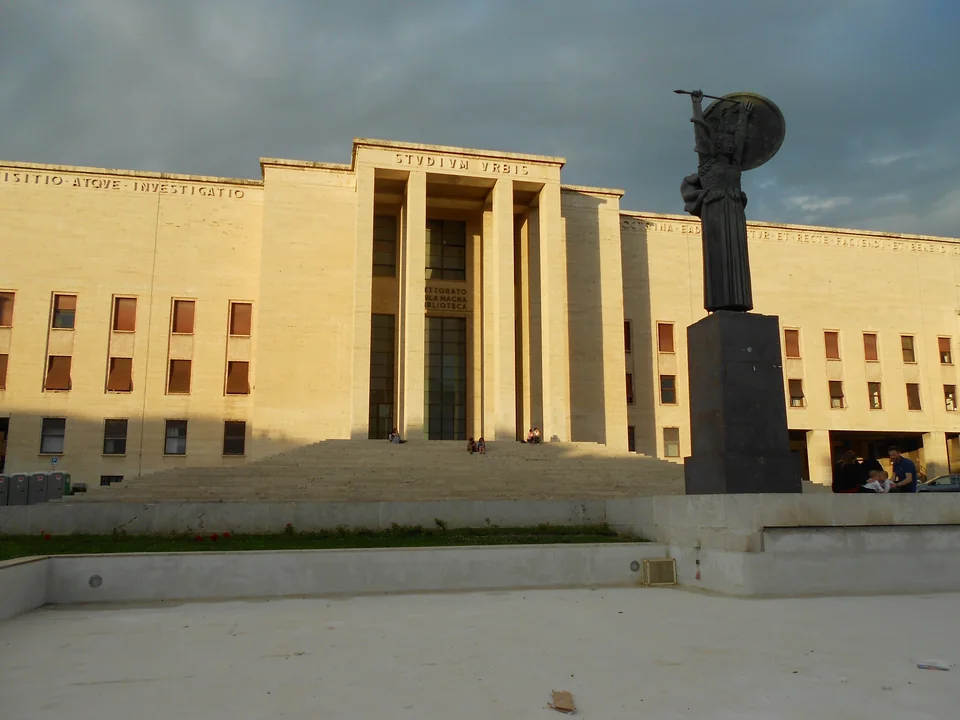
Rome's universities at a glance
| Institution | Type | Fields it is often considered for | Fee for international students |
|---|---|---|---|
| Sapienza | State | Medicine, engineering, humanities, architecture, physics | $340–1,710 (€300–1,500) a year by country of residence, 2026/27 |
| Tor Vergata | State | Economics, engineering, medicine, sciences | Flat rate for non-EU students with family income abroad: $1,140 (€1,000) on most programmes, $2,850 (€2,500) for economics, pharmacy and medicine, $570 (€500) for developing countries, plus $178 (€156) tax and stamp duty |
| Roma Tre | State | Political science, law, economics, architecture, engineering | Income-based; English-taught options mostly at master's level |
| Foro Italico | State | Sport sciences | Per university rules |
| LUISS Guido Carli | Private | Economics, management, law, political science | Single contribution not linked to income: $15,980 (€14,000) for first-year bachelor's in 2026/27, plus regional tax |
| Campus Bio-Medico | Private | Medicine and life sciences | Per price list; English-taught medicine via its own test |
| UniCamillus | Private | Medicine and health professions | Per price list |
| Cattolica, Rome campus | Private | Medicine (Policlinico Gemelli) | Per price list; English-taught medicine via its own test |
| LUMSA, UNINT, Europea di Roma, Link Campus | Private | Social sciences and humanities, languages, communication | Per price lists |
| John Cabot University | US-system university | International affairs, business, art, communication | $25,900 (€22,700) tuition for full-time study in 2026/27 |
Figures are tuition only, excluding housing and living costs. The list of state and non-state universities follows the Ministry's USTAT portal; Rome-registered online universities (Marconi, Uninettuno, Mercatorum and others) are left out because a student visa requires an on-campus programme.
State universities
Sapienza
Rome's largest university and one of Italy's best known. It reached 111th place in QS 2027, its best result ever. For international students, Sapienza combines broad choice with low fees: full tuition on its English-taught bachelor's and master's programmes was $340–1,710 (€300–1,500) a year for 2026/27, depending on country of residence.
How to apply to English-taught programmes:
- Pre-selection. For non-EU applicants who need a visa, the 2026/27 window ran from 22 December 2025 to 15 May 2026; for EU and equivalent applicants, until 31 July 2026.
- Fee. $34 (€30) per application, up to two applications a year, with no waivers.
- Universitaly. Pre-accepted students had to register on Universitaly by 30 June 2026.
- Language. At least B2 in English or Italian depending on the programme; some programmes, such as medicine, also require an entrance test.
Sapienza's English-taught medicine (course F) had 13 places for non-EU citizens in 2026/27, and dentistry had 6, both via the IMAT. More in our Sapienza profile.
Tor Vergata
A university with a large campus in south-east Rome. Three points matter for non-EU applicants:
- Flat fees. If your family's income is abroad, you can skip the income declaration and pay a flat fee: $1,140 (€1,000) a year on most programmes, and $570 (€500) for citizens of developing countries on the Ministry's list. Some programmes carry a fixed rate regardless of country: $2,850 (€2,500) for economics programmes (the Business Administration and Economics bachelor's and several master's), pharmacy and medicine, and $5,140 (€4,500) for the Global Governance bachelor's. A $178 (€156) regional tax and stamp duty come on top. Amounts are as shown on the university's page, checked on 23 September 2026.
- Pre-enrolment. A Universitaly pre-enrolment is compulsory for all non-EU applicants living abroad. The deadline is 31 July, except for programmes with an entrance exam, which have their own dates.
- An English-taught foundation year. For students with fewer than 12 years of school, Tor Vergata runs a Foundation Course. For 2026/27 it accepted applications in two windows, 29 April–16 July and 31 August–30 September 2026, and required B2 English.
Tor Vergata's English-taught medicine offered 20 non-EU places in Rome for 2026/27, plus 320 on its Tirana (Albania) course, which is taught outside Italy.
Roma Tre
The youngest of Rome's three large state universities. Four programmes are fully taught in English: a master's in architectural restoration, Sustainable Coastal and Ocean Engineering, Biomedical Engineering and International Studies. Several English-taught tracks also sit inside master's degrees in economics and finance, telecommunications engineering and law. These English options are mostly at master's level, so check each programme's level in the catalogue.
Private universities and medical schools
LUISS Guido Carli is a private university for economics, management, law and political science. It uses a single contribution that does not depend on family income: first-year bachelor's tuition for 2026/27 is $15,980 (€14,000) plus the Lazio regional tax, paid in three instalments. Siblings enrolled at the same time get 20% off the younger student's fee. Late payment costs $57 (€50) per month.
Private medicine in Rome. Rome has more English-taught private medicine places than any other Italian city. For 2026/27, non-EU places were: UniCamillus 225, Cattolica (Rome) 70, and Campus Bio-Medico 36 plus 12 on its MedTech course. Each selects through its own test: Campus Bio-Medico held its non-EU online test on 6 February 2026, Cattolica on 25 March 2026. The full route, including the IMAT, is in our guide to medicine in Italy and the IMAT.
John Cabot University is a US-system university based in Rome that teaches in English. For fall 2026–spring 2027, full-time tuition is $25,900 (€22,700) a year, or about $27,240 (€23,870) with mandatory fees. It awards US degrees, so check how that degree will be recognised for your plans in Italy or at home.
Art, design and music
Rome has the state Academy of Fine Arts (Accademia di Belle Arti di Roma) and the Santa Cecilia conservatory, as well as private design schools with Rome campuses, such as IED and NABA. For 2026/27, IED charged non-EU students $23,740 (€20,800) a year and NABA $25,390 (€22,250). See our guide to design and fashion schools in Italy for how to choose.
Which Rome university fits your goal
| Goal | Start with | Why |
|---|---|---|
| Low-cost English-taught bachelor's | Sapienza | Separate pre-selection; fees $340–1,710 (€300–1,500) |
| Engineering or sciences with a predictable flat fee | Tor Vergata | $1,140 (€1,000) a year for most non-EU students with income abroad; economics $2,850 (€2,500) |
| English-taught master's in international studies or engineering | Roma Tre, Sapienza | Fully English-taught master's programmes |
| Economics, law, politics at a private university | LUISS | Single contribution of $15,980 (€14,000) in year one, English-taught programmes |
| Medicine in English | Sapienza or Tor Vergata via IMAT; UniCamillus, Cattolica, Campus Bio-Medico via own tests | Most non-EU places in the private sector |
| A US-style degree | John Cabot University | American degrees and credits |
What it costs to study and live in Rome
On top of tuition come rent, food, transport and insurance. For the 2026/27 and 2027/28 visas, the consulate requires proof of at least $11,600 (€10,179.85) a year from lawful, traceable sources, plus housing in Italy. That is the visa minimum, not a realistic Rome budget.
Regional grants and residences in Lazio are managed by the DiSCo Lazio agency. At Tor Vergata, DiSCo grant winners are exempt only from the $160 (€140) regional tax and still pay the flat tuition fee. A grant counts towards visa funds only once formally awarded.
How to apply: steps and timing
- Check you have 12 years of school. With 11, you need a foundation year (for example Tor Vergata's) or a year of university at home.
- Start a year ahead. Sapienza's non-EU window for 2026/27 opened in December 2025 and closed in May 2026. Private medical schools tested in February–March.
- Prepare documents. Diploma and transcripts, translations, a CIMEA statement or Dichiarazione di valore if requested, and a B2+ language certificate.
- File a Universitaly pre-enrolment. From 2026/27, universities can approve no more pre-enrolments than their non-EU places plus 20%.
- Apply for the visa. By 30 November 2026 for 2026/27 and by 31 October 2027 for 2027/28, unless your university sets an earlier date.
The university decides on admission, the Italian consulate on the visa, and the regional agency or foundation on grants; one decision does not guarantee another.
Common mistakes when choosing Rome
- Planning around summer deadlines. Sapienza's non-EU applicants apply to English-taught programmes by mid-May, not in summer.
- Assuming Tirana means Rome. Tor Vergata's medicine course with 320 non-EU places is taught in Albania.
- Not choosing between income-based and flat fees. At Tor Vergata, a non-EU applicant with income abroad can pick either, and the choice changes the budget significantly.
- Looking for English-taught bachelor's degrees at Roma Tre. Its English options are mostly master's programmes.
- Not checking recognition of a US degree. A John Cabot degree is American, and its recognition path differs from an Italian laurea.
Comparing cities? See universities in Milan and our overview of universities in Italy for international students. The Italy country guide covers the system as a whole.
FAQ
State: Sapienza, Tor Vergata, Roma Tre and Foro Italico. Private: LUISS, LUMSA, Campus Bio-Medico, UniCamillus, Europea di Roma, UNINT, Link Campus and Cattolica's Rome campus. There is also the American John Cabot University, plus art academies.
On English-taught programmes in 2026/27, $340–1,710 (€300–1,500) a year depending on country of residence. Each pre-selection application costs $34 (€30).
For non-EU applicants who need a visa, the 2026/27 pre-selection ran from 22 December 2025 to 15 May 2026. Expect a similar winter-to-spring cycle for 2027/28 and check the university's page.
Yes. Sapienza has English-taught bachelor's and master's programmes, Roma Tre has English-taught master's programmes, and English is the main language at John Cabot and many private programmes.
At Sapienza and Tor Vergata via the IMAT; at UniCamillus, Cattolica and Campus Bio-Medico via their own tests, held in February–March.
Not for an English-taught programme. Italian-taught programmes require at least B2 Italian. For daily life, internships and administration, Italian makes a big difference.
Under the 2026/27–2027/28 procedures, at least $11,600 (€10,179.85) a year from lawful, traceable sources.
A graduate of an Italian university can request a 9–12 month residence permit to look for work or start a business. The conditions, including income and health-cover requirements, are set by Article 39-bis.1 of the Immigration Act. While studying, paid work is capped at 20 hours per week and 1,040 hours per year.
Sources
- USTAT (MUR) — list of Italian universities
- Sapienza — programmes in English and 2026/27 pre-selection
- Tor Vergata — admissions for international students
- Tor Vergata — fees for non-EU students with income abroad
- Tor Vergata — English-taught Foundation Course
- Roma Tre — programmes taught in English
- LUISS — single contribution and payment deadlines
- LUISS — bachelor's fees 2026/27 (table)
- MUR — English-taught medicine places 2026/27 (Table B, Decree 1005)
- Immigration Act (D.Lgs. 286/1998), Art. 39-bis.1
- Integrazione Migranti — working on a study permit
- John Cabot University — tuition 2026/27
- MUR — Decree 1005/2026 on IMAT and place tables
- Campus Bio-Medico — non-EU admission to medicine 2026/27
- Università Cattolica — medicine entrance exam (Rome)
- Il Sole 24 Ore — Italian universities in QS 2027
- Universitaly — procedures for international students, 2026/27 and 2027/28
Dollar amounts use the ECB reference rate of 23 September 2026 (€1 = $1.1411), rounded.
During the free initial consultation, we clarify your goal, profile, timing, and budget and identify the next realistic step. Apply
Next steps
- Bachelor's in Italy for International Students: Entry Rules, Tests, Deadlines and Fees
- Free University Education in Italy for International Students: What "Free" Means in 2026/27
- Sapienza University of Rome
- Studying in Italy for international applicants
- Design and Fashion Schools in Italy: Politecnico, AFAM Academies and Private Schools
- Documents for University Admission in Italy (2026–2027): Checklist, Apostille, CIMEA and Declaration of Value
