

Sapienza University of Rome
- Tuition
- Tuition at Sapienza for international students starts at roughly $3,340 per year.
- Study profile
- Sapienza Università di Roma is the oldest university in Rome and one of the largest higher-education institutions in Europe.
About the university
Sapienza Università di Roma is the oldest university in Rome and one of the largest higher-education institutions in Europe. Founded in 1303, today it brings together around 120,000 students, including about 10,000 international students and more than 2,000 Erasmus exchange participants.
The university offers around 300 bachelor's and master's programs, of which more than 60 are in English, plus over 90 doctoral programs and dozens of specialized schools. In its more than 700-year history Sapienza has produced over 180,000 graduates, including several Nobel laureates in physics, chemistry and biology.
Sapienza is among Italy's leaders in research and teaching quality: thanks to more than 1,400 international agreements with universities in 87 countries, students gain access to double degrees, scholarships abroad and internships worldwide.
Sapienza in the rankings
Sapienza is especially strong in the humanities and fundamental sciences, ranking among the world's best in a number of subjects.
- 134th in the world — QS World University Rankings 2024
- 1st in the world in Classics & Ancient History — QS by Subject 2023
- 17th in the world in Art History — QS by Subject 2023
- 101-150th in the world — Academic Ranking of World Universities (ARWU) 2023
- World Top 100 in 6 subjects — Times Higher Education 2023
- 1st in Italy according to the Center for World University Rankings (CWUR) 2023
Campus and facilities

Sapienza's main campus, Città universitaria, was designed by the architect Marcello Piacentini and opened in 1935 in the San Lorenzo district. It is a true “city within a city”, where teaching buildings sit alongside administrative offices, libraries and museums. Besides the historic campus, faculties and departments are located in various districts of Rome.
The university system includes one of Italy's largest botanical gardens (30 acres), a school of aerospace engineering, two sports centres with swimming pools, the Musica Sapienza orchestras and choirs, the Theatron theatre and the RadioSapienza web radio. Every faculty has tutoring offices and a careers service.
Faculties and programs

Sapienza offers around 300 degree programs across 11 faculties:
- Architecture
- Economics
- Pharmacy and Medicine
- Legal
- Civil and Industrial Engineering
- Information Engineering, Informatics and Statistics
- Mathematical, Physical and Natural Sciences
- Medicine and Dentistry
- Medicine and Psychology
- Political Sciences, Sociology and Communication
Not sure which faculty suits you?
Selection of agreed Sapienza options and admission support are provided under an agreement with StudyU; the university makes the admission decision.
How to apply to Sapienza
Applicants from Russia, Kazakhstan and other CIS countries should note that bachelor's admission requires a school certificate covering at least 12 years of schooling. The missing year can be made up with a preparatory program or by transferring to Sapienza after the first year of university at home.
Master's admission requires a bachelor's degree and sometimes relevant research experience (for example, laboratory work or data analysis for the corresponding programs).
The admission route to Sapienza University of Rome for international students:
- Choose a program (12 months ahead). Decide on the level and language: English-taught tracks admit with IELTS/TOEFL, Italian-taught ones with CILS/CELI.
- Pre-enrollment via Universitaly. The main pre-enrollment window via Universitaly is February–May; some universities open admission as early as October. Scholarship deadlines come before university ones — start a year ahead.
- Document package. School certificate or degree with transcript, notarized translations, Dichiarazione di Valore or a CIMEA statement — we prepare these for you.
- Entrance tests. Depending on the program: the TOLC test, IMAT for English-taught medicine, a portfolio for design and architecture.
- Type-D student visa and relocation. After enrollment comes the visa, and upon arrival — the permesso di soggiorno.
Requirements and exams
For a number of programs (e.g. IT and artificial intelligence) the university asks you to demonstrate basic knowledge of mathematics and science through one of these tests:
- SAT (College Board) — from 960 of 1600
- TOLC-I in English (CISIA) — from 18 of 50
- TOLC-I or TOLC-S in Italian with an English section — from 18 of 50 and 24 of 30
Minimum grade point average (GPA): 75 of 100. English or Italian level — no lower than B2. The exact set of requirements depends on the program — we'll help you understand them and prepare.
Tuition and living costs
Tuition at Sapienza for international students starts at roughly $3,340 per year. At Italian public universities, tuition is calculated based on family income, so the final amount is individual. Accommodation is approximately from $4,740 per year depending on the chosen option and district of Rome.
State and university scholarships are available — based both on academic merit and on the family's financial situation. In a consultation we'll tell you which discounts and scholarships you can qualify for, and help you prepare the documents for them.
Prices are approximate (converted from roubles at ≈80 ₽/$). You see tuition, required extras and scholarship options before the application.
Costs in Italy: public universities charge a registration fee of $1,020–4,540 (€900–4,000) per year; private ones start from $11,360 (€10,000).
Dollar amounts use the ECB reference rate of 29 September 2026 (€1 = $1.1355) and are rounded.
When planning the budget, add housing, insurance, visa fees and flights; we map the full route before the application.
Student accommodation
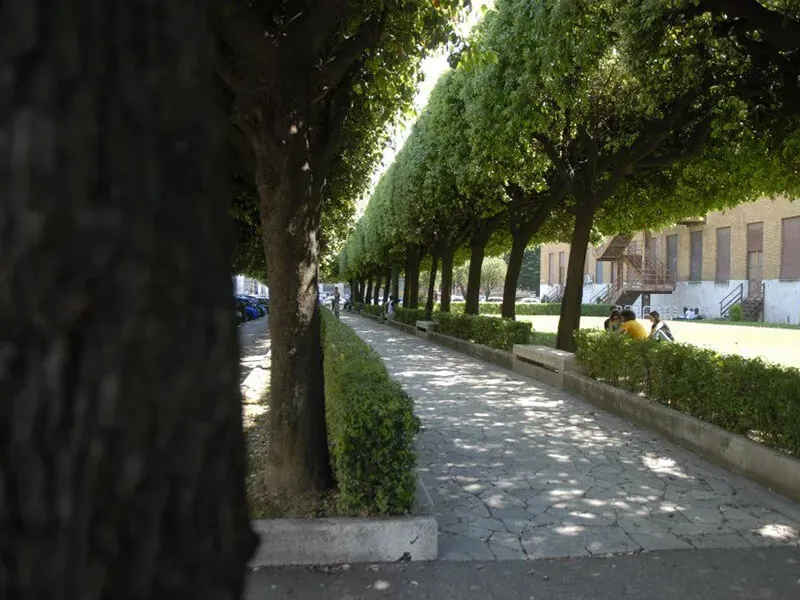
Sapienza offers students more than 10 accommodation options in different parts of Rome — in residences and with trusted property operators. Single and double rooms are available with everything needed for study and rest. The university regularly checks the offered housing for safety and comfort. All options are within walking distance of the university or near transport hubs convenient for getting to class.
Housing options: a student residence, a room in a shared flat or a studio — book right after enrollment, the choice narrows by September. The DSU scholarship can include a residence place.
In the first weeks you arrange the codice fiscale (tax number), a bank card and the permesso di soggiorno — we provide a checklist and help with the appointment.
Career after graduation
After graduation. Italy lets graduates extend their stay to look for work (permesso di soggiorno per attesa occupazione) — we will clarify the current terms for your graduation year.
For further study, check how the receiving institution assesses the degree from Sapienza University of Rome. For a regulated profession, check the destination country’s competent authority: participation in the Bologna Process does not give automatic access to every profession. University career services, relevant internships and Italian-language skills can help you prepare for a job search in Italy.
An alternative track is a master’s: an Italian bachelor’s opens programs and scholarships across Europe.
FAQ
No — a bachelor's requires 12 years of schooling. Graduates of 11-year systems take a foundation year (about $5,680 (€5,000)) or transfer after the first year of university at home. For a master's, a bachelor's degree is accepted directly.
Country benchmark for Italy: public universities charge a registration fee of $1,020–4,540 (€900–4,000) per year; private ones start from $11,360 (€10,000). Budget $795–1,360 (€700–1,200) per month for living; Milan and Rome are the most expensive. Exact university fees for your intake year will be verified against official sources.
Studying can be nearly free thanks to the DSU scholarship: it is granted based on family income, not grades, and can cover the fee, housing and meals. Universities add their own merit grants.
Under an agreement with StudyU, we check requirements, prepare documents, submit the application, and support the agreed steps. The university makes the admission decision; the relevant authority decides the visa, and the university or provider confirms housing availability.
Want to study at Sapienza?
Get a free consultation
During the free initial consultation, we clarify your goal, profile, timing, and budget and identify the next realistic step. A personal strategy, requirement checks, selection of agreed options, document preparation, applications, and support are provided under an agreement with StudyU. Under the agreement with StudyU, we explain Sapienza's application route and select agreed programme options; the university makes the admission decision.
- Discuss your study goal and academic profile
- Clarify budget, timing and destination constraints
- Identify a realistic next step and what to verify before applying
Write to us
Leave a request and we'll get in touch.
StudyU is an ICEF Accredited Trusted Agency (#7302). Our consultants are students and graduates of universities in the countries they help you apply to. About StudyU
For your first enquiry, a contact detail and your question are enough. Do not send passport details or document scans through this form. If documents are needed for your application, we will explain why and how to send them. How we process personal data