
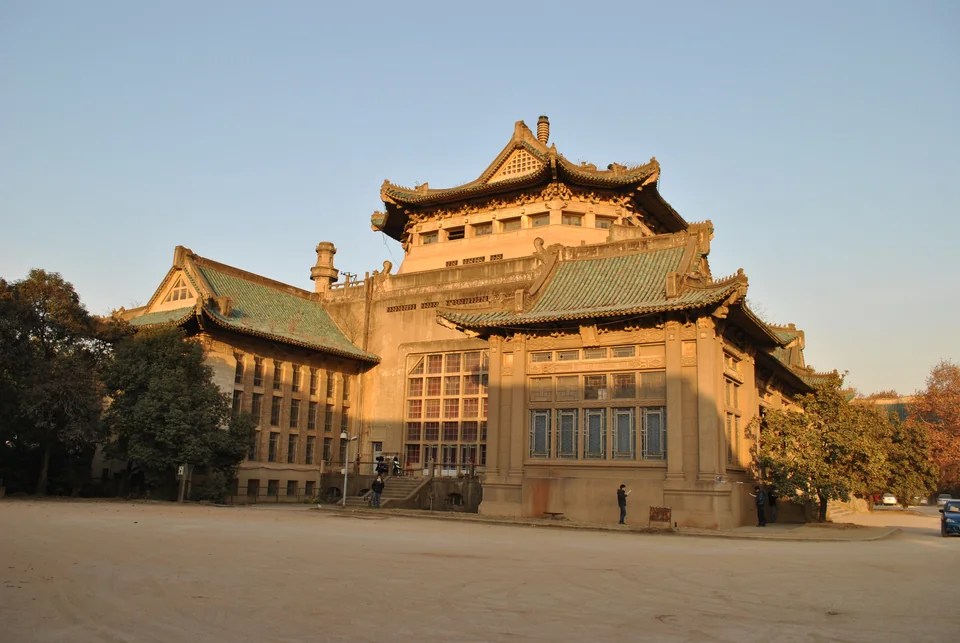
Wuhan University (武汉大学, WHU) is one of China's largest public universities, with roots going back to 1893. Its campus sits on Luojia Mountain beside East Lake in Wuhan, Hubei province. It is tied for 122nd in the THE World University Rankings 2026 and ranks 77th in ARWU 2026 (ShanghaiRanking). International students pay tuition: a Chinese-taught bachelor's costs $2,980–4,470 (CNY 20,000–30,000) a year and an English-taught one $3,430–5,960 (CNY 23,000–40,000). Since 2026, bachelor's applicants need the CSCA test plus HSK 4 with 180 points (or IELTS 6.0 / TOEFL 80 for English-taught programmes). Applications for the spring 2027 semester run from October to December 2026.
| At a glance | Details |
|---|---|
| City | Wuhan, Hubei province; a main campus for humanities and sciences plus a medical campus |
| Founded | 1893 (Ziqiang Institute) |
| Rankings | THE 2026: =122; ARWU 2026: 77 |
| Double First-Class | 11 disciplines on the second-round list (2022), including law, chemistry, surveying and mapping, hydraulic engineering and stomatology |
| Bachelor's | 4–6 years, mostly in Chinese; English-taught management, economics, software engineering and medicine (MBBS) |
| Bachelor's tuition | Chinese-taught $2,980 / $3,580 / $4,470 a year (humanities / science and engineering / medicine); English-taught $3,430 / $4,170 / $5,960 |
| Master's | under 35; $3,430–5,670 a year in Chinese, $4,920–7,450 in English |
| Chinese courses | $1,270 (CNY 8,500) a semester, $2,530 (17,000) a year |
| Requirements | CSCA for bachelor's; HSK 4 (180) or IELTS 6.0 / TOEFL 80; bank statement of at least $5,000 |
| Application fee | CNY 800 ($120) |
| Housing | $1,030–2,390 (CNY 6,900–16,000) a year on the main campus |
Who Wuhan University suits, and who should look elsewhere
WHU is a large comprehensive university with humanities, sciences, engineering and medicine side by side. Its strengths show in China's "Double First-Class" list, the national programme that funds leading universities and disciplines. WHU has 11 listed disciplines: theoretical economics, law, Marxist theory, chemistry, geophysics, biology, civil engineering, hydraulic engineering, surveying and mapping, stomatology, and library, information and archives management.
Consider WHU if you:
- are interested in geomatics, remote sensing, hydraulic engineering or law, fields where WHU is well known in China;
- want an English-taught programme in business, finance, software engineering or medicine;
- prefer a major university outside Beijing and Shanghai with lower living costs: WHU itself estimates CNY 1,000–2,000 a month;
- want a campus room in the first year: the School of International Education (SIE) arranges on-campus rooms for all new students who register on time.
Look elsewhere if you want a humanities bachelor's taught entirely in English, because WHU offers almost none. If you need a long Chinese course first in a city with more course formats, Beijing Language and Culture University is a better fit.
Programmes for international students
Chinese-taught bachelor's
The list open to international applicants closely follows the university's general catalogue: philosophy and psychology; Chinese literature and teaching Chinese to speakers of other languages; English, Russian, German, French, Spanish and Japanese language and translation; journalism and advertising; history and archaeology; economics and finance; law; political science and diplomacy; information management and e-commerce. Science and engineering options include mathematics and data science, physics and microelectronics, chemistry, geography and GIS, environmental science, energy engineering, electrical engineering, civil engineering, hydraulic engineering, and five-year architecture and urban planning. SIE runs a separate Chinese Language major.
Students who have studied Chinese at university level for a year with excellent grades and hold HSK 4 (180) can apply to enter the second year of the Chinese Language major; with HSK 5 (180) they can be assessed for the third year.
English-taught bachelor's
| Area | Programmes | Length |
|---|---|---|
| Management | Business Administration, Logistics Management, Human Resources Management, Marketing, Accounting, Financial Management | 4 years |
| Economics | Finance, Public Finance, Insurance, International Economy and Trade | 4 years |
| Engineering | Software Engineering | 4 years |
| Medicine | Clinical Medicine (MBBS) | 6 years |
If you are considering the MBBS to practise medicine at home, check how your country recognises foreign medical degrees first; see our guide to studying medicine in China.
Master's and doctoral degrees
Master's programmes last two to three years and doctorates four years. Most are taught in Chinese. English-taught options include clinical medicine, software engineering, hydraulic engineering, electrical engineering, international law, media and communication, and a two-year Master of Public Health (Global Health track). A separate English-taught master's in International Law and Chinese Law, funded by China's Ministry of Commerce, is aimed at civil servants and professionals from developing countries.
Chinese courses and the pre-university programme
SIE's language programme runs for a semester or a year: beginner classes have 20 hours a week, intermediate and advanced 22, over 17 teaching weeks per semester, with a certificate on completion. Short courses cost CNY 800 a week (up to four weeks) or CNY 700 a week (longer than four weeks).
For English-taught bachelor's applicants there is an English-taught Pre-University Programme: 441 class hours from March to June, including mathematics, physics, chemistry and biology (178 hours) and academic English (170 hours). For the spring 2026 intake it required applicants to be under 24 and show at least $2,500 in funds; applications ran from 25 September to 10 January, and tuition was $2,610 (CNY 17,500) per semester. Students who complete it and pass the assessments can apply to WHU's undergraduate programmes. Compare formats in our guides to the foundation year in China and Chinese language programmes.
How to apply to Wuhan University
Bachelor's requirements
- Age: 18–30 on 1 September of the entry year. Applicants under 18 need a guarantee letter from a guardian living in China.
- Nationality: non-Chinese citizen with an ordinary foreign passport. Applicants with Chinese parents or former Chinese nationality must have held foreign nationality for at least four years and lived abroad for at least two of them.
- Language: Chinese-taught programmes need the new HSK 4 with 180 points; English-taught programmes need TOEFL 80, TOEFL Essentials 8 or IELTS 6.0. Native English speakers and graduates of English-medium study may be exempted at the university's discretion.
- CSCA: compulsory for all WHU bachelor's applicants from 2026.
Which CSCA papers to take
| Programme area | Subject Chinese | Mathematics | Physics | Chemistry |
|---|---|---|---|---|
| Humanities and social sciences | humanities paper | yes | — | — |
| Science and engineering | science paper | yes | yes | for chemistry, biology and environmental science |
| Medicine | science paper | yes | — | yes |
| English-taught programmes | not required | yes | for medicine | yes |
All papers are multiple choice: subject Chinese takes 90 minutes, mathematics, physics and chemistry 60 minutes each. Sessions for Europe, Africa and the Americas are in January and March; for Asia-Pacific in December, April and June. For now the test is mostly taken online at home with a two-camera setup. One subject costs CNY 450, two or more CNY 700, and results arrive in about two weeks. Chinese Language applicants with HSK 4 can skip subject Chinese.
Documents
- Passport photo page and any Chinese visa. In the 2026 guide, passports had to be valid until at least December 2026.
- Secondary school diploma or proof of expected graduation, with transcripts, in Chinese or English or with a notarised translation.
- CSCA score report and HSK certificate (Chinese-taught) or IELTS/TOEFL.
- Bank statement or financial guarantee of at least $5,000.
- Medical examination report issued within the last six months.
- Academic records from any previous study in China.
Shortlisted applicants are invited to an interview and entrance test by email; outstanding applicants may be exempted. For translation and certification rules, see our guide to applying to Chinese universities.
Master's and doctoral applicants
Master's applicants need a bachelor's degree and must be under 35; doctoral applicants need a master's and must be under 45 (per the 2026 guide). Language thresholds match the bachelor's: HSK 4 (180) or IELTS 6.0 / TOEFL 80. You also submit:
- two academic references from associate professors or professors in your field;
- a personal statement and research plan of at least 1,000 words, plus a summary of research experience for doctoral applicants;
- degrees and transcripts from all previous levels;
- a bank statement of at least $5,000 and a medical report.
The CNY 800 fee must be paid online within seven days of applying.
Step-by-step plan
- September–October 2026. Choose your programme and language of instruction. For a bachelor's, register for CSCA and HSK.
- October–December 2026. Applications open for spring 2027. For autumn 2027, use last cycle as a guide: bachelor's applications ran from 1 October to 30 June, master's and doctoral from 1 December to 15 June.
- Application. Create an account at admission.whu.edu.cn, complete the form, upload documents and pay the fee.
- Interview and decision. Results are published in the same system in batches.
- Visa. Take your admission letter, JW202 form and medical records (including blood tests) to a Chinese consulate for an X1 or X2 study visa. WHU will not register students on other visa types. See our China student visa guide.
- Registration. Usually August–September, on the date in your admission letter. Bring your passport, admission letter, JW202 and study visa; graduate students also show original or notarised degree certificates.
Application deadlines for 2027
| Programme | Application window | Status on 23 Sep 2026 |
|---|---|---|
| Bachelor's, spring 2027 | October–December 2026 | announced in the 2026 guide |
| Non-degree programmes, spring 2027 | October–December 2026 | announced |
| Bachelor's, autumn 2027 | 1 October – 30 June in the 2026 cycle | 2027 guide not yet published (the previous one appeared on 18 Nov 2025) |
| Master's and doctoral, autumn 2027 | 1 December – 15 June in the 2026 cycle | same |
| Pre-University, spring | 25 September – 10 January in the last intake | 2027 terms not yet published |
| CSC Type A | usually early December to end of March, set by the embassy | check with the Chinese embassy |
| WHU freshman scholarship | 5 March – 20 May in the latest published rules | amounts and quotas are reviewed annually |
How much it costs to study and live in Wuhan
Tuition
| Level | Humanities | Science and engineering | Medicine and stomatology |
|---|---|---|---|
| Chinese-taught bachelor's | $2,980 (CNY 20,000) | $3,580 (24,000) | $4,470 (30,000) |
| English-taught bachelor's | $3,430 (23,000) | $4,170 (28,000) | $5,960 (40,000) |
| Chinese-taught master's | $3,430 (23,000) | $4,170 (28,000) | $5,670 (38,000) |
| English-taught master's | $4,920 (33,000) | $5,670 (38,000) | $7,450 (50,000) |
| Chinese-taught doctoral | $4,470 (30,000) | $5,960 (40,000) | $6,710 (45,000) |
| English-taught doctoral | $5,370 (36,000) | $6,860 (46,000) | $8,200 (55,000) |
Fees are per academic year, from the SIE fee table. The first year must be paid before or at registration, or you will not be registered. Only the application fee, tuition and accommodation can be paid by transfer to the university's Bank of China account; bring the receipt to registration. Check early which route your bank can use for a CNY transfer.
Housing
| Building (humanities and sciences campus) | Per year | Per month |
|---|---|---|
| Building 6: flat with two twin rooms | $1,030 (CNY 6,900) | CNY 800 |
| Building 1: flat with four single rooms; Building 4: flat with two single rooms | $1,940 (13,000) | 1,500 |
| Buildings 2 and 3: single room | $2,090 (14,000) | 1,600 |
| Building 3: single room with balcony | $2,390 (16,000) | 1,800 |
| Medical campus, twin rooms | $1,420–1,430 (9,500–9,600) | 1,150–1,200 |
Electricity is extra at CNY 0.6 per kWh. Bedding is not provided, and family members cannot stay in the dormitories. Rooms are reserved for scholarship students; self-funded graduate students apply for housing in August.
Other costs
| Item | Amount |
|---|---|
| Medical insurance | CNY 500 a semester, 1,000 ($150) a year |
| Medical check | about CNY 300 |
| Residence permit | CNY 400 (up to a year), 800 (2–3 years), 1,000 (over 3 years) |
| Textbooks | CNY 200–1,000 a year |
| Living costs (university estimate) | CNY 1,000–2,000 ($150–300) a month |
A self-funded Chinese-taught humanities student therefore pays roughly $2,980 in tuition, $1,030–2,390 for housing and $1,790–3,580 in living costs over 12 months, plus insurance and permits. Our guide to the cost of studying in China shows how to plan the first year.
Scholarships: CSC and university awards
| Programme | Who | Key points |
|---|---|---|
| CSC bilateral programme (Type A) | bachelor's under 25, master's under 35, doctoral under 40 | apply through the Chinese embassy, usually December to March; bachelor's applicants need CSCA and HSK 3, Chinese-taught graduate applicants HSK 4 |
| CSC High Level Graduate Program (Type B) | master's under 35, doctoral under 40 | apply through WHU; HSK 5 goes straight to the degree, HSK 4 starts with a year of Chinese; in the 2026 cycle passports had to be valid until 1 March 2027 |
| CSC Belt and Road Program (Type B) | citizens of Belt and Road partner countries, master's and doctoral | country list at yidaiyilu.gov.cn |
| International Chinese Language Teachers Scholarship | future Chinese teachers and language learners | apply at chinese.cn and in the WHU system |
| WHU freshman scholarship | up to 80 bachelor's and 20 graduate students a year | one-off payment: CNY 4,000 ($600) for bachelor's, 6,000 ($890) for master's, 8,000 ($1,190) for doctoral; requires HSK 4 (bachelor's) or HSK 5, or TOEFL 85 / IELTS 6.5, and at least a B average or GPA 3.0 |
The standard CSC monthly stipend in 2026 is CNY 2,500 ($370) for bachelor's, 3,000 ($450) for master's and 3,500 ($520) for doctoral students, on top of free tuition, housing and insurance. For self-funded students the realistic options are CSC and the WHU freshman scholarship; the separate English-taught law master's is funded by China's Ministry of Commerce and aimed at public servants. CSC or the WHU committee makes the award decision, not an agent.
Where you study: Luojia Mountain and the medical campus
The main campus spreads over Luojia Mountain beside East Lake in Wuchang, one of Wuhan's three historic districts. Humanities, sciences and engineering are taught here. Medicine and stomatology are on a separate medical campus, home to Buildings 8 and 10. The university describes itself as "China's most beautiful university" because of its setting between the hill and the lake.
Wuhan is a major transport hub in central China. Do not confuse WHU with the city's other large universities: Wuhan University of Technology, Huazhong University of Science and Technology (HUST) and China University of Geosciences (Wuhan). Each has its own website, rules and scholarships.
WHU strengths and limitations for international applicants
| Strengths | Limitations |
|---|---|
| Chinese-taught humanities bachelor's at $2,980 a year, less than at Nanjing, Xiamen or Sun Yat-sen universities (CNY 21,000–26,000) | CSCA is compulsory, and science programmes add physics or chemistry |
| spring intake, with applications from October to December 2026 | bachelor's age limit of 30 |
| on-campus rooms for new students who arrive on time | bedding and electricity are extra; buildings differ in price by more than double |
| English-taught bachelor's in business, finance, IT and medicine | no English-taught humanities bachelor's |
| strong positions in THE (=122) and ARWU (77) | a $5,000 bank statement is part of the required documents |
Mistakes to avoid
- Relying on HSK alone. Bachelor's applications for 2026–2027 are not accepted without CSCA, and science programmes also need physics and chemistry.
- Missing the spring window. Spring 2027 applications close in December 2026, before many applicants have sat HSK.
- Using outdated age limits. In 2026 the doctoral limit rose to 45, while the bachelor's range stays at 18–30.
- Arriving without the bank statement or medical originals. The $5,000 statement is checked at application, and medical originals, including blood tests, are needed both at the consulate and at registration.
- Paying the wrong way. Bank transfers to the university account are accepted only for the application fee, tuition and accommodation; other charges are paid after arrival as the university instructs.
Checklist before you apply
- Your passport is valid beyond the guide's cut-off (in the 2026 cycle, at least until December 2026; for CSC High Level, until 1 March 2027).
- You have chosen the language of instruction and know your CSCA subjects: physics for science programmes, chemistry for chemistry, biology and environmental science.
- Your CSCA session leaves a margin: results take about two weeks, and Europe had only January and March sessions last cycle.
- You hold HSK 4 with 180 (Chinese-taught) or IELTS 6.0 / TOEFL 80 / TOEFL Essentials 8 (English-taught).
- A bank statement or financial guarantee of at least $5,000 is ready.
- Your medical report, including a blood test, is no older than six months; originals are needed at the consulate and at registration.
- Master's applicants have two letters from associate or full professors, a research plan of 1,000+ words, and will pay the CNY 800 fee within seven days of applying.
- Your budget covers tuition, housing ($1,030–2,390 a year), CNY 1,000 insurance and CNY 1,000–2,000 a month for living costs, as WHU estimates.
Working during and after your studies
A study visa (X1) and study residence permit do not allow regular employment. China's Ministry of Education rules on international students (Order No. 42, Art. 30) permit only university-run work-study (勤工助学) and prohibit employment and business activity, and the Exit and Entry Administration Law (Art. 43) treats work beyond the permitted type or hours as illegal. Internships are organised by the university within the curriculum. After graduation you need a work permit arranged by an employer. See our guide to work and internships for students in China.
FAQ
How much does a year at Wuhan University cost?
A Chinese-taught bachelor's costs $2,980 (CNY 20,000) in the humanities, $3,580 (24,000) in science and engineering and $4,470 (30,000) in medicine. English-taught bachelor's programmes cost $3,430–5,960 a year. Add housing ($1,030–2,390 a year), CNY 1,000 insurance and CNY 1,000–2,000 a month for living costs.
Can I study at WHU in English?
Yes: bachelor's programmes in management, economics and finance, software engineering and medicine (MBBS), plus several master's programmes. You need IELTS 6.0, TOEFL 80 or TOEFL Essentials 8. English-taught applicants still take CSCA mathematics and chemistry, and medical applicants also take physics.
What HSK level do I need?
The new HSK 4 with 180 points for Chinese-taught programmes at every level. The WHU freshman scholarship asks for more: HSK 4 for bachelor's and HSK 5 for master's and doctoral applicants.
Is there a spring intake?
Yes. Spring 2027 applications for bachelor's and non-degree programmes run from October to December 2026. Master's and doctoral programmes start in autumn.
Does WHU provide housing?
SIE arranges on-campus housing for new students who register within the stated period. Self-funded graduate students apply in August. Prices depend on the building: CNY 6,900–16,000 a year on the main campus.
Can I study for free?
Full funding comes from a CSC scholarship or, for language and teaching programmes, the International Chinese Language Teachers Scholarship. The WHU freshman scholarship is a one-off CNY 4,000–8,000 payment, not a fee waiver. CSC and the university run the selection, so you cannot count on an award in advance.
Does StudyU help with WHU applications?
Under an agreement with StudyU, we shortlist programmes, check requirements, prepare documents and support the application, CSCA preparation and the visa stage. Wuhan University decides on admission, and CSC or the WHU committee on scholarships; the Chinese consulate as the consular authority decides on the visa.
Sources
- 2026 bachelor's admissions guide (admission.whu.edu.cn)
- CSCA instructions for WHU applicants
- 2026 master's and doctoral admissions guide
- Tuition and other fees
- Accommodation
- Chinese language programme
- Pre-University Program, spring semester
- English-taught bachelor's programmes (guide attachment)
- CSC bilateral programme 2026
- CSC High Level Graduate Program 2026
- WHU freshman scholarship
- 2026 CSC stipend rates (BLCU bilateral programme guide)
- About WHU
- THE World University Rankings 2026: Wuhan University
- ARWU 2026
- Ministry of Education rules on international students, Order No. 42
- Second-round "Double First-Class" list, Ministry of Education
- Exchange rate: ECB reference rates on 23 Sep 2026, €1 = $1.1411 = CNY 7.6538 (about CNY 6.71 per $1), rounded to $10
To compare Wuhan with other cities and universities, see studying in China. If you want to check whether you can still make the spring 2027 intake, send us a request.
During the free initial consultation, we clarify your goal, profile, timing, and budget and identify the next realistic step.
Next steps
- Studying Medicine in China: English-Taught MBBS, the Ministry of Education List and Recognising the Degree Back Home
- Foundation Year in China: Which Format to Choose and What It Costs
- Applying to Chinese Universities: Documents Checklist for 2027
- Work and Internships for Students in China: What a Study Visa Allows and How to Register an Internship
- Studying in China for international applicants
- Cost of Studying in China: Tuition, Housing and a First-Year Budget
