
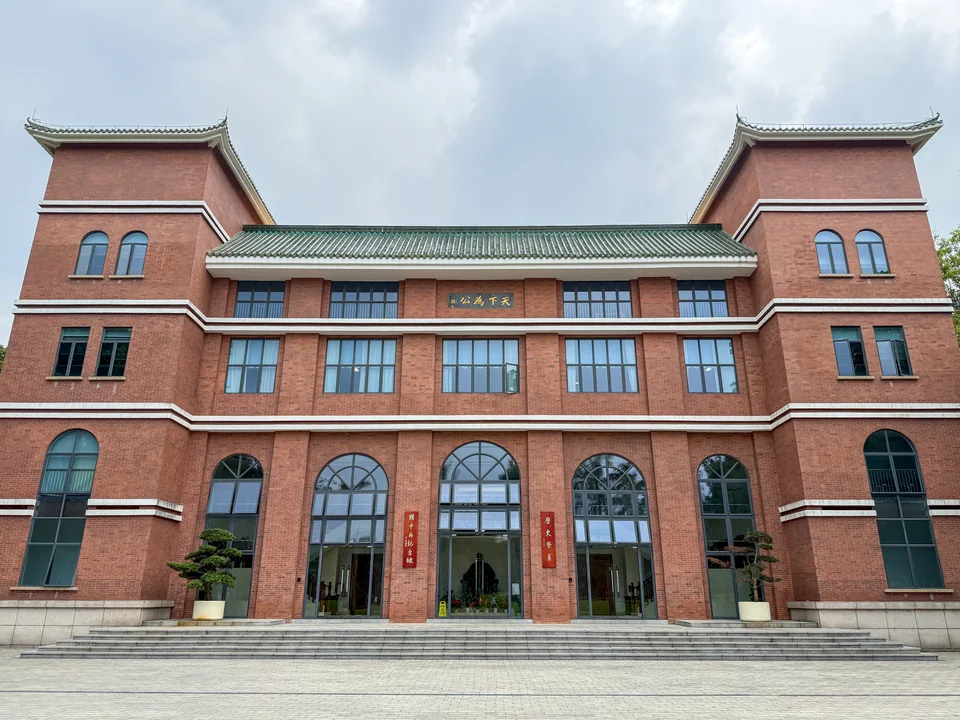
Sun Yat-sen University (中山大学, SYSU, also known as Zhongshan University) is a public university in southern China, founded by Sun Yat-sen in 1924. It has five campuses in three cities, Guangzhou, Zhuhai and Shenzhen, and ten affiliated hospitals. It ranks 62nd in ARWU 2026 and sits in the 201–250 band of the THE World University Rankings 2026. Bachelor's programmes for international students are taught only in Chinese and require HSK 5 with 180 points plus the CSCA test. Tuition is $3,880–7,160 (CNY 26,000–48,000) a year. One point to plan for: self-funded students are not given dormitory places and must find their own housing.
| At a glance | Details |
|---|---|
| Cities and campuses | Guangzhou, Zhuhai, Shenzhen: five campuses; ten affiliated hospitals |
| Founded | 1924, by Sun Yat-sen |
| Rankings | ARWU 2026: 62; THE 2026: 201–250 |
| Double First-Class | 11 disciplines (2022): philosophy, mathematics, chemistry, biology, ecology, materials science, electronic science, basic medicine, clinical medicine, pharmacy, business administration |
| Bachelor's | Chinese-taught only; $3,880 (CNY 26,000) humanities, $5,040 (33,800) science, engineering and agriculture, $7,160 (48,000) medicine, arts and sports |
| Master's and doctoral | master's $4,470 / $5,810 / $8,200 (CNY 30,000 / 39,000 / 55,000), IMBA $16,250 (109,000); doctoral $5,070 / $6,590 / $9,690 (34,000 / 44,200 / 65,000) |
| Housing | not provided to self-funded students; rates for scholarship holders $450–2,680 (CNY 3,000–18,000) a year |
| Requirements | HSK 5 (180), HSK 4 (180) for the Chinese Language major; CSCA; TOEFL 79 or IELTS 6.5 for English-taught master's |
| 2026 admission rounds | bachelor's: 1 Jan – 28 Feb and 1 Mar – 30 Apr; master's: 1 Jan – 15 Feb and 16 Feb – 30 Apr |
| Pre-university year | $4,530 (CNY 30,400), with housing $5,220 (35,000), Zhuhai campus |
| Application fee | CNY 400 ($60) |
| Scholarships | CSC, Guangdong Government Scholarship (one-off), SYSU Scholarship (from half tuition to a full waiver plus CNY 30,000–42,000 a year) |
Who SYSU suits, and who should look elsewhere
SYSU is a large research university in the Guangdong–Hong Kong–Macao Greater Bay Area. On the second-round Double First-Class list it has 11 disciplines: philosophy, mathematics, chemistry, biology, ecology, materials science, electronic science and technology, basic medicine, clinical medicine, pharmacy and business administration. By its own count, 21 SYSU disciplines are in the global top 1% of ESI and 13 in the top 0.1%.
Consider SYSU if you:
- can study in Chinese or will reach HSK 5 before applying;
- are choosing medicine, pharmacy, biology, chemistry or business in Chinese;
- want to live in Guangdong, near Hong Kong and Macao;
- are counting on a scholarship: the university's own award ranges from half tuition to a full waiver with a living allowance.
Look elsewhere if you need an English-taught bachelor's (SYSU has none) or a campus room you can count on. Wuhan University, for example, offers English-taught bachelor's programmes and provides rooms for new students who arrive on time.
Programmes for international students
Bachelor's degrees
In 2026 Chinese-taught programmes were open to international students on all three city campuses:
| Campus | Examples of majors |
|---|---|
| Guangzhou | Chinese language, history, philosophy, sociology, economics, law, business management, psychology, mathematics, physics, chemistry, biology, geography, materials, computer science, electronics, clinical medicine, stomatology, pharmacy, public health, nursing |
| Zhuhai | economics, history, philosophy, international politics, tourism management, mathematics, physics, atmospheric sciences, geology, marine science, artificial intelligence, software engineering |
| Shenzhen | business management, clinical medicine, pharmacy, public health, aeronautics, biomedical engineering, biotechnology, ecology, mechanical engineering, flexible electronics, smart transportation, smart agriculture |
The same major may run on different campuses, so choose the right one in your application. All bachelor's teaching is in Chinese. Every programme except Chinese Language requires HSK 5 with 180; Chinese Language requires HSK 4 with 180.
Master's and doctoral degrees
Master's programmes are taught in Chinese (HSK 5 with 180) or English. English-taught programmes need TOEFL iBT 79 (at least 15 per section) or IELTS Academic 6.5 (at least 5.5 per band); graduates of English-medium degrees may be exempt with a certificate. Some programmes set higher bars: the Master of Teaching Chinese to Speakers of Other Languages (MTCSOL) needs HSK 5 with 210 and HSKK intermediate with at least 60. The master's study plan must exceed 3,000 words. The fee table lists the two-year IMBA separately at CNY 109,000 ($16,250) a year. There is also a fully English-taught Master of Public Administration in Chinese Governance for public servants from developing countries, funded by China's Ministry of Commerce.
Pre-university programme
This one-year programme on the Zhuhai campus prepares students for Chinese-taught bachelor's study. It runs for 38 weeks and 1,152 class hours, at 32 hours a week. It combines intensive Chinese with subjects in one of two tracks, Business and Humanities (mathematics, business Chinese, principles of economics and management) or Sciences and Engineering (mathematics, Chinese for science and engineering, physics, chemistry), plus China studies and HSK and CSCA preparation. Students who go on to a SYSU bachelor's can transfer at least 15 credits.
| Item | 2026 intake |
|---|---|
| Tuition | $4,530 (CNY 30,400) a year or $2,270 (15,200) a semester |
| With housing | $5,220 (35,000) a year or $2,610 (17,500) a semester; double rooms of about 25 m² in Liyuan Building 6 |
| Applications | until 31 July 2026 (now closed); start September 2026 |
| One-semester option | starts February 2027, requires HSK 4 |
| Documents | passport valid to 1 December 2026, diploma, transcripts, language certificate, study plan of at least 600 words, police clearance |
After the programme, you can apply to SYSU or other Chinese universities if you meet their language and academic requirements. Our guide to the foundation year in China compares this route with a language course.
How to apply to SYSU
Requirements
- Nationality: non-Chinese citizen with a foreign passport. Children of Chinese citizens and former PRC citizens face extra nationality rules and must provide entry–exit records from 1 May 2022.
- Education: completed secondary school or equivalent (a bachelor's degree for master's programmes).
- Age: the 2026 guide sets no upper age limit for self-funded students. Applicants under 18 on 1 September 2026 submit a notarised commitment letter from a guardian living in Guangdong province. Scholarships have their own age limits.
- Chinese: HSK 5 with 180 (HSK 4 with 180 for Chinese Language). A certificate that your school or university taught in Chinese can replace HSK.
- CSCA: compulsory for bachelor's applicants. In 2026, the first round accepted sessions held by 1 March and the second round sessions held by 1 May.
| Field | CSCA papers |
|---|---|
| Humanities, economics, law, management | humanities (or science) Chinese, mathematics |
| Sciences, engineering, psychology | science Chinese, mathematics, physics |
| Medicine, pharmacy, public health, nursing | science Chinese, mathematics, physics, chemistry |
Bachelor's documents
- Ordinary passport (in the 2026 cycle, valid until at least 1 December 2026) and a photo.
- Secondary school diploma or proof of expected graduation; without the diploma before enrolment, the offer is cancelled.
- Complete senior high school transcripts.
- CSCA score report and HSK certificate.
- Foreigner physical examination form with chest X-ray, ECG and lab tests, stamped by the hospital, issued within six months.
- Birth certificate and parents' nationality documents (an extended set for former Chinese citizens and children of PRC citizens).
- Police clearance certificate issued within six months.
- For under-18s, notarised documents from a guardian in Guangdong.
- Optional awards and certificates.
Documents in languages other than Chinese or English need a notarised translation. The application form, commitment letters and financial guarantee generated by the system must be printed, signed by hand and uploaded. See our guide to applying to Chinese universities.
Selection steps
- Take CSCA before your round's cut-off, and HSK.
- Register at apply.sysu.edu.cn, complete the form and upload documents.
- Sign and upload the generated forms.
- Pay the CNY 400 fee online; without it the application is invalid.
- Attend an interview on overall ability and language.
- Check the preliminary result 15 days after the interview; admission letters are released from July.
- With the admission letter and the Confirmation Form for Study in China, apply for an X1 study visa at a Chinese consulate. See our China student visa guide.
- Arrive for registration (late August or early September) and convert your visa into a study residence permit within 30 days of entry. Early registration is not allowed.
Application deadlines for 2027
| Programme | 2026-cycle dates | Status on 23 Sep 2026 |
|---|---|---|
| Bachelor's, first round | 1 Jan – 28 Feb; CSCA sessions by 1 Mar | 2027 guide not yet published (the previous one appeared on 10 Dec 2025) |
| Bachelor's, second round | 1 Mar – 30 Apr; CSCA sessions by 1 May | same |
| Master's, first round | 1 Jan – 15 Feb | same |
| Master's, second round | 16 Feb – 30 Apr | same |
| Pre-university year | until 31 July; one-semester stream starts Feb 2027 | 2026 intake closed |
| Scholarships (CSC, SYSU) | per their own guides | 2026 guides closed |
If the pattern repeats, 2027 applications will open on 1 January 2027. It is best to have CSCA and HSK results ready for the first round, since the second leaves less time for the visa and housing search. For HSK preparation, see our HSK exam guide.
How much it costs to study and live in Guangzhou, Zhuhai and Shenzhen
Tuition
| Level | Humanities | Science, engineering, agriculture | Medicine, arts, sports |
|---|---|---|---|
| Bachelor's | $3,880 (CNY 26,000) | $5,040 (33,800) | $7,160 (48,000) |
| Master's | $4,470 (30,000) | $5,810 (39,000) | $8,200 (55,000) |
| Doctoral | $5,070 (34,000) | $6,590 (44,200) | $9,690 (65,000) |
| IMBA | $16,250 (109,000) | — | — |
| Pre-university year | $4,530 (30,400) | — | — |
Fees are per academic year from the 2026 admission and registration guides; next year's amounts are set by SYSU's official fee announcement.
Housing
Under SYSU's guidelines, self-funded bachelor's and master's students arrange their own housing because dormitory space is limited. Campus rooms go to CSC scholarship holders (free of charge), SYSU Scholarship holders (who pay the fee; on Guangzhou East Campus they are placed in quad rooms) and pre-university students who choose the housing option.
Dormitory fees for 2026/27 are published in SYSU's registration guide for new international students (28 July 2026). Water and electricity are extra, and you need to bring or buy your own bedding.
| Campus and building | Room | Fee per academic year |
|---|---|---|
| Guangzhou South Campus, No. 502 | quad | $450 (CNY 3,000) |
| Guangzhou East Campus, other buildings | quad | $460 (3,100) |
| Zhuhai, Liyuan Building 6 | double | $690 (4,600) |
| Shenzhen, West and East quarters | quad / double | $890 / $1,790 (6,000 / 12,000) |
| Guangzhou East Campus, Gezhiyuan No. 3 | double / single | $910 / $1,360 (6,100 / 9,100) |
| Guangzhou North Campus, Building No. 4 | double / single | $1,060 / $2,100 (7,100 / 14,100) |
| Guangzhou South Campus, Nos. 253, 256, 488 | double / single | $1,190–1,490 / $2,150–2,680 (8,000–10,000 / 14,400–18,000) |
For a self-funded student these figures are a benchmark rather than an offer: you will rent near your campus. Before renting, submit the off-campus commitment letter in the university system. Within 24 hours of moving in, register with the local police together with your landlord, bringing the lease, a copy of the landlord's ID and the property certificate. SYSU recommends secure residential compounds and agreeing on registration and tax with the landlord before signing. Our guide to student life and housing in China has practical tips.
Compulsory costs
| Item | Amount |
|---|---|
| Application fee | CNY 400 ($60), non-refundable |
| Medical insurance | CNY 800 ($120) a year; paid 20–25 August in 2026; no registration without it |
| Medical check in China before the first residence permit | about CNY 400 ($60) at the Zhuhai centre |
| Study residence permit | CNY 400 ($60) for under a year, CNY 800 ($120) for a year or more; renewed annually |
| Late residence permit | fines of up to CNY 500 ($70) a day after 30 days from entry |
Tuition and dormitory fees are paid online at pay.sysu.edu.cn before registration: in 2026, bachelor's students paid on 20–27 August and graduate students on 27 August – 3 September. The platform accepts Alipay, WeChat Pay, UnionPay, Visa, Mastercard, JCB and American Express free of charge. There are no cash desks at registration, and banks or payment apps may cap single transactions, in which case you split the payment. Check with your bank which of these options works for you before you travel.
SYSU does not publish estimates for food or rent. The official figures add up to a compulsory first-year minimum for a self-funded humanities bachelor's student of CNY 26,000 tuition, 800 insurance, 800 for a one-year residence permit and about 400 for the medical check: roughly CNY 28,000 ($4,170) before housing, food and flights. For a full budget, see our guide to the cost of studying in China.
Scholarships: CSC, Guangdong province and SYSU
| Scholarship | Coverage | Conditions |
|---|---|---|
| CSC bilateral programme (Type A) | tuition, housing, insurance and a monthly stipend | through the Chinese embassy or national selection body |
| CSC Silk Road Program (Type B) | same | through SYSU and campuschina.org, agency number 10558 |
| Guangdong Government Outstanding International Student Scholarship | one-off payment: CNY 10,000 ($1,490) for bachelor's, 20,000 ($2,980) for master's | SYSU nominates strong self-funded first-year students after enrolment; no separate application |
| SYSU Scholarship for International Students | first class: tuition waiver plus CNY 30,000 a year (bachelor's), 36,000 (master's), 42,000 (doctoral); second class: tuition waiver; third class: 50% tuition | requires a recommendation from an organisation on SYSU's published list or a recognised recruitment ambassador; bachelor's under 25, master's under 35; annual review; not for MPA or MBA |
SYSU Scholarship holders pay their own accommodation, utilities, insurance, visa, flights and medical checks. The award cannot be combined with CSC, the Center for Language Education and Cooperation (CLEC) scholarship or the Ministry of Commerce scholarship. The list of recommending organisations is updated every year: the 2026 list included one private education company from Russia and the Chinese embassy in Turkmenistan, and no organisation from Kazakhstan. CSC, the province or the SYSU committee decides on awards.
Where you study: Guangzhou, Zhuhai and Shenzhen
SYSU describes itself as "five campuses in three cities". Guangzhou, the provincial capital, hosts the humanities, law, economics, basic sciences and most medical programmes. Zhuhai, a coastal city bordering Macao, hosts economics, history, marine and atmospheric sciences, software engineering and the pre-university programme. Shenzhen, the technology hub next to Hong Kong, hosts engineering, biomedical and medical programmes.
The catalogue lists the campus for each major. It decides your city, your rent and your commute to clinics or labs.
Do not confuse SYSU with National Sun Yat-sen University in Kaohsiung, Taiwan: it is a separate institution with a different admissions system. For the SYSU Scholarship, only recommendations from organisations on the university's published list count, so check any agency against it.
SYSU strengths and limitations for international applicants
| Strengths | Limitations |
|---|---|
| 62nd in ARWU 2026, strong medicine and sciences | bachelor's only in Chinese, HSK 5 required |
| a wide choice of majors across three Greater Bay Area cities | no dormitory places for self-funded students |
| the SYSU Scholarship can cover tuition in full plus CNY 30,000–42,000 a year | the scholarship needs a recommendation from a recognised organisation |
| a pre-university year with credit transfer | science and medical fees are higher than at WHU and NJU |
| two application rounds, the first from 1 January | the second round closes on 30 April with no later option |
Mistakes to avoid
- Applying for an English-taught bachelor's. There is none: every SYSU bachelor's is in Chinese with HSK 5.
- Counting on a dormitory. Self-funded students find their own housing and should start before the visa.
- Taking CSCA after your round's cut-off. Sessions count up to 1 March for the first round and 1 May for the second.
- Choosing a guardian anywhere in China. For applicants under 18, the guardian must live in Guangdong.
- Registering early. SYSU does not accept students before the date in the admission letter or on non-study visas.
- Confusing SYSU with National Sun Yat-sen University. They are different universities in different education systems.
Checklist before you apply
- Your passport will be valid beyond the date set in the 2027 guide (in the 2026 cycle, at least until 1 December of the entry year).
- You have chosen both the major and the campus: the city determines rent and commute.
- You hold, or have booked before the end of winter, HSK 5 with 180 (HSK 4 for Chinese Language).
- Your CSCA session meets the round cut-off: in 2026, sessions by 1 March for round one and by 1 May for round two.
- Your medical form (with X-ray, ECG and lab tests) and police clearance are no older than six months when you apply.
- The application form, commitments and financial guarantee generated by the system are printed, signed by hand and uploaded.
- Applicants under 18 have a guardian resident in Guangdong province, with notarised documents.
- For the SYSU Scholarship, you have a recommendation from an organisation on the university's list.
- You have a housing plan: for self-funded students, a rental near campus with police registration within 24 hours.
Working during and after your studies
A study visa (X1) and study residence permit do not allow regular employment. China's Ministry of Education rules on international students (Order No. 42, Art. 30) permit only university-run work-study (勤工助学) and prohibit employment and business activity, and the Exit and Entry Administration Law (Art. 43) treats work beyond the permitted type or hours as illegal. Internships are organised by the university within the curriculum. After graduation you need a work permit arranged by an employer. See our guide to work and internships for students in China.
FAQ
How much does SYSU cost?
Under the 2026 guides, a bachelor's costs $3,880 (CNY 26,000) a year in the humanities, $5,040 (33,800) in science and engineering and $7,160 (48,000) in medicine. Master's programmes cost $4,470–8,200. Add CNY 800 a year for insurance, CNY 400–800 for the residence permit and private rent, because self-funded students do not get dormitory places. The compulsory first-year minimum for a humanities student, before housing and food, is about CNY 28,000 ($4,170).
Are any SYSU programmes taught in English?
Not at bachelor's level. Some master's programmes are taught in English, such as the MPA in Chinese Governance for public servants, and they require TOEFL iBT 79 or IELTS 6.5 with minimum section scores.
What level of Chinese do I need?
HSK 5 with 180 for Chinese-taught bachelor's and master's programmes, and HSK 4 with 180 for the Chinese Language major. A certificate of Chinese-medium schooling can replace HSK.
When should I apply for 2027?
The 2027 guide has not been published yet. In the 2026 cycle, bachelor's applications ran from 1 January to 28 February and 1 March to 30 April; master's from 1 January to 15 February and 16 February to 30 April. Aim to have CSCA and HSK by January.
How do I get the SYSU Scholarship?
You need a recommendation from an organisation on SYSU's published list or a recruitment ambassador recognised by the university. First class waives tuition and pays CNY 30,000 a year for bachelor's students; second class waives tuition; third class halves it. The award is reviewed every year on academic performance.
Where do I live without a dormitory place?
Rent a flat or room near your campus in Guangzhou, Zhuhai or Shenzhen and register with the police together with your landlord within 24 hours of moving in. SYSU publishes no rents; for comparison, dormitory places for scholarship holders cost from CNY 3,000 a year in a quad to 18,000 for a single. CSC and SYSU Scholarship holders are housed on campus under university rules.
Does StudyU help with SYSU applications?
Under a service agreement we shortlist majors and campuses, check requirements, prepare documents and support the application, CSCA preparation and the visa stage. SYSU decides on admission, CSC, Guangdong province or the SYSU committee on scholarships, and the Chinese consulate on the visa. Housing is confirmed by the landlord.
Sources
- 2026 bachelor's enrolment guidelines (iso.sysu.edu.cn)
- 2026 bachelor's catalogue: majors, campuses, CSCA (PDF)
- 2026 master's enrolment guidelines
- 2026 pre-university programme
- 2026 SYSU Scholarship for International Students
- SYSU Scholarship recommending institutions
- 2026 registration guide for new international students: fees, dormitories, insurance, residence permit (PDF)
- Ministry of Education rules on international students, Order No. 42
- 2026 CSC Silk Road Program
- 2026 CSC bilateral programme
- MPA in Chinese Governance 2026
- THE World University Rankings 2026: Sun Yat-sen University
- ARWU 2026
- Second-round "Double First-Class" list, Ministry of Education
- Exchange rate: ECB reference rates on 23 Sep 2026, €1 = $1.1411 = CNY 7.6538 (about CNY 6.71 per $1), rounded to $10
To compare Guangdong with other regions, see studying in China. If you want to plan HSK and CSCA for the first 2027 round, send us a request.
During the free initial consultation, we clarify your goal, profile, timing, and budget and identify the next realistic step.
Next steps
- HSK Exam Guide 2026: Levels, the Switch to HSK 3.0 on 13 December, Dates, Fees and Test Centres
- Foundation Year in China: Which Format to Choose and What It Costs
- Applying to Chinese Universities: Documents Checklist for 2027
- Work and Internships for Students in China: What a Study Visa Allows and How to Register an Internship
- Studying in China for international applicants
- Cost of Studying in China: Tuition, Housing and a First-Year Budget
