
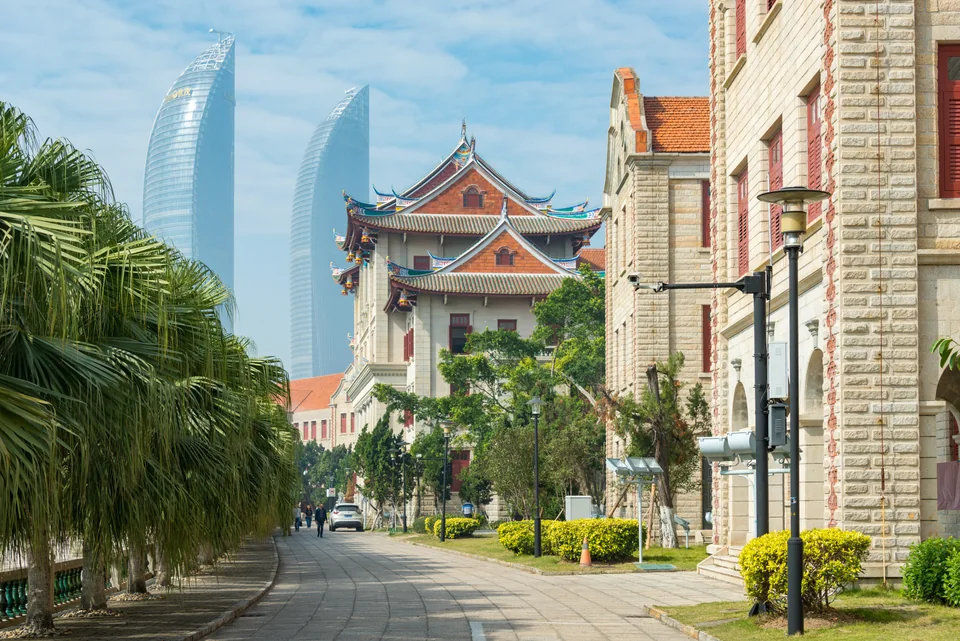
Xiamen University (厦门大学, XMU) is a public university in Xiamen, Fujian province, founded in 1921 by Tan Kah Kee, an overseas Chinese business leader. It has more than 47,000 students and sits in the 251–300 band of the THE World University Rankings 2026 and the 101–150 band of ARWU 2026. Degree admission happens once a year, for autumn, and closes early: in the 2026 cycle the deadlines were 15 February for CSC applicants, 10 April for provincial and university scholarships and 10 May for self-funded students. A Chinese-taught bachelor's costs $3,580–3,880 (CNY 24,000–26,000) a year. The HSK bar is higher than at many peers: 210 points at level 4 or 5.
| At a glance | Details |
|---|---|
| City and campuses | Xiamen: Siming and Xiang'an campuses; Zhangzhou (a neighbouring city); a separate XMU Malaysia campus |
| Founded | 1921, by Tan Kah Kee |
| Rankings | THE 2026: 251–300; ARWU 2026: 101–150 |
| Double First-Class | 6 disciplines (2022): chemistry, marine science, biology, ecology, statistics, education |
| Bachelor's | Chinese-taught $3,580 (CNY 24,000) for humanities, $3,880 (26,000) for other fields; English-taught MBBS $5,670 (38,000) |
| Master's | Chinese-taught $3,880–4,470 (CNY 26,000–30,000) a year, 3 years; English-taught $5,810–6,710 (39,000–45,000), 2 years |
| Chinese courses | $1,940 (CNY 13,000) a semester, $3,880 (26,000) a year |
| Language | HSK 5 (210) for humanities, economics, management, law and arts; HSK 4 (210) for sciences, engineering and medicine; IELTS 6.0 / TOEFL 80 for English-taught |
| Age | bachelor's 18–30; master's generally under 45 |
| Application fee | CNY 400 ($60) |
| Housing | Siming CNY 35–65 a night; Xiang'an CNY 1,600–4,000 a year; Zhangzhou CNY 1,100–1,200 a year |
Who Xiamen University suits, and who should look elsewhere
XMU is one of the strongest universities on China's south-east coast and belongs to the national "985", "211" and "Double First-Class" programmes. Its six Double First-Class disciplines are chemistry, marine science, biology, ecology, statistics and education. The university is closely tied to South-East Asia: it runs 14 Confucius Institutes and opened the first overseas campus of any Chinese university, in Malaysia.
XMU makes sense if you:
- already have HSK 4–5 and want to study in Chinese in economics, law, chemistry, marine science or journalism;
- are looking for an English-taught master's in finance, accounting, law or marine affairs;
- can apply in winter and start only in September;
- want a lower-cost university city by the sea: XMU estimates campus meals at CNY 1,000–1,500 a month.
Look elsewhere if you want a spring start, an English-taught bachelor's in economics or IT (XMU has none) or a room you can count on in the city centre: Siming campus rooms go to scholarship holders first. For a spring intake, consider Wuhan University.
Programmes for international students
Bachelor's degrees
Chinese-taught programmes are open in almost every school: humanities, foreign languages, journalism, history, law, economics, management, international relations, sociology, mathematics, physics, chemistry, materials, informatics, electronics, energy, aerospace engineering, architecture and civil engineering, ocean and earth sciences, environment and ecology, medicine, pharmacy, public health, art and film. First-year students take common courses across a broad field and move into their major from the second year.
Only four bachelor's programmes were taught in English in 2026:
| Programme | Campus | Length | Annual tuition |
|---|---|---|---|
| Clinical Medicine (MBBS) | Xiang'an | 6 years | $5,670 (CNY 38,000) |
| Environmental Design | Zhangzhou | 4 years | $13,420 (90,000) |
| Visual Communication Design | Zhangzhou | 4 years | $13,420 (90,000) |
| Digital Media Art | Zhangzhou | 4 years | $13,420 (90,000) |
The design programmes are run by the Institute of Creativity and Innovation (ICI) and are XMU's most expensive. If you plan to practise medicine at home, check recognition rules first in our guide to studying medicine in China.
There is also a Chinese Language bachelor's at the Chinese International Education College (also called the Overseas Education College, OEC), with trade, teaching and culture tracks. It lasts three to four years and costs $3,880 (CNY 26,000) a year.
Master's and doctoral degrees
Chinese-taught master's programmes last three years, English-taught "international" programmes two years, and doctorates four years, with no tuition charged in the fourth doctoral year. English-taught master's programmes include finance and accounting (Institute for Financial and Accounting Studies), fiscal and tax law, international law, civil and commercial law, marine affairs and chemical engineering. There is also a China–OECD LLM programme on taxation.
Chinese language courses
OEC runs the long-term Chinese programme at beginner (including absolute beginner), intermediate and advanced levels, with classes Monday to Friday for 18–24 hours a week. Electives include HSK 4–6 preparation, calligraphy, Chinese painting, kung fu, Chinese history and translation. Graduates receive an XMU continuing education certificate, not a degree.
| Item | 2026/27 academic year |
|---|---|
| Semesters | autumn: Sep 2026 – Jan 2027; spring: Feb–Jun 2027 |
| Tuition | $1,940 (CNY 13,000) a semester, $3,880 (26,000) a year |
| Application fee | CNY 400, first semester only |
| Age and education | 18–55, secondary school diploma |
| Spring 2027 deadline | 30 December 2026 |
Pre-admitted students pay the first semester (CNY 13,000) and sit an online placement test before XMU issues visa documents. Late applications are accepted, but you may join your class after the start. Compare XMU with other options in our guide to Chinese language programmes in China.
How to apply to Xiamen University
Requirements
- Age: bachelor's 18–30 on 1 September of the entry year (under-18s submit a guardian guarantee); master's generally under 45.
- Education: a final-year secondary student or holder of a diploma with good grades; for a master's, a bachelor's degree or proof of expected graduation.
- Nationality: non-Chinese citizen. Applicants of Chinese descent and former PRC citizens go through a nationality check: at least four years of foreign nationality and two years' residence abroad within the last four years.
- Chinese: humanities, economics, management, law and arts need HSK 5 with 210; sciences, engineering, medicine and sport need HSK 4 with 210. A certificate that your school (or university, for a master's) taught in Chinese can replace HSK.
- English (English-taught programmes): TOEFL iBT 80 or IELTS Academic 6.0; citizens of countries where English is an official language are exempt.
CSCA for bachelor's applicants
| Paper | Who takes it |
|---|---|
| Subject Chinese | all Chinese-taught applicants; Chinese Language applicants with HSK 4 are exempt |
| Mathematics | everyone |
| Physics and/or chemistry | one or both for science, engineering, agriculture and medicine |
The test language must match the programme's language, so MBBS applicants sit mathematics and science in English. For HSK preparation, see our HSK exam guide.
Documents
- Passport scan; in the 2026 cycle it had to be valid until at least 31 October 2026.
- Birth certificate and parents' identity documents.
- Secondary school diploma (or proof of expected graduation) and transcripts.
- HSK or IELTS/TOEFL certificate and CSCA score report.
- One signed recommendation letter with the referee's details.
- Personal statement of at least 800 words covering your background, studies, motivation, study plan and career goals, in Chinese for Chinese-taught programmes and English for English-taught ones.
- Physical examination record for inbound travellers with chest X-ray, ECG and lab results, issued within six months.
- Proof of financial support with supporting documents (scholarship applicants included).
- Police clearance certificate issued within six months before applying.
- A portfolio for art programmes.
An optional pre-acceptance letter from a college gives priority in admission. Once submitted, an application cannot be edited, so check everything first. Documents not in Chinese or English need a notarised translation; see our guide to applying to Chinese universities.
How selection works
- Apply at application.xmu.edu.cn and pay the CNY 400 fee.
- XMU checks nationality, education, grades, language and health.
- The college runs an academic assessment: document review and, if needed, an online interview or written test.
- Decisions are published in the application system in June or July.
- With the admission letter and JW202 form, apply for an X1 study visa at a Chinese consulate. See our China student visa guide.
- Arrive and register in September; within 30 days of entry, convert the visa into a study residence permit.
Application deadlines for 2027
| Category | 2026-cycle date | What it means for 2027 |
|---|---|---|
| Degree applications open | 1 December 2025 | if the pattern repeats, early December 2026 |
| CSC applicants (Type B, through XMU) | 15 February 2026 | sit CSCA and HSK by the end of January |
| Fujian Provincial Government Scholarship and XMU New Student Scholarship | 10 April 2026 | earlier than the self-funded deadline |
| Self-funded (bachelor's and master's) | 10 May 2026 | autumn intake only |
| CSC Type A (through the embassy) | usually January to early April | set by the Chinese embassy |
| Chinese courses, spring 2027 | 30 December 2026 | published |
As of 23 September 2026, XMU's 2027 guides have not been published. Use last cycle's dates for planning and confirm them at admissions.xmu.edu.cn once the new guide appears.
How much it costs to study and live in Xiamen
Tuition
| Level and programme | Language | Humanities | Sciences, engineering, medicine, economics, management, law, arts |
|---|---|---|---|
| Bachelor's (4–5 years) | Chinese | $3,580 (CNY 24,000) | $3,880 (26,000) |
| Chinese Language bachelor's (OEC) | Chinese | $3,880 (26,000) | — |
| Master's (3 years) | Chinese | $3,880 (26,000) | $4,470 (30,000) |
| International master's (2 years) | English | $5,810 (39,000) | $6,710 (45,000) |
| Doctoral (4 years) | Chinese | $4,470 (30,000) | $5,070 (34,000) |
| International doctoral | English | $6,260 (42,000) | $8,200 (55,000) |
Fees are per academic year and exclude textbooks (CNY 400–700 a year). XMU asks students to pay only according to the official guide and enrolment documents and to ignore any other payment notices. Check early whether your bank can send a CNY transfer to a Chinese university account.
Housing
| Campus | Room type | Price |
|---|---|---|
| Siming | double | CNY 35–65 per bed per night (≈ $160–290 for 30 nights) |
| Xiang'an | suites of four double rooms | CNY 1,600–4,000 ($240–600) a year |
| Zhangzhou | quad | CNY 1,100–1,200 ($160–180) a year |
Rooms have beds, desks, wardrobes, air conditioning, a water heater and a bathroom; internet is paid separately, and water and electricity follow university rules. Places are limited and go first to scholarship holders whose awards include housing; others are told to arrange housing before arrival. A flat near Siming campus costs about CNY 2,500 ($370) a month, and OEC quotes CNY 600–1,500 for a room near Xiang'an.
Living costs
| Item | XMU figure |
|---|---|
| Meals | CNY 1,000–1,500 ($150–220) a month |
| Medical insurance | CNY 800 ($120) a year, compulsory |
| Textbooks | CNY 400–700 a year |
| Rent near Siming | about CNY 2,500 a month |
A self-funded Chinese-taught humanities student living on the Xiang'an campus would pay roughly $3,580 in tuition, $240–600 for housing, $1,790–2,680 for meals and $120 for insurance in the first year, plus visa, residence permit, flights and personal spending. Our guide to the cost of studying in China has a fuller budget.
Scholarships: CSC, Fujian province and XMU
| Scholarship | Coverage | Conditions |
|---|---|---|
| CSC Type A (bilateral) | full: tuition, housing, insurance and a monthly stipend | through the Chinese embassy, usually January to early April |
| CSC Type B (university programme) | same | through XMU's system (agency number 10384) and studyinchina.csc.edu.cn; 15 February in the 2026 cycle |
| Fujian Provincial Government Scholarship | $4,470 (CNY 30,000) a year for bachelor's, $5,960 (40,000) for master's, $7,450 (50,000) for doctoral | about 20 places for new students; HSK 3 or above; bachelor's under 30, master's under 35, doctoral under 40; awarded for one academic year and paid at the end of the year; for the following year the university recommends the best students who pass the annual review for renewal |
| XMU New International Students Scholarship | bachelor's: tuition only (5 places); master's: tuition plus CNY 3,000 a month (3) or tuition only (8); doctoral: tuition plus CNY 3,500 a month (3) or tuition only (5) | bachelor's under 25, master's under 40, doctoral under 45; 10 April in the 2026 cycle; annual review |
| International Chinese Language Teachers Scholarship | tuition, housing, insurance, stipend | under the rules of the Center for Language Education and Cooperation |
One detail matters with the Fujian scholarship: nominees start studying and pay tuition only after the award is confirmed at the end of the year. If it is not confirmed, they pay as self-funded students. The Tan Kah Kee Scholarship was suspended in 2026. CSC, the province or the XMU committee decides on awards.
Where you study: Siming, Xiang'an and Zhangzhou
Siming is the historic campus between the hills and the sea. English-taught master's programmes in finance, accounting and law, for example, are taught here. International dormitories are double rooms, but places are scarce.
Xiang'an is XMU's second campus in Xiamen. It hosts the School of Medicine with the MBBS and the Coastal and Ocean Management Institute, home of the English-taught Marine Affairs master's. International students live in suites of four double rooms, charged per year.
Zhangzhou is a campus in the neighbouring city, home to the Institute of Creativity and Innovation and its English-taught design programmes. It has the cheapest housing: quad rooms.
XMU Malaysia is a separate campus with its own admissions and fees. Do not confuse it with the main university, or XMU with Xiamen University of Technology, which is a different institution.
XMU strengths and limitations for international applicants
| Strengths | Limitations |
|---|---|
| Chinese-taught bachelor's at $3,580–3,880 a year; Xiang'an housing from $240 a year | an HSK bar of 210 points, higher than many universities at the same level |
| a provincial scholarship of up to CNY 50,000 a year plus university awards | autumn intake only, with windows closing between February and May |
| strong chemistry, marine science, economics and statistics | only four English-taught bachelor's programmes, three of them at $13,420 a year |
| Chinese courses with a spring start, apply by 30 December 2026 | few Siming dormitory places; nearby rent is about CNY 2,500 a month |
| lower living costs than Beijing or Shanghai, meals from CNY 1,000 a month | bachelor's applicants must supply a birth certificate and parents' documents |
Mistakes to avoid
- Aiming for HSK 180. XMU degrees need 210 points: HSK 5 for humanities and HSK 4 for sciences.
- Applying in spring. In the 2026 cycle self-funded applications closed on 10 May, the provincial scholarship on 10 April and CSC on 15 February.
- Booking housing before knowing your campus. Your programme may be on Xiang'an or Zhangzhou, not Siming.
- Confusing XMU with XMU Malaysia. The Malaysian campus has its own admissions, and a place there is not a place in Xiamen.
- Treating the Fujian scholarship as an admission discount. It is confirmed only at the end of the year, and if it falls through you pay full tuition.
- Paying against third-party instructions. XMU warns that only the bank details in its guide and official enrolment documents are valid.
Checklist before you apply
- You have decided on your category: CSC Type B (15 February in the 2026 cycle), the Fujian or XMU scholarships (10 April) or self-funded (10 May).
- Your passport will be valid beyond the new guide's cut-off (in the 2026 cycle, at least until 31 October of the entry year).
- You hold, or have booked before winter, HSK with 210 at the right level: HSK 5 for humanities, economics and law, HSK 4 for science, engineering and medicine.
- Your CSCA session delivers the report before your deadline, and the test language matches the programme language.
- Your personal statement of 800+ words is written in the language of the programme.
- Your medical form (X-ray, ECG, lab tests) and police clearance are no older than six months when you apply.
- A financial guarantee with supporting documents is ready; scholarship applicants need one too.
- You have checked the whole application: it cannot be changed after submission.
- You have an off-campus housing plan in case no dormitory place is available.
Working during and after your studies
A study visa (X1) and study residence permit do not allow regular employment. China's Ministry of Education rules on international students (Order No. 42, Art. 30) permit only university-run work-study (勤工助学) and prohibit employment and business activity, and the Exit and Entry Administration Law (Art. 43) treats work beyond the permitted type or hours as illegal. Internships are organised by the university within the curriculum. After graduation you need a work permit arranged by an employer. See our guide to work and internships for students in China.
FAQ
How much does Xiamen University cost?
A Chinese-taught bachelor's costs $3,580 (CNY 24,000) a year in the humanities and $3,880 (26,000) in other fields. The English-taught MBBS costs $5,670 (38,000) and English-taught design $13,420 (90,000). Master's programmes start at $3,880 in Chinese and $5,810 in English. A Chinese course costs $1,940 per semester.
What HSK score does XMU require?
HSK 5 with 210 points for humanities, economics, management, law and arts, and HSK 4 with 210 for sciences, engineering, medicine and sport. Language courses need no certificate.
When should I apply for 2027?
The 2027 guide has not been published yet. In the 2026 cycle applications opened on 1 December 2025 and closed on 15 February for CSC, 10 April for the Fujian and XMU scholarships and 10 May for self-funded students. For Chinese courses starting in spring 2027, the deadline is 30 December 2026.
Does XMU offer English-taught bachelor's degrees?
Only four: the MBBS (6 years, Xiang'an) and three design programmes at Zhangzhou. Economics, IT and engineering bachelor's degrees are taught in Chinese. The English-taught choice is wider at master's level.
Can self-funded students get a scholarship?
Yes: the Fujian Provincial Government Scholarship and the XMU New International Students Scholarship are open to applicants who apply through the university's system. You apply for the scholarship together with admission in the XMU system by the April deadline (10 April in the 2026 cycle). Places are few: about 20 new-student places for the Fujian scholarship and 5 bachelor's places for the XMU scholarship.
Where do international students live?
On campus if there is space: Siming CNY 35–65 a night, Xiang'an CNY 1,600–4,000 a year, Zhangzhou CNY 1,100–1,200 a year. Scholarship holders have priority. Without a place, arrange private housing before arrival; expect about CNY 2,500 a month near Siming.
Does StudyU help with XMU applications?
Under an agreement with StudyU, we shortlist programmes and campuses, check requirements, prepare documents and support the application, scholarship steps and visa stage. Xiamen University decides on admission, and the scholarship provider (CSC, Fujian province or the XMU committee) decides on scholarships; the Chinese consulate as the consular authority decides on the visa.
Sources
- 2026 bachelor's admission guide (admissions.xmu.edu.cn)
- 2026 master's admission guide
- Study costs
- English-medium bachelor's programmes 2026
- English-medium master's programmes 2026
- Fujian Provincial Government Scholarship 2026
- XMU New International Students Scholarships 2026
- OEC long-term Chinese programme 2026/27
- THE World University Rankings 2026: Xiamen University
- ARWU 2026
- Ministry of Education rules on international students, Order No. 42
- Second-round "Double First-Class" list, Ministry of Education
- Exchange rate: ECB reference rates on 23 Sep 2026, €1 = $1.1411 = CNY 7.6538 (about CNY 6.71 per $1), rounded to $10
For other universities and general rules, see studying in China. If you want to be ready for XMU's winter window with CSCA and HSK in hand, send us a request.
During the free initial consultation, we clarify your goal, profile, timing, and budget and identify the next realistic step.
Next steps
- HSK Exam Guide 2026: Levels, the Switch to HSK 3.0 on 13 December, Dates, Fees and Test Centres
- Studying Medicine in China: English-Taught MBBS, the Ministry of Education List and Recognising the Degree Back Home
- Applying to Chinese Universities: Documents Checklist for 2027
- Work and Internships for Students in China: What a Study Visa Allows and How to Register an Internship
- Studying in China for international applicants
- Cost of Studying in China: Tuition, Housing and a First-Year Budget
