
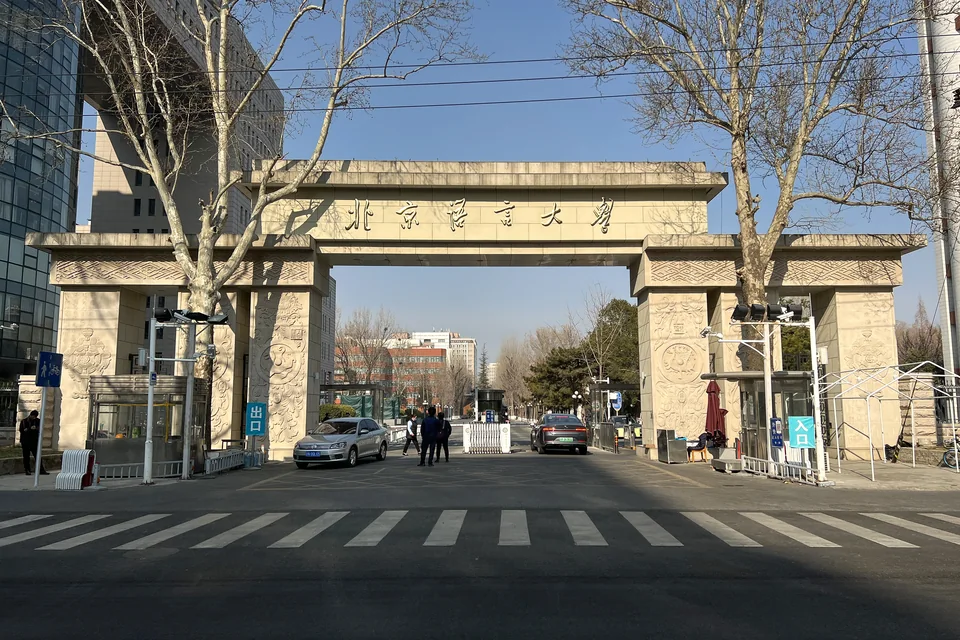
Beijing Language and Culture University (BLCU, 北京语言大学) is a public university under China's Ministry of Education, founded in 1962 as a preparatory school for international students. It is best known for teaching Chinese to foreigners: a full-year Chinese course starting in autumn 2026 costs $3,970 (CNY 26,600), and a Chinese-taught bachelor's degree costs $3,850 (CNY 25,800) a year. From autumn 2026, every bachelor's applicant needs a score on the new CSCA test, and most programmes also require HSK 4 or HSK 5. On-campus rooms are charged per night, from $10 (CNY 70) for a bed in a four-person room.
| At a glance | Details |
|---|---|
| City and campus | Beijing, Haidian District, 15 Xueyuan Road; some scholarship students start on the Hainan campus |
| Founded | 1962 (Beijing Language Institute from 1964, current name since 2002) |
| Status | directly administered by the Ministry of Education; not on the second-round "Double First-Class" list (2022) |
| Bachelor's | 64 majors; separate classes for international students (Chinese language, translation, trade) plus classes shared with Chinese students |
| Bachelor's tuition | $3,850 (CNY 25,800) a year; English and Business English $4,110 (27,600); English-taught programmes $5,810 (39,000) |
| Chinese courses | one semester $2,030 (CNY 13,600); academic year $3,970 (26,600) |
| Foundation year | $5,820 (CNY 39,000) a year or $2,980 (20,000) a semester |
| Requirements | CSCA for bachelor's; HSK 4 (180) or HSK 5 (180–200); IELTS 5.5–6.5 for English-taught programmes |
| Application fee | $120 (CNY 800) for degrees, $90 (CNY 600) for courses and the foundation programme |
| Scholarships | Chinese Government Scholarship (CSC), Beijing Government Scholarship (first-year tuition), International Chinese Language Teachers Scholarship |
Who BLCU suits, and who should look elsewhere
BLCU is not a broad research university like Peking University or Tsinghua. It is a specialist institution for languages, translation and area studies. It launched China's first bachelor's programme in Chinese for international students and the first college dedicated to training teachers of Chinese as a foreign language. The university calls itself a "little United Nations" because of how many nationalities study there.
BLCU makes sense if you:
- want to go from zero to HSK 4–5 in one or two years and then apply to a Chinese university;
- plan a career as a translator, Chinese teacher, China specialist or in international communication;
- are a native speaker of another language BLCU teaches (Russian, Japanese, Korean, French, Arabic and others) and are considering a translation master's where native proficiency replaces a language certificate;
- are ready to study in Chinese, because almost all BLCU degrees are taught in Chinese.
Look elsewhere if you need a strong engineering or medical degree, a wide choice of English-taught programmes, or a university from China's elite "985" and "211" groups. Our overview of universities in Beijing compares the alternatives.
Which programmes BLCU offers international students
Non-degree Chinese courses
This is BLCU's core offer. Classes are split into six levels, from beginner A to advanced F, with 20 class hours a week on weekday mornings. Speaking, listening and reading are complemented by a "Chinese for special purposes" module: business, medical, tourism, science and technology or workplace Chinese. A placement test before the start decides your class.
Autumn 2026 intake (official course list published on 23 March 2026):
| Course | Dates | Tuition |
|---|---|---|
| Practical Chinese, 12 weeks | 7 Sep – 27 Nov 2026 | $1,520 (CNY 10,200) |
| Intensive Practical Chinese, 12 weeks (mornings and afternoons) | 7 Sep – 27 Nov 2026 | $2,390 (16,000) |
| Practical Chinese, one semester | 7 Sep – 31 Dec 2026 | $2,030 (13,600) |
| Intensive Practical Chinese, one semester | 7 Sep – 31 Dec 2026 | $3,250 (21,800) |
| Practical Chinese, academic year | 7 Sep 2026 – late Jun 2027 | $3,970 (26,600) |
| Advanced Chinese, Language and Culture, or Translation course (year) | 7 Sep 2026 – 1 Jul 2027 | $3,970 (26,600) |
| Practical Chinese, 4 weeks (basic Chinese required) | 30 Nov – 25 Dec 2026 | $670 (4,500) |
| Practical Chinese, 4 weeks | 4–29 Jan 2027 | $670 (4,500) |
Applications for the autumn courses closed on 17 July 2026. Only the four-week winter groups remain open: the deadline is 5 October 2026 for the December group and 10 November 2026 for the January group. The spring 2027 course list is published separately; last cycle's spring list appeared on 22 October.
Textbooks are included for courses shorter than a year and paid separately for year-long programmes. If a course does not reach the minimum group size, students are moved to the closest alternative. For a wider comparison, see our guide to Chinese language programmes in China.
Undergraduate Pathway (foundation year)
In Chinese the programme is called 本科直通车, "direct route to a bachelor's degree". It combines a year of Chinese with subject preparation in either a humanities track (Chinese history and culture, introductions to law and international business) or a science track (mathematics, physics and chemistry in Chinese). It totals 56 credits over two semesters and includes HSK and entrance-test preparation. Graduates receive a BLCU certificate and then apply for a bachelor's degree under the normal rules: the pathway does not replace HSK or CSCA. Our article on the foundation year in China explains how it differs from a plain language course.
Tuition is $5,820 (CNY 39,000) a year or $2,980 (20,000) a semester, plus a $90 (CNY 600) application fee. In the 2026 cycle the deadlines were 10 January for the spring start and 15 July for the autumn start.
BLCU also runs a "CSCA fast-track" of three 12-week modules taking students from zero to HSK 4 with mathematics, on campus or online. In 2026 a module cost $2,240–2,460 (CNY 15,000–16,500) on campus or $1,420–1,570 (9,500–10,500) online, with 5% off for two consecutive modules and 10% off for three. The autumn module is under way; the 2027 schedule has not been published yet.
Bachelor's degrees
Programmes fall into three groups:
- International students only (taught in Chinese): Chinese Language with tracks in Chinese, economics and trade, or Chinese–English; Translation (English–Chinese, Korean–Chinese, localisation); International Chinese Language Education; International Economics and Trade; Applied Chinese (business, tourism, technology); Communication Studies; International Organisations and Global Governance. Requirement: HSK 4 with at least 180 points;
- Shared with Chinese students (taught in Chinese): English and Business English, International Politics, Journalism, Psychology, Computer Science, Artificial Intelligence, Data Science. These need HSK 5 with at least 180; English majors also need IELTS 6.5 or TOEFL 90; International Politics and Journalism need HSK 5 with 200 and at least 60 in each section, plus an interview;
- Taught in English: Finance, International Economics and Trade, Accounting, Special Education (Speech and Hearing Science), Sinology. Requirement: IELTS 5.5 with no band below 5.5, TOEFL 80 or TOEIC 650; Sinology requires IELTS 6.5 or TOEFL 90.
Dual-degree options start with two years at BLCU ($3,850 (CNY 25,800) a year), after which students move to the partner university and pay its fee: "Chinese + Artificial Intelligence" with the University of Science and Technology Beijing (USTB, $3,480 (CNY 23,300) a year; HSK 4 with 180 and at least 60 per section) and "Chinese + Arts Management" with the National Academy of Chinese Theatre Arts ($5,220 (CNY 35,000) a year). The 2+2 route with BLCU's Tokyo branch means two years in Beijing and two in Tokyo, where a year costs about $6,360 (JPY 1 million).
Majors marked with an asterisk in the catalogue (Chinese Language, Translation, International Chinese Language Education) admit students in both March and September; all others start in September only.
Master's and doctoral degrees
Master's programmes last two to three years and doctorates three years; both start only in autumn. Nearly everything is taught in Chinese: the minimum is HSK 5 with 180, rising to HSK 5 with 210 for literature, history, journalism and education, and HSK 6 for computer science. Three master's programmes are taught in English: International Business and Finance (IELTS 6.0 with no band below 5.5, or TOEFL 90) and Speech-Language Pathology.
Language-and-translation master's programmes typically combine HSK 5 (180) with native proficiency or a C1 certificate in the other language. For example, Russian Language and Literature asks for HSK 5 with 180 and at least 60 per section and accepts native Russian speakers instead of the TORFL-2 certificate; the translation programmes add an interview.
How to apply to BLCU: requirements for international students
Age and nationality
- Bachelor's: 18–55, with a secondary school diploma. Applicants under 18 need the university's consent and notarised guardianship documents.
- Master's and doctoral: under 55, with a bachelor's or master's degree.
- Language courses: 18–50 for programmes of a year or longer; 18–60 for courses under six months.
- Nationality: you need an ordinary foreign passport. If a parent is a Chinese citizen, extra Ministry of Education rules apply on how long you have held foreign nationality (at least four years) and lived abroad.
HSK, English tests and CSCA
HSK is China's official Chinese proficiency test for foreigners; see our HSK exam guide. CSCA (China Scholastic Competency Assessment) is a new entrance test for international students applying to bachelor's programmes in China. From autumn 2026 BLCU requires it of every bachelor's applicant.
| Test | Who takes it | Details |
|---|---|---|
| Subject Chinese (humanities or science) | all Chinese-taught programmes | 90 minutes; applicants to Chinese Language, Chinese Language and Culture, Translation (including localisation), Applied Chinese and International Chinese Education with HSK 4 are exempt |
| Mathematics | everyone, including English-taught programmes | 60 minutes |
| Sessions | 2025/26 cycle: Asia-Pacific in December, April, June; Europe, Africa and the Americas in January and March | mostly home-based online with a live proctor; online results within 7 working days, paper-based within 14 |
| Fee | one subject $67 (CNY 450), two or more $105 (CNY 700) | registration at csca.cn |
Documents for a bachelor's application
- Passport photo page.
- Secondary school diploma and transcripts for all semesters. Documents not in Chinese or English need a notarised translation into one of them. Final-year students upload a letter from their school and submit the diploma before registration.
- HSK certificate and CSCA score report.
- A recommendation letter in Chinese or English, signed, with the referee's contact details.
- A guarantor's ID (passport or Chinese ID card).
- A police clearance certificate and a photo.
- A non-refundable $120 (CNY 800) application fee paid online.
Master's applicants add two letters from associate professors or above and a study plan of at least 800 Chinese characters (1,500 for doctoral applicants; English for English-taught programmes). Doctoral applicants also need a supervisor's pre-acceptance letter. Translation and legalisation are covered in our guide to applying to Chinese universities.
Step-by-step plan for 2027
- September–November 2026. Choose between a course, the foundation year and a degree. For a bachelor's, register for CSCA and plan your HSK date: applications without these results are not accepted.
- December 2026 – March 2027. Sit CSCA and HSK. CSCA results take about two weeks, so the last session before a deadline is risky.
- Before the deadline. Complete the form at apply.blcu.edu.cn, upload documents and pay the fee. The university says processing takes about three weeks.
- Interview. For degrees, BLCU contacts you by phone or email to schedule an interview; Computer Science adds a written test in mathematics and logic.
- Offer and JW202. Admitted students receive an admission letter and a JW202 form, which the Chinese consulate uses to issue an X1 study visa (over 180 days) or X2 (shorter stays).
- Arrival. Registration is 1–5 days before classes. An X1 visa must be converted into a study residence permit within 30 days of entry. More in our China student visa guide.
Application deadlines for 2027
| Programme | Deadline | Status on 23 Sep 2026 |
|---|---|---|
| Winter courses (4 weeks) | 5 Oct 2026 (group 30 Nov – 25 Dec) and 10 Nov 2026 (group 4–29 Jan 2027) | published |
| Spring 2027 semester courses | 15 January in the 2026 cycle (15 February for the 12-week course starting in April) | list not yet published; last year's appeared on 22 Oct 2025 |
| Bachelor's, spring (March) 2027 | 12 January in the 2026 cycle | 2027 guide not yet published |
| Bachelor's, autumn (September) 2027 | 30 June in the 2026 cycle | same |
| Master's and doctoral, autumn 2027 | 6 July in the 2026 cycle | the 2026 guide appeared on 20 Oct 2025 |
| Beijing Government Scholarship, spring 2027 | 12 January 2027 | published |
| International Chinese Language Teachers Scholarship, programmes from March 2027 | 31 October 2026, at chinese.cn | published |
| CSC scholarship | set by the Chinese embassy or the university channel (Type B) | the 2026 guide appeared in Nov 2025 |
Last cycle's dates are useful for planning but may change. Check the admissions page at admission.blcu.edu.cn before you apply.
How much it costs to study and live in Beijing
Tuition
| Level | Annual tuition |
|---|---|
| Chinese-taught bachelor's (most programmes) | $3,850 (CNY 25,800) |
| Bachelor's in English or Business English | $4,110 (27,600) |
| English-taught bachelor's | $5,810 (39,000) |
| Chinese-taught master's | $4,470 (30,000); literary theory and art studies $5,730 (38,400) |
| English-taught master's | International Business $7,310 (49,000), Finance $7,160 (48,000), Speech-Language Pathology $4,470 (30,000) |
| Doctoral | $4,850 (32,500) for most programmes; International Chinese Language Education $7,160 (48,000) |
| Chinese course, academic year | $3,970 (26,600) |
Dollar amounts use the ECB reference rates of 29 September 2026 (about CNY 6.70 per $1), rounded. BLCU bills in yuan. You can pay on registration in cash, by bank card (2.5–4% surcharge) or in advance by bank transfer; if a transfer has not arrived by registration day, you will not be registered, so confirm a workable payment route with your bank early.
On-campus housing
International student dormitories are on campus and priced per night.
| Building and room | Per night | About 30 nights |
|---|---|---|
| Building 16, bed in a triple | $10 (CNY 70) | $310 (2,100) |
| Building 17, bed in a quad | $10 (CNY 70) | $310 (2,100) |
| Building 16, bed in a double | $15 (CNY 100) | $450 (3,000) |
| Building 17, bed in a double | $18 (CNY 120) | $540 (3,600) |
| Building 16, single | $22 (CNY 150) | $670 (4,500) |
| Building 17, single | $45 (CNY 300) | $1,340 (9,000) |
Rooms have air conditioning, a shower and bedding; Building 17 has a shared kitchen and laundry on every floor. Internet is extra, $15–30 (CNY 100–200) a month according to the admissions office. Longer stays get a discount, and long-term students sign per semester. Living off campus is allowed, but you must register with the local police station together with your landlord within 24 hours of arriving in China.
Living costs
The university estimates $4–7 (CNY 25–50) a day for meals in campus canteens. Add comprehensive medical insurance of $120 (CNY 800) a year, paid together with tuition (you cannot register without it), plus the residence permit, textbooks for year-long programmes and a phone plan. A taxi from the airport costs about $22 (CNY 150). For a full annual budget, see our guide to the cost of studying in China.
Scholarships: CSC, Beijing and teacher programmes
| Scholarship | Coverage | Eligibility and timing |
|---|---|---|
| Chinese Government Scholarship (CSC), bilateral programme (Type A) | tuition, dormitory or housing allowance, $120 (CNY 800) insurance and a monthly stipend: bachelor's $375 (CNY 2,500), master's $450 (3,000), doctoral $520 (3,500) | through the Chinese embassy; bachelor's under 25, master's under 35, doctoral under 40; CSCA for bachelor's, HSK 4 for Chinese-taught graduate study |
| CSC university programmes (High Level Postgraduate, Silk Road, China Link) | per programme terms | through the university and campuschina.org |
| Beijing Government Scholarship | first-year tuition only | self-funded first-year students; bachelor's under 30, master's under 35, doctoral under 40; for spring 2027, apply by 12 January 2027 |
| International Chinese Language Teachers Scholarship | tuition, housing, insurance and a monthly stipend (not for four-week courses) | nominated by a recommending institution such as a Confucius Institute or HSK centre; apply at chinese.cn, which opened on 1 March in the 2026 cycle |
CSC candidates can request a BLCU pre-admission letter by emailing their documents to scholarship@blcu.edu.cn, with no application fee. The letter helps but guarantees nothing: CSC makes the award decision.
Where you study: Wudaokou, Hainan and overseas branches
The main campus is in Haidian, Beijing's university district in the north-west of the city, near Wudaokou. It holds teaching buildings, international student dormitories, canteens (including a halal one), sports grounds and an HSK test centre.
From 2026, BLCU sends some new CSC scholarship holders to its campus on Hainan Island:
| Scholarship students | Where they study | Room |
|---|---|---|
| Bachelor's | years 1–2 on Hainan, years 3–4 in Beijing | double on Hainan, quad in Beijing |
| Master's and doctoral | first half on Hainan, second half in Beijing | double on Hainan |
| One-year non-degree | first semester on Hainan, second in Beijing | double on Hainan |
| One-semester non-degree and preparatory students | Beijing throughout | quad |
No such rule is published for self-funded students, but scholarship holders should plan for the move. BLCU also has overseas units: a college in Bangkok, a Tokyo branch, a Kazakhstan branch opened in July 2024 and a teaching centre in Saudi Arabia.
BLCU strengths and limitations for international applicants
| Strengths | Limitations |
|---|---|
| You can start from zero: beginner courses and March or September starts | almost every degree is taught in Chinese; few English-taught options |
| a year of Chinese costs $3,970; a bachelor's $3,850 a year | dormitories are charged per night: a bed in a double starts at $450 (CNY 3,000) for 30 nights |
| language classes of 18–20 students, placed by test | so many international students that everyday Chinese practice takes deliberate effort |
| translation and language master's that accept native proficiency | not on the "Double First-Class" list and absent from overall world rankings |
| branches in Kazakhstan, Japan and Thailand | CSCA is compulsory for bachelor's applicants from 2026 |
Mistakes to avoid
- Confusing a course with a degree. A year of Chinese gives a certificate of completion, not a diploma. Moving on to a bachelor's requires a separate application, HSK and CSCA.
- Leaving CSCA to the last session. Results take one to two weeks, and there are only five sessions a year.
- Assuming HSK 4 is enough everywhere. Programmes shared with Chinese students need HSK 5; Journalism and International Politics need 200 points with a minimum in every section.
- Arriving on the wrong visa. BLCU does not enrol students on work or tourist visas; you need an X1 or X2 visa issued on the JW202 form.
- Booking Beijing housing before campus allocation. CSC scholarship holders may be sent to Hainan.
- Treating the application fee as a deposit. $120 (CNY 800) or 600 is not refunded, even if you change your mind.
Checklist before you apply
- You have chosen the format (course, pathway or degree) and noted its deadline.
- For a bachelor's, your CSCA date on csca.cn leaves at least two weeks for results before the deadline.
- You hold, or have booked, the right HSK level: HSK 4 for international-only programmes, HSK 5 for programmes shared with Chinese students, and 200 with at least 60 per section for Journalism and International Politics.
- Your diploma and transcripts are translated into Chinese or English and notarised.
- Your recommendation letter is signed and includes the referee's contact details; master's applicants have two letters from associate professors or above and a study plan of 800+ characters.
- A police clearance certificate, photo and guarantor's ID are ready.
- You know how you will pay the application fee ($120 (CNY 800) or 600 online) and tuition: by card with a 2.5–4% surcharge, or by a transfer that must arrive before registration.
- Your first-month budget covers housing, $120 (CNY 800) insurance and $4–7 (CNY 25–50) a day for meals.
Rankings and reputation
BLCU does not appear in the overall THE World University Rankings 2026 or ARWU 2026 (ShanghaiRanking), and it is not on the second "Double First-Class" list (2022). That is typical for a specialist language university, because overall rankings lean heavily on citations in the natural sciences.
Its standing comes from elsewhere. The university was set up with the involvement of Premier Zhou Enlai, became the Beijing Language Institute in 1964 and took its current name in 2002. It opened China's first bachelor's programme in Chinese for international students and the first doctoral programme in teaching Chinese as a foreign language. BLCU has established 30 Confucius Institutes and Classrooms, more than any other Chinese university.
For a career in translation, teaching or China studies, your HSK level, practical experience and programme specialisation matter more than a ranking position. If status is a priority, compare BLCU with the options in our overview of universities in China for international students.
Working during and after your studies
A study visa (X1) and study residence permit do not allow regular employment. China's Ministry of Education rules on international students (Order No. 42, Art. 30) permit only university-run work-study (勤工助学) and prohibit employment and business activity, and the Exit and Entry Administration Law (Art. 43) treats work beyond the permitted type or hours as illegal. Internships are organised by BLCU within the curriculum; after graduation you need a work permit arranged by an employer. See our guide to work and internships for students in China.
BLCU's programmes lead to careers where Chinese is a working tool: translation and localisation, teaching Chinese, foreign trade and work with Chinese partners.
FAQ
Can I get into BLCU without any Chinese?
For language courses, yes: there are beginner groups. Chinese-taught bachelor's programmes need at least HSK 4 (180), and English-taught ones need IELTS 5.5 or TOEFL 80. Without Chinese, the route is the foundation year or a year-long course, followed by a separate degree application.
How much does a year at BLCU cost?
A year of Chinese for 2026/27 costs $3,970 (CNY 26,600), a Chinese-taught bachelor's $3,850 (25,800) a year and a Chinese-taught master's $4,470 (30,000). Add housing (from $10 (CNY 70) a night), insurance of $120 (CNY 800) a year and meals of $4–7 (CNY 25–50) a day.
Do I need CSCA if I already have HSK?
For a bachelor's from 2026, yes. HSK 4 only exempts you from the subject Chinese paper for Chinese Language, Chinese Language and Culture, Translation, Applied Chinese and International Chinese Education; everyone takes mathematics. Master's programmes and language courses do not require CSCA.
What is the minimum age?
- Bachelor's applicants under 18 are accepted only with the university's consent and notarised guardianship documents. The upper limit is 55 for degrees and 50 for long language programmes.
Can I start in spring?
Yes: March intakes exist for Chinese courses and for the asterisked bachelor's majors (Chinese Language, Translation, International Chinese Language Education). Master's and doctoral programmes start only in autumn.
Are there scholarships for self-funded students?
Self-funded first-year students can apply for the Beijing Government Scholarship, which covers first-year tuition. For the spring 2027 intake the deadline is 12 January 2027. The university's scholarship committee decides; if you are not selected, you study at your own expense.
Does StudyU help with BLCU applications?
Under an agreement with StudyU, we shortlist programmes, check requirements, prepare documents and support the application, CSCA preparation and the visa stage. The university (BLCU) decides on admission, CSC or the scholarship committee as scholarship provider decides on funding, and the Chinese consulate, as the consular authority, decides on the visa.
Sources
- Bachelor's entry requirements and majors 2026 (admission.blcu.edu.cn)
- CSCA instructions for BLCU applicants
- Graduate entry requirements and tuition
- 2026 master's admission guide (deadline)
- Autumn 2026 non-degree course list, PDF
- Undergraduate Pathway 2026
- CSCA fast-track 2026
- Dormitories and prices
- 2026 campus allocation for scholarship students
- CSC bilateral programme 2026
- Beijing Government Scholarship
- International Chinese Language Teachers Scholarship 2026
- Admissions FAQ: payment, insurance, meals
- About BLCU: history, majors, branches (blcu.edu.cn)
- Ministry of Education rules on international students, Order No. 42
- Second-round "Double First-Class" list, Ministry of Education
- Exchange rate: ECB reference rates on 29 Sep 2026, €1 = $1.1355 = CNY 7.6117
For other universities, living costs and visa rules, see studying in China. If you want help deciding between a course, the foundation year and a degree, send us a request.
During the free initial consultation, we clarify your goal, profile, timing, and budget and identify the next realistic step.
Next steps
- HSK Exam Guide 2026: Levels, the Switch to HSK 3.0 on 13 December, Dates, Fees and Test Centres
- Foundation Year in China: Which Format to Choose and What It Costs
- Applying to Chinese Universities: Documents Checklist for 2027
- Work and Internships for Students in China: What a Study Visa Allows and How to Register an Internship
- Studying in China for international applicants
- Cost of Studying in China: Tuition, Housing and a First-Year Budget
