
Tsinghua University is a public research university in Beijing, founded in 1911 and ranked 14th in the world in the QS World University Rankings 2027. International students can enter at bachelor's, master's and doctoral level, but the routes differ sharply: most bachelor's programmes are taught in Chinese and English and require HSK 5, while only four bachelor's programmes and around thirty master's programmes are taught entirely in English. Bachelor's applications for 2027 are already open: round one runs from 30 September to 20 November 2026 and round two from 21 November 2026 to 28 February 2027.
| At a glance | Details |
|---|---|
| Location | Haidian District, Beijing; some master's programmes at Tsinghua Shenzhen International Graduate School |
| Founded | 1911 |
| Rankings | QS 2027: 14th; THE 2026: 12th; ARWU 2026: 18th |
| Teaching languages | Chinese and English (bachelor's); English or Chinese (graduate) |
| Bachelor's tuition per year | $3,880–4,470 (CNY 26,000–30,000) on Chinese-English programmes; $14,910 (CNY 100,000) on English-taught programmes |
| Master's tuition per year | $4,170–4,920 (CNY 28,000–33,000) on standard 2027 programmes; English-taught programmes set their own fees |
| Bachelor's intake 2027 | 30 Sep–20 Nov 2026 and 21 Nov 2026–28 Feb 2027 |
| Application fee | $120 (CNY 800), non-refundable |
| Housing | about $180 a month for a bed in a double room (CNY 40 a day); online booking, not enough places for everyone |
Who Tsinghua suits, and who should look elsewhere
| Strengths | Drawbacks and risks |
|---|---|
| One of China's leading technical universities (ARWU 2026: 18th), 93 bachelor's majors | Most bachelor's teaching mixes Chinese and English, so HSK 5 is needed |
| Standard master's tuition of $4,170–4,920 a year | English-taught bachelor's programmes cost $14,910 a year |
| Around 30 master's and 9 doctoral programmes fully in English | Each school sets its own language threshold and deadline |
| Campus housing from about $130 a month per bed | A dorm place is not guaranteed; booking is first come, first served |
| Two bachelor's rounds, with round-one decisions by January; about 45% of international freshmen received a university scholarship in 2026 | The 2027 requirements make HSK 5 mandatory; the old HSK 4 conditional-admission clause is not in them |
Tsinghua makes sense for applicants heading into engineering, computer science, architecture, materials, economics or public policy who are ready either to reach HSK 5 or to target an English-taught master's. If you need an English-only bachelor's on a limited budget, compare it with Peking University, Zhejiang University and Hong Kong options such as the University of Hong Kong. For the wider picture, see studying in China.
Which programmes are available in English and Chinese
Bachelor's degrees
Tsinghua admits undergraduates by division and college rather than by single major, and international students study alongside Chinese students. Eleven divisions and ten colleges are open to international applicants, and the university offers 93 bachelor's majors in total.
Most programmes are "Chinese-English taught": the core is in Chinese, with some courses in English. They include architecture, intelligent manufacturing, electronic information, computer science, automation, mathematics and physics, chemistry and life sciences, economics, finance and management, law, arts and clinical medicine.
Four bachelor's programmes are taught entirely in English:
- Global Talents in Science and Engineering (Zijing College);
- Urban Regeneration and Design (Zijing College);
- Politics, Economics and Sociology for Global Leaders in Smart Society (Zhishan College);
- the Tsinghua–Chinese University of Hong Kong dual bachelor's degree in economics, open only in round two.
The university also lists up to 200 courses taught in English or bilingually.
English-taught master's and doctoral programmes
The graduate admissions site lists 31 master's and 9 doctoral programmes in English, and most doctoral programmes in engineering and the natural sciences are also delivered in English. Notable master's options include:
- engineering and computing: Advanced Computing, Electronic and Information Engineering, Vehicle and Mobility, Global Manufacturing and Analytics, International Engineering Management, Materials Science and Engineering, Nuclear Engineering and Management;
- architecture and construction: Architecture, International Construction and Project Management;
- economics, politics and law: Global MBA, Public Administration in International Development, Chinese Politics, Foreign Policy and International Relations, LL.M. in Chinese Law, International Affairs and Global Governance;
- other fields: Global Business Journalism, International Master of Applied Psychology, International Master of Public Health, Schwarzman Scholars;
- Shenzhen-based programmes: Data Science and Information Technology, Sustainable and Renewable Energy Technology, AI for Material Engineering, Biomedical Engineering and Translational Medicine and others.
Chinese-taught graduate programmes are far more numerous. They appear in the 2027 Catalog of Graduate Programs, which schools publish progressively.
How to apply to Tsinghua: requirements for international applicants
Bachelor's
The 2027 undergraduate requirements are:
- Nationality. Only foreign nationals holding a valid foreign passport may apply. Applicants with one or both parents who are Chinese citizens, and former Chinese citizens, must meet Ministry of Education Document No. 12 (2020) and submit nationality-status documents.
- School leaving certificate. A high school diploma earned through full-time, in-person study. GED and equivalency certificates are not accepted.
- Academic evidence. Transcripts in Chinese or English, national matriculation results, international tests (CSCA, SAT, ACT, A-Level, AP, IB and others) and olympiad awards. For the 2026 intake Tsinghua stated that CSCA was not required; the 2027 requirements list it alongside SAT and other tests.
- Language. Chinese-English programmes need HSK 5 with more than 60 points in listening, reading and writing, plus an English test (TOEFL, IELTS or another). Tsinghua's FAQ for earlier intakes allowed HSK 4 on condition of reaching HSK 5 in the first year, but the 2027 requirements contain no such clause, so plan to have HSK 5 when you apply. English-taught programmes need no Chinese, only an English test; the general requirements do not publish a minimum score.
- Age. Applicants must be 18 by 1 September 2027. Younger students present a guardian's guarantee from someone living in China at registration.
- Selection. Document screening, then a Comprehensive Assessment; architecture and arts add a portfolio review.
The application fee is CNY 800. Original documents are checked at the assessment or at registration. Tsinghua does not accept transfer students and does not run paid entrance-preparation classes.
Master's and doctoral
- A bachelor's degree is required (a master's for PhD). Degrees from outside China must be authenticated by CSCSE, the Ministry of Education's service centre, before registration. Thirty-nine schools accept bachelor's graduates directly into PhD programmes.
- Language: each school sets HSK or IELTS/TOEFL thresholds in the catalogue remarks. There is no university-wide minimum.
- Documents: personal statement (written in the online system), degree certificates and transcripts, two recommendation letters from associate professors or above, passport page, nationality documents and, for PhD, a research plan.
- Scans must be made in colour with a scanner; phone photos are rejected. Documents in other languages need notarised Chinese or English translations.
- The fee is CNY 800 and cannot be covered by a Chinese Government Scholarship.
Tsinghua states that it does not work with intermediaries for graduate admissions: applicants submit their own application through yzbm.tsinghua.edu.cn. Under contract, StudyU helps you choose a programme and prepare documents and your statement, but you submit them and only the university decides.
Step-by-step plan for 2027
- September–October 2026. Choose a field and teaching language. For a bachelor's, decide whether you can have HSK 5 and an English score before applying; for a master's, open your school's catalogue entry and note its deadline, language threshold and document list.
- By 20 November 2026 (bachelor's round one) or 28 February 2027 (round two). Register at apply.join-tsinghua.edu.cn, upload documents and pay CNY 800.
- September 2026–February 2027 (master's). Apply by your school's deadline. The winter break runs from 21 January to 17 February 2027; the system stays open but verification slows, so submit two or three weeks early.
- January–May 2027. Round-one bachelor's results arrive by January, round-two results in early May.
- Summer 2027. Receive the admission letter and JW202 form (JW201 for CSC scholars), apply for an X1 visa and book campus housing online immediately.
- September 2027. Register with original documents, pay for insurance and apply for a residence permit.
For help with the statement, see our guide to applying to Chinese universities.
When to apply for 2027 entry
| Level | Application window (Beijing time) | Results |
|---|---|---|
| Bachelor's, round one | 08:00 30 Sep 2026 – 17:00 20 Nov 2026 | by January 2027 |
| Bachelor's, round two | 08:00 21 Nov 2026 – 17:00 28 Feb 2027 | early May 2027 |
| Bachelor's design and fine arts | round one only | by January 2027 |
| Tsinghua–CUHK economics | round two only | early May 2027 |
| Master's and doctoral | usually September 2026 to February 2027, set by each school | per school |
| CSC Type A scholarship | via the Chinese embassy, usually November to April | per country |
What studying at Tsinghua costs
Bachelor's fees
| Programmes | Tuition per year |
|---|---|
| Architecture, engineering, computing, automation, maths and physics, chemistry and life sciences, most colleges | $4,470 (CNY 30,000) |
| Economics, finance and management, law, Xinya, Rixin and Zhishan colleges | $3,880 (CNY 26,000) |
| Arts | $5,960 (CNY 40,000) |
| Clinical medicine | $5,960 → $8,950 → $10,440 (CNY 40,000 / 60,000 / 70,000 by stage) |
| English-taught programmes | $14,910 (CNY 100,000) |
Graduate tuition for 2027
Tsinghua published the 2027 table on 23 September 2026.
| Programmes | Tuition |
|---|---|
| Master's in science, engineering, medicine | $4,920 a year (CNY 33,000) |
| Master's in economics and management | $4,470 a year (CNY 30,000) |
| Master's in philosophy, law, education, literature, history | $4,170 a year (CNY 28,000) |
| PhD in science, engineering, medicine, economics, management | $5,960 a year (CNY 40,000) |
| PhD in philosophy, law, education, literature, history, psychology | $4,770 a year (CNY 32,000) |
| Advanced Computing, Electronic Information (English) | $5,810 a year (CNY 39,000) |
| Vehicle and Mobility, Global Manufacturing and Analytics, IMEM, Environmental Science (English) | $11,630 for the whole programme (CNY 78,000) |
| Master of Architecture (English) | $17,890 per programme (CNY 120,000) |
| LL.M. in Chinese Law | $21,770 per programme (CNY 146,000) |
| Global MBA | $29,520 per programme (CNY 198,000) |
Add insurance at CNY 800 ($120) a year and the CNY 800 application fee.
What living in Beijing costs
Tsinghua does not publish an overall student budget. Reliable figures exist only for individual items:
| Item | Amount |
|---|---|
| Bed in a double room, Zijing apartments | CNY 40 a day, about $180 a month |
| Bed in a triple room | CNY 30 a day, about $130 a month |
| Accident and hospitalisation insurance | CNY 800 ($120) a year |
| Government benchmark: CSC living stipend | CNY 3,000 ($450) a month for master's, CNY 3,500 ($520) for doctoral students |
The stipend is not a price list: it is what CSC pays scholars who also get free housing, so it shows the level of spending state support is designed for. Add canteen meals, transport, phone and books according to your lifestyle, plus flights, visa and medical checks in year one. See our overview of the cost of studying in China. Dollar figures use the ECB rate of 23 September 2026 ($1 ≈ CNY 6.71), rounded to $10.
Which scholarships are available: CSC Type A and B, Beijing and Tsinghua
- Tsinghua University International Undergraduate Freshmen Scholarship. Covers first-year tuition in full, by half or in part; you apply through the admission system. About 45% of international freshmen received it in 2026. From the second year, students can apply for other awards, including the Beijing Government Scholarship.
- Chinese Government Scholarship (CSC), Type A. The only CSC route for Tsinghua bachelor's students. Apply through the Chinese embassy or your country's designated agency and list Tsinghua as first choice; you must also meet Tsinghua's own requirements.
- CSC for master's and doctoral study. Full awards cover tuition, housing or a housing allowance, a monthly stipend and insurance; partial awards cover some of these. Holders face an annual academic review.
- Beijing Government Scholarship and Tsinghua tuition scholarships (graduate level). Cover full or partial tuition for one year; students may reapply annually on a competitive basis.
- Fully funded programmes. Schwarzman Scholars, the international master's programmes in nuclear engineering, public health and public administration for development (MID, IMPA) and others; see each programme's page.
- Assistantships. Current graduate students can apply for teaching, research or management assistantships, usually at the start of each semester.
For how CSC types and timelines work, see our guide to scholarships abroad in 2026. Awards are decided by CSC, the Beijing authorities or the university, not by StudyU.
Where to live: Zijing apartments and renting
International students live in the Zijing International Student Apartments on campus, in double and triple rooms. Rooms are booked online in a set window on a first-come, first-served basis; those who miss out find housing off campus themselves. Xinya and Zijing are residential colleges where Chinese and international students live together. If you rent off campus, register with the local police within 24 hours of moving in (a general rule for foreigners in China, which neighbouring Peking University repeats in its admission notice). More on housing in our guide to student life and housing in China.
How to get the X1 visa, JW202 form and residence permit
After admission the university issues an admission letter and JW202 form (JW201 for CSC scholars). With these you apply for an X1 study visa at a Chinese embassy or consulate, then apply for a study residence permit within 30 days of entry. The consulate decides on the visa and China's immigration authority on the residence permit. For the visa file, Tsinghua asks bachelor's applicants for a financial sponsor form and income certificate. See our China student visa guide.
What helps and what gets in the way for applicants from Russia, Kazakhstan and the CIS
- School certificates from these countries meet the basic requirement: Tsinghua asks only for completed full-time secondary education.
- There is no gaokao for international applicants; documents and the Comprehensive Assessment decide.
- Chinese-English bachelor's tuition is $3,880–4,470 a year, and roughly half of international freshmen receive a first-year scholarship.
- HSK 5 is a high bar for beginners; a Chinese language programme or foundation year before applying is common.
- Documents in Russian or Kazakh need notarised translations, and foreign degrees need CSCSE authentication.
- Fees are paid in yuan. Check early whether your bank handles yuan transfers to Chinese banks and pay only through legal channels.
- Off-campus work needs university approval and a residence-permit annotation, so do not build your budget on it; see work and internships for students in China.
Which mistakes to avoid
- Waiting for spring. Round one closes on 20 November 2026, and design and fine arts accept applications only then.
- Counting on HSK 4. Conditional admission with HSK 4 appears only in older FAQ answers; the 2027 requirements call for HSK 5 with more than 60 in each of the three sections.
- Mixing up programme types. Chinese-English programmes need both HSK 5 and English, and fees differ almost fourfold.
- Looking for a single master's deadline. Each school sets its own, and the winter break slows verification.
- Uploading phone photos. Graduate admissions accepts only colour scans of originals or notarised copies.
- Counting on CSC Type B for a bachelor's. Only Type A through the embassy applies.
Where teaching takes place: campus and city
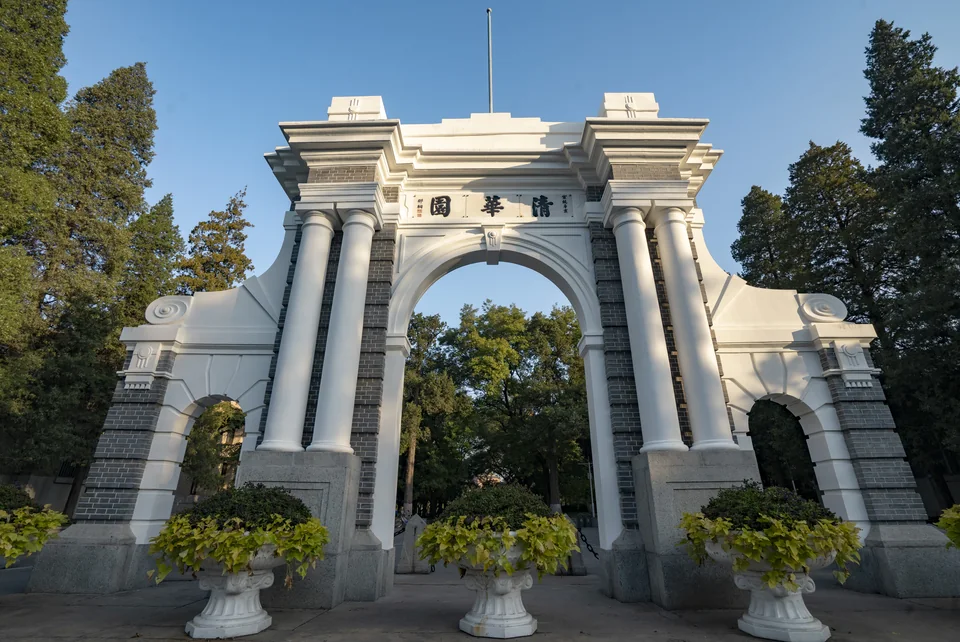
The main campus sits in north-west Beijing on the Qing-dynasty Tsinghua Garden site, next to the Zhongguancun technology district and Peking University. Teaching buildings, labs, dorms and sports facilities share one site, so most students need no daily commute. Some graduate programmes run in Shenzhen at Tsinghua Shenzhen International Graduate School, where housing is arranged separately.
How Tsinghua ranks
| Ranking | Position |
|---|---|
| QS World University Rankings 2027 | 14 |
| THE World University Rankings 2026 | 12 |
| ARWU 2026 | 18 |
| U.S. News Best Global Universities 2026–2027 (as reported by Tsinghua) | 6 |
Use rankings to compare institutions, but choose a programme by its research groups and curriculum.
FAQ
Can I apply to Tsinghua straight after high school?
Yes, if you hold a diploma from full-time secondary school. You must be 18 by 1 September 2027; younger applicants present a guardian's guarantee statement at registration. Chinese-English programmes need HSK 5 plus English; the four English-taught programmes need English only. SAT, CSCA or olympiad results strengthen the file.
How much does Tsinghua cost for international students?
Bachelor's tuition is $3,880–4,470 a year (CNY 26,000–30,000) on Chinese-English programmes and $14,910 (CNY 100,000) on English-taught ones. Standard master's tuition for 2027 is $4,170–4,920 a year; English-taught programmes set their own fees, for example $5,810 a year for Advanced Computing.
Is CSCA required for Tsinghua?
Tsinghua said CSCA was not required for 2026 entry. For 2027 it lists CSCA as one accepted test alongside SAT, ACT, A-Level and IB. If you apply for a CSC scholarship, check CSC's own requirements with the embassy.
Can I study at Tsinghua entirely in English?
At bachelor's level, on four programmes at CNY 100,000 a year. At graduate level there are around 30 master's and 9 doctoral programmes in English, and most engineering doctoral programmes are delivered in English.
When should I apply for 2027?
Bachelor's: 30 September–20 November 2026 or 21 November 2026–28 February 2027. Master's: usually September 2026 to February 2027; check your school's catalogue entry.
Can I count on a place in campus housing?
No. Places are booked online in a set window on a first-come basis; a bed costs CNY 40 a day in a double room and CNY 30 in a triple.
Can StudyU help me apply to Tsinghua?
Under an agreement with StudyU, we shortlist programmes, check requirements, prepare documents and support the application, scholarship and visa stages. You submit the application in Tsinghua's system yourself; the university decides on admission, and CSC or another funder on scholarships; the Chinese consulate as the consular authority decides on the visa.
Sources
- Tsinghua Undergraduate Admissions: Eligibility 2027
- Tsinghua Undergraduate Admissions: Schedule
- Tsinghua Undergraduate Admissions: Fees
- Tsinghua Undergraduate Admissions: FAQ
- Freshmen Scholarships
- Graduate Admissions: How to Apply
- Tuition Fees of Graduate Programs for International Students 2027
- Graduate Programs in English
- Miscellaneous Expenses
- Financial Aid System
- Tsinghua: Advantages
- Fudan University: Chinese-taught postgraduate admission 2026 (CSC stipend levels)
- Peking University: 2026 Undergraduate Program Entrance Examination
- QS: Tsinghua University
- THE: Tsinghua University
- ARWU 2026
- ECB reference rates, 23 Sep 2026
To compare Tsinghua with other options, see universities in Beijing and studying in China. If you want to know which Tsinghua route is realistic for your profile, apply for a consultation.
During the free initial consultation, we clarify your goal, profile, timing, and budget and identify the next realistic step.
Next steps
- Foundation Year in China: Which Format to Choose and What It Costs
- Applying to Chinese Universities: Documents Checklist for 2027
- Work and Internships for Students in China: What a Study Visa Allows and How to Register an Internship
- Cost of Studying in China: Tuition, Housing and a First-Year Budget
- Studying in China for international applicants
- University of Hong Kong (HKU)
