
The University of Padua (UniPD) is a public research university in north-east Italy, founded in 1222. For international applicants its main advantages are a wide choice of English-taught master's programmes, a fixed and predictable fee for non-EU students (up to $3,650 a year in 2026/27, regional tax included) and an early admissions calendar: the first application window for 2027/28 opened on 15 September 2026 and closes on 15 November 2026. Applicants need at least 12 years of schooling for a bachelor's degree.
| At a glance | Details |
|---|---|
| Location | Padua (Veneto); some programmes in Legnaro, Rovigo, Treviso, Vicenza and Conegliano |
| Founded | 1222 |
| Rankings | QS World University Rankings 2027: 204th; THE World University Rankings 2026: 201–250 |
| Languages | Italian and English |
| Fee for non-EU citizens (family abroad) | $3,180–3,410 (€2,790–2,990) in 2026/27, plus up to $240 (€208) regional tax and stamp duty |
| 2027/28 admissions | 15 Sep – 15 Nov 2026 for most programmes; 7 Jan – 7 Mar 2027 for some |
| Funding | Regional DSU grant (up to $9,410 / €8,246 in 2026/27); Padua International Excellence Scholarship ($9,130 / €8,000 a year + fee waiver) |
| Housing | ESU residences (competitive), partner residences, private rentals |
Who the University of Padua suits, and who should look elsewhere
| Pros | Cons and risks |
|---|---|
| Transparent fixed fee of $3,180–3,650 a year | 12 years of schooling required for a bachelor's |
| About 60 English-taught master's entries | Only 7–8 English-taught bachelor's programmes |
| November deadline lets you lock in plans early | Missing 15 November can cost you your first-choice programme |
| Excellence Scholarship is considered automatically | Only 76 awards across the whole university |
| Published rent benchmark of $340–680 for a single room | ESU residence places are not guaranteed |
Padua suits master's applicants in engineering, physics, computing, psychology and agricultural sciences who want strong academics on a moderate budget. If you are comparing it with other Italian public universities, see our profile of the University of Bologna.
Which programmes are taught in English
Teaching is coordinated by eight schools: Agricultural Sciences and Veterinary Medicine; Economics and Political Science; Engineering; Human and Social Sciences and Cultural Heritage; Law; Medicine; Psychology; Science.
English-taught bachelor's degrees
- Animal Care (Legnaro)
- Biology of Human and Environmental Health
- Earth and Climate Dynamics
- Economics, Governance and Decision-Making
- Information Engineering
- Psychological Science
- Techniques and Methods in Psychological Science (online)
- Italian Medieval and Renaissance Studies (listed on the portal as Italian/English)
Four further programmes — Management, Finance and Business Analytics; Physics for Technology; Food Safety for Global Health; Innovative Technologies in Agriculture — are announced for 2027/28 but still marked "to be approved". Keep a backup choice if you target one of them.
English-taught master's degrees
The 2027/28 catalogue lists about 60 English-taught master's entries, including separate tracks. Key clusters:
- engineering and computing: Computer Engineering, Computer Science, Cybersecurity, Data Science, Electrical, Electronic, Energy, Environmental, Materials, Mathematical and Aerospace Engineering, Control Systems Engineering, ICT for Internet and Multimedia;
- physics and mathematics: Physics, Physics of Data, Astrophysics and Cosmology, Quantum Science and Engineering, Mathematics;
- economics and management: Accounting, Finance & Business Consulting; Applied Economics; Computational Finance; Management for Sustainable Firms;
- psychology and neuroscience: Cognitive Neuroscience and Clinical Neuropsychology; Clinical, Social and Intercultural Psychology; Applied Child and Adolescent Psychology;
- social sciences: Human Rights and Multi-level Governance; European and Global Studies; Local Development; Mobility Studies; Social Sciences and Digital Data;
- agriculture and food: Italian Food and Wine; Sustainable Agriculture; Forest Sciences; Food, Nutrition and Health; Biotechnologies for Food Science.
Medicine
The single-cycle Medicine and Surgery programme in English (and its MedTech variant) follows a separate national admission procedure with an entrance test. It is not handled through apply.unipd.it (see our guide to medicine in Italy in English), so read its own admission notice.
How to apply to the University of Padua, step by step
The route below is for a non-EU citizen living outside Italy and applying to an English-taught programme. Italian-taught programmes follow the same steps plus a B2 Italian certificate.
- September–October 2026: choose the programme. On apply.unipd.it note the window, entry requirements, language, teaching location and fee. Windows differ: some close on 15 November 2026, others open only on 7 January 2027.
- Before the window closes: apply online. Upload your passport, transcript, school certificate or degree (if already awarded), CV, motivation letter, language certificate and any programme-specific documents. No legalisation is required at this stage; documents must be in Italian or English or come with an official translation into one of them. An application fee applies.
- After the window closes: evaluation. The programme's committee assesses your academic record and, at the same time, selects Padua International Excellence scholars — there is no separate scholarship application.
- Spring–summer 2027: Universitaly and visa. Once admitted, complete pre-enrolment on the national Universitaly portal and apply for a type D study visa at the Italian consulate. The visa decision belongs to the consulate, not the university; see our student visa guide.
- August–September 2027: enrolment and arrival. Submit originals and proof of qualification validity, pay the first instalment. Classes start at the end of September or early October; second-semester entry is not available.
- After arrival: obtain a tax code (codice fiscale), a residence permit for study (permesso di soggiorno — see our guide) and health cover. If you apply for the regional grant, you need a lease of at least 10 months.
When to apply for 2027/28
| Stage | Dates | Who |
|---|---|---|
| First window | 15 Sep – 15 Nov 2026, 23:59 Rome time | most programmes, including many English-taught master's |
| Second window | 7 Jan – 7 Mar 2027 | selected programmes; only for non-EU applicants living outside Italy |
| Language certificate | by 31 Jul 2027 | all international applicants |
| Classes start | late Sep – early Oct 2027 | all |
For example, Computer Science, Data Science and Physics of Data close on 15 November 2026, while Psychological Science, Information Engineering and Biology of Human and Environmental Health accept applications from 7 January to 7 March 2027. Dates were checked on apply.unipd.it on 23 September 2026.
Which documents and language certificates you need
Bachelor's degrees. Padua requires at least 12 years of schooling. With 11 years you need one of: one year of university study with all exams passed; a post-secondary qualification from a non-university institution covering the missing year; or a Foundation course at an Italian university. These routes only give access to the first year and cannot be used to shorten the degree. If your country requires a state exam for university entry, Padua also asks for proof that you passed it. Check the country-by-country list of accepted qualifications before applying.
Master's degrees. You need an accredited bachelor's degree plus the programme's curricular requirements (a minimum number of credits in specific subject areas), which are listed on each course page.
English. English-taught programmes require at least B2, proven only with certificates on the university's list. Minimum scores for the 2027/28 intake:
| Certificate | B2 minimum |
|---|---|
| IELTS Academic / General Training | 6.0 |
| TOEFL iBT | 86 (tests up to 20 Jan 2026) or 4.5 (tests from 21 Jan 2026, new scale) |
| Cambridge B2 First | 173 |
| PTE Academic | 65 |
| Duolingo English Test | 115 |
You may submit the certificate after applying, but no later than 31 July 2027. Italian-taught programmes require B2 in a CLIQ exam (CELI, CILS, PLIDA or CERT.IT); the master's in Linguistics requires C1. See our guide to Italian language certificates.
How much studying and living in Padua costs
Since 2023/24, students with non-EU citizenship whose family does not live in Italy pay a fixed fee that is not recalculated by income. Rules for 2026/27:
| Programme group | Annual fee | Regional tax + stamp duty | Maximum total |
|---|---|---|---|
| Group A (humanities) | $3,180 (€2,790) | up to $240 (€208) | $3,420 (€2,998) |
| Group B (sciences, primary teacher education) | $3,410 (€2,990) | up to $240 (€208) | $3,650 (€3,198) |
The $240 (€208) first instalment is paid at enrolment, the rest by 15 February and 15 May. Students from countries on the ministerial list of particularly poor countries pay one third; no CIS country is on that list. For 2027/28 the course pages show $3,140 (€2,750) or $3,370 (€2,950) a year, and a few programmes cost more — Food, Nutrition and Health lists $6,850 (€6,000). The binding amount will be set in the 2027/28 fee regulations.
For this group, the ISEE parificato (a certificate of the family's foreign income and assets recalculated under Italian rules) only reduces the regional tax. It still matters because it is required for the regional grant, and a grant winner is fully exempt from fees.
Indicative living costs published by the university:
| Item | Amount |
|---|---|
| Single room | $340–680 (€300–600) a month + utilities |
| Bed in a double room | $290–460 (€250–400) a month + utilities |
| Groceries | about $70 (€60) a week |
| University canteen meal | $2–10 (€2–8.50) |
| Annual bus/tram pass | $280 (€247.50) |
| Residence permit for study | about $130 (€116.46) |
| Health insurance for the permit | $140–170 (€120–150) a year |
Add a rental deposit, usually one to two months' rent. Dollar amounts use the ECB rates of 23 and 29 September 2026 (€1 = $1.1411 and $1.1355), rounded.
How to get a DSU grant or the Excellence Scholarship
Regional grant (DSU). Funded by the Veneto region and administered by the university with the ESU agency; international students compete on equal terms. In the 2026/27 cycle the deadline was 30 September 2026, by which applicants had to submit the benefits request in Uniweb, obtain an ISEE parificato from a CAF (tax assistance centre) affiliated with the university and enrol. See our guide to ISEE parificato.
| 2026/27 parameter | Value |
|---|---|
| Income limits | ISEE up to $29,870 (€26,306.25) and ISPE (assets indicator) up to $48,970 (€43,125.94) |
| Maximum for off-site students | $9,410 (€8,246) with ISEE up to $14,940 (€13,153.12) |
| Service deductions | $1,820 (€1,600) for an ESU residence place, $865 (€760) for one daily meal |
| Off-site status | lease of at least 10 months |
| Merit | 20 ECTS credits; without them the grant is revoked and must be repaid |
Padua International Excellence Scholarship. Up to 76 awards of $9,130 (€8,000) gross a year plus a fee waiver (only the regional tax and stamp duty remain), for three years on a bachelor's and two on a master's. Eligible: non-Italian citizens with a foreign qualification, not resident in Italy, applying to an English-taught programme. Selection is automatic from your programme application; the 2027/28 calls will be published in November 2026. You keep the award with 20 ECTS by 30 November of the following year, and it cannot be combined with other scholarships. See also our scholarships in Italy guide.
Where to live: ESU, partner residences and private rentals
- ESU residences: subsidised places allocated through an annual competition based on merit, family income and room type; the call is published in early summer. DSU winners pay through a deduction from the grant.
- Partner residences: places reserved for international students at Collegio Universitario Don Nicola Mazza (three residences in Padua) and with Homstudent.
- International Housing Office (Cerco Alloggio): help with private rentals, English translation of leases and explanation of contract terms.
- Private market: UniPD students get 20% off the tenant protection fee on HousingAnywhere; our student housing guide covers lease checks.
Start looking as soon as you are admitted. A registered lease is needed for the residence permit and for off-site status in the DSU competition.
Which mistakes to avoid when applying
- Waiting until spring: many master's programmes close on 15 November 2026.
- Treating Universitaly as the application: pre-enrolment is for the visa and makes sense only after the university has admitted you.
- Expecting ISEE to cut the fee: for non-EU students with family abroad the fee is fixed.
- Signing a lease shorter than 10 months if you plan to apply for DSU as an off-site student.
- Using the old TOEFL benchmark: from 21 January 2026 the threshold is on the new 1–6 scale (4.5).
What sets Padua apart from other Italian universities
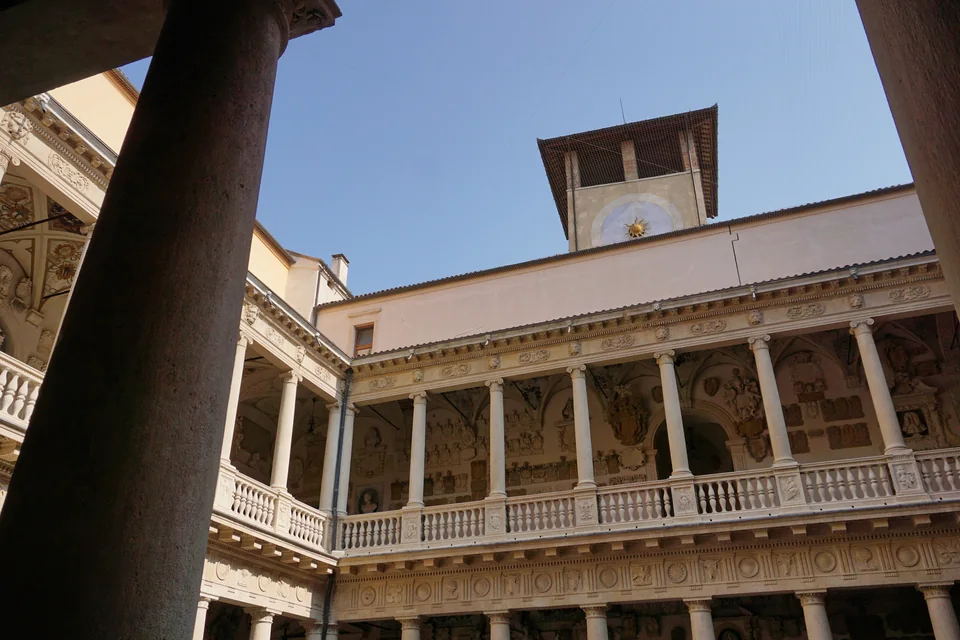
Padua was not founded by a papal or imperial charter. According to the university, teachers and students moved here from Bologna, and the city backed them; 1222 is recognised as the founding year because it is the first record of a regular university organisation. In 1545 the university created the Orto dei Semplici, the first botanical garden in Europe.
Since 2012 Padua has had no faculties. Departments run the programmes and eight schools coordinate them, so every course listing names a department and an address. That address tells you where you will actually study: in the historic centre, at the Agripolis campus in Legnaro or in another town of the region.
For applicants, the most useful feature is the central portal apply.unipd.it. International students apply there for almost every programme, including Italian-taught ones. For the 2027/28 intake the portal lists about 180 bachelor's, master's and single-cycle programme entries (some tracks have their own entry), each with its window and annual fee — a far easier comparison than hunting through department websites.
Where the university stands in the rankings
Verified positions as of September 2026:
| Ranking | Position |
|---|---|
| QS World University Rankings 2027 | 204 (up from =233 in 2026) |
| THE World University Rankings 2026 | 201–250 |
| THE 2026 by subject: Arts and Humanities | 126–150 |
| THE 2026 by subject: Medical and Health | 151–175 |
Rankings describe the institution, not your programme. Before applying, look at the research groups in the department, whether the course includes an internship and whether there is a double-degree option.
Where classes take place: Padua, Legnaro and other towns
There is no single enclosed campus. Palazzo del Bo on Via 8 Febbraio is the historic headquarters, while engineering, physics and economics departments sit in different parts of Padua. Agriculture, veterinary, food and forestry programmes are based at Agripolis in Legnaro, just outside the city: the English-taught bachelor's in Animal Care and the master's programmes in Sustainable Agriculture, Forest Sciences and Food, Nutrition and Health run there. Italian Food and Wine is partly taught in Conegliano (Treviso) and Water and Geological Risk Engineering in Rovigo. Check the teaching location before you sign a lease.
Padua is a compact student city in Veneto, close to Venice. The university's own estimate for a single room is $340–680 (€300–600) a month, utilities excluded.
What a Padua degree means for work and further study
A Padua degree is a standard Italian laurea or laurea magistrale within the Bologna Process, so it can lead to further study across Europe. For work in Italy, three things matter most: an internship or thesis with a company, at least B1 Italian, and early networking through your department. Check in the study plan whether an internship is included and how many credits it carries. After graduating, you can apply to convert your study permit into a permit to look for work; confirm the conditions with the local Questura (immigration police office) at that time. Regulated professions such as medicine, psychology and law need separate recognition in each country.
FAQ
Can I apply with 11 years of school?
Not directly. You need one completed year of university with all exams passed, a qualifying post-secondary diploma or a Foundation course at an Italian university. These only give access to the first year.
How much does the University of Padua cost for non-EU students?
In 2026/27 non-EU citizens whose family lives abroad pay a fixed $3,180 (€2,790) for humanities or $3,410 (€2,990) for science programmes, plus up to $240 (€208) in regional tax and stamp duty. Course pages show $3,140–3,370 (€2,750–2,950) for 2027/28, to be confirmed by the new fee regulations.
When is the application deadline for 2027/28?
The first window runs from 15 September to 15 November 2026; selected programmes use a second window from 7 January to 7 March 2027. The course page on apply.unipd.it shows which one applies.
What IELTS score do I need?
IELTS 6.0 for B2. For TOEFL iBT the minimum is 86 for tests up to 20 January 2026 and 4.5 on the new scale afterwards. The certificate can be submitted until 31 July 2027.
Can I study for free?
Only if you win the regional DSU grant (fee exemption plus up to $9,410 a year) or a Padua International Excellence Scholarship. Both are competitive and depend on academic progress.
Do I need Italian for an English-taught programme?
Not for admission, but it helps with daily life, part-time work and internships.
Can StudyU help me apply?
Under an agreement with StudyU, we shortlist programmes, check requirements, prepare documents and support the application, Universitaly and visa stages. Admission is decided by the university and the DSU grant by the university and the region; the Italian consulate as the consular authority decides on the visa.
Sources
- Admission of international students — How to apply
- Programme catalogue and 2027/28 deadlines (apply.unipd.it)
- Language requirement for admission
- Student fees and 2026/27 fee regulations
- Regional scholarships 2026/27
- Padua International Excellence Scholarship Programme
- Housing for international students
- Cost of living in Padua
- History of the University of Padua
- QS World University Rankings: Università di Padova
- THE World University Rankings: University of Padua
- Call for contributions and exemptions 2026/27 (PDF)
For an overview of the Italian system and other universities, see Study in Italy. To discuss whether Padua fits your plans, send us a request.
During the free initial consultation, we clarify your goal, profile, timing, and budget and identify the next realistic step.
Next steps
- Italian Language Certificates CILS, CELI and PLIDA: Which One You Need for University and When to Sit It
- ISEE Parificato for International Students: Home-Country Documents, CAF, Timing and Tuition
- Studying Medicine in Italy in English: IMAT, Non-EU Places and the 2026/27 Rules
- Permesso di Soggiorno for Students: How to Get and Renew Your Italian Residence Permit
- Studying in Italy for international applicants
- University of Bologna
