
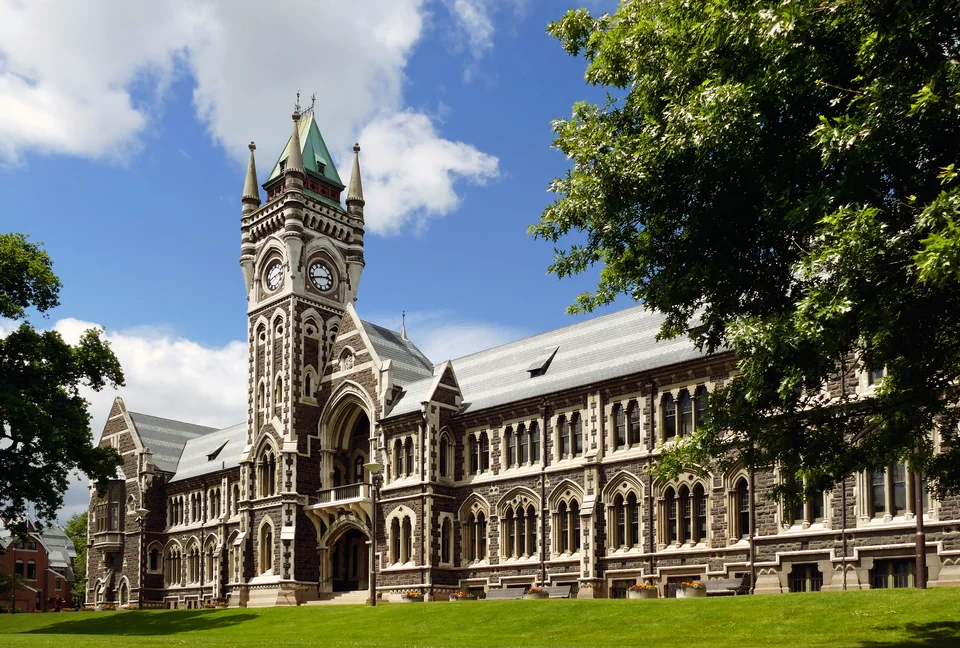
The University of Otago in Dunedin is New Zealand's oldest university, and health sciences is its largest division: medicine, dentistry, pharmacy and biomedical science. Applicants with a school certificate that Otago does not list as equivalent to New Zealand university entrance, such as the Russian attestat or most other post-Soviet certificates, normally start with Otago's own Foundation Studies Certificate or complete a year at a recognised university first. Offshore applications for Semester 1, 2027 close on 15 November 2026. International undergraduate tuition for 2027 runs from $22,500 (NZD 39,690) to $27,260 (NZD 48,090) a year, and a catered residential college adds about $12,840 (NZD 22,651).
| At a glance | Details |
|---|---|
| Location | Dunedin, South Island; further campuses in Christchurch, Wellington and Southland |
| Founded | 1869, New Zealand's first university |
| Students | 21,295 in 2025, including 2,737 international students |
| Rankings | QS World University Rankings 2027: 198th; THE World University Rankings 2026: 351–400 band |
| Entry from a Russian or CIS school | not direct; Foundation Studies Certificate or one year at a recognised university |
| English, undergraduate | IELTS Academic 6.0 with no band below 5.5; Duolingo 105 |
| Semester 1, 2027 applications | 1 May–15 November 2026 for offshore applicants |
| Tuition, 2027 | bachelor's: NZD 39,690–48,090 ($22,500–27,260); Health Sciences First Year: NZD 45,415 ($25,750) |
| Housing | 15 catered residential colleges, NZD 21,488–25,580 ($12,180–14,500) for the 2027 academic year |
| Automatic scholarship | Vice-Chancellor's Scholarship, NZD 10,000 ($5,670) towards first-year bachelor's fees |
Who Otago suits
Otago makes most sense for students aiming at health sciences, biomedical science, pharmacy or sport science, and for anyone who wants a campus town where most first-years live a few minutes' walk from lectures. Health sciences accounted for 6,557 of the university's 19,126 equivalent full-time students in 2025, more than any other division.
It suits you less if you expect to enter medicine straight from school. International places in the professional health programmes are counted in tens for the whole world and are allocated only after a competitive first year. If you want a large city, compare Otago with Victoria University of Wellington (capital city, law and public policy) or the University of Canterbury in Christchurch (engineering).
| Your goal | Fit | What to plan for |
|---|---|---|
| Medicine or dentistry | yes, via competition | Health Sciences First Year, then selection for a limited number of places |
| Biomedical science, pharmacology, genetics, neuroscience | yes | continue after HSFY without competitive selection |
| Business, economics, tourism | yes | Bachelor of Commerce, no admission tests |
| Humanities and social sciences | yes | Bachelor of Arts with a wide choice of majors |
| PhD | yes | domestic-rate fees for doctoral candidates living in New Zealand, plus funded scholarships |
| Direct entry after an 11-year school system | no | add a foundation year or a year of university at home |
Entry routes if your school certificate is not on Otago's list
Otago lists the qualifications it accepts directly: a completed IB Diploma with at least 24 points; Cambridge or Pearson Edexcel International A levels with 120 points on the New Zealand tariff; the NCUK International Foundation Year at CCC or better; its own Foundation Studies Certificate; and one year of successful study at a tertiary institution listed in the World Higher Education Database. A country selector covers further national qualifications, and applications with qualifications that are not listed are considered case by case.
| Route | For whom | Length | International fee, 2027 |
|---|---|---|---|
| Foundation Studies Certificate | school leavers without IB or A levels | two 13-week semesters | NZD 32,341 ($18,330) Arts/Commerce; NZD 33,637 ($19,070) Health Sciences/Sciences |
| Diploma in Arts, Commerce or Science | "near-miss" applicants | one academic year, February start only | NZD 38,535–40,635 ($21,850–23,040), then direct entry to year 2 of the BA, BCom or BSc |
| One year at a recognised university | students who have finished a first year at home | 1 year | your home university's fee; you then start year 1 at Otago |
| IB Diploma or A levels | international-school graduates | — | direct entry if you meet the scores |
The Foundation Studies Certificate is a Level 4 qualification on the New Zealand framework, taught by Otago's Pathway and English Language Centre. It has four streams (Health Sciences, Sciences, Business, Arts/Humanities) with intakes in February, June and October; the Health Sciences stream starts in February and June only. To progress to a degree you need at least a C in both Academic English papers. English entry is IELTS 5.5 with no band below 5.0, Duolingo 95 or PTE Academic 42.
The DipArts, DipCom and DipSc diplomas require a completed final year of school, the equivalent of a B− average across three relevant subjects and IELTS 5.5. Russia is not in the country table published for these programmes, so the pathway team decides individually; for most 11-year school graduates the Foundation Studies Certificate is the realistic plan.
Medicine and dentistry: quotas and selection
School leavers who have not studied at university enter the health professional programmes only through Health Sciences First Year (HSFY): seven compulsory papers in Dunedin, one intake a year in late February. There are no subject prerequisites, but Otago strongly recommends school chemistry, physics and calculus. HSFY costs NZD 45,415 ($25,750) in 2027.
Completing HSFY does not guarantee a place. The University Council reviews international numbers every year, usually in July. For second-year entry in 2027 (after HSFY in 2026) the expected places for applicants from all countries are:
| Programme | International places expected for 2027 |
|---|---|
| Bachelor of Dental Surgery | up to 40 |
| Bachelor of Medicine and Bachelor of Surgery | up to 25 |
| Bachelor of Pharmacy | up to 20 |
| Bachelor of Physiotherapy | up to 10 |
| Bachelor of Medical Laboratory Science | 10 at most |
| Bachelor of Oral Health; Bachelor of Dental Technology | 2 each |
- The Alternative Category for holders of overseas qualifications covers dentistry, pharmacy, physiotherapy and medical laboratory science, but not medicine, and usually requires a prescribed year in the Bachelor of Science.
- Pharmacy direct entry is open to high achievers from recognised pre-university programmes, including Otago's Foundation Year; they progress to year 2 by passing all HSFY papers.
- A non-competitive fallback is the Bachelor of Biomedical Sciences or a BSc major in anatomy, biochemistry, genetics, microbiology, neuroscience, physiology or pharmacology, which you can continue after HSFY without losing a year.
Clinical programmes are expensive: in 2027, MB ChB years 2–3 cost NZD 101,567 ($57,580) a year and years 4–6 NZD 116,080 ($65,800); BDS year 2 costs NZD 114,535 ($64,930) and years 3–5 NZD 120,587 ($68,360) a year.
Programmes and 2027 tuition
Otago publishes indicative annual fees for a full-time load taken entirely from one subject area; your invoice is the sum of the papers you choose. For continuing students, annual fee increases are capped at 5%.
| Programme, 2027 | Length | International fee per year |
|---|---|---|
| Bachelor of Arts, from biblical studies to environmental management | 3 years | NZD 39,690–48,090 ($22,500–27,260) |
| BA Economics | 3 years | NZD 44,520 ($25,240) |
| BA / BSc Psychology | 3 years | NZD 45,360 / 46,200 ($25,710 / 26,190) |
| Bachelor of Laws | 4 years | NZD 45,675 ($25,890) |
| Bachelor of Commerce, tourism to finance | 3 years | NZD 42,840–45,570 ($24,290–25,830) |
| BSc: mathematics / physics / biochemistry / computer science | 3 years | NZD 44,520 / 46,935 / 47,040 / 47,145 ($25,240 / 26,610 / 26,670 / 26,730) |
| Health Sciences First Year | 1 year | NZD 45,415 ($25,750) |
| Bachelor of Biomedical Sciences | 3 years | NZD 49,350 ($27,980) |
| Bachelor of Pharmacy, year 2 / years 3–4 | 4 years incl. HSFY | NZD 50,825 / 53,505 ($28,810 / 30,330) |
Compulsory extras are billed to your eVision account:
- Student Services Fee (Dunedin): NZD 11.93 per 0.01 EFTS; most new international full-degree students are charged on 1.05 EFTS, which was NZD 1,252.65 ($710) in 2026.
- Studentsafe Inbound University insurance: NZD 999 ($570) for an individual for the 2027 academic year (NZD 499.50 for one semester). Alternative policies must be approved at least four weeks before semester starts.
- Pūtea Tautoko Student Relief Fund Fee: a small annual levy.
A worked first-year budget for BA Economics in a residential college: NZD 44,520 tuition + NZD 1,253 services fee + NZD 999 insurance + NZD 22,651 college + NZD 5,400 personal and entertainment costs (Otago's estimate) ≈ NZD 74,820, or about $42,420, before flights, books and visa fees. For a country-wide comparison see the cost of studying in New Zealand.
2027 application timeline
The main international window is 1 May–15 November for Semester 1 (late February) and up to 30 April for Semester 2 (July). Teaching, oral health, dental technology and some postgraduate health programmes close earlier. PhD and thesis-only master's applications are accepted year-round once a supervisor has agreed.
| Step | Date |
|---|---|
| Applications open for 2027 (both semesters) | 1 May 2026 |
| Residential college applications open | 1 August 2026 |
| Offshore deadline, full-degree study starting Semester 1, 2027 | 15 November 2026 |
| Offshore deadline for colleges and UniFlats | 1 December 2026 |
| Deadline for international applicants already in New Zealand | 10 December 2026 |
| Recommended latest arrival | 21 February 2027 |
| Compulsory orientation | 22–26 February 2027 |
| Semester 1 lectures begin | 1 March 2027 |
| Semester 2, 2027 deadline | 30 April 2027 |
| Semester 2 classes begin | 12 July 2027 |
Immigration New Zealand recommends applying for a student visa at least three months before travel and notes that October to March is its busiest period, so an application to Otago in September or October leaves a safer margin than one filed in the final week.
How to apply
- Pick a programme and check its page. Entry settings differ by programme, and health professional programmes have their own selection.
- Prepare documents. Undergraduate applicants upload official school or foundation transcripts; postgraduate applicants upload tertiary transcripts only. Non-English documents need an official translation made by a translation company, stamped, signed, named and dated. Otago may ask for an Educational Credential Evaluators (ECE) report, and will not assess the application until it arrives.
- Certify your identity document. A lawyer, notary, New Zealand embassy officer or authorised agent certifies a copy of your passport page, writing "Certified true copy", their authority, name, signature and stamp in English.
- Apply online in eVision via the Apply Now button on the programme page.
- Accept the Offer of Place in eVision; the letter also covers visa, insurance and fees.
- Pay and request a fee receipt. Otago does not issue visa receipts automatically: request one in eVision under My Finances once the money has reached the university's account, which can take several days.
Research master's and PhD applicants also submit a detailed research proposal, a CV, the name of the staff member who agreed to supervise, and an approximate start date.
English requirements
Test results must be no more than two years old when you start. Otago does not accept TOEFL MyBest scores.
| Test | Undergraduate | Postgraduate |
|---|---|---|
| IELTS Academic (incl. IELTS Online) | 6.0, no band below 5.5 | 6.5, no band below 6.0 |
| TOEFL iBT from 21 January 2026 | overall 4, writing 4 | overall 4.5, writing 4.5 |
| TOEFL iBT before 21 January 2026 | 80, writing 20 | 90, writing 21 |
| PTE Academic | 50, no skill below 42 | 58, no skill below 50 |
| Duolingo English Test | 105, no subscore below 95 | 120, no subscore below 95 |
| C1 Advanced / C2 Proficiency | 169, no component below 162 | 176, no component below 169 |
Higher scores apply to social work (IELTS 7.0 in every band), postgraduate law (IELTS 7.5 with 7.0 in every band) and clinical postgraduate dentistry (7.0 in every band). HSFY uses the standard 6.0.
Scholarships
Most Otago scholarships are assessed with your admission application, but you must accept the scholarship offer separately by the stated deadline.
| Scholarship | Value | Open to Russian and CIS citizens? |
|---|---|---|
| Vice-Chancellor's Scholarship for International Students | NZD 10,000 ($5,670) towards first-year bachelor's fees | yes, automatic assessment |
| International Academic Excellence Scholarship | about NZD 35,000 ($19,840): first-year college fees plus tuition awards in years 2 and 3 | yes, by invitation in eVision after accepting a base scholarship; competitive |
| University of Otago Global Scholarship | NZD 15,000 ($8,500) | no: 13 Asian passports only |
| Coursework Master's Scholarship | NZD 10,000 ($5,670) | yes (excludes MBA) |
| International Master's Research Scholarship | NZD 18,204 ($10,320) stipend a year plus a one-year fee waiver capped at NZD 35,000 | yes |
| University of Otago Doctoral Scholarship | NZD 34,128 ($19,350) stipend a year plus domestic fees for 36 months | yes |
| Te Huarahi Scholarship (Foundation Studies Certificate) | from NZD 5,000 ($2,830) | yes, separate PDF application |
The New Zealand Government's Manaaki scholarships are for citizens of eligible developing countries; check the current country list before counting on them. More options are collected in scholarships abroad 2026.
Housing and living costs in Dunedin
Most first-year bachelor's, diploma and Foundation students live in one of Otago's 15 official residential colleges: a private furnished bedroom, shared bathrooms, full catering, tutorials and pastoral support. Most colleges are within six minutes' walk of campus; Aquinas, Knox and Salmond run a free shuttle.
| Option | Price | Notes |
|---|---|---|
| Catered college, 2027 | NZD 21,488 ($12,180) at Aquinas and Toroa; NZD 22,651 ($12,840) at most; up to NZD 25,580 ($14,500) at Selwyn | applications from 1 August 2026; offshore deadline 1 December 2026 |
| UniFlats standard room | NZD 268 a week on a 48-week contract (2025-based estimate) | transfer, postgraduate and exchange students; self-catered |
| Homestay, 2027 | NZD 64.25 a night plus a NZD 482 placement fee | usually further from campus |
| Private flatting | varies | January–February searches can take weeks; electric heating is costly in winter |
Otago recommends NZD 22,000–27,000 ($12,470–15,310) for living costs over the 40-week academic year on top of tuition, and more for a full calendar year. Immigration New Zealand requires evidence of at least NZD 20,000 ($11,340) per year. Students under 18 must live in a college, a homestay, with a designated caregiver or with parents under the Education (Pastoral Care of Tertiary and International Learners) Code of Practice 2021.
Master's and PhD
Most postgraduate programmes need a relevant bachelor's degree; some also require work experience or professional registration. Honours or postgraduate diploma holders may qualify for a thesis-only master's. A PhD normally follows a master's or a first-class / upper-second honours degree.
| Programme, 2027 | Size | International fee |
|---|---|---|
| Master of Business (most subjects) | 180 points, about one year | NZD 64,785 ($36,730) |
| MBA | 240 points, 15 months | NZD 76,240 ($43,220) for the programme |
| Master of Public Health | 240 points, 2 years | NZD 55,125 ($31,250) a year |
| MSc (Coursework), Computer Science | 180 points | NZD 74,760 ($42,380) |
| Master of International Studies | 180 points, 1 year | NZD 49,875 ($28,270) |
| PhD (domestic-rate fee) | 3 years | NZD 8,063–12,385 ($4,570–7,020) a year in 2026, depending on field |
The domestic PhD rate applies while you live in New Zealand throughout your studies, apart from approved research trips. See also master's degrees in New Zealand.
Visa, work and post-study options
Immigration New Zealand, not the university, decides your visa. The Fee Paying Student Visa is applied for online. For Russian and Kazakh citizens INZ's fee tool shows NZD 850 ($480), which already includes the NZD 100 International Visitor Conservation and Tourism Levy (IVL); payment is by Visa, Mastercard or UnionPay card. 80% of applications are decided within 8 weeks.
- Funds: proof of tuition for one year (or the whole course if shorter) and NZD 20,000 for each year of living costs, or NZD 1,667 ($950) a month for shorter study. For multi-year study, a credible plan for later years strengthens the application.
- Paying after approval in principle: offshore applicants may hold off paying tuition until the visa is approved in principle, at the cost of a longer process.
- Health: citizens of countries that are not on the low-TB list, including Russia and Kazakhstan, need a chest X-ray from an approved panel physician for stays over 6 months. Belarus is on the low-incidence list.
- Police certificates: required from age 17 if your total stay will reach 24 months, which covers a three-year degree; certificates must be under 6 months old.
- Work: up to 25 hours a week in term and full-time in scheduled holidays, as stated in your visa conditions.
- After graduation: the Post-Study Work Visa gives open work rights once. A master's or doctorate with at least 30 weeks of full-time study in New Zealand gives 3 years; a bachelor's gives a visa equal to your study time, up to 3 years.
For the full visa process see the New Zealand student visa guide; for legal payment routes from Russia see how to pay for studies abroad from Russia. The wider admission picture is in applying to New Zealand universities, and other institutions are compared in universities in New Zealand and on the New Zealand country page.
Common mistakes
- Applying for year 1 with an 11-year school certificate only. Plan a foundation year, a university year at home or IB/A levels.
- Treating HSFY as a guaranteed route into medicine. There are up to 25 international MB ChB places for the whole world in 2027; keep biomedical science as plan B.
- Leaving it until 15 November. College places are allocated from August, and visa processing peaks from October to March.
- Forgetting to request the fee receipt. Without it your visa application is incomplete.
- Budgeting only the visa minimum. NZD 20,000 is below Otago's own NZD 22,000–27,000 estimate for 40 weeks in Dunedin.
- Buying your own insurance without approval. If it is not approved four weeks before semester, you still pay for Studentsafe.
FAQ
Do I need my school certificate recognised by a government body first?
No separate recognition step appears in Otago's document list. The admissions team assesses your documents and may request an ECE report after you apply; you provide official translations and a certified passport copy.
How long does a bachelor's take after an 11-year school system?
Usually four years in total: about a year of Foundation Studies Certificate plus a three-year BA, BCom or BSc. Law (LLB) takes four years after foundation, and medicine including HSFY takes six.
Can I start in July?
Many undergraduate programmes accept Semester 2 entrants, with applications due by 30 April 2027. HSFY, the DipArts/DipCom/DipSc diplomas and several professional programmes start in February only.
Is there any tuition discount for international students?
The Vice-Chancellor's Scholarship of NZD 10,000 works as a first-year discount and is assessed for every new international bachelor's student. The larger Academic Excellence award is competitive, and the NZD 15,000 Global Scholarship is limited to 13 Asian passports.
What is a realistic first-year budget?
Around $42,000 for a mid-priced bachelor's with a catered college, counting tuition, the services fee, insurance, college and Otago's estimate for personal costs. Add flights and visa fees on top.
Can StudyU help with an Otago application?
Under a service agreement we choose the right route (foundation, diploma or direct entry), prepare documents and the eVision application, track college deadlines and help assemble the visa file. The university decides on admission and Immigration New Zealand on the visa.
Sources
- University of Otago: University entrance requirements, English language requirements, Documents required, How to apply
- University of Otago: Key dates for new international students
- University of Otago: International tuition fees — Health Sciences, Humanities, Sciences, Business School; Student Services Fee
- University of Otago: Foundation Studies Certificate, entry requirements, Diplomas, Pathway fees
- University of Otago: Undergraduate Health Science information for international students
- University of Otago: International scholarships
- University of Otago: Residential colleges, Accommodation, Living costs, Insurance, Quick statistics
- Immigration New Zealand: Fee Paying Student Visa, International Visitor Levy, Low-incidence TB countries, Post-Study Work Visa, Staying to work after study
- QS World University Rankings 2027: University of Otago; THE World University Rankings 2026: University of Otago
Dollar amounts are converted at the ECB reference rate of 28 September 2026 (NZD 1 = $0.5669) and rounded to the nearest $10.
To check which Otago route is realistic for you and whether you can still make the 2027 intake, send an application.
During the free initial consultation, we clarify your goal, profile, timing, and budget and identify the next realistic step.
Next steps
- Victoria University of Wellington (Te Herenga Waka)
- University of Canterbury, New Zealand
- Universities in New Zealand: All Eight, 2027 Fees and How to Choose
- Applying to New Zealand Universities After 11 Years of School: Routes, Deadlines and Documents
- Studying in New Zealand for international applicants
- Scholarships abroad 2026: where international students study for free
