
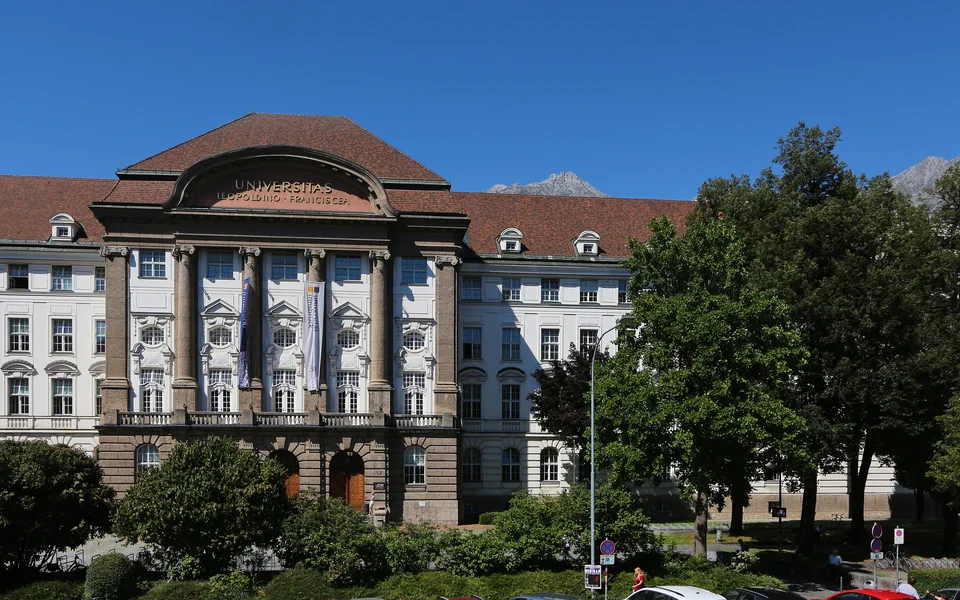
The University of Innsbruck (Leopold-Franzens-Universität), founded in 1669, has 27,436 students, more than half of them international, and sits in the 301–350 band of the THE World University Rankings 2026 — ahead of the universities in Graz and Linz. Non-EU students pay $825 (€726.72) per semester plus the $30 (€26.20) ÖH student union fee. What sets Innsbruck apart is its German requirement: B2 is enough to enrol in a German-taught programme, whereas Graz asks for C1. The catch is timing — non-EEA citizens must apply for the winter semester by 15 May, almost four months before the general deadline.
| At a glance | Details |
|---|---|
| City | Innsbruck, capital of Tyrol |
| Founded | 1669 |
| Students | 27,436 (winter semester 2024/25), 52.1% international |
| Faculties | 16, around 130 programmes |
| Ranking | THE World University Rankings 2026: 301–350 (Physical Sciences 176–200) |
| Non-EU tuition | $825 (€726.72) per semester + $30 (€26.20) ÖH fee |
| German | A2 to apply, B2 to enrol (C1 only for the Translation Studies master's) |
| English | B2 for English-taught programmes: IELTS 6.5 or TOEFL iBT 87 (4.5 on the 2026 scale) |
| English-taught master's | 25: 21 fully in English, 4 in two or three languages |
| Non-EEA application windows | winter 2026/27: 1 April – 15 May 2026; summer 2027: 1 September – 15 October 2026 |
| German preparation | university-run preparatory course, $1,360 (€1,200) per semester |
Who Innsbruck suits
Innsbruck is a comprehensive university in an Alpine city, strongest in the sciences: THE 2026 places its physical sciences at 176–200 and life sciences, computer science and psychology at 251–300. The mountains are part of the curriculum — atmospheric sciences, climate physics, mountain environmental management and sport science all have a prominent place in the catalogue.
| A good fit if you… | Consider alternatives if you… |
|---|---|
| have German close to B2 and don't want an extra year to reach C1 | decide late — the non-EEA window closes on 15 May |
| want an English-taught master's in physics, maths, computing, atmospheric and climate science, economics or management | want an English-taught bachelor's — there are none |
| like mountains, sport and a small university city | need cheap housing — rents are high and OeAD halls are full for winter 2026/27 |
| want an international environment: over half the students come from abroad | are counting on a university scholarship |
If your German is already C1, compare the University of Graz; if you are weighing the capital against the regions, see the University of Vienna.
Faculties and programmes
The university has 16 faculties: Architecture; Business and Management; Educational Sciences; Biology; Chemistry and Pharmacy; Geo- and Atmospheric Sciences; Teacher Education; Mathematics, Computer Science and Physics; Psychology and Sport Science; Social and Political Sciences; Engineering Sciences; Economics and Statistics; Catholic Theology; Language, Literature and Culture; Philosophy and History; Law.
All bachelor's and diploma programmes are taught in German; English appears in some master's and doctoral programmes.
English-taught master's programmes
In September 2026 the university catalogue lists English as a language of instruction for 25 master's programmes: 21 are taught only in English and four in two or three languages.
| Field | Programmes |
|---|---|
| Economics and management | Banking and Finance, Experimental and Empirical Economics, Information Systems, International Management, Marketing and Branding, Organization Studies, Strategic Management and Innovation |
| Computing and maths | Computer Science, Software Engineering, Mathematics |
| Physics, chemistry, materials | Physics, Chemistry, Functional Materials Science, Pharmaceutical Sciences |
| Atmosphere, climate, mountains | Atmospheric Sciences, Environmental Meteorology and Climate Physics, Environmental Management of Mountain Areas (German, English and Italian) |
| Life sciences | Biomedical Life Sciences |
| Society and humanities | Digital Society, Social Innovation and Global Citizenship; Media, Society and Communication; Peace and Conflict Studies; Philosophy of Religion; English and American Studies (German and English) |
| Law | Business, Digitalisation and Sustainability Law (German and English) |
| Engineering | Electrical Engineering (German and English) |
Most master's programmes have no competitive selection: the university checks your degree, language and documents. For 2026/27, selection procedures applied to Digital Society, Social Innovation and Global Citizenship; Peace and Conflict Studies; Pharmaceutical Sciences – Drug Development and Regulatory Affairs; Psychology; and Psychotherapy.
Bachelor's programmes with selection
For 2026/27, selection applies to teacher training, Architecture, Physical Education, Psychology, Sport Management and Sport Science. Selection for Biology, Computer Science, Pharmacy and Management and Economics was suspended for 2026/27, so these admitted applicants through the regular procedure. Some programmes, mainly in the humanities, also require supplementary exams such as Latin, descriptive geometry or biology, taken before admission or during the degree depending on the programme.
How to apply
After secondary school
For a bachelor's, you must prove general university entrance qualification. Certificates from Russia, Kazakhstan and other CIS countries are assessed individually; in addition to your certificate and transcript, the university may require further proof — national entrance exam results, supplementary exams, a foundation college or university study. Your admission decision states what applies to you. If you already hold a bachelor's when you apply, your application is assessed on that basis.
Master's programmes
You need a bachelor's that matches the programme, with a transcript or Diploma Supplement. Special rules apply to degrees from Bangladesh, India, Nepal, Nigeria and Pakistan; Russia and the other CIS countries are not on that list, so their degrees are assessed under the general rules.
Step-by-step plan for 2027/28
- Autumn 2026. Choose a programme and check for a selection procedure. For a German-taught programme, take at least an A2 exam — ideally B2.
- Winter 2026/27. Apostille your certificate or degree and order sworn translations (not needed for documents in German or English).
- From 1 April 2027 (expected, based on 2026). Apply online. Non-EEA nationals must apply by 15 May; the university publishes 2027 dates in its deadlines calendar.
- Summer 2027. Receive your decision. If your German is below B2, it will require the German exam in the preparatory course.
- In parallel. Apply for your residence permit and look for housing.
- 13 July – 5 September (expected, based on 2026). Enrol and pay the ÖH and tuition fees. In 2026, winter-semester teaching began on 5 October.
Deadlines for non-EEA applicants
| Step | Winter semester 2026/27 | Summer semester 2027 |
|---|---|---|
| Online application, non-EEA nationals and stateless persons | 1 April – 15 May 2026 | 1 September – 15 October 2026 |
| Admission period, non-EEA nationals | 13 July – 5 September 2026 | 11 January – 5 February 2027 |
| General online application (EU/EEA) | 1 April – 5 September 2026 | 1 September 2026 – 5 February 2027 |
| ÖH and tuition fee payment for continuing students | by 31 October 2026 | by 31 March 2027 |
| Teaching and exams | 5 October 2026 – 2 February 2027 | 1 March – 27 June 2027 |
The next window you can still reach is summer 2027: applications run from 1 September to 15 October 2026. Programmes with selection procedures do not admit in the summer semester.
Language requirements
German at application: A2. Under the Austrian Universities Act, you must submit at least A2 with your application: ÖSD A2 or the ÖSD A2 integration exam, Goethe-Zertifikat A2 (including Fit in Deutsch), ÖIF A2, DTÖ, DSD I, telc A2 or an A2 course at the university's language centre, no older than two years.
German at enrolment: B2 for all bachelor's and diploma programmes and most master's (C1 for Translation Studies). Accepted proofs include ÖSD B2, Goethe-Zertifikat B2, TestDaF level 3 in all parts, ÖIF B2, DSD II, DSH-1, telc B2 or a B2 course at the language centre, no older than two years. A school-leaving certificate from a German-language school, three years of university study in German, or the German exam of a preparatory programme have unlimited validity. See our guide to German language tests.
English for English-taught programmes: B2 at application (Rectorate decision of 18 March 2026): TOEFL iBT 87 (4.5 on the 2026 scale), IELTS Academic 6.5, Cambridge B2 First, PTE Academic 62 or a B2 course at the language centre, no older than two years; C1 for English and American Studies. An English-taught degree counts only if it lasted at least two years and was completed in the EU/EEA, Switzerland, the UK, the US, Australia, New Zealand or Canada.
The German preparatory course
Unlike Graz, where all universities share the VGUH, Innsbruck runs its own German preparatory course as a university course.
- Who can attend: applicants admitted to a degree who have been assigned the German exam (and possibly other supplementary exams). Minimum starting level: A2.
- Length: two semesters, 45 ECTS; module I targets B1/B1+, module II B2/B2+. A placement test can put you straight into module II.
- Cost: $1,360 (€1,200) per semester, $2,730 (€2,400) in total, plus the ÖH fee.
- Winter 2026/27 dates: registration closed on 28 September 2026; placement tests on 15 September and 5 October, classes from 12 October 2026 to 12 February 2027. Places are limited; registration runs July–September for winter and January–March for summer.
- Outcome: you sit the German supplementary exam within the course, which counts as the B2 proof you need.
For preparatory programmes elsewhere in Austria, see our guide to the Vorstudienlehrgang.
Documents
Bachelor's: proof of German (A2 or higher); original school-leaving certificate with grades, legalised (apostille for most CIS countries) and sworn-translated unless in German or English; additional proof of entrance qualification where needed; passport-standard photo; valid ID; tabular CV.
Master's: language certificate; bachelor's certificate and transcript or Diploma Supplement, signed and stamped (physically or verifiably digital), legalised and translated; photo; ID; tabular CV.
Costs
Fees paid to the university
| Item | Per semester | Per year |
|---|---|---|
| Tuition fee, non-EU students with a student residence permit | $825 (€726.72) | $1,650 (€1,453.44) |
| ÖH fee (2026/27) | $30 (€26.20) | $60 (€52.40) |
| Total | $855 (€752.92) | $1,710 (€1,505.84) |
| German preparatory course (per course page) | $1,360 (€1,200) + ÖH | $2,730 (€2,400) + ÖH |
Tuition is due from the first semester at every level. Exemption is possible for holders of EU long-term residence and certain other permits, and for people covered by Austria's regulation on eligible groups; the university does not grant status-based exemption to holders of a student residence permit. Students from least-developed countries are exempt automatically, but Russia and the CIS are not on that list. Waiver applications are due by 31 October (winter) and 31 March (summer).
Living costs and proof of funds
The 2025 Austrian Student Social Survey, quoted by TU Graz, puts average student spending at about $1,480 (€1,300) a month, including $565 (€497) on housing. Innsbruck is above average: the university says net rents start at about $15.90 (€14) per square metre, plus roughly 25% for service charges and VAT, with electricity and often heating billed separately.
For a student residence permit in 2026 you must prove $820 (€722.58) a month under age 24 or $1,490 (€1,308.39) from 24, for 12 months. Add ÖGK health insurance at $90 (€78.84) a month and a $250 (€218) permit fee. If your rent exceeds $440 (€386.43) a month — common in Innsbruck — you must prove the difference too.
| Minimum first year | Under 24 | 24 and over |
|---|---|---|
| Tuition and ÖH | $1,710 | $1,710 |
| Proof of living costs, 12 months | $9,856 | $17,847 |
| Insurance, 12 months | $1,075 | $1,075 |
| Permit fee | $250 | $250 |
| Total without the preparatory course | about $12,880 (€11,340.88) | about $20,860 (€18,370.60) |
If you go through the preparatory course, add $2,730 (€2,400) for its two semesters. The course page does not say whether participants also pay the $825 (€726.72) tuition fee, while the tuition-fee page says non-degree studies such as preparing for the university entrance qualification exam (Studienberechtigungsprüfung) are fee-paying. Until the admissions office confirms in writing, budget for both.
Scholarships
University merit and research scholarships under Austria's Student Support Act (StudFG) are aimed at Austrian and EEA nationals and those treated equally. Non-EEA students should look at external funding (the OeAD database grants.at, home-country programmes) and part-time work of up to 20 hours a week, for which the employer obtains a permit from the AMS.
Housing
Housing is Innsbruck's bottleneck: the valley setting limits building land, and the university openly describes a tight market.
- OeAD Housing: Technikerstraße from $355 (€314), Höttinger Au from $370 (€324), GreenINN from $485 (€425) and Reichenauer Straße from $555 (€488) a month. As of September 2026, all four are fully booked for winter 2026/27, so apply as soon as you have submitted your university application.
- Student associations and private halls: search the ÖH housing exchange (oehboersen.at).
- Private rentals: Willhaben, the Tiroler Tageszeitung property section (immo.tt.com) and regional papers; the university also suggests placing your own "looking for a flat" ad.
- Surrounding towns: the Inn valley from Telfs to Hall is well served by ÖBB trains and VVT transport and can be cheaper.
The residence authority requires a contract of at least three months, so short-term options (Kolpinghaus, short lets) only work for your first weeks.
Residence permit
Stays longer than six months need the "Aufenthaltsbewilligung – Student" permit, lodged in person at the Austrian embassy or consulate responsible for your place of residence — not at a visa centre. The Innsbruck authorities decide within up to 90 days, and OeAD recommends applying three to six months before travelling. Because Innsbruck's application deadline is in May, admission letters usually arrive in summer, which leaves little slack before October. Renewal requires at least 16 ECTS per year. See our guide to the student visa and residence permit in Austria.
Pros and cons for non-EU applicants
| Pros | Cons |
|---|---|
| B2 instead of C1 German — saves one or two semesters of preparation | Non-EEA window closes on 15 May |
| 25 master's with English as a language of instruction, at B2 (IELTS 6.5) | No English-taught bachelor's |
| Highest THE band of the universities in Graz, Innsbruck and Linz (301–350) | Expensive rent and full OeAD halls |
| More than half the students are international | German preparatory course costs more than VGUH in Graz |
| Strengths in mountain, climate and atmospheric science and sport | Buildings spread across several campuses |
Practical notes: fees are paid to an Austrian account, and the account for proof of funds must be in your name and accessible from Austria, so plan a legal payment route early. You apply yourself through the university's online system: the account, email address and signature on the application must be yours. An adviser can help you prepare the file, but the decision rests with the university.
Mistakes to avoid
- Working to 5 September. That is the EU/EEA deadline; non-EEA applications for winter close on 15 May.
- Applying without A2. A German-taught application without proof of German will not be considered.
- Using an old IELTS. English certificates must be no older than two years.
- Looking for housing after admission. OeAD halls are full by summer and private rents are high.
- Ignoring supplementary exams. Latin or descriptive geometry for some programmes is an extra workload before graduation.
Campus
There is no single campus. The main sites are Innrain (main building at Innrain 52), Universitätsstraße, Technikerstraße and the sports campus, with some institutes outside Innsbruck. The city is small and connected by buses and trams; the university notes that a cable car takes you from the centre to 2,300 metres in the Karwendel nature park within minutes.
FAQ
How much does the University of Innsbruck cost?
For non-EU students with a student residence permit: $825 (€726.72) per semester plus the $30 (€26.20) ÖH fee — about $1,710 (€1,505.84) a year at any level.
What level of German do I need?
A2 when you apply and B2 when you enrol. Without B2, you will be assigned the university's German preparatory course ($1,360 or €1,200 per semester, two semesters).
When is the application deadline?
For non-EEA nationals, 1 April – 15 May for the winter semester; the 2026/27 window has closed. The next options are summer 2027 (applications 1 September – 15 October 2026) or winter 2027/28: as of 24 September 2026 its dates have not been published; in 2026 the window ran from 1 April to 15 May.
Are there English-taught programmes?
Yes, 25 master's programmes (21 in English only, 4 bilingual or trilingual), including Computer Science, Software Engineering, Physics, Mathematics, Banking and Finance, International Management, Atmospheric Sciences and Peace and Conflict Studies. You need B2 English (IELTS 6.5), or C1 for English and American Studies. Bachelor's programmes are in German only.
Can I apply with 11 years of school?
You can apply, but your certificate is assessed individually, and the university may ask for further proof of eligibility (such as entrance exam results) or assign supplementary exams. Submit your national exam results, such as Russia's EGE or Kazakhstan's UNT, with your application.
Is housing hard to find?
Yes, and it is expensive. OeAD halls start at $355 (€314) a month but are full for winter 2026/27. Apply for halls together with your university application and consider towns along the Inn valley.
How can StudyU help with Innsbruck?
Under an agreement with StudyU, we shortlist programmes, check degree and language requirements, help you prepare documents for the 15 May deadline, budget for Innsbruck rents and plan your residence permit. You submit the application yourself. Admission is decided by the university; the Austrian authorities decide on the residence permit.
Sources
- University of Innsbruck: At a Glance 2025 (PDF)
- History of the university
- Application and admission deadlines 2026/27
- Documents for applicants from third countries
- Language certificates for admission
- Admission procedures 2026/27
- Programme catalogue (language filter)
- Supplemental exams
- German preparatory course: cost and dates
- Tuition fee and ÖH fee 2026/27
- Accommodation in Innsbruck and Tyrol
- OeAD Housing in Innsbruck
- University locations
- TU Graz FAQ: 2025 Student Social Survey spending
- Migration.gv.at: 2026 proof-of-funds amounts (German)
- OeAD: student residence permit, 2026 amounts
- THE World University Rankings 2026: University of Innsbruck
Dollar amounts are converted at the ECB reference rate of 29 September 2026 (€1 = $1.1355). For general admission rules see applying to universities in Austria; for other universities see studying in Austria. Application planning for the 15 May deadline is provided under an agreement with StudyU — to start, submit an application.
During the free initial consultation, we clarify your goal, profile, timing, and budget and identify the next realistic step.
Next steps
- Applying to Universities in Austria: Deadlines, Documents, Supplementary Exams and the Residence Permit
- Austrian Student Visa and Residence Permit: Where to Apply, Proof of Funds, Timing and Renewal
- Vorstudienlehrgang (VWU): Austria's University Preparation Programme — Who Needs It, How to Enrol, What It Costs
- German Language Tests for German Universities: TestDaF, DSH, Goethe and telc Compared (2026–2027)
- Studying in Austria for international applicants
- University of Vienna (Universität Wien)
