
The University of Graz (Karl-Franzens-Universität Graz), founded in 1585, is one of Austria's largest universities, with more than 30,000 students, six faculties and a 501–600 band in the THE World University Rankings 2026. Non-EU students pay $826 (€726.72) per semester plus the $30 (€26.20) Austrian Student Union (ÖH) fee. Every bachelor's programme is taught in German: you can apply with an A2 certificate, but you start your degree only after proving C1, and applicants with 11 years of schooling are assigned four supplementary exams. Around 25 master's programmes can be taken in English, from physics and data science to economics and climate science.
| At a glance | Details |
|---|---|
| City | Graz, capital of Styria and Austria's second-largest city |
| Founded | 1585 |
| Students | 30,000+ (winter semester 2025/26), 20.8% international |
| Faculties | 6: Humanities; Catholic Theology; Natural Sciences; Law; Social and Economic Sciences; Environmental, Regional and Educational Sciences (URBI) |
| Ranking | THE World University Rankings 2026: 501–600 |
| Non-EU tuition | $826 (€726.72) per semester + $30 (€26.20) ÖH fee |
| Bachelor's language | German only; C1 to enrol, at least A2 to apply |
| English-taught master's | about 25 including bilingual ones, some run jointly with TU Graz (NAWI Graz) |
| How to apply | online via UNIGRAZonline, personally — agencies may not apply for you |
| Preparatory programme | VGUH, $568 (€500) per semester in 2026/27 |
Who the University of Graz suits
Graz is a comprehensive university whose subject rankings sit above its overall band: in THE 2026, arts and humanities and education studies are placed 176–200 and psychology 201–250. In the natural sciences it teams up with Graz University of Technology under the NAWI Graz label, so students on joint programmes use the labs of both universities.
| A good fit if you… | Consider alternatives if you… |
|---|---|
| are ready to reach C1 German and study in a German-speaking environment | want an English-taught bachelor's — Graz has none |
| want an English-taught master's in physics, maths, earth or climate science, or economics | have English below C1: Graz asks for IELTS 7.0 even where others accept 6.5 |
| plan to study psychology, law, teacher education or languages, including Slavic studies | are looking for engineering — see Graz University of Technology |
| want Austria's second-largest city, home to eight higher education institutions | count on a university merit scholarship — these are not open to non-EEA nationals |
If you are comparing Austrian cities, look at the University of Vienna and the University of Innsbruck; Innsbruck admits German-taught students at B2 rather than C1.
Programmes and languages of instruction
All bachelor's and diploma programmes (a diploma programme is a single long degree, such as law) are taught in German. English appears only at master's and doctoral level.
English-taught master's programmes
The university lists languages of instruction in a short PDF guide. As of September 2026:
| Group | Programmes | How admission works |
|---|---|---|
| English only, no selection | Environmental System Sciences (Climate Change and Environmental Monitoring; Applied Human-Environment Research; Climate Change and Transformation Science; Economics; Sustainability and Innovation Management), Geosciences, Mathematics, Physics, Technical Physics, Applied Physical Geography and Mountain Research | standard online application within the deadline |
| German or English, your choice | English and American Studies, Political, Economic and Legal Philosophy (PELP), Theoretical and Empirical Linguistics, Biology, Political and Empirical Economics, Global Studies (three tracks) | tick "English" on the form or your file is assessed for German |
| English, competitive selection run by TU Graz | Advanced Materials Science, Biotechnology, Chemical and Pharmaceutical Engineering, Chemistry, Technical Chemistry, Data Science, Computational Social Systems | registration for 2027/28 runs 15 October – 15 December 2026 |
From winter 2026/27, Data Science and Computational Social Systems have restricted admission. Selection for them and for the chemistry-related NAWI Graz master's is handled by TU Graz once a year, so places for autumn 2027 are allocated in the 2026 round. Unless your bachelor's is from Graz, there is no other way in.
Programmes with an admission procedure
Biology, Molecular Biology, Pharmaceutical Sciences, Psychology and the Law diploma have an entrance procedure held in German — in practice, you need C1 for it. Registration for 2026/27 ran from 2 March to 4 May 2026; the 2027/28 window opens in spring 2027. Teacher education has its own procedure, sport requires a fitness exam, and Romance and Slavic studies hold placement tests at the start of term.
How to apply
First: is your school certificate equivalent?
Austrian law admits you to a bachelor's only if your school-leaving certificate is equivalent to the Austrian Matura. The University of Graz states how it applies this:
- where your country has a national university entrance exam, you must submit the results — for example the Unified State Exam (EGE) for Russia, the UNT for Kazakhstan, or the ORT for Kyrgyzstan;
- with 11 years of schooling, four supplementary exams (Ergänzungsprüfungen) are assigned: mathematics, a language, a natural science and a humanities subject;
- if more than four exams would be needed, the certificate is not considered comparable at all.
The exams are taken at the VGUH preparatory programme, depend on your certificate rather than on your chosen subject, and are not waived for unfinished university studies. They can be waived only if you have already completed a degree of at least three years by the time you apply.
Master's programmes
You need a relevant degree of at least three years. The university checks each file against the programme curriculum; NAWI Graz programmes, Business Administration, Computational Social Systems and Business Education also require a supplementary form. You cannot apply before you hold the degree.
Step-by-step plan for 2027/28
- October – December 2026. Choose a programme and confirm its language. For chemistry, biotechnology, Data Science or Computational Social Systems, register for the TU Graz selection by 15 December 2026.
- Before applying. Apostille and sworn-translate your documents and obtain your language certificate. Submit only a complete file — an application rejected for missing documents cannot be resubmitted in the same semester.
- During the window. Create a basic account in UNIGRAZonline (code 25 for a foreign school certificate, 31 for a foreign degree), fill in the application and upload colour scans of the originals.
- Wait weeks to months. Files are processed strictly in order. The outcome is admission, conditional admission via VGUH (German and/or supplementary exams) or rejection.
- After admission. Sign the application for enrolment, email it to the Admissions Office and pay the ÖH and tuition fees. Start your residence permit application at the same time.
- 1 October. The winter semester begins. Allow up to 90 days for the residence permit decision plus time to get an embassy appointment.
Application deadlines
Deadlines depend on citizenship, not on where your certificate was issued, and non-EU windows close much earlier.
| Who applies | Winter semester 2026/27 (for reference) | Summer semester 2027 |
|---|---|---|
| Bachelor's and diploma without admission procedure | 15 June – 13 July 2026 | 16 November – 14 December 2026 |
| Master's without admission procedure | 11 May – 8 June 2026 | 16 November – 14 December 2026 |
| Master's in Psychology | 15 June – 13 July 2026 | — |
| Bachelor's in Pharmaceutical Sciences / Microbiology / Psychology | 13 July – 10 August / 21 July – 18 August / 29 July – 26 August 2026 | — |
| Bachelor's in Sport Science / teacher education | 8 July – 5 August / 26 June – 27 July 2026 | — |
English-taught master's with selection at TU Graz (the NAWI Graz chemistry-related programmes, Data Science, Computational Social Systems) follow their own calendar: registration for 2027/28 runs from 15 October to 15 December 2026, with results by 1 March 2027.
As of 24 September 2026, the winter 2027/28 windows have not been published. Plan with the 2026 dates and check the deadlines page as soon as it is updated. Applying in the wrong window — for example, using the EU deadline — leads to cancellation and a two-semester block.
Language requirements
German. To start a German-taught degree you need C1: ÖSD C1, Goethe-Zertifikat C1, telc C1, TestDaF with TDN 5 in all parts, DSH-2, DSD II, or the EPD exam at a preparatory programme. All parts must be passed at C1 and the certificate may be at most five years old. Without C1 you may apply with an A2–B2 certificate (ÖSD, Goethe, telc, TestDaF, ÖIF and others) no older than two years; you are then admitted conditionally and must pass the EPD at VGUH — no other C1 certificate is accepted after such an admission. With A1 or no certificate, the application is rejected immediately and cannot be fixed later.
English. English-taught master's programmes require C1 at the time of application: IELTS Academic 7.0, TOEFL iBT 95 (score 5 on the 2026 scale), Cambridge C1 Advanced 180, C2 Proficiency, PTE Academic 76 or telc C1, no older than five years. A university letter about the medium of instruction is not accepted; only an entry in the official Diploma Supplement counts.
VGUH: the Graz preparatory programme
VGUH (Vorstudienlehrgang der Grazer Universitäten und Hochschulen) is the shared preparatory programme of all Graz universities, run by the Austrian agency OeAD. You cannot apply to it directly: you apply for a degree, and VGUH becomes relevant only if your admission letter assigns German or supplementary exams.
- Who attends: applicants with A2–B2 German and holders of 11-year school certificates who have four exams to pass.
- Maximum duration: four semesters for German, five for German plus exams, two for exams only. Extensions are not granted, even if your visa arrives late.
- Cost: $568 (€500) per semester in 2026/27 plus the $30 (€26.20) ÖH fee. Students enrolled only in the preparatory programme do not pay the $826 tuition fee.
- Registration: pre-register online, then register in person with your admission letter and passport; for winter 2026/27 this ran from 6 July to 31 October.
- Status: you are a non-degree student of the University of Graz, and your enrolment confirmation is accepted for residence and insurance purposes.
Attending subject courses is optional — the university only needs passed exams, and you may prepare on your own — but you remain enrolled via VGUH only while you are registered for the programme. For the full picture see our guide to the Vorstudienlehrgang in Austria.
Documents for your application
Bachelor's: signed application form; copy of your passport; CV (PDF); school-leaving certificate with transcript and senior-year reports; national entrance exam results where applicable; German certificate of at least A2; and, for NAWI Graz programmes, a supplementary form.
Master's: degree certificate; transcript or Diploma Supplement with ECTS or contact hours; language certificate; and a supplementary form if the programme requires one.
Documents not in German or English need a sworn translation, made in Austria or abroad; upload the original and the translation as one colour PDF. The legalisation (an apostille for most CIS countries) goes on the original academic document; language certificates need no legalisation. Scans of certified copies are not accepted in place of originals.
What studying and living in Graz costs
Fees paid to the university
| Item | Per semester | Per year |
|---|---|---|
| Tuition fee for non-EU/EEA nationals | $826 (€726.72) | $1,652 (€1,453.44) |
| ÖH fee (student union, including accident and liability insurance) | $30 (€26.20) | $60 (€52.40) |
| Total | $856 (€752.92) | $1,712 (€1,505.84) |
| For comparison: a semester at VGUH | $598 (€526.20) | $1,196 (€1,052.40) |
The fee is the same for every level and subject and is charged from the first semester. Exemptions exist for holders of other residence permits (such as EU long-term residence, family member permits or the Red-White-Red Card). With a student residence permit, you can be exempt only if you hold a certificate from an Austrian school abroad or have lived in Austria for at least five years before admission. You must apply by 31 October (winter) or 31 March (summer); nothing is granted automatically.
Living costs and proof of funds
According to the 2025 Austrian Student Social Survey, quoted by TU Graz, students spend about $1,478 (€1,300) a month on average: $565 (€497) on housing, $310 (€273) on food, $93 (€82) on transport, and the rest on study materials, leisure and other items. Students under 25 typically spend less.
For a student residence permit in 2026 you must show funds for 12 months:
| Category | Per month | Per year |
|---|---|---|
| Student under 24 | $821 (€722.58) | $9,856 (€8,670.96) |
| Student aged 24+ | $1,487 (€1,308.39) | $17,847 (€15,700.68) |
| Student health insurance (ÖGK) | $90 (€78.84) | $1,075 (€946.08) |
If your rent exceeds $439 (€386.43) a month, you must prove the difference as well. The residence permit fee is $248 (€218) and is not refunded if you are refused.
Example minimum first-year budget for a 20-year-old without VGUH: $1,712 in fees + $9,856 living costs + $1,075 insurance + $248 permit fee ≈ $12,891 (€11,340.88). For a student aged 24 or over, the same calculation comes to about $20,882. This is the legal minimum, not a comfortable budget.
Scholarships and fee exemptions
The university does not offer scholarships that cover tuition or living costs for international applicants. Merit scholarships (Leistungsstipendien) under the Student Support Act (StudFG) go to Austrian and EEA nationals, refugees and stateless persons; the state study grant targets EU/EEA citizens. Realistic options for non-EEA students are external grants listed in the OeAD database grants.at, scholarships from your home country, and part-time work of up to 20 hours a week, for which the employer obtains a permit from the public employment service (AMS).
Where to live
The university has no halls of its own; it publishes a list of operators including OeAD Housing, WIST, Akademikerhilfe, Home4Students, Greenbox, STUWO, ÖJAB, Kolpinghaus and the Johannes Kepler Haus international residence. OeAD Housing's Graz guesthouses were listed in September 2026 from $454 (€399) a month at Neubaugasse, from $455 (€400) at Steyrergasse near TU Graz, from $614 (€540) at Moserhofgasse and from $716 (€630) at Zinzendorfgasse. The university says shared flats are generally the cheapest option; they are advertised on Willhaben and in student groups.
- Apply for halls at the same time as for your programme.
- The residence authority needs a housing contract for at least three months; rent above $439 (€386.43) raises the funds you must prove.
- Degree students under 26 can buy the Top-Ticket Studierende, a semester pass for all public transport in Styria: $227 (€199.50) per semester. It is only for regular (ordentliche) students, not VGUH participants.
Visa and residence permit in brief
Stays of more than six months require the "Aufenthaltsbewilligung – Student" residence permit. The first application is lodged in person at the Austrian embassy or consulate responsible for your place of residence; external visa centres and honorary consulates cannot accept it. The decision is taken by the authority of your future Austrian place of residence within up to 90 days, and OeAD recommends applying three to six months before travelling. Once approved, you receive a four-month D visa to enter and collect the permit. To renew it, you must pass at least 16 ECTS each academic year. Our guide to the student visa and residence permit in Austria covers the steps.
Pros and cons for non-EU applicants
| Pros | Cons |
|---|---|
| $1,712 a year in university fees | Bachelor's in German only, and C1 is required rather than B2 |
| You can apply with A2 German and reach C1 at VGUH | Four supplementary exams for 11-year school certificates |
| About 25 English-taught master's, including physics, maths and climate science | IELTS 7.0 for English-taught programmes |
| NAWI Graz gives access to the labs of two universities | The most popular English-taught programmes are selective, with one round a year |
| Online application with colour scans; originals only on request | Short non-EU application windows of about four weeks |
Two practical points. First, you must apply yourself: the university warns that applying through an agency is prohibited by law and leads to a two-semester block. Advisers, StudyU included, can help you prepare, but the account and the submission must be yours. Second, fees are paid by transfer to an Austrian account, and the account used for proof of funds must be in your name and accessible from Austria — plan a legal payment route from your country before you are admitted.
Mistakes to avoid
- Using EU deadlines. Non-EU windows close six to eight weeks earlier, and applying in the wrong window blocks you for two semesters.
- Submitting an incomplete file. A missing apostille, translation or entrance exam result means rejection and no second try that semester.
- Applying with A1 German. A2 no older than two years is the minimum and cannot be added later.
- Forgetting to tick "English". On bilingual master's programmes your file is otherwise assessed for German.
- Waiting for admission before registering for TU Graz selection. Registration for the selective English-taught programmes closes on 15 December, almost a year before classes start.
- Underestimating VGUH time limits. If you do not pass the EPD within four semesters, you lose your place.
Checklist before you apply
- Programme and language confirmed; "English" ticked for bilingual programmes.
- Selection procedure and its dates known.
- National exam results attached, originals apostilled, sworn translations ready.
- Language certificate at the right level and within its validity period.
- First-year budget calculated for your age group and expected rent.
- Legal payment route from your country tested before the invoice arrives.
Campus and city
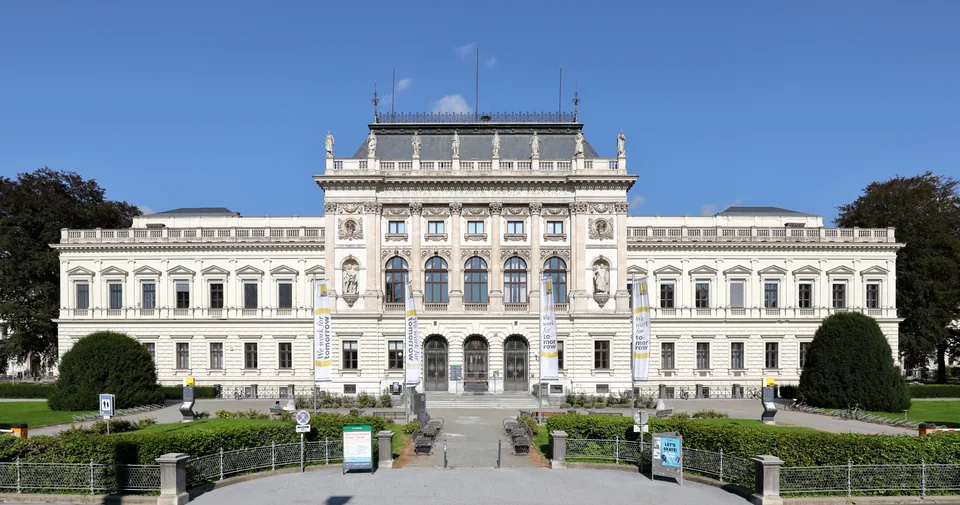
The main building and university library stand on Universitätsplatz in the Geidorf district near the old town, with most faculty buildings around it; some NAWI Graz classes take place at TU Graz, also in the city centre. According to TU Graz, Graz has eight higher education institutions, so students are a visible part of city life. The city is compact: from the main building you can reach the old town and the TU Graz campuses on foot, by bike or by tram.
FAQ
How much does the University of Graz cost for non-EU students?
$826 (€726.72) per semester plus the $30 (€26.20) ÖH fee — about $1,712 (€1,505.84) a year for any level or subject. While you are enrolled only at VGUH, you pay the programme fee of $568 (€500) per semester plus ÖH instead of tuition.
Can I apply with 11 years of school?
Yes, but you will not start your degree straight away. You submit your certificate with national entrance exam results, and the university assigns four supplementary exams that you take at VGUH. A completed degree of at least three years can replace them.
What level of German do I need?
C1 to begin your studies. An A2 certificate no older than two years is enough to apply; you are then admitted conditionally and must pass the EPD at VGUH.
Are there English-taught programmes?
Only at master's level: about 25 including bilingual options, such as Physics, Mathematics, Geosciences, the Environmental System Sciences tracks, Global Studies and Political and Empirical Economics, plus selective NAWI Graz programmes and Data Science. All require C1 English — IELTS 7.0 or TOEFL iBT 95.
When should I apply for 2027?
For summer 2027, non-EU applicants apply from 16 November to 14 December 2026. Winter 2027/28 dates will be published in spring 2027; in 2026 the windows were 15 June – 13 July for bachelor's and 11 May – 8 June for master's. Selective English-taught master's require registration from 15 October to 15 December 2026.
Can I study in Graz for free?
Not as a non-EU student on a student residence permit, except in narrow cases: a certificate from an Austrian school abroad or at least five years of residence in Austria. Merit scholarships are not open to non-EEA nationals.
Can StudyU help me apply to the University of Graz?
Under an agreement with StudyU, we shortlist programmes, check language and degree requirements, help prepare documents, calculate your budget and plan VGUH, housing and the residence permit. You submit the application yourself, as Austrian law requires. Admission is decided by the university, the Austrian authorities decide on the residence permit, and the hall operator, as housing provider, confirms room availability.
Sources
- University of Graz: facts and figures
- University of Graz: faculties
- International applicants: deadlines, procedures, documents
- Submission deadlines for international students
- Bachelor's documents and national entrance exams
- FAQ for international students
- Language certificates
- Languages of instruction for master's programmes (PDF)
- Restricted admission to Data Science and Computational Social Systems
- VGUH rules at the University of Graz
- VGUH semester fee 2026/27
- Tuition fee for non-EU students
- ÖH fee from winter 2026/27
- Fees for non-degree and preparatory-programme students
- Financing your studies and merit scholarships
- Accommodation in Graz
- OeAD Housing in Graz
- TU Graz: NAWI Graz master's selection
- TU Graz FAQ: 2025 Student Social Survey spending
- Migration.gv.at: 2026 proof-of-funds amounts (German)
- Verbund Linie: Top-Ticket Studierende
- OeAD: student residence permit, 2026 amounts
- THE World University Rankings 2026: University of Graz
Dollar amounts are converted at the ECB reference rate of 24 September 2026 (€1 = $1.1367). For other universities and general rules, see studying in Austria and our overview of universities in Austria for international students. Help deciding whether Graz fits your plans is provided under an agreement with StudyU — to start, submit an application.
During the free initial consultation, we clarify your goal, profile, timing, and budget and identify the next realistic step.
Next steps
- Universities in Austria for International Students: Public, Applied and Private — How to Choose
- Austrian Student Visa and Residence Permit: Where to Apply, Proof of Funds, Timing and Renewal
- Vorstudienlehrgang (VWU): Austria's University Preparation Programme — Who Needs It, How to Enrol, What It Costs
- Studying in Austria for international applicants
- University of Vienna (Universität Wien)
- University of Innsbruck
