
You apply to an Austrian public university directly: there is no central portal, and each institution checks your school certificate and language and sets its own conditions. For German-taught bachelor's programmes, German at A2 is enough to apply, but C1 is required before you can enrol in the degree itself; the gap is closed in a university preparation programme such as the VWU in Vienna. School certificates from 11-year systems (Russia, Kazakhstan and others) often lead to supplementary examinations (Ergänzungsprüfungen) in mathematics, physics or chemistry. The law sets 5 September and 5 February as the final dates, but many universities close earlier for non-EU applicants: the University of Vienna's window for winter semester 2026/27 ran from 22 June to 3 August. Tuition for non-EU citizens is $826 (€726.72) per semester plus a $30 (€26.20) students' union fee.
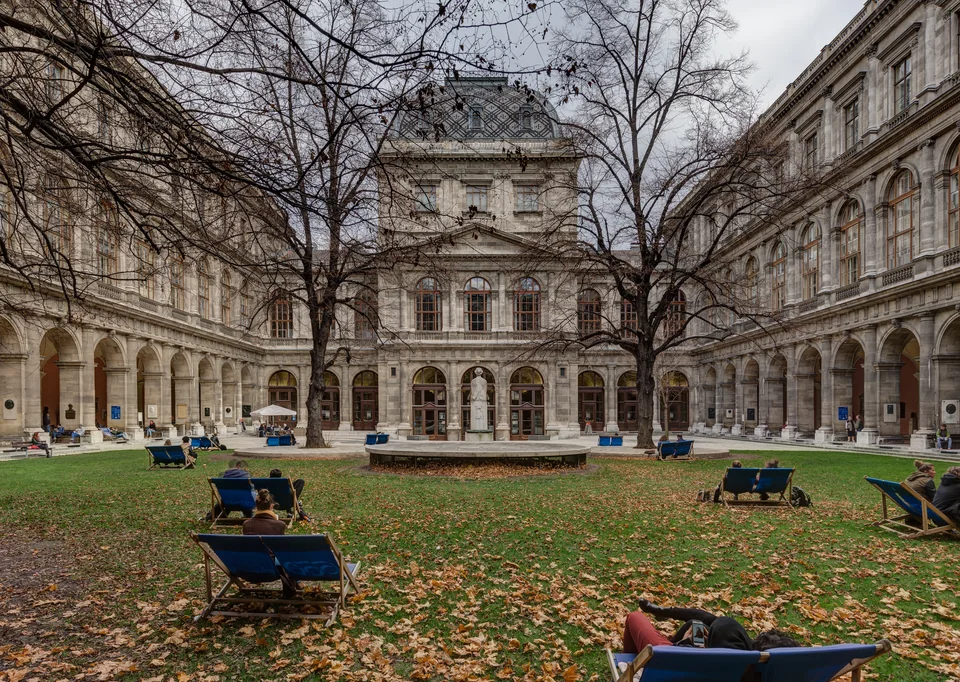
How admission works
Austria has no equivalent of UCAS or uni-assist. You submit the application, documents and fees to one university, and it issues the admission decision (Zulassungsbescheid) that you later present at the embassy for your residence permit.
| Type of institution | Selection | Bachelor's language | When to apply |
|---|---|---|---|
| Public university | Document check; entrance test once a year for some programmes | Almost always German | Separate, earlier window for non-EU applicants |
| Medical university | Joint MedAT test; non-EU applicants get at most 5% of human medicine places | German | MedAT registration in March, test in early July |
| University of applied sciences (Fachhochschule) | Competitive: test, interview, written materials | German or English | Often spring; FH Technikum Wien: 31 March 2027 for non-EU applicants |
| Private university | Own procedure | Often English | Institution's own dates |
According to OeAD, Austria offers more than 2,500 programmes at 77+ institutions; its 21 universities of applied sciences run about 640 programmes, roughly 80 of them fully in English. For an overview of institutions see our guide to universities in Austria; the country page is studying in Austria.
Who this route suits and how long it takes
| Your profile | Realistic route | Time to add |
|---|---|---|
| School leaver, German A2–B1 | Apply with A2, then preparation programme for German and any prescribed subjects | 2–4 semesters |
| School leaver with German C1 | Apply directly; subject exams may still be prescribed | 0–2 semesters |
| 1st–2nd-year university student at home | Apply with school and university transcripts; prior study can reduce exams | Depends on the university |
| Bachelor's graduate | Apply to a related master's; many are in English | Usually none |
| English-only bachelor's | Few options: two University of Vienna programmes, WU's BBE (240 places), some FH and private universities | Competition and higher private fees |
What the university checks in a foreign school certificate
The university decides whether your certificate is equivalent to the Austrian Reifeprüfung. TU Wien lists three tests: the certificate must give access to all fields of higher education in the issuing country; schooling must last at least 12 years (a shortfall can be compensated by supplementary exams); and upper secondary school must include six general subjects — two languages, mathematics, a science, a humanities subject and one more — with at most one missing subject compensable by an exam.
An 11-year certificate therefore often results in prescribed exams in mathematics, chemistry or physics, plus German if C1 is not proven. In Vienna these are taken at the VWU; see our guide to the Vorstudienlehrgang.
National exams matter at some universities: TU Wien requires proof of the Russian Unified State Exam (EGE) or Kazakhstan's national entrance exam (UNT), among others. The University of Vienna publishes special rules for some countries (for example China, Iran and Türkiye) but assesses each application individually and gives no advance rulings. A year of university study at home can reduce the gap, but it is not a mandatory step.
Some programmes need an extra subject. At the University of Vienna, Latin must be proven before enrolment for, for example, classical philology and Egyptology, while law, history, pharmacy and many language programmes let you take it during your studies. TU Wien requires descriptive geometry for mechanical engineering and management, geodesy and chemical engineering; if you did not have it at school, you take the exam during the bachelor's.
Language: A2 to apply, C1 to start
For German-taught programmes, the University of Vienna accepts applications with A2. C1 is required for all German-taught bachelor's and most master's programmes. Without it, the admission decision prescribes the supplementary exam in German and you enrol as a non-degree student in the preparation programme, which no longer runs beginner courses. Its two English-taught bachelor's programmes — International Legal Studies and Mathematical Foundations of Data Science — require English at B2. See also our overview of German language tests.
Deadlines
The legal limits are 5 September (winter) and 5 February (summer); semesters start on 1 October and 1 March. Plan around the earlier institutional windows:
| What | Winter semester 2026/27 | Summer semester 2027 |
|---|---|---|
| University of Vienna, non-EU applicants | 22 Jun – 3 Aug 2026 | 16 Nov 2026 – 7 Jan 2027 |
| University of Vienna, programmes with entrance exam | 2 Mar – 4 May 2026; tests from 6 Jul; once a year | Not offered |
| TU Wien, non-EU (recommended window for complete files) | 16 Jan – 15 Jul | 16 Jul – 15 Jan |
| TU Wien pre-registration | By 5 Sep | By 5 Feb |
| WU English-taught BBE | Registration 2 Mar – 19 May 2026; winter start only | Not offered |
| MedAT (medicine, dentistry) | Registration 2–31 Mar 2026; test 3 Jul 2026 | Not offered |
Dates for winter 2027/28 come later: WU expects to publish the BBE selection details in mid-November 2026, and the MedAT organisers announce their dates around the turn of the year. There is no grace period at the University of Vienna.
What is still realistic if you are reading this in autumn 2026. For summer semester 2027 you can apply to the University of Vienna (non-EU window 16 November 2026 – 7 January 2027) or TU Wien (by 15 January), but only to programmes without an entrance test. Psychology, computer science, business, WU's BBE and medicine admit once a year, so the next chance is spring 2027 registration for an October 2027 start. Remember the residence permit: with an admission decision in January, up to 90 days of processing will almost certainly overlap with the start of the summer semester. TU Wien accepts paper applications by post only, takes 10–12 weeks to process them and allows at most two applications per person.
Documents for a bachelor's application
| Document | Notes |
|---|---|
| Passport | Data page scan; the residence permit later needs copies of all pages |
| School certificate (all pages) and grade list | Apostille (Russia and Kazakhstan are Hague Convention members), then a sworn German translation unless issued in German or English |
| National exam results | Required at TU Wien; elsewhere as specified |
| University transcripts, if any | Also apostilled and translated |
| German A2 certificate (or English B2) | ÖSD, Goethe, telc, TestDaF, DSD or a university language centre |
| Application form | Online (University of Vienna, WU) or signed paper form (TU Wien) |
Apostille first, translation second, so the translator also translates the apostille.
A 12-month plan
| When | Step |
|---|---|
| 12–10 months before | Shortlist programmes on studienwahl.at; get German A2 |
| 10–8 months | Certificate or school confirmation, national exam results, apostille, translation |
| 8–6 months | Spring registrations for programmes with entrance tests; MedAT in March |
| 6–3 months | Apply within the non-EU window; TU Wien by 15 July |
| Right after admission | Book the embassy appointment and apply for the student residence permit (up to 90 days) |
| 1–2 months before | Visa D, housing, VWU pre-registration (for winter 2026/27: 31 Jul – 13 Aug) |
| On arrival | Register your address within three working days, enrol, pay fees, collect the permit card |
Entrance tests and competition
At the University of Vienna, programmes such as psychology, biology, computer science, economics, law, business, communication and political science have an entrance exam held in Vienna from early July, with no alternative dates. You may register without full German proof but must have it at enrolment. Many other programmes require a compulsory online self-assessment before enrolment. TU Wien runs entrance procedures for computer science and architecture and a compulsory orientation phase for most other programmes. Universities of applied sciences select every applicant. Medicine is covered in our guide to studying medicine in Austria.
Master's programmes
You need a relevant bachelor's degree of at least six semesters (180 ECTS). The university may admit you on condition that you make up specific courses. At the University of Vienna, master's programmes with a selection procedure accepted applications once a year, from 2 March to 7 April 2026. English-taught programmes usually need English proof, a CV and a motivation letter.
After admission
With the admission decision you apply in person at the Austrian embassy or consulate responsible for your place of residence for the "Residence Permit – Student". External visa centres cannot accept this application. The provincial residence authority decides within 90 days. For one year you must show $9,856 (€8,670.96) if under 24 or $17,847 (€15,700.68) from age 24. Details: student visa and residence permit in Austria. Budget planning: cost of studying in Austria.
Common mistakes
- Planning for 5 September when the non-EU window closed in early August.
- Posting documents to TU Wien in late summer despite a 10–12-week review.
- Translating before the apostille is attached.
- Arriving at the preparation programme without A2.
- Assuming a year at a home university is compulsory.
- Starting the residence permit in August.
FAQ
Yes. Because Austrian schooling lasts 12 years, the university often prescribes supplementary exams taken in a preparation programme. A school leaver with A2 German should plan one to two years before the degree starts.
TU Wien requires them for Russian and Kazakh certificates, among others. The University of Vienna lists requirements for specific countries and assesses others individually. Check your university's document list before applying.
A2 to apply to a German-taught programme and C1 to enrol in it. The preparation programme ends with a German exam that counts as proof.
The legal limits are 5 September and 5 February, but non-EU windows are earlier: the University of Vienna closed on 3 August for winter 2026/27, and TU Wien recommends sending complete files by 15 July. Programmes with entrance tests take registrations in spring.
Non-EU citizens pay $826 (€726.72) per semester plus the $30 (€26.20) students' union fee. The Vienna preparation programme costs $696 (€612) or $2,103 (€1,850) per semester depending on the group and course provider.
Yes, applications are independent. TU Wien accepts at most two applications per person, and a MedAT result counts only at the university where you sat the test.
Under a service agreement we shortlist programmes that fit your certificate and language, prepare apostilled and translated documents, track deadlines and support you through the residence permit. Universities decide on admission and the residence authority on the permit; we cannot guarantee either.
Sources
- OeAD / Study in Austria: application and admission, universities of applied sciences, find your programme — checked 24 Sep 2026
- University of Vienna: application periods, third-country students, German proficiency, additional exams, entrance exams, fees — checked 24 Sep 2026
- TU Wien: admission with an international certificate — checked 24 Sep 2026
- WU: BBE selection procedure — checked 24 Sep 2026
- VWU: first registration; MedAT basics; FH Technikum Wien deadlines — checked 24 Sep 2026
- OeAD: Residence Permit – Student — checked 24 Sep 2026
- Conversion: ECB rate of 24 Sep 2026, €1 = $1.1367
Next steps
- Studying Medicine in Austria as an International Student: MedAT, the 5% Quota, German C1 and the Preparation Year
- Cost of Studying in Austria in 2026/27: Tuition, the Preparation Year and Living Costs
- Universities in Austria for International Students: Public, Applied and Private — How to Choose
- Austrian Student Visa and Residence Permit: Where to Apply, Proof of Funds, Timing and Renewal
- German Language Tests for German Universities: TestDaF, DSH, Goethe and telc Compared (2026–2027)
- Studying in Austria for international applicants
