
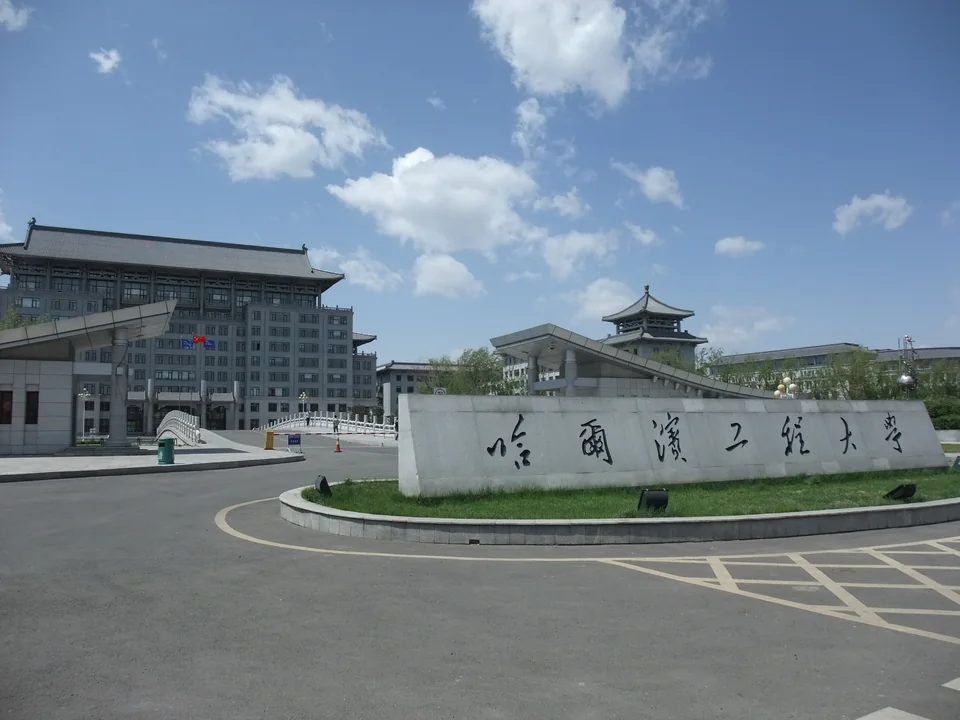
Harbin Engineering University (哈尔滨工程大学, HEU) is a public technical university in Harbin whose schools of naval architecture, underwater acoustics and nuclear engineering are among the strongest in China. It belongs to the 211 Project and the national "Double First-Class" initiative. International applicants can choose from 35 bachelor's programmes, five of which are also taught in English, and at master's level roughly half of the fields are available in English. A Chinese-taught bachelor's degree costs $2,390–2,540 (CNY 16,000–17,000) a year and the English-taught Artificial Intelligence degree $3,280 (CNY 22,000). Since 2026 bachelor's applicants need a CSCA score and a school average of at least 75 out of 100. Applications are accepted in four rounds between 1 November and 15 May.
| At a glance | Details |
|---|---|
| Location | 145 Nantong Street, Nangang District, Harbin |
| Founded | 1953 as the PLA Military Engineering Institute; named HEU since 1994 |
| Supervising body | Ministry of Industry and Information Technology of China |
| Status | 211 Project since 1996; Double First-Class since 2017 (Naval Architecture and Ocean Engineering) |
| Students | about 35,600, including more than 700 international students |
| Ranking | THE World University Rankings 2027: 651–700 band |
| Bachelor's tuition | Chinese-taught $2,390–2,540 (CNY 16,000–17,000); English-taught $3,280 (CNY 22,000), or $6,710 (CNY 45,000) for the dual degree with the University of Aberdeen |
| Master's tuition | $4,030 (CNY 27,000) in Chinese, $4,920 (CNY 33,000) in English |
| Language | HSK 3 for Chinese Language and Literature, HSK 4 for other Chinese-taught bachelor's programmes, HSK 5 for postgraduate study in Chinese; TOEFL 90 or IELTS 6.0 for English-taught programmes |
| Housing | five price tiers, $60–390 (CNY 400–2,600) a month |
How HEU differs from other engineering universities in Harbin
HEU's profile is summed up by the Chinese formula "three seas and one nucleus": shipbuilding, naval equipment, ocean development and nuclear power. In the Ministry of Education's fourth-round discipline evaluation, HEU's naval architecture and ocean engineering ranked first in China, nuclear science third and control science sixth. The university reports eight fields in the global top 1% of ESI, with engineering in the top 0.1%.
Compared with its neighbour, Harbin Institute of Technology, HEU is narrower and deeper: HIT covers a broader engineering spectrum and ranks higher internationally, while HEU is stronger wherever water, ships, acoustics or reactors are involved. Heilongjiang University is primarily a humanities institution, although it also teaches some engineering majors in Chinese. Our overview of universities in Harbin compares them all.
HEU is a good choice if you:
- want to work in naval architecture, marine power, underwater acoustics or nuclear power plants, fields where HEU's naval architecture is ranked first nationally;
- need a technical master's degree in English, with around fifteen such fields listed for 2026;
- are willing to learn Chinese for a bachelor's degree, since 30 of the 35 undergraduate programmes are taught only in Chinese.
Look elsewhere if you need broad computer science or business in English from the first year. HEU's English-taught bachelor's options are artificial intelligence, robotics, computer science, electronic information engineering and civil engineering; economics and management are taught only in Chinese.
Bachelor's programmes open to international students
All bachelor's programmes last four years. For the 2026 intake HEU listed 35 programmes:
| Field | Programmes | Language |
|---|---|---|
| Shipbuilding and marine power | naval architecture and ocean engineering; energy and power engineering; marine engineering | Chinese |
| Underwater acoustics | underwater acoustics engineering; electronic information engineering (acoustics); marine information engineering | Chinese |
| Intelligent systems | artificial intelligence; robotics engineering | Chinese or English |
| electrical engineering and automation; measurement and control; automation | Chinese | |
| Computing and communications | computer science and technology; electronic information engineering | Chinese or English |
| information security; software engineering; communications engineering | Chinese | |
| Mechanical engineering and materials | mechanical design and automation; industrial design; intelligent manufacturing; materials science; chemical engineering; new energy materials and devices | Chinese |
| Nuclear engineering | nuclear energy engineering and technology; nuclear chemical and fuel engineering | Chinese |
| Civil engineering | civil engineering (dual degree) | Chinese or English |
| Science, management and law | mathematics; applied physics; opto-electronics; business administration; big data management; English; law; sociology; Chinese language and literature; ideological and political education | Chinese |
Civil engineering dual degree. Students spend three years in Harbin and the fourth at the University of Aberdeen in Scotland. At $6,710 (CNY 45,000) a year for the HEU years it is the most expensive option, and the final year requires a UK student visa with its own documents.
Artificial Intelligence in English costs $3,280 (CNY 22,000) a year. Robotics, computer science and electronic information engineering are marked as available in English, but the 2026 admission book gives no separate fee for them, so request the rate before applying.
Bachelor's requirements
- foreign citizenship and good health;
- a secondary-school certificate and age 18–25; applicants under 18 need documents from a guardian living in Harbin;
- an average of at least 75 out of 100; the rules do not explain how other grading scales are converted, so include an explanation of your school's scale;
- language: HSK 3 for Chinese Language and Literature, HSK 4 for other Chinese-taught programmes, TOEFL 90 or IELTS 6.0 for English-taught ones;
- a CSCA score report.
CSCA subjects for HEU
HEU sets a minimum by programme group: mathematics and physics for engineering, Professional Chinese and mathematics for arts and management. Its CSCA information page adds the general rule that Professional Chinese is mandatory for Chinese-taught programmes. In practice:
| Programme | Papers to take |
|---|---|
| Chinese-taught engineering | Professional Chinese (STEM), mathematics, physics |
| English-taught engineering | mathematics and physics in English; Chinese Government Scholarship applicants also sit Professional Chinese, which the CSCA rules make compulsory for them |
| Economics, law, languages, sociology | Professional Chinese (Humanities) and mathematics |
| Chemical engineering and materials | add chemistry to mathematics and physics if the school asks for it |
The CSCA is mostly taken online from home. The 2026/27 cycle has six sessions: 14–15 November and 19–20 December 2026, then 23–24 January, 13–14 March, 24–25 April and 26–27 June 2027; the January and March sessions start at 09:00 Moscow time. One subject costs $67 (CNY 450), two or more $100 (CNY 700), and scores are released within 10 working days. See our CSCA exam guide.
Documents and selection
The online application includes the HEU application form, passport page, CSCA results, notarised school certificate and transcript, a language certificate, a study plan of at least 800 words, the medical examination form, proof of financial support, a criminal record check and, for minors, guardian documents. After document screening there is an interview, followed by the admission notice. Applications are tracked in the hrbeu.at0086.cn/student system, which replaced the old portal on 1 June 2025. Certification and translation rules are covered in applying to Chinese universities.
The study plan is the only document in the file where you explain your choice in your own words. For an engineering programme, show which subjects you studied at an advanced level, any projects or competitions, why the marine or nuclear specialisation appeals to you, and what you plan to do after graduating.
Master's and doctoral programmes
Master's degrees at HEU take three years and doctorates four. Master's applicants need a bachelor's degree and must be under 35; doctoral applicants need a master's degree and must be under 40; both need an average of at least 75/100. Chinese-taught study requires HSK 5 and English-taught study TOEFL 90 or IELTS 6.0. Recommendation letters and a research plan of at least 1,000 words are also required.
English-taught fields on the 2026 list include:
- design and construction of naval architecture and ocean structures; mechanics; civil engineering;
- power engineering and engineering thermophysics; marine engine engineering;
- control science; intelligent science and technology;
- underwater acoustics; information and communication engineering;
- mechanical engineering, materials science, chemical engineering;
- mathematics and optical engineering;
- nuclear energy engineering (master's) and nuclear science and technology (doctoral).
Computer science (master's), electrical engineering, economics, management, law, sociology, translation and international Chinese education remain Chinese-taught. For how to choose a supervisor and programme, see master's degrees in China.
Application rounds
| Round | Bachelor's (2026 intake) | Master's and doctoral (2026 intake) |
|---|---|---|
| 1 | 1 November – 15 January | 1 November – 15 January |
| 2 | 16 January – 15 February | 16 January – 28 February |
| 3 | 16 February – 15 March | 1–31 March |
| 4 | 16 March – 15 May | 1–30 April |
HEU published its 2026 admission books on 22 October 2025 and the next edition is expected around the same time; in the last cycle the first round opened on 1 November. If you hope for a scholarship, apply early: Chinese Government Scholarship rounds have their own, earlier deadlines, and the December CSCA session gives you a score by January.
Costs
Tuition (2026 admission book)
| Programme | Application fee | Per year |
|---|---|---|
| Bachelor's, Chinese Language and Literature | $60 (CNY 400) | $2,390 (CNY 16,000) |
| Other Chinese-taught bachelor's programmes | $60 (CNY 400) | $2,540 (CNY 17,000) |
| Bachelor's, Artificial Intelligence in English | $60 (CNY 400) | $3,280 (CNY 22,000) |
| Civil engineering dual degree in English | $60 (CNY 400) | $6,710 (CNY 45,000) |
| Master's, Chinese / English | $60 (CNY 400) | $4,030 (CNY 27,000) / $4,920 (CNY 33,000) |
| Doctorate, Chinese / English | $60 (CNY 400) | $5,220 (CNY 35,000) / $6,270 (CNY 42,000) |
| Chinese language training | $39 (CNY 260) | $1,040 (CNY 7,000) per semester |
Application fees are non-refundable. The rates are those published for the 2026 intake; the 2027/28 rates will appear in the next admission book.
Housing and living costs
HEU prices campus rooms in five tiers depending on room type:
| Monthly rate | If paid for 12 months |
|---|---|
| $60 (CNY 400) | $720 (CNY 4,800) |
| $120 (CNY 800) | $1,430 (CNY 9,600) |
| $210 (CNY 1,400) | $2,510 (CNY 16,800) |
| $300 (CNY 2,000) | $3,580 (CNY 24,000) |
| $390 (CNY 2,600) | $4,650 (CNY 31,200) |
The university estimates everyday living costs at $220–370 (CNY 1,500–2,500) a month. At registration you pay once for the residence permit, $60–120 (CNY 400–800), and the medical check, $60 (CNY 400); insurance costs $120 (CNY 800) a year.
Sample first-year budget for a Chinese-taught bachelor's degree with a $120 (CNY 800) room: tuition and application fee $2,600 (CNY 17,400), housing $1,430 (CNY 9,600), insurance $120 (CNY 800), residence permit and medical check up to $180 (CNY 1,200), living costs $2,690–4,480 (CNY 18,000–30,000). The total is about $7,010–8,800 (CNY 47,000–59,000) before flights. Payments go to HEU's ICBC account in Harbin; for payment routes from Russia see how to pay for studies abroad from Russia, and for city comparisons the cost of studying in China.
HEU and government scholarships
HEU Excellent Student Scholarship covers the standard length of the degree and is reviewed each year:
| Class | Bachelor's | Master's | Doctoral |
|---|---|---|---|
| First | full tuition waiver + $220 (CNY 1,500) a month | full waiver + $300 (CNY 2,000) a month | full waiver + $450 (CNY 3,000) a month |
| Second | full tuition waiver | same | same |
| Third | 50% tuition waiver | 50% | 50% |
Age limits are normally 25 for bachelor's, 35 for master's and 40 for doctoral applicants. A first-year bachelor's student with strong Chinese or notable sports or cultural achievements may receive a one-off $750 (CNY 5,000) talent award without applying, provided they hold no other scholarship.
Government and sector programmes. HEU hosts Chinese Government Scholarship students under the Silk Road, Atomic Energy and Marine programmes, International Chinese Language Teachers scholars, and participants in the Ministry of Education and Heilongjiang Province programme for Eurasian countries, which includes Russia and Kazakhstan. Master's and doctoral Type B applications go through the China Scholarship Council system with HEU's agency number 10217. Bachelor's Type A awards are allocated under intergovernmental quotas through Chinese embassies, usually between November and February. For a broader view, see scholarships abroad in 2026.
Every award is decided by HEU's scholarship committee or the council that funds it.
Sample timeline for an autumn 2027 start
- September–October 2026. Choose the programme and language. If you plan to study in Chinese without HSK 4, a language year first, at $1,040 (CNY 7,000) per semester at HEU, and a 2028 start is more realistic.
- October–November 2026. Register for the CSCA (registration for the November session opens in mid-October), draft the 800-word study plan, have your school certificate notarised and translated.
- November 2026 – January 2027. Sit the CSCA on 14–15 November or 19–20 December, complete the medical examination and criminal record check. December scores arrive in early January, still in time for round one (closes 15 January); with the January session, round two (to 15 February) is the realistic target.
- February–March 2027. Interview and admission notice.
- June–August 2027. JW202 form, X1 study visa from a Chinese consulate, then a residence permit within 30 days of arrival. See the China student visa guide.
Common mistakes
- Confusing HEU and HIT. Harbin Engineering University (哈尔滨工程大学) and Harbin Institute of Technology (哈尔滨工业大学) are different universities, and a wrong name on a CSC application sends it to the wrong place.
- Choosing an English-taught programme without checking the fee. Rates are published for only two English-taught bachelor's programmes.
- Skipping Professional Chinese for a Chinese-taught engineering programme. The mathematics-and-physics minimum does not override the CSCA's general rule.
- Treating the study plan as a formality. With an 800-word minimum, a short generic text stands out at interview.
- Picking the dual degree without a budget buffer. The final year in Aberdeen is paid for and arranged separately under UK rules.
FAQ
Can I study at Harbin Engineering University in English?
Yes, but options depend on the level. Five bachelor's programmes are available in English: artificial intelligence, robotics, computer science, electronic information engineering and the civil engineering dual degree. At master's level around 15 fields are taught in English, mainly marine engineering, power, control, acoustics and materials; doctoral study adds computer science and nuclear science.
What HSK level does HEU require?
HSK 3 for the Chinese Language and Literature bachelor's programme, HSK 4 for other Chinese-taught bachelor's programmes and HSK 5 for Chinese-taught master's and doctoral study. English-taught programmes require TOEFL 90 or IELTS 6.0 instead.
How much does a year at HEU cost with housing?
Under the 2026 rates a Chinese-taught bachelor's degree costs $2,540 (CNY 17,000) a year. With a $120 (CNY 800) room, insurance, registration charges and the university's own living-cost estimate, the first year comes to about $7,010–8,800 (CNY 47,000–59,000).
Is HEU a 211 and Double First-Class university?
Yes. HEU joined the 211 Project in 1996 and entered the national Double First-Class initiative in 2017 with Naval Architecture and Ocean Engineering. Its supervising body is the Ministry of Industry and Information Technology rather than the Ministry of Education.
Are there scholarships for Russian citizens at HEU?
Russian applicants can compete for the HEU Excellent Student Scholarship, the Chinese Government Scholarship (Type B for master's, agency number 10217) and the Ministry of Education and Heilongjiang Province programme for Eurasian countries. All are competitive and decided by the university committee or the scholarship council.
How can StudyU help with an HEU application?
Choosing the programme and CSCA papers, checking your school certificate and average, preparing the study plan and documents, submitting the HEU and scholarship applications and support through to the visa are provided under an agreement with StudyU. Harbin Engineering University makes the admission decision, the university or the scholarship provider decides on the scholarship, and the consular authorities decide on the visa.
Sources
- HEU: 2026 International Student Admission Book (Undergraduate Programs): programmes, requirements, CSCA, rounds, fees, housing, living costs
- HEU: 2026 International Student Admission Book (Postgraduate Programs): English-taught fields, fees, CSC agency number 10217
- HEU: Bachelor Programs: discipline evaluation, ESI, Aberdeen dual degree
- HEU: Introduction to the CSCA and the CSCA website: 2026/27 session schedule
- HEU: HEU Scholarship
- HEU: Notices on Silk Road, Atomic Energy and Eurasian scholarships; application portal change
- HEU: university profile (Chinese): history, 211, Double First-Class, enrolment
- HEU: General Information
- Times Higher Education: Harbin Engineering University
Dollar conversions follow the ECB reference rate for 29 September 2026 (one euro bought USD 1.1355 or CNY 7.6117, giving CNY 1 ≈ USD 0.1492); sums below $100 are rounded to whole dollars, larger ones to tens.
If you are weighing HEU against HIT or other Chinese engineering universities, send us a request; more profiles are on our study in China page.
During the free initial consultation, we clarify your goal, profile, timing, and budget and identify the next realistic step.
Next steps
- Heilongjiang University (HLJU), Harbin: Admission, Fees and Scholarships
- Universities in Harbin for International Students: HIT, HEU, Heilongjiang University and More
- CSCA Exam Guide: Subjects, 2026/27 Test Dates, Registration and Preparation
- Studying in China for international applicants
- Harbin Institute of Technology (HIT)
- Applying to Chinese Universities: Documents Checklist for 2027
