
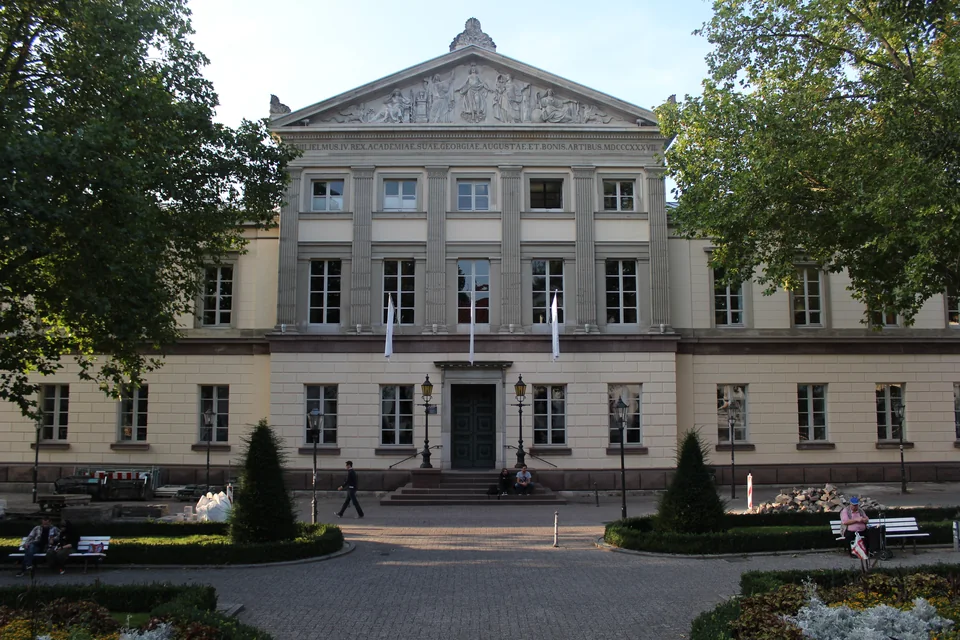
The University of Göttingen is one of Germany's largest and oldest research universities, founded in 1737 in a small student city in Lower Saxony. There is no tuition for international students: you pay only a semester contribution of $550 (€484.18) in winter 2026/27, including a Germany-wide transport pass. Bachelor's applications go directly through the university's portal rather than uni-assist, and you only need A1 German to apply, although DSH-2 is required by enrolment. Dozens of master's programmes are taught in English, from physics and data science to agricultural and forest sciences.
| At a glance | Details |
|---|---|
| Location | Göttingen, Lower Saxony |
| Founded | 1737 |
| Students | about 28,000 |
| Faculties | 13, with more than 210 degree programmes |
| Rankings | THE 2026: =122; ARWU 2026: 151–200 |
| Tuition | none |
| Semester contribution | $550 (€484.18) in winter 2026/27 |
| Bachelor's applications | university portal; foreign certificate evaluation fee of $74 (€65) per semester |
| Language to apply | A1 German for bachelor's (DSH-2 by enrolment); master's as set by each programme |
| Housing | 35 Studierendenwerk residences |
Who Göttingen suits, and who should look elsewhere
Göttingen is a classic university town in which the university sets the pace of life. Max Planck institutes and other research centres work alongside it as part of the Göttingen Campus. It is particularly strong in the natural and life sciences, agricultural and forest sciences, and development economics, and its 13 faculties range from theology to medicine.
| Good fit | Consider alternatives |
|---|---|
| Master's applicants in physics, mathematics, computer science, biology, neuroscience, agriculture or forestry, where many programmes are in English | Students who want big-city life and a broad internship market |
| School leavers who want to apply early with limited German | Anyone who needs an English-taught bachelor's in business or IT |
| Students who value tuition-free study in a more affordable city | Applicants who want a current University of Excellence |
| Future researchers: fast-track routes to a PhD with Max Planck institutes | Students who expect to take much longer than the standard period: extra fees apply |
For a bigger city without tuition, compare Göttingen with the University of Hamburg and the University of Bonn.
Which programmes are available, including in English
The 13 faculties cover the natural sciences, humanities and social sciences, economics, law, theology, agricultural and forest sciences, and medicine at the University Medical Center (UMG).
Bachelor's programmes
Almost all bachelor's degrees are taught in German. English-taught exceptions are Ecosystem Sciences (B.Sc.) and Intercultural Theology (B.A.). World Literature is bilingual and requires at least B2 German; Sustainable Development Studies requires C1.
English-taught master's programmes
| Field | Programmes |
|---|---|
| Physics, mathematics, computer science | Physics, Mathematics, Applied Computer Science, Applied Data Science, Applied Statistics, Information Systems, Matter to Life |
| Life sciences | Molecular Biology and Neurosciences (with Max Planck institutes; fast track to PhD possible), Molecular Medicine, Cardiovascular Science, Biodiversity, Ecology and Evolution, Developmental, Neural and Behavioral Biology, Microbiology and Biochemistry |
| Agriculture and forestry | Crop Protection, Forest and Ecosystem Sciences, Tropical and International Forestry, Integrated Plant and Animal Breeding, International Agribusiness and Rural Development, Sustainable International Agriculture (with Kassel) |
| Economics | Development Economics, International Economics, History of Global Markets |
| Humanities | English: Language, Literatures and Cultures; North American Studies; Linguistics; Digital Humanities; Modern Indian Studies; Iranian and Persianate Studies |
| Law (fee-paying LL.M.) | European and Transnational Law of IP and IT (LIPIT); International Law — GOMIL; fees are listed on the programme pages |
Some of these also require German, including Biodiversity, Ecology and Evolution; Developmental, Neural and Behavioral Biology; Microbiology and Biochemistry; and International Economics. For Mathematics and Physics the university notes that German "might be required".
How to apply to Göttingen with A1 German
Bachelor's: apply first, prove German by enrolment
Göttingen has an unusual rule: to apply for a German-taught bachelor's you only need A1 German, while DSH-2 or an equivalent is required by enrolment. Our guide to TestDaF, DSH and Goethe exams explains the certificates. Psychology requires DSH-3, and medicine and dentistry require DSH-2 at application. You can take the DSH at the university.
- Check your access in anabin. If your certificate does not give direct access, you need a Studienkolleg (see below) or a year of university study at home.
- Apply on the university portal from 1 June to 15 July for the winter semester. You can submit up to three applications.
- Pay the evaluation fee of $74 (€65) per application semester for assessing your foreign certificate, unless exempt.
- Receive your decision and accept your place on the portal by the deadline in your letter.
- Enrol: upload documents, proof of DSH-2 and health insurance, and pay the contribution.
Studienkolleg for applicants with 11 years of school
Göttingen has no preparatory college of its own; applicants are referred to the Studienkolleg in Hannover. You submit a regular bachelor's application through Göttingen's portal in special windows: 1 March to 30 April for the winter semester and 1 September to 31 October for the summer semester. You can apply for only one course, and the G course (humanities) does not start in summer. Taking part in the Studienkolleg selection is not admission to a degree: after passing the FSP you apply again. See our guide to the Studienkolleg in Germany.
Master's programmes
Faculties handle master's applications, and each programme lists its own deadlines. According to the international programmes catalogue, several biology master's programmes set a 1 January to 15 February window for non-EU applicants (winter start); confirm it on the programme page. The Max Planck-linked Molecular Biology and Neurosciences programmes accept applications from 15 September to 15 January, and their courses start in September. Many English-taught physics, mathematics and computer science programmes also admit in summer.
When to apply for 2027
| Applicant group | Winter semester 2027/28 | Summer semester 2027 |
|---|---|---|
| Bachelor's, non-EU citizens | 1 Jun to 15 Jul 2027 | most programmes start only in winter |
| Studienkolleg (via Göttingen, in Hannover) | 1 Mar to 30 Apr 2027 | 1 Sep to 31 Oct 2026 (no G course) |
| Biology master's (non-EU applicants) | 1 Jan to 15 Feb 2027 | — |
| Molecular Biology, Neurosciences (IMPRS, September start) | 15 Sep 2026 to 15 Jan 2027 | — |
| Other master's programmes | see programme page | some programmes admit |
| Deutschlandstipendium (enrolled students) | 1 to 30 Sep | — |
Which documents you need
- school-leaving certificate or degree with transcript and translation;
- proof of a completed university year (if not going through the Studienkolleg);
- German certificate: A1 to apply for a bachelor's, DSH-2 by enrolment;
- for master's programmes, whatever the programme requires: degree, transcript, module descriptions, motivation letter, English certificate and sometimes references;
- proof of payment of the $74 (€65) evaluation fee;
- at enrolment, health insurance and the proof of measles protection the university requires.
What studying and living in Göttingen costs
Semester contribution
| Category | Winter 2026/27 |
|---|---|
| Standard contribution (administration, student body, Germany-wide transport pass, culture pass, Studierendenwerk) | $550 (€484.18) |
| Long-term students beyond the permitted period | $1,120 (€984.18), including a $570 (€500) surcharge |
| Exchange students and holders of German publicly funded scholarships | $465 (€409.18) |
Lower Saxony charges no tuition to non-EU students; only some LL.M. programmes are fee-paying.
Living in Göttingen
For the visa you must show $1,130 (€992) a month, or $13,520 (€11,904) for the first year. Rent is the main expense; demand for Studierendenwerk rooms peaks in March and in August and September. Statutory student health insurance costs about $165 (€145) a month, and transport is covered by the contribution.
A minimum first-year budget is $13,584 for living costs and about $1,100 (€968.36) in contributions for two semesters, or roughly $14,690, plus the $74 evaluation fee. See our blocked account guide.
How to fund your studies: scholarships and part-time work
- Deutschlandstipendium: $340 (€300) a month. Göttingen accepts applications once a year, from 1 to 30 September, for funding from 1 October. Only enrolled students with a university account can apply.
- DAAD scholarships for master's and doctoral students; check the DAAD database a year ahead. Russia added the DAAD to its list of "undesirable organisations" in February 2026, so participation carries legal risk for Russian citizens and we do not recommend it to them.
- Part-time work: 140 full or 280 half days a year; student assistant jobs at the university do not count towards the limit.
Where to live: Studierendenwerk Göttingen residences
Studierendenwerk Göttingen runs 35 residences, from half-timbered houses in the old town to 1960s and 1970s blocks and modern apartments near the campus, with rooms in shared corridors or flats, single and double apartments and family housing. Its advice:
- apply as soon as Göttingen is on your list; you do not need an admission letter;
- be flexible about your move-in date to improve your chances;
- expect peak demand before each semester.
If you do not get a hall place, our student housing guide covers the private market.
The culture pass is included in the semester contribution, and almost everything in town is reachable by bike.
Strengths and drawbacks of Göttingen for international applicants
| Pros | Cons |
|---|---|
| No tuition | Higher semester contribution than many universities: $553 |
| Apply for a bachelor's with A1 German; DSH-2 needed only by enrolment | 11-year certificates require the Studienkolleg in Hannover, with early windows (March to April) |
| Direct applications, no uni-assist | $74 evaluation fee for each application semester |
| Many English-taught master's in the sciences and agriculture | Small city with fewer internships and part-time jobs |
| Strong research environment with Max Planck institutes | Not currently a University of Excellence |
Applicants resident in Russia should plan for the usual German constraints: visas only through the German Embassy in Moscow (the St Petersburg consulate general closed on 18 September 2026), Russian bank statements not accepted as proof of funds and no Russian bank offering a suitable blocked account. See our student visa guide.
Mistakes to avoid
- Applying with A1 and missing DSH-2: without DSH-2 by enrolment, you lose your place.
- Missing the early Studienkolleg window: it closes on 30 April, not 15 July.
- Looking for Göttingen in uni-assist: the university handles international bachelor's applications itself.
- Expecting a Deutschlandstipendium in your first semester: only enrolled students apply, in September.
- Assuming English-taught master's never need German: some do.
Checklist before you apply
- Whether anabin gives you direct access or you need the Studienkolleg, and whether you can meet the 1 March to 30 April window.
- Your German: A1 to apply, but a realistic plan to reach DSH-2 by enrolment.
- The deadline and language rules of your master's programme, including German requirements for some English-taught programmes.
- The $74 evaluation fee paid before the deadline.
- A housing application sent straight away.
Where classes take place and what life in Göttingen is like
Göttingen is compact, with university buildings, libraries and residences spread across the city centre and the North Campus for the natural sciences. Bikes are the main way to get around, and the Germany-wide transport pass is included in the semester contribution. The city is small, which usually means calmer and cheaper living than in Munich, Frankfurt or Hamburg, but fewer part-time jobs and internships.
Where Göttingen stands in rankings
| Ranking | Position |
|---|---|
| THE World University Rankings 2026 | =122 |
| ARWU (Shanghai Ranking) 2026 | 151–200 |
Göttingen is not currently a University of Excellence: the ten universities confirmed on 11 March 2026 do not include it, and it is not among the applicants in the new round (decision due on 2 October 2026). The campus network nonetheless includes five Max Planck Institutes, the German Primate Center and the German Aerospace Center. For choosing a programme, the research environment matters more; many English-taught master's and fast-track PhD programmes are run with the Max Planck institutes.
Which jobs to look for after graduation
After graduation you can obtain a residence permit to look for work for up to 18 months. Many graduates stay in research, in doctoral programmes at the university and the Göttingen Campus institutes, or move into agribusiness, biotech, data and consulting elsewhere in Germany. Outside academia, most German employers expect German.
FAQ
How much does it cost to study at Göttingen?
There is no tuition, including for non-EU students. The semester contribution in winter 2026/27 is $550 (€484.18) with a Germany-wide transport pass. Studying well beyond the standard period adds $570 (€500) per semester. For the visa you need $13,520 (€11,904) for the first year.
Can I apply after 11 years of school?
Not directly. You need the Studienkolleg (via Göttingen in Hannover; apply 1 March to 30 April for winter) or a year of related university study at home.
Is A1 German really enough to apply?
Yes, for German-taught bachelor's programmes. By enrolment you need DSH-2 or an equivalent (DSH-3 for psychology), and medicine and dentistry require DSH-2 at application.
Which programmes are taught in English?
The bachelor's programmes Ecosystem Sciences and Intercultural Theology, and dozens of master's programmes including Physics, Mathematics, Applied Computer Science, Applied Data Science, Molecular Biology, Neurosciences, Development Economics and agricultural and forestry programmes.
Do I need uni-assist?
Not for bachelor's programmes: you apply through the university portal and pay $74 (€65) for the evaluation of your certificate. Master's applications go to the faculties according to each programme's rules.
When should I apply for 2027?
Bachelor's: 1 June to 15 July 2027. Studienkolleg: 1 March to 30 April 2027. Master's: per programme; several biology programmes list a 1 January to 15 February 2027 window for non-EU applicants, and the Max Planck-linked programmes close on 15 January 2027.
Can StudyU help me apply to Göttingen?
Under an agreement with StudyU, we shortlist programmes, check anabin and master's requirements, prepare your portal documents and plan the Studienkolleg, DSH, housing and visa budget. The university decides on admission, the German mission, as the consular authority, decides on your visa, and Studierendenwerk Göttingen, as housing provider, confirms room availability in its residences.
Sources
- University of Göttingen: home page (key facts)
- Application and Enrolment (EU and non-EU applicants)
- Studienkolleg application procedure and $74 (€65) evaluation fee
- German language skills
- English degree programmes
- Semester contributions and long-term study fees
- Deutschlandstipendium: information for students
- Studierendenwerk Göttingen: student accommodation
- DFG: Universities of Excellence evaluation, 11 March 2026 (German)
- THE World University Rankings 2026: University of Göttingen
- ShanghaiRanking ARWU 2026
- German Embassy Moscow: national visas and proof of funds (RU)
- DFG: applicants in the new Universities of Excellence round (PDF)
- IMPRS Molecular Biology: application period
Dollar amounts are converted at the ECB reference rate of 29 September 2026 (€1 = $1.1355). For other universities and general admission rules, see studying in Germany. Help working out which route to Göttingen fits you is provided under an agreement with StudyU — to start, submit an application.
During the free initial consultation, we clarify your goal, profile, timing, and budget and identify the next realistic step.
Next steps
- University of Hamburg (Universität Hamburg)
- University of Bonn (Rheinische Friedrich-Wilhelms-Universität Bonn)
- German Language Tests for German Universities: TestDaF, DSH, Goethe and telc Compared (2026–2027)
- Studienkolleg in Germany: Who Needs It, How to Get In and What the FSP Exam Gives You
- Scholarships abroad 2026: where international students study for free
- Studying in Germany for international applicants
