
The University of Bonn is a University of Excellence on the Rhine, founded in 1818. It ranks 69th in the 2026 Shanghai ARWU ranking (fourth in Germany) and has had eight Clusters of Excellence since 2026, more than any other German university. There is no tuition for international students: each semester you pay only a social contribution of $414 (€363.07) in winter 2026/27, including a Germany-wide transport pass. Non-EU applicants to German-taught bachelor's programmes apply directly on the university's portal with B2 German, and DSH-2 is required by enrolment. Dozens of master's programmes are taught in English, from mathematics, physics and computer science to economics and agricultural sciences.
| At a glance | Details |
|---|---|
| Location | Bonn, North Rhine-Westphalia |
| Founded | 1818 |
| Faculties | 7 |
| Status | University of Excellence, funding renewed from 2027; 8 Clusters of Excellence |
| Rankings | ARWU 2026: 69; THE 2026: =92 |
| Tuition | none |
| Semester contribution | $414 (€363.07) in winter 2026/27 |
| Bachelor's applications | university portal, free of charge |
| Language | B2 German to apply for a bachelor's, DSH-2 by enrolment |
| Living costs | about $1,141 (€1,000) a month, according to the university |
Who the University of Bonn suits, and who should look elsewhere
Bonn is one of Germany's strongest research universities. On 11 March 2026 it passed its scheduled evaluation and keeps University of Excellence status for 2027 to 2033, and since January 2026 it has eight Clusters of Excellence, more than any other German university. It is best known for mathematics (the Hausdorff Center for Mathematics), economics (ECONtribute), physics and astronomy, life sciences and agricultural sciences. Bonn, the former West German capital, is a calm city on the Rhine hosting international organisations including UN bodies, with Cologne and its job market close by.
| Good fit | Consider alternatives |
|---|---|
| Master's applicants in mathematics, economics, physics, computer science, neuroscience, immunobiology or agriculture, with many English-taught options | School leavers who need a nearby Studienkolleg: North Rhine-Westphalia has no state one |
| Students who want tuition-free study at a research powerhouse | Anyone needing an English-taught bachelor's: Bonn has none |
| Applicants able to reach B2 to apply and C1 (DSH-2) by enrolment | Anyone who wants to live in a major metropolis |
| Students interested in international organisations and NGOs | Anyone counting on a hall place being available for the first semester |
For a big city without tuition, compare Bonn with the University of Hamburg. In research strength and rankings Bonn is closest to Heidelberg, but it charges international students no tuition.
Which programmes are available, including in English
The seven faculties are Catholic Theology; Protestant Theology; Law and Economics; Medicine; Arts (Philosophische Fakultät); Mathematics and Natural Sciences; and Agriculture, Nutrition and Engineering. Bachelor's degrees come as single-subject and two-subject programmes; the university's programme catalogue lists language and deadlines for each.
Bachelor's programmes
Bachelor's programmes are taught in German. Some, such as German-French and German-Italian Studies, archaeology, geography, economics and computer science, have special rules or extra requirements such as B2 English or an aptitude test.
English-taught master's programmes
| Field | Programmes | Window (international programmes database) |
|---|---|---|
| Mathematics, physics, computer science | Mathematics, Physics and Astrophysics (Bonn-Cologne Graduate School), Computer Science, Artificial Intelligence, Mobile Robotics, Life Science Informatics | Physics/Astrophysics for non-EU applicants: by 1 May; Life Science Informatics: by 1 March 2027; Mobile Robotics: by 31 May 2027 |
| Economics and policy | Economics, Strategy and International Security | Economics: by 31 March 2027 |
| Life sciences and medicine | Neurosciences, Molecular Cell Biology, Immunobiology, Medical Immunosciences and Infection, Biochemistry, Plant Sciences, Planetary Health, Global Health and Drug Regulatory Affairs (both fee-paying) | Neurosciences, Molecular Cell Biology: by 31 March 2027 |
| Agriculture and earth sciences | Agricultural and Food Economics, Crop Sciences, ARTS, Geodetic Engineering, Physics of the Earth and Atmosphere, Palaeontology | AFECO: 1 December to 15 July |
| Humanities | Applied Linguistics, English Literatures and Cultures, North American Studies, Slavery Studies, Anthropology of the Americas, Comparative Theological Studies | often by 15 September (winter start) |
Each master's programme sets its own deadlines and requirements on its departmental page. For physics, the portal opens only three to four weeks before the deadline, and the Bonn-Cologne Graduate School scholarship programme closes on 1 December of the year before you start.
How to apply to the University of Bonn without uni-assist
After 11 years of school
Under anabin, certificates from Russia, Belarus, Kazakhstan and several other CIS countries do not give direct access to a bachelor's degree. You need a year of related university study at home or a Studienkolleg. Note that North Rhine-Westphalia has no university-run state Studienkolleg, only two private colleges licensed or recognised by the state: Bochum (T track only) and Mettingen (T, W, G, M). Check their admission terms, costs and whether their FSP is recognised in other states before committing. Many applicants therefore choose a university-run college in a neighbouring state, such as Mainz. See our guide to the Studienkolleg in Germany.
Language: B2 to apply, DSH-2 to enrol
Bachelor's applications require B2 German; enrolment requires DSH-2 (C1) or an equivalent. Our guide to TestDaF, DSH and Goethe exams compares the certificates. If you are at B1, you can apply for the university's German preparatory course, which starts one or two semesters before your degree and prepares you for the DSH. Master's programmes set their own language requirements.
Bachelor's step by step
- Check anabin and any special rules for your programme.
- Register on the university portal and complete the online application; do not post documents.
- Upload your documents by 15 July (winter) or 15 January (summer). Documents not in German, English or French need a sworn translation. German-French and German-Italian Studies and several other bachelor's programmes also require B2 English by the application deadline.
- Track your status on the portal, where missing documents are flagged. Winter results are published at the end of July.
- Enrol by the date in your admission letter and keep certified copies ready: the university may request them by post during your first semester.
- Visa: apply for a national D visa at the German mission responsible for your place of residence; residents of Russia apply at the embassy in Moscow, as the St Petersburg consulate general closed on 18 September 2026. See our student visa guide.
Master's programmes
Each master's programme runs its own selection, listing documents, language requirements and deadlines on its page.
When to apply for 2027
| Applicant group | Winter semester 2027/28 | Summer semester 2027 |
|---|---|---|
| Bachelor's, Staatsexamen and church degrees (non-EU) | early June to 15 Jul 2027 | early December 2026 to 15 Jan 2027 |
| Pharmacy | — | by 15 January |
| Medicine and dentistry | winter only | — |
| Master's programmes | see programme page | see programme page |
Which documents to upload to the portal
- school-leaving certificate or degree with transcript (for a bachelor's, plus proof of a university year or the FSP);
- a sworn translation for documents not in German, English or French;
- a B2 German certificate to apply (DSH-2 by enrolment);
- for some bachelor's programmes, B2 English (for example Cambridge B2 First);
- for master's programmes, whatever the programme requires;
- certified copies kept ready in case the university requests them in your first semester.
What studying and living in Bonn costs
Semester contribution
| Item | Winter 2026/27 |
|---|---|
| Deutschlandsemesterticket transport pass | $259 (€226.80) |
| Studierendenwerk contribution | $131 (€115) |
| Student body and funds | about $24 (€21.27) |
| Total | $414 (€363.07) |
Bonn charges neither tuition nor an application fee. Only a few master's programmes, such as Global Health, charge fees.
Living in Bonn
The university estimates student living costs in Bonn at about $1,141 (€1,000) a month, mostly rent. For the visa you must show $1,132 (€992) a month, or $13,584 (€11,904) for the first year. Statutory student health insurance is about $165 (€145) a month. A minimum first-year budget is roughly $13,693 (€12,000) in living costs based on the university's estimate plus $829 (€726.14) in contributions for two semesters, about $14,520. See our blocked account guide.
How to fund your studies: scholarships and part-time work
- Degree Completion Scholarship (2025/26 call): $742 (€650) a month for international students with good or very good results who are due to graduate within 12 months; the university plans the next call for December 2026. It is funded by the DAAD.
- Deutschlandstipendium: $342 (€300) a month, awarded on merit.
- DAAD scholarships for master's and doctoral students. Russia added the DAAD to its list of "undesirable organisations" in February 2026, so participation, including in DAAD-funded university scholarships, carries legal risk for Russian citizens and we do not recommend it to them.
- Part-time work: 140 full or 280 half days a year; student assistant jobs at the university do not count.
Where to live: Studierendenwerk Bonn residences
Studierendenwerk Bonn allocates residence places. You can apply before you are admitted, but you are entitled to a room only once enrolled. Applications are handled in order of receipt; if nothing is available for your date, you stay on the waiting list and must confirm your interest every month via an emailed link, so check your spam folder. Studierendenwerk Bonn advises choosing a 1 August move-in date, as chances are better before the semester starts. It runs 29 residences with about 3,781 places in Bonn, Sankt Augustin and Rheinbach. Our student housing guide covers other options.
Bonn is a compact university city with the Rhine, museums and cafés close to the lecture halls, and Cologne is easy to reach with the student transport pass.
Strengths and drawbacks of Bonn for international applicants
| Pros | Cons |
|---|---|
| No tuition; a University of Excellence in the ARWU top 70 | No university-run Studienkolleg in North Rhine-Westphalia |
| Apply for a bachelor's with B2 German; DSH prep course available from B1 | German-only bachelor's degrees |
| Direct, free applications without uni-assist | Each master's programme has its own deadline, which is easy to miss |
| Many English-taught master's in mathematics, economics and life sciences | Hall waiting list requiring monthly confirmation |
| Bonn–Cologne region with international organisations | The university's own international scholarship is DAAD-funded |
Applicants resident in Russia face the usual German constraints: visas only through the German Embassy in Moscow, Russian bank statements not accepted as proof of funds and no Russian bank offering a suitable blocked account.
Mistakes to avoid
- Looking for a Studienkolleg in Bonn: North Rhine-Westphalia has no state college, so plan one elsewhere or a university year at home.
- Posting documents: everything is uploaded to the portal.
- Discarding certified copies: the university may request them during your first semester.
- Ignoring waiting-list emails: without monthly confirmation you drop off the housing list.
- Assuming one master's deadline: every programme has its own.
Checklist before you apply
- How you will complete a 12th year of education: university study at home or a Studienkolleg in another state.
- A B2 certificate to apply and a plan to reach DSH-2 by enrolment.
- Special programme rules (B2 English, aptitude tests) for economics, computer science, geography and others.
- Your master's deadline and portal opening date.
- A first-year budget of about $14,520.
Where classes take place: the palace, Poppelsdorf and Venusberg
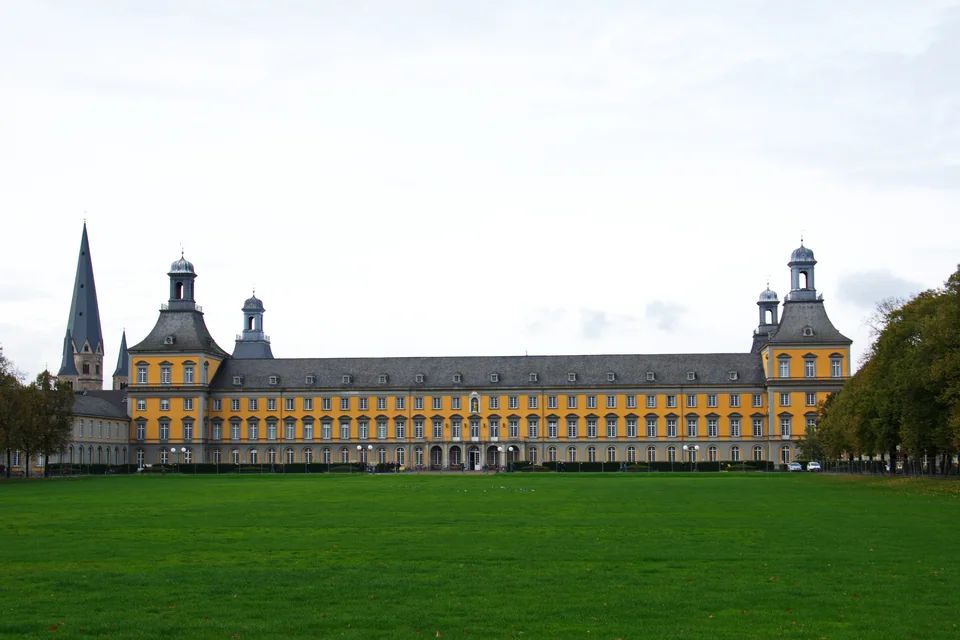
The university is woven into the city: the main building is the former electoral palace in central Bonn, the sciences, mathematics and computer science are in Poppelsdorf and Endenich, and the medical faculty is at the university hospital on the Venusberg. The Germany-wide transport pass is included in the semester contribution, so travel to Cologne and across the Rhineland costs nothing extra.
Where Bonn stands in rankings
| Ranking | Position |
|---|---|
| ARWU (Shanghai Ranking) 2026 | 69, fourth among German universities after TUM, LMU and Heidelberg |
| THE World University Rankings 2026 | =92 |
ARWU weighs research prizes and publications heavily, where Bonn is particularly strong. THE places Bonn 16th among EU universities. For choosing a programme, the Clusters of Excellence tell you more than rankings: if your master's connects to one of them (mathematics and the Hausdorff Center, or economics and ECONtribute), the research environment will be particularly dense.
Which jobs to look for after graduation
After graduation you can obtain a residence permit to look for work for up to 18 months. The Bonn–Cologne region offers jobs in federal agencies, international organisations and NGOs, telecommunications, logistics, insurance and consulting. Most roles outside research require German.
FAQ
How much does it cost to study at the University of Bonn?
There is no tuition and applying is free. The semester contribution in winter 2026/27 is $414 (€363.07), including a Germany-wide transport pass. The university estimates living costs at about $1,141 (€1,000) a month; for the visa you need $13,584 (€11,904) for the first year.
Can I apply after 11 years of school?
Not directly. You need a year of related university study at home or a Studienkolleg ending with the FSP. There is no university-run Studienkolleg in North Rhine-Westphalia, so many applicants attend one in another state.
What German level do I need for a bachelor's?
B2 to apply and DSH-2 (C1) by enrolment. With B1 you can apply for the university's German preparatory course.
Do I need uni-assist?
No. Non-EU applicants apply for bachelor's programmes on the University of Bonn portal by 15 July (winter) or 15 January (summer).
Which master's programmes are taught in English?
Mathematics, Physics, Astrophysics, Computer Science, Artificial Intelligence, Economics, Neurosciences, Molecular Cell Biology, Plant Sciences, Agricultural and Food Economics, Crop Sciences, North American Studies and many others.
Are there scholarships for international students?
The DAAD-funded Degree Completion Scholarship ($742 a month) supports students close to graduation, and the Deutschlandstipendium ($342 a month) is open to all.
Can StudyU help me apply to Bonn?
Under an agreement with StudyU, we shortlist programmes, check anabin and master's requirements, prepare your portal documents and plan the Studienkolleg, language exams, housing and visa budget. The university decides on admission, the German mission, as the consular authority, decides on your visa, and Studierendenwerk Bonn, as housing provider, confirms room availability in its residences.
Sources
- University of Bonn: University (1818, University of Excellence)
- Clusters of Excellence: eight clusters from 2026
- Faculties and Research Institutes
- National and International Rankings
- Applications from International Students
- Applicants from non-EU/EEA countries
- Application deadlines
- Costs: semester contribution 2026/27
- Costs and financing for international students
- Studierendenwerk Bonn: Accommodation
- Studienkollegs by state
- DFG: Universities of Excellence evaluation, 11 March 2026 (German)
- ShanghaiRanking ARWU 2026
- THE World University Rankings 2026: University of Bonn
- German Embassy Moscow: national visas and proof of funds (RU)
Dollar amounts are converted at the ECB reference rate of 23 September 2026 (€1 = $1.1411). For other universities and general admission rules, see studying in Germany. Route planning for Bonn, including the Studienkolleg and German, is provided under an agreement with StudyU — to start, submit an application.
During the free initial consultation, we clarify your goal, profile, timing, and budget and identify the next realistic step.
Next steps
- University of Hamburg (Universität Hamburg)
- Heidelberg University
- Studienkolleg in Germany: Who Needs It, How to Get In and What the FSP Exam Gives You
- German Language Tests for German Universities: TestDaF, DSH, Goethe and telc Compared (2026–2027)
- Scholarships abroad 2026: where international students study for free
- Studying in Germany for international applicants
