
Goethe University Frankfurt is one of Germany's largest universities, with 40,684 students, located in the country's financial capital and founded by Frankfurt's citizens in 1914. There is no tuition for international students: in winter 2026/27 you pay only a $466 (€408.28) semester contribution, including a Germany-wide transport pass. Its language rules are stricter than at many universities: German-taught bachelor's programmes require DSH-2 level at the application stage, and international applicants usually apply through uni-assist. Its main English-taught master's programmes are in economics and finance, with others in neuroscience and East Asian studies.
| At a glance | Details |
|---|---|
| Location | Frankfurt am Main, Hesse |
| Founded | 1914; a foundation university since 2008 |
| Students | 40,684 (winter 2025/26) |
| Faculties | 16, with 159 degree programmes |
| Rankings | THE 2026: 201–250; ARWU 2026: 151–200 |
| Tuition | none |
| Semester contribution | $466 (€408.28) in winter 2026/27 |
| Bachelor's applications | usually via uni-assist |
| Language | DSH-2 at application for bachelor's (DSH-3 for medicine and dentistry) |
| Preparation | own Studienkolleg and DSH courses (from B1) |
Who Goethe University suits, and who should look elsewhere
Goethe University is a large comprehensive university with strengths in economics and finance, law, life sciences, physics and the humanities; it is the home of the Frankfurt School of critical social theory. Since 2008 it has operated as a foundation university with greater autonomy. With TU Darmstadt and the University of Mainz it forms the Rhine-Main Universities alliance, which has applied in the new University of Excellence round; the decision is due on 2 October 2026. The university already hosts two Clusters of Excellence, the Cardio-Pulmonary Institute (CPI) and SCALE.
| Good fit | Consider alternatives |
|---|---|
| Master's applicants in economics, finance, management and quantitative methods | Bachelor's applicants without DSH-2 at the application stage |
| Students aiming for finance careers: the ECB, the Bundesbank and major banks are in Frankfurt | Anyone looking for a cheap city: Frankfurt rents are high |
| School leavers who need a Studienkolleg at the university itself | Anyone needing an English-taught bachelor's: there are none |
| Students willing to do intensive DSH preparation on site | Applicants who prioritise overall rankings: Bonn or Heidelberg rank higher |
For comparison, Bonn and Hamburg are also tuition-free, and let you apply with B2 German (Bonn) or prove German by enrolment (Hamburg).
Which programmes are available, including in English
Sixteen faculties cover law, economics and business, social sciences, education, psychology and sport, history and philosophy, languages and cultures, earth sciences, biology, chemistry, physics, computer science and mathematics, medicine and pharmacy, with 159 programmes.
Bachelor's programmes
Bachelor's programmes are taught in German; there are no English-taught bachelor's degrees.
English-taught master's programmes
| Field | Programmes |
|---|---|
| Economics and finance | Money, Macro and Finance; International Economics and Economic Policy; Management Science; Quantitative Economics/Finance/Accounting/Marketing (MSQ, GSEFM); Global Finance and Economics (fee-paying) |
| Law (LL.M.) | Legal Theory; Finance; International Banking, Securities & Finance (all fee-paying) |
| Life sciences | Interdisciplinary Neuroscience |
| Area studies | Modern East Asian Studies |
Indicative 2027 deadlines listed in the international programmes catalogue: 15 May for Money, Macro and Finance, International Economics and Economic Policy and Management Science; 15 March for Interdisciplinary Neuroscience; 15 August for Modern East Asian Studies. The programme page is binding: the MSQ tracks, for example, follow the GSEFM schedule. LL.M. fees are also published only on the programme pages.
How to apply: German, Studienkolleg and uni-assist
German: DSH-2 at application
All German-taught bachelor's programmes require DSH-2 level German at the application stage; medicine and dentistry require DSH-3. The same generally applies to German-taught master's programmes. Without such a certificate you first need a DSH preparatory course at the university's International Study Centre (ISZ). The DSH course and the Studienkolleg require at least B1, shown by a B1 certificate or a completed B2-level course. The DSH exam costs $131 (€115) for ISZ course participants and $183 (€160) for others, and can be retaken. Our guide to TestDaF, DSH and Goethe exams compares the options.
After 11 years of school
Under anabin, certificates from Russia, Belarus, Kazakhstan and several other CIS countries do not give direct access to a bachelor's. You need a year of related university study at home or the Studienkolleg Frankfurt at the ISZ. Applications close earlier than for degrees: for the Studienkolleg, via uni-assist from about 25 March to 1 May (winter) and 25 September to 1 November (summer); for DSH courses, by 1 June and 1 December. Missing documents cannot be added after the deadline. The entrance test is a computer-based German C-test taken in person in Frankfurt; no one is exempt, and you can sit it at most three times. All Hessian Studienkollegs hold the test on the same day, so you can sit only one; for winter 2027/28 it is 19 June 2027. The course lasts two semesters at 30 hours a week in one of four tracks: G (humanities), M (medicine and biology), T (engineering and sciences) or W (economics and social sciences). The winter intake starts in mid or late August, and the final FSP exam costs $114 (€100). See our guide to the Studienkolleg in Germany.
Applying via uni-assist
Applicants with foreign school certificates usually apply for bachelor's programmes through uni-assist, which charges $86 (€75) for the first programme and $34 (€30) for each additional one per semester. The university advises applying early with a complete file to leave time for the visa. After admission you receive your letter via the Goethe-Campus portal (or Hochschulstart for medicine), enrol online, upload documents and proof of health insurance and pay the contribution. Our guide to applying through uni-assist explains the process.
Master's programmes
You need a first degree whose content matches the programme; the university checks whether your coursework fits. Each master's programme sets its own procedure and deadline.
When to apply for 2027
| Applicant group | Winter semester 2027/28 | Summer semester 2027 |
|---|---|---|
| Bachelor's with restricted admission | 1 Jun to 15 Jul 2027 | 1 Dec 2026 to 15 Jan 2027 |
| Bachelor's with open admission | 1 Jun to 30 Sep 2027 | 1 Dec 2026 to 28 Feb 2027 |
| Studienkolleg Frankfurt (ISZ) | c. 25 Mar to 1 May 2027 | c. 25 Sep to 1 Nov 2026 |
| DSH courses (ISZ) | by 1 Jun 2027 | by 1 Dec 2026 |
| Hessian Studienkolleg entrance test | 19 Jun 2027 | 16 Jan 2027 |
| Master's programmes | see programme page | see programme page |
Which documents you need
- school-leaving certificate or degree with transcript and translation (per uni-assist's rules for your country);
- proof of a completed university year or the FSP;
- a DSH-2 level German certificate for German-taught bachelor's applications;
- for master's programmes, whatever the programme requires, including an English certificate and motivation letter;
- at enrolment, health insurance and a photo for your student card.
What studying and living in Frankfurt costs
Semester contribution
| Item | Winter 2026/27 |
|---|---|
| Germany-wide transport pass | $259 (€226.80) |
| Studierendenwerk ($122 [€106.50]), administrative fee ($57 [€50]), student body and its schemes: hardship fund, culture ticket, bike hire, Palmengarten ($29 [€24.98]) | $207 (€181.48) |
| Total | $466 (€408.28) |
Hesse charges no tuition, including to non-EU students; only some master's and LL.M. programmes are fee-paying.
Living in Frankfurt
For the visa you must show $1,132 (€992) a month, or $13,584 (€11,904) for the first year. In an expensive city like Frankfurt that minimum rarely covers rent plus other costs, so budget a buffer. Statutory student health insurance is about $165 (€145) a month, and transport is included in the contribution. A minimum first-year budget based on official figures is $13,584 in living costs and about $932 (€816.56) in contributions for two semesters, roughly $14,516, plus the uni-assist fee. See our blocked account guide.
How to fund your studies: scholarships and part-time work
- Deutschlandstipendium: a federal programme paying $342 (€300) a month; universities select recipients on merit.
- DAAD scholarships for master's and doctoral students. Russia added the DAAD to its list of "undesirable organisations" in February 2026, so participation carries legal risk for Russian citizens and we do not recommend it to them.
- Part-time work: 140 full or 280 half days a year; student assistant jobs at the university do not count. Frankfurt's finance and service sectors offer more part-time options than small university towns.
Where to live: Studierendenwerk residences and private housing
Studierendenwerk Frankfurt runs 34 residences with about 3,726 places, 30 of them in Frankfurt close to Goethe University and other institutions.
- Applying online puts you straight onto the waiting list; you can apply before admission but need proof from your university when signing the contract.
- The broader your choice, the shorter the wait; if you only want a studio apartment, waiting can exceed a year.
- The deposit is two months' rent, and there are no organised viewings.
Look for a WG room in parallel; Frankfurt's housing market is tight. Our student housing guide covers search channels and scams.
Strengths and drawbacks for international applicants
| Pros | Cons |
|---|---|
| No tuition; a large research university | DSH-2 required at bachelor's application |
| Strong English-taught master's in economics and finance | No English-taught bachelor's |
| Own Studienkolleg and DSH courses from B1 | Early Studienkolleg deadlines (1 May / 1 November) and a single Hessian test day |
| Germany's financial capital: internships and jobs | High rents and housing waiting lists |
| Major international airport | uni-assist fee to apply |
Applicants resident in Russia face the usual German constraints: visas only through the German Embassy in Moscow (the St Petersburg consulate general closed on 18 September 2026), Russian bank statements not accepted as proof of funds and no Russian bank offering a suitable blocked account. See our student visa guide.
Mistakes to avoid
- Applying for a bachelor's with B2 or C1 but no DSH-2: Frankfurt requires DSH-2 at application.
- Missing the Studienkolleg deadline: it closes on 1 May, not 15 July, and documents cannot be added later.
- Registering for several Hessian Studienkolleg tests: they are held on the same day, so you can take only one.
- Limiting your housing application to studios: waits can exceed a year.
- Treating the visa minimum as a real budget: in Frankfurt it usually falls short.
Checklist before you apply
- Whether you have DSH-2 or an equivalent at the application stage; if not, plan a DSH course or the Studienkolleg.
- Studienkolleg deadlines and the Hessian test date.
- Your master's programme's requirements and window.
- A budget with a buffer for Frankfurt rents.
- A housing application with a broad choice of residence types.
Where you study: five campuses in Frankfurt
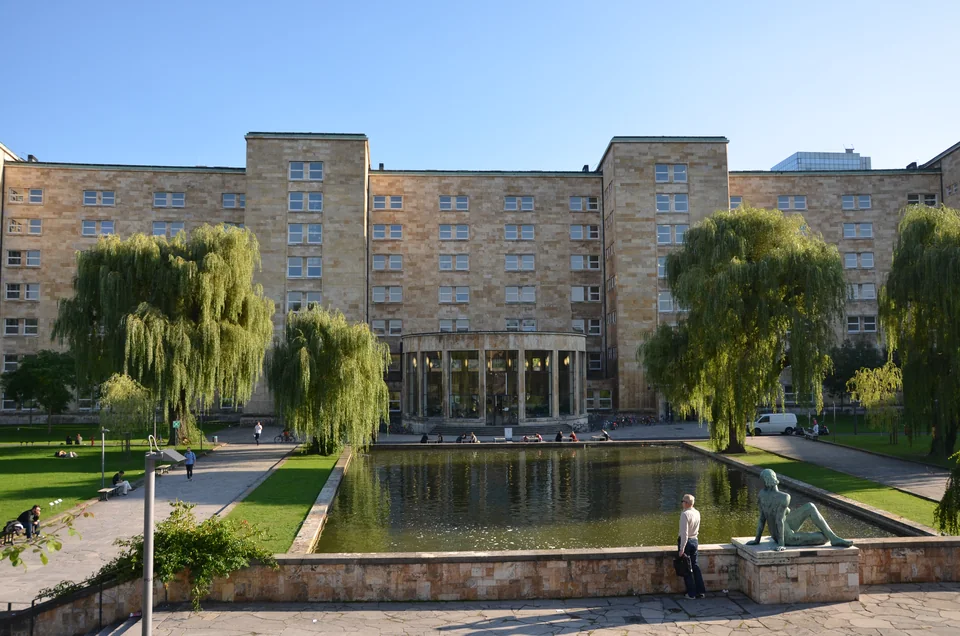
The university has five campuses. Westend, the main campus with the historic IG-Farben-Haus, houses the humanities, social sciences, economics and law. Riedberg hosts the natural sciences, Niederrad medicine and the university hospital, Ginnheim sports, and Bockenheim is the historic campus. The Germany-wide transport pass is included in the semester contribution.
Frankfurt is Germany's financial centre, with a major international airport and an international population, but rents are high.
Where Goethe University stands in rankings
| Ranking | Position |
|---|---|
| THE World University Rankings 2026 | 201–250 |
| ARWU (Shanghai Ranking) 2026 | 151–200 |
Overall rankings understate particular fields: economics and finance in Frankfurt draw on strong research centres and the Graduate School of Economics, Finance and Management (GSEFM), run with partner universities.
What career options Frankfurt offers
After graduation you can obtain a residence permit to look for work for up to 18 months. Frankfurt is a centre for banking, insurance, audit and consulting, logistics and aviation; some finance roles are available in English, but German widens your options considerably.
FAQ
How much does it cost to study at Goethe University?
There is no tuition, including for non-EU students. The semester contribution in winter 2026/27 is $466 (€408.28) with a Germany-wide transport pass. For the visa you must show $13,584 (€11,904) for the first year.
What level of German do I need?
For German-taught bachelor's programmes, DSH-2 or an equivalent at the application stage; DSH-3 for medicine and dentistry. With B1 you can join the university's DSH preparatory course or Studienkolleg.
Can I apply after 11 years of school?
Not directly. You need the Studienkolleg Frankfurt (apply via uni-assist by 1 May for winter with at least B1 German; Hessian test on 19 June 2027) or a year of university study at home.
Do I need uni-assist?
Usually yes: applicants with foreign certificates apply for bachelor's programmes via uni-assist ($86 for the first programme). The university lists exceptions on its website.
Which programmes are taught in English?
Only master's programmes: Money, Macro and Finance; International Economics and Economic Policy; Management Science; the GSEFM MSQ tracks; Interdisciplinary Neuroscience; Modern East Asian Studies; and several LL.M. degrees.
Is it easy to find housing?
No. Studierendenwerk Frankfurt has about 3,726 places, and with narrow preferences the wait can exceed a year. Apply immediately and search for a WG room in parallel.
Can StudyU help me apply to Goethe University?
Under an agreement with StudyU, we shortlist programmes, check anabin and master's requirements, prepare your uni-assist file and plan the Studienkolleg, DSH, housing and visa budget. The university decides on admission, the German mission, as the consular authority, decides on your visa, and Studierendenwerk Frankfurt, as housing provider, confirms room availability in its residences.
Sources
- Goethe University: facts and figures (German)
- Goethe University: About the University
- Goethe University: Campus and Locations
- Studying with a Foreign Degree (uni-assist, Studienkolleg, DSH)
- Language Requirements
- Dates and deadlines: bachelor's, Studienkolleg, DSH courses (German)
- Continue and Complete Studies: semester contribution 2026/27
- Studierendenwerk Frankfurt: residences and applicant FAQ
- Studienkolleg Mittelhessen: Hessian test dates
- Studienkolleg Frankfurt: deadlines, test, tracks, FSP (German)
- ISZ: DSH and certificate exams, fees (German)
- uni-assist: handling fees
- DFG: applicants in the new Universities of Excellence round (PDF)
- THE World University Rankings 2026: Goethe University Frankfurt
- ShanghaiRanking ARWU 2026
- German Embassy Moscow: national visas and proof of funds (RU)
Dollar amounts are converted at the ECB reference rate of 23 September 2026 (€1 = $1.1411). For other universities and general admission rules, see studying in Germany. Route planning through a DSH course or the Studienkolleg in Frankfurt is provided under an agreement with StudyU — to start, submit an application.
During the free initial consultation, we clarify your goal, profile, timing, and budget and identify the next realistic step.
Next steps
- University of Bonn (Rheinische Friedrich-Wilhelms-Universität Bonn)
- University of Hamburg (Universität Hamburg)
- German Language Tests for German Universities: TestDaF, DSH, Goethe and telc Compared (2026–2027)
- Studienkolleg in Germany: Who Needs It, How to Get In and What the FSP Exam Gives You
- Scholarships abroad 2026: where international students study for free
- Studying in Germany for international applicants
