
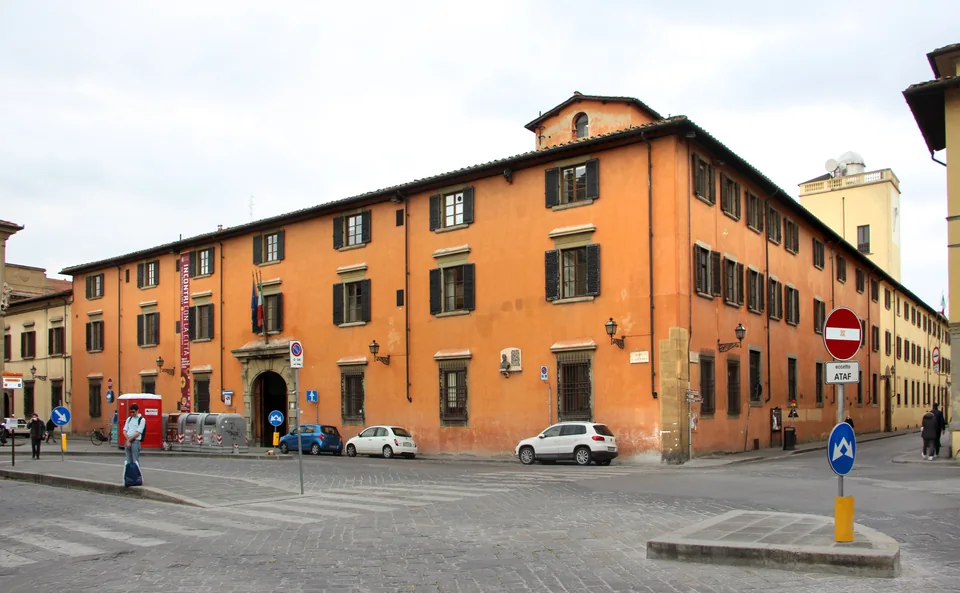
The University of Florence (UniFi) is one of Italy's largest public universities, with about 51,000 students and 148 degree programmes, 17 of them in English. It traces its roots to the Studium Generale founded by the Florentine Republic in 1321 and took its current name in 1924. Students who live abroad pay a fee based on their country's World Bank income group: in 2026/27, from $610 (€536) to $2,730 (€2,395.30) a year, taxes included. Non-EU applicants living abroad can apply to master's programmes in two winter–spring rounds; in the 2026/27 cycle these ran from 10 December to 6 February and from 16 February to 17 April.
| At a glance | Details |
|---|---|
| Location | Florence; science campus in Sesto Fiorentino; sites in Prato, Pistoia, Empoli and Calenzano |
| Roots | Studium Generale 1321; university status 1924 |
| Rankings | QS World University Rankings 2027: =409; THE World University Rankings 2026: 351–400 |
| Size | about 51,000 students, 10 schools, 21 departments |
| Fee for students living abroad (2026/27) | $610–2,730 (€536–2,395.30) by country group, taxes included |
| Master's rounds for non-EU applicants (2026/27) | 10 Dec 2025 – 6 Feb 2026 and 16 Feb – 17 Apr 2026 |
| Funding | DSU Toscana grant: up to $3,810 (€3,338) cash + free housing and meals |
| Housing | DSU Toscana residences (competitive); otherwise private rentals |
Who the University of Florence suits, and who should look elsewhere
| Pros | Cons and risks |
|---|---|
| High-income countries pay less than in Pisa or Milan: $2,730 incl. taxes | Only 10 fully English-taught programmes |
| Middle-income countries pay $1,070–1,670 | Sites spread across Florence, Sesto Fiorentino and Prato |
| Two rounds for visa applicants; outcome by March in round one | Third round closed to visa applicants |
| No translation needed for English documents | DSU residence places are competitive |
| DSU Toscana includes free housing and meals | No official rent benchmarks from the university |
Florence suits applicants to engineering, economics, agriculture or sustainable tourism master's programmes who want to live in Tuscany. For a wider English-taught choice, compare the University of Bologna and Sapienza.
Which programmes are taught in English and Italian
UniFi has 10 schools, 21 departments and 148 programmes. According to the university (July 2025), 18 programmes are taught fully or partly in English, 10 of them fully.
| Level | Fully English-taught programme | Area |
|---|---|---|
| Bachelor's | Sustainable Business for Societal Challenges | Economics |
| Master's | Mechanical Engineering for Sustainability | Engineering |
| Master's | Management Engineering | Engineering |
| Master's | Geoengineering (natural-risk mitigation) | Engineering |
| Master's | Advanced Chemical Sciences & Technologies (successor to Advanced Molecular Sciences, blended format) | Chemistry |
| Master's | Design of Sustainable Tourism Systems | Statistics |
| Master's | Tropical and Subtropical Agriculture | Agriculture |
| Master's | Economics and Development | Economics |
| Master's | Finance and Risk Management | Economics |
| Master's | Software: Science and Technology (with IMT School for Advanced Studies Lucca) | Computer Science |
Partly English-taught: Biotechnology for Environmental Management and Sustainable Agriculture; Urban and Regional Planning and Design for Sustainability; Economics, Institutions, Sustainability; Geography, Spatial Management, Heritage for International Cooperation; Physical and Astrophysical Sciences; Energy Engineering; Mechanical Engineering; Robotics, Automation and Electrical Engineering. UniFi also runs double degrees with partners in Germany, France, Hungary and Albania, each with its own call.
This list comes from the university's July 2025 overview. For the 2026/27 cycle, Apply Unifi lists English as the teaching language of Physical and Astrophysical Sciences, and Advanced Molecular Sciences has been replaced by Advanced Chemical Sciences & Technologies. Check the language on each programme's Apply Unifi page, because it determines which certificate you need.
How to apply to the University of Florence, step by step
Master's (foreign bachelor's degree)
- Check requirements. Open-admission master's programmes require an Admission Document.
- Apply on Apply Unifi (fee: $23, or €20). In the 2026/27 cycle non-EU applicants living abroad could use round one (10 Dec 2025 – 6 Feb 2026, outcomes around mid-March) or round two (16 Feb – 17 Apr 2026, outcomes around mid-May). Round three (15 Jun – 31 Aug) was open only to EU citizens and non-EU residents of Italy; other applications were not considered and fees not refunded.
- Outcome: admitted; admitted subject to single courses to make up gaps; or rejected (final).
- Universitaly: visa pre-enrolment by 31 July if admitted, or by 31 December if admitted to single courses.
- Visa, arrival, residence permit: apply for the permit within 8 working days of arrival; the university's PER-Università desk offers free help with the first application. See our guides to the student visa and the permesso di soggiorno.
- Enrolment: passport, visa, permit receipt, apostilled or legalised degree and transcript, Admission Document, and a Declaration of Value or CIMEA verification and comparability certificates.
Admission does not automatically lead to a visa or enrolment: the university verifies the qualification and that the programme is offered that year.
Bachelor's. A school diploma after 12 years of schooling is required. With 11 years you need a first-year university transcript, a completed Foundation Year or an Italian upper-secondary diploma. Non-EU applicants abroad pre-enrol on Universitaly, obtain a visa and enrol after arrival.
When to apply for 2027/28
As of 23 September 2026 the 2027/28 rounds had not been published. The 2026/27 pattern:
| Round | 2026/27 dates | Who can apply | Outcome |
|---|---|---|---|
| First | 10 Dec 2025 – 6 Feb 2026 | everyone, including non-EU applicants abroad | around mid-March |
| Second | 16 Feb – 17 Apr 2026 | everyone, including non-EU applicants abroad | around mid-May |
| Third | 15 Jun – 31 Aug 2026 | EU citizens and non-EU residents of Italy only | end of September |
| Universitaly | by 31 Jul (or 31 Dec if admitted to single courses) | visa applicants | — |
If you need a visa, apply in the first round so you have the decision by March.
Which documents and language certificates you need
- Documents in English, French or Spanish do not need an Italian translation; other languages do.
- School diplomas, degrees and transcripts must be apostilled or legalised for enrolment.
- Qualification validity: Declaration of Value or CIMEA certificates.
- English-taught programmes usually ask for B2 English: Cambridge First, IELTS, TOEFL, or a bachelor's taught entirely in English. Some accept only certificates issued within the last five years; the programme page on Apply Unifi has the list.
- Italian-taught programmes: non-EU applicants living abroad need a B2 certificate from a CLIQ body (CELI, CILS, CERT-IT or PLIDA), or can sit the Italian test the university runs once a year. See our guide to CILS, CELI and PLIDA.
How much studying in Florence costs in 2026/27
If you live abroad, the university automatically assigns a notional ISEE based on your country's World Bank income group and calculates the fee from it. Amounts for 2026/27 from Annex 5 of the Manifesto degli Studi, including regional tax and stamp duty:
| Income group (notional ISEE) | Examples | 1st instalment | 2nd instalment | Annual total |
|---|---|---|---|---|
| High ($85,730 (€75,500)) | Russia, EU, USA | $1,700 (€1,499.58) | $1,020 (€895.72) | $2,730 (€2,395.30) |
| Upper-middle ($59,610 (€52,500)) | Kazakhstan, Armenia, Azerbaijan, Georgia, Albania | $1,070 (€942.78) | $595 (€524.52) | $1,670 (€1,467.30) |
| Lower-middle ($41,450 (€36,500)) | Uzbekistan, Kyrgyzstan, Tajikistan | $710 (€625.80) | $355 (€313.20) | $1,070 (€939) |
| Low ($28,960 (€25,500)) | e.g. Afghanistan | $435 (€384) | $175 (€152) | $610 (€536) |
The same notional ISEE applies to other university benefits unless a call says otherwise. Students who win a DSU Toscana grant or are declared eligible for one (idoneo) pay only the $18 (€16) stamp duty (section 15.1 of the Manifesto degli Studi). Exemption requests filed after the main deadlines are accepted until 22 January 2027 with a $115 (€100) administrative charge.
For living costs, UniFi publishes no rent or budget benchmarks. DSU Toscana values a residence place at $3,590 (€3,150) a year and meals at $2,010 (€1,760); budget a deposit for private rentals and check current listings in the right area. Dollar amounts use the ECB rates of 23 and 29 September 2026 (€1 = $1.1411 and $1.1355).
How to get a DSU Toscana grant
Grants and residence places for Florence students are awarded by the regional agency DSU Toscana. International students count as off-site unless their family lives in Italy; off-site winners receive cash plus a free residence place and two free meals a day.
| ISEE (2026/27) | Cash for off-site students |
|---|---|
| up to $15,330 (€13,500) | $3,810 (€3,338) |
| $15,330–20,440 (€13,500.01–18,000) | $2,580 (€2,262) |
| $20,440–30,660 (€18,000.01–27,000) | $1,210 (€1,060) |
Amounts are higher for female students in STEM programmes. In 2026/27 applications ran from 20 July to 7 September 2026. Non-EU students whose family lives abroad do not use an Italian ISEE: they submit documents from their home country on 2025 family income and on property held at 31 December 2025, issued in 2026, translated into Italian and apostilled or legalised. DSU Toscana does not accept self-declarations or affidavits (article 8 and Appendix B of the call). DSU Toscana makes the grant decision; if a grant is not awarded or is revoked, UniFi places the student in a fee band based on ISEE. For other regions, see our scholarships in Italy guide.
Where to live: DSU residences and private rentals
- DSU Toscana residences: for winners of the grant and housing competition.
- UniFi Welcome Service (international office): advises the university's "international guests" on finding accommodation; degree students should ask the International Desk which contacts it can share.
- Private market: rooms in shared flats; choose the area by where your classes are held.
Your lease must be registered: you need it for the residence permit and to prove off-site status for DSU. Our student housing guide covers searching and lease checks.
Which mistakes to avoid when applying
- Waiting for summer: the third round is closed to non-EU applicants abroad and the fee is not refunded.
- Treating the Admission Document as a visa: the consulate decides on visas.
- Paying for translations of English documents that do not need them.
- Ignoring "admitted with single courses": it shifts the Universitaly deadline and your study timeline.
- Renting before checking where your programme is taught.
History and size of UniFi
In 1321 the Florentine Republic established a Studium Generale teaching civil and canon law, letters and medicine; Giovanni Boccaccio lectured there on the Divine Comedy. Under the Medici the Studium moved to Pisa in 1472 and was moved repeatedly with changes of government. Florence regained its own institution in 1859, and a 1924 decree formally named it a university. Engineering was added in 1970 and Psychology in 2002; since 2013 schools have replaced faculties.
Today UniFi has around 1,800 faculty and permanent researchers, over 1,600 PhD students and postdocs, and 21 departments. A quarter of its students come from outside Tuscany. Since November 2020 it has been part of the EUniWell European University alliance.
Where the university stands in the rankings
| Ranking | Position |
|---|---|
| QS World University Rankings 2027 | =409 (=404 in 2026) |
| THE World University Rankings 2026 | 351–400 |
In QS 2027 Florence sits close to the University of Turin (405th). Between universities at a similar level, compare programmes, teaching language, location and the fee for your country rather than the rank.
Where classes take place: campuses in Florence and Tuscany
Most programmes are taught in various parts of Florence; the science campus is in Sesto Fiorentino and some programmes run in Prato, Pistoia, Empoli and Calenzano. Check your programme's address before choosing where to live. The university does not publish private rent benchmarks; the only official housing value comes from DSU Toscana, which values a residence place at $3,590 (€3,150) a year.
How the degree and internships help you find work
The university reports, citing AlmaLaurea data, that the share of its graduates in work one year after graduation is above the Italian average. For international graduates, an internship in the study plan and a thesis linked to a company or department project make the biggest difference. After graduating you can apply for a job-seeking permit in place of your study permit; confirm the conditions with the Questura. B1–B2 Italian widens the range of employers considerably. Work-hour limits during studies are covered in our guide to working while studying in Italy.
FAQ
How much does the University of Florence cost for international students?
It depends on your country's World Bank income group: in 2026/27, $2,730 (€2,395.30) for high-income, $1,670 (€1,467.30) for upper-middle, $1,070 (€939) for lower-middle and $610 (€536) for low-income countries, taxes included.
When can I apply for a master's?
In 2026/27, visa applicants could apply from 10 December 2025 to 6 February 2026 or from 16 February to 17 April 2026. The 2027/28 dates will be published on Apply Unifi; plan for December.
Which programmes are fully taught in English?
Per the university's overview, one bachelor's (Sustainable Business for Societal Challenges) and nine master's: Mechanical Engineering for Sustainability, Management Engineering, Geoengineering, Advanced Chemical Sciences & Technologies (formerly Advanced Molecular Sciences), Design of Sustainable Tourism Systems, Tropical and Subtropical Agriculture, Economics and Development, Finance and Risk Management, and Software: Science and Technology. Apply Unifi also lists Physical and Astrophysical Sciences as English-taught.
Do I need Italian for an Italian-taught programme?
Yes. Non-EU applicants living abroad need a B2 certificate from CELI, CILS, CERT-IT or PLIDA, or must pass the university's annual Italian test.
Can I study for free?
Partly. DSU Toscana winners and eligible students (idonei) pay the university only the $18 (€16) stamp duty, and winners also get cash, a residence place and meals. You apply to DSU between July and early September with translated and apostilled family income documents.
Can I apply after 11 years of school?
You need a 12th year: a first-year university transcript, a Foundation Year or an Italian diploma.
Do I need to translate my documents into Italian?
Not if they are in English, French or Spanish. Diplomas and transcripts must be apostilled or legalised.
Can StudyU help?
Under an agreement with StudyU, we shortlist programmes, check requirements and prepare the Admission Document application and the Universitaly and visa files. The university's committee decides on admission, the consulate, as the consular authority, decides on the visa, and DSU Toscana decides on grants and, as housing provider, confirms room availability.
Sources
- Non-EU Students — enrolment routes
- Admission Document
- 2026/27 intake rounds on Apply Unifi
- Admission Document fee
- How contributions are determined (ISEE for residents abroad)
- Manifesto degli Studi 2026/27 (PDF)
- Annex 5: country classification and fees (PDF)
- Studying in English in Florence
- History and Profile
- DSU Toscana: grant and housing 2026/27
- DSU Toscana call 2026/27 (PDF)
- Apply Unifi programme catalogue
- THE World University Rankings: University of Florence
- QS World University Rankings: University of Florence
For more on studying in Italy, see Study in Italy. Help choosing the right round and programme is provided under an agreement with StudyU; to start, send us a request.
During the free initial consultation, we clarify your goal, profile, timing, and budget and identify the next realistic step.
Next steps
- Italian Language Certificates CILS, CELI and PLIDA: Which One You Need for University and When to Sit It
- Permesso di Soggiorno for Students: How to Get and Renew Your Italian Residence Permit
- Working While Studying in Italy: Hour Limits, Student Jobs and Staying After Graduation
- Scholarships in Italy for International Students 2026/27: DSU, MAECI, Invest Your Talent and University Awards
- Studying in Italy for international applicants
- University of Bologna
