
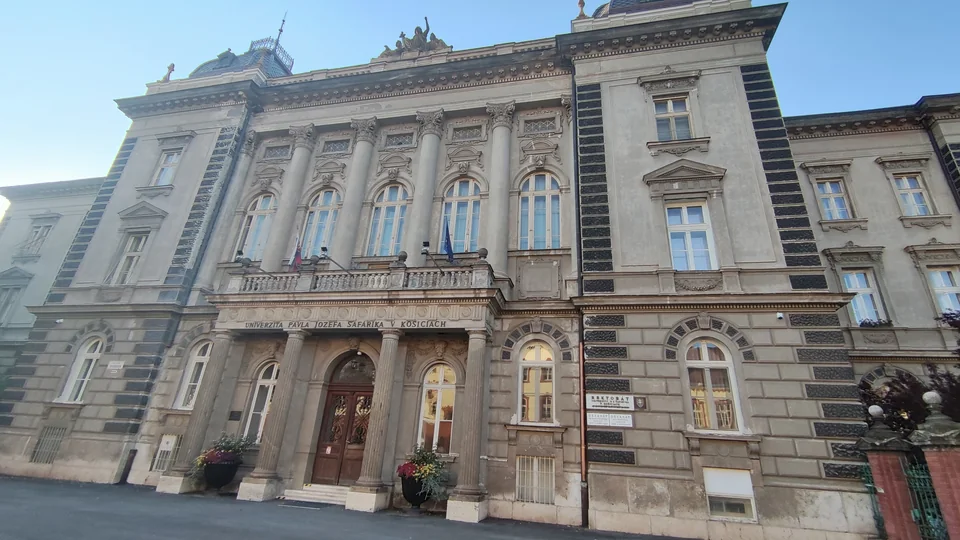
Pavol Jozef Šafárik University (Univerzita Pavla Jozefa Šafárika v Košiciach, UPJŠ) is a comprehensive research university in eastern Slovakia, founded in 1959; Košice's university tradition goes back to a Jesuit academy of 1657. It has five faculties and an institute of physical education and sport, and its best-known faculty abroad is Medicine, which has taught in English for more than 30 years. Study in Slovak is free, English-taught programmes cost $3,410–15,330 (€3,000–13,500) a year in 2026/27, and a dormitory bed for UPJŠ students starts at $72 (€63) a month, among the cheapest at any major Slovak university.
| At a glance | Details |
|---|---|
| City | Košice |
| Founded | 1959 (the Faculty of Medicine since 1949, then part of Comenius University) |
| Faculties | Medicine, Science, Law, Public Administration, Arts; Institute of Physical Education and Sport |
| Status | research university |
| Ranking | QS World University Rankings 2027: 1001–1200 |
| Languages | Slovak; medicine, dentistry and selected programmes in English |
| Fees in Slovak | none (full-time, within the standard length) |
| Fees in English, 2026/27 | $3,410–15,330 (€3,000–13,500) a year |
| Application fee | up to $23 (€20) without an exam and $34 (€30) with one, for online applications |
| Dormitories | 1,755 beds; $72–76 (€63–67) for UPJŠ students; fee-paying students in the international block $99–265 (€87–232) a month |
Dollar amounts use the ECB rate of 29 September 2026 (€1 = $1.1355).
Who UPJŠ suits, and who should look elsewhere
| Strengths | Weaknesses and risks |
|---|---|
| English-taught medicine and dentistry with a long record: over 1,600 international graduates | The English medical exam is in person in Košice only |
| Cheap dormitories and lower living costs than Bratislava | Fee-paying students pay a higher dormitory rate |
| Many science, law and public administration programmes admit on school results | Few English options outside medicine, and they cost $3,423–6,276 a year |
| A comprehensive university with law, psychology and sciences | Košice has a smaller English-speaking job market than Bratislava |
| Research-university status | English medical applications go by post with a translation made in Slovakia |
UPJŠ suits future doctors and dentists who care about living costs, and anyone wanting free Slovak-taught study in sciences, law or public administration. For medicine with an online exam, compare Comenius University in Bratislava and Martin; for engineering, STU; for free English-taught economics, EUBA, which also has a faculty in Košice.
Faculties
| Faculty | Established | Fields |
|---|---|---|
| Medicine | 1949 (part of UPJŠ since 1959) | general medicine, dentistry, nursing, physiotherapy, public health, laboratory diagnostics |
| Science | 1963 | biology, chemistry, physics, mathematics, informatics, geography; single- and two-subject programmes |
| Law | 1973 | law |
| Public Administration | 1998 | public administration, European public administration |
| Arts | 2007 | psychology, philology, history, political science, social work |
| Institute of Physical Education and Sport | 2010 | sport and recreation |
English-taught programmes
Under Rector's Decision 3/2026, English-taught options in 2026/27 are:
| Programme | Annual fee |
|---|---|
| General Medicine (6 years, MUDr.) | $14,760 (€13,000) |
| Dental Medicine (5 years, MDDr.) | $15,330 (€13,500) |
| Faculty of Science programmes | $3,410 (€3,000) |
| Law | $5,680 (€5,000) |
| Psychology, master's (Faculty of Arts) | $6,250 (€5,500) |
| European Public Administration, bachelor's | $5,680 (€5,000) |
The 2026/27 intake plan was 210 places in General Medicine and 40 in Dental Medicine. Medical students pay in two instalments, due by 31 August and 1 March in 2026/27. Students admitted in 2024/25 pay less for General Medicine, $14,190 (€12,500); the 2025/26 and 2026/27 intakes pay $14,760 (€13,000). A study contract fixes the fee for the whole programme.
How to apply
Faculties run admissions, and applications are online (e-prihlaska.upjs.sk). According to the university, many programmes in science, law, public administration and arts admit on school results, while medicine and some arts programmes use a written exam. The Faculty of Science also accepts SCIO test results as an alternative to school grades.
After secondary school
You need a completed secondary education recognised in Slovakia. Certificates covered by a bilateral agreement, such as the Russian certificate of general secondary education and vocational secondary diploma, are recognised by the Košice Regional Office of School Administration for $8 (€7). Documents from other countries cost $45 (€40) and require a certified record of subjects and grades for all years.
English-taught medicine and dentistry
| Item | 2026/27 |
|---|---|
| Exam | written test in Košice: 100 biology and 100 chemistry questions, 2.5 hours |
| Scoring | 0–4 points per question, 800 maximum, no negative marking; the pass mark is usually 75% |
| Latest dates | 12 August and 5 September 2026 |
| Documents due | 29 July and 22 August 2026 respectively (by postmark) |
| Fee | $34 (€30), non-refundable |
| Attempts | one per programme per year (medicine and dentistry separately) |
The postal package contains the printed, signed AiS2 application, a doctor's certificate no older than three months in English or Slovak, a passport copy, proof of payment and a notarised copy of the apostilled school-leaving certificate with a sworn Slovak translation. The faculty requires the notarisation and translation to be done in Slovakia. The question bank is published on the faculty site, and paid preparatory courses are available.
The faculty has stated officially that admission rests solely on the exam; the only exemption is for applicants who passed biology and biochemistry at the same faculty within the past ten years. Any intermediary claiming it can bypass the exam contradicts these rules.
For a comparison with the medical faculties in Bratislava and Martin, see studying medicine in Slovakia.
Slovak-taught medicine
For 2026/27, applications for medicine and dentistry closed on 28 February 2026; the medicine test ran on 24–26 April or 8–12 June, and dentistry on 8–12 June. The online application fee is $34 (€30). Other health programmes (nursing, laboratory diagnostics, public health) closed on 30 April, and some programmes on 18 August.
A step-by-step plan for 2027/28
- Autumn 2026. Choose faculty and language, order an apostille and start the language or the question bank.
- Winter 2027. Apply online; for Slovak-taught medicine, aim for the end of February.
- Spring–summer 2027. Exam where applicable; for English medicine, the dates the faculty publishes for 2027/28.
- After the decision. Certificate recognition in Košice, residence documents, dormitory application, first instalment.
- September 2027. Move in from 1 September and enrol.
Language requirements
For English-taught medicine the faculty expects a good command of English, which the test effectively checks. Slovak-taught programmes need Slovak good enough for study; without it, plan a preparatory year, see Slovak language preparatory courses.
Documents and certificate recognition
- AiS2 application, doctor's certificate, passport copy, proof of fee.
- Notarised copy of the apostilled school-leaving certificate and a sworn Slovak translation (made in Slovakia for English medicine).
- A recognition decision from the Košice Regional Office of School Administration. Submit originals, which are not returned; you collect the decision in person after an email from the officer. The faculty suggests handing a notarised copy of the decision to the study office and keeping the original.
See our guide to recognition of school certificates.
What study and living cost
Tuition. Zero in Slovak within the standard length. Exceeding the standard length in 2026/27 costs $910 (€800) a year on health bachelor's and master's programmes, $1,140 (€1,000) in sciences and arts, $1,360 (€1,200) in public administration, $1,480 (€1,300) in medicine and $1,700 (€1,500) in dentistry. English fees are in the table above.
Housing. UPJŠ dormitories are among the cheapest in the country (below). The university does not publish an estimate for private rent in Košice, so rely on listings and your contract.
Living costs. UPJŠ publishes no official estimate. For comparison, EUBA gives $295–815 (€260–718) a month for Bratislava, and in Košice the main saving is on housing. A sample year on a free programme in Košice with a dormitory comes to about $3,100–3,900; see our cost of studying in Slovakia guide.
Scholarships. Scholarships do little for fee-paying medical students: UPJŠ has no grants covering a whole degree. For non-medical programmes, check the government scholarship for talented international students: $5,680 (€5,000) a year if the programme is on the ministry's list and you have an SAT score of 1100+ or equivalent SCIO results. See our cost guide.
Summer. The dormitory contract ends on 30 June. If you stay for the holidays, a UPJŠ student pays $91 (€80) a month for a bed.
Insurance. Non-EU students must be insured for their entire stay, either with a home policy valid in Slovakia or commercial cover bought in Slovakia. Proof of insurance is needed for the residence permit.
Where to live: UPJŠ dormitories
| Dormitory | Beds | Residents | Price per bed per month (from 01.09.2024) |
|---|---|---|---|
| Medická 4 and 6 | 1,400 | students of all faculties | $72 (€63) in a triple, $76 (€67) in a double |
| Popradská 66 | 155 | mainly Public Administration students | $72–76 (€63–67) |
| Popradská 76 | 200 | international students | UPJŠ students $72–225 (€63–199); self-paying students $99–265 (€87–232) |
At Medická, a double and a triple room form a cell with a shower and toilet shared by five. The complex has a canteen, a buffet and sports grounds. A rectorate committee allocates places by points. Contracts run from 1 September to 30 June without a break; in 2026 move-in ran from 1 to 23 September, and students who did not move in without good reason lost their place. You pay September and October on arrival, then by the 15th of each month, by bank transfer only.
Strengths and weaknesses for applicants from Russia and the CIS
Strengths. Russian certificates are recognised under a bilateral agreement for $8 (€7). Košice is Slovakia's second university city, with lower prices. English-taught medicine has a 30-year track record, and many Slovak-taught programmes admit on school results.
Weaknesses and risks. The English medical exam is in person, so Russian citizens need a Schengen visa, which is harder to get than before 2022. Documents go by post, and the translation must be made by a Slovak sworn translator. Tuition and rent are paid only by euro transfer; from Russia use only lawful routes, see our guide on paying for studies abroad from Russia.
Residence rules. You need temporary residence for the purpose of study, applied for at the Slovak embassy accredited to your country of citizenship or residence; the embassy in Moscow accepts applications from Russian citizens. You submit confirmation of admission and a criminal record certificate; university students need not prove accommodation. Since 15 July 2026 the police may take up to 90 days, which leaves very little time after an August or September exam. See our guide to the student residence permit.
Mistakes to avoid
- Waiting for the last exam date. With up to 90 days for residence, August and September are too late to start on time.
- Translating your certificate at home. For English medicine the faculty requires the copy and translation to be made in Slovakia.
- Sending an incomplete package. Missing documents mean rejection, and the deadline is judged by postmark.
- Not moving in by 23 September. The dormitory place lapses.
- Believing in "guarantees". The exam is the only way into English-taught medicine.
Where teaching takes place
Faculties are located in different parts of Košice. The Faculty of Medicine is on Trieda SNP and works closely with the Košice teaching hospital, where clinical training takes place. The Medická Street dormitories are close to the centre, with good transport links to the faculties.
Rankings
| Ranking | Position |
|---|---|
| QS World University Rankings 2027 | 1001–1200 |
| QS World University Rankings 2026 | 1001–1200 |
UPJŠ holds research-university status in Slovakia and runs projects in 18 fields of science. For applicants, the more telling figure is the medical faculty's record of over 1,600 international doctors and dentists in 30 years.
Work during and after study
University students with residence for study may work up to 80 hours a month without a separate permit. After graduating, you can extend residence for nine months to look for work or start a business. According to the faculty, EU member states must recognise UPJŠ medical and dental diplomas regardless of the language of instruction; for practice outside the EU, check your home country's recognition procedure early.
FAQ
Can I apply to UPJŠ straight after secondary school?
Yes, with a completed secondary education recognised in Slovakia. A Russian certificate is recognised under a bilateral agreement for $8 (€7).
How much is English-taught medicine at UPJŠ?
In 2026/27 General Medicine costs $14,760 (€13,000) a year and Dental Medicine $15,330 (€13,500), paid in two instalments, with the fee fixed by contract for the whole programme.
Can I take the medical exam online?
No. UPJŠ's English-programme exam is written and held in Košice. The medical faculties of Comenius University in Bratislava and Martin offer online exams.
Are there exams for non-medical programmes?
Many science, law and public administration programmes admit on school results; some arts programmes hold a written exam.
How much is a dormitory?
Since 1 September 2024, $72–76 (€63–67) a month for UPJŠ students. At Popradská 76, where international students live, fee-paying students pay $99–265 (€87–232).
When should I apply for 2027/28?
Slovak-taught medicine closed on 28 February in the last cycle. The faculty publishes 2027/28 English exam dates separately; in 2026 the last rounds were on 12 August and 5 September, but because of the residence permit, aim for the earliest one.
Does StudyU help with applications to UPJŠ?
Under an agreement with StudyU, we help choose the faculty and programme, check requirements for your intake year, and prepare documents, certificate recognition, the application and the residence permit. At the university, the dean decides on admission based on the exam or competition, and the Slovak Foreign Police as the migration authority decides on residence. See other options in our guide to universities in Slovakia.
Sources
- UPJŠ: history and admissions — checked 24.09.2026
- UPJŠ: Rector's Decision 3/2026 on 2026/27 fees (PDF) and medical fee deadlines (PDF) — checked 24.09.2026
- UPJŠ Faculty of Medicine: programmes in English, entrance exam, official statement on admission — checked 24.09.2026
- UPJŠ Faculty of Medicine: Slovak-programme admission, certificate recognition, health insurance — checked 24.09.2026
- UPJŠ: dormitories, fees from 01.09.2024 (PDF), 2026 move-in rules — checked 24.09.2026
- QS World University Rankings: Pavol Jozef Šafárik University in Košice — checked 24.09.2026
- IOM Migration Information Centre: temporary residence for study and changes from 15.07.2026 — checked 24.09.2026
- Slovak Embassy in Moscow: residence of foreigners — checked 24.09.2026
- EUBA: living costs in Bratislava — checked 24.09.2026
- Slovak Ministry of Education: scholarships for talented international students and Slov-Lex: Act No. 5/2004, Section 23a (work up to 80 hours a month) — checked 24.09.2026
- Exchange rate: ECB reference rate of 29.09.2026, €1 = $1.1355
For an overview of the education system, other universities and timelines, see studying in Slovakia. To discuss whether UPJŠ suits you and which faculty to choose, send us a request.
During the free initial consultation, we clarify your goal, profile, timing, and budget and identify the next realistic step.
Next steps
- Studying Medicine in Slovakia: Faculties, Entrance Exams, 2026/27 Fees and 2027/28 Dates
- Recognition of School Certificates in Slovakia: Recognition Statement, RÚŠS and Timelines
- Slovak Language Preparatory Courses Before University: Options, Costs and Immigration Status
- Cost of Studying in Slovakia: 2026/27 Tuition, Dormitories and a First-Year Budget
- How to Pay for Studies Abroad from Russia: What Works in 2026
- Studying in Slovakia for international applicants
