
The Slovak University of Technology in Bratislava (Slovenská technická univerzita v Bratislave, STU) is Slovakia's main engineering university, with seven faculties and an Institute of Management in Bratislava and Trnava. It traces its tradition to the Mining Academy founded in Banská Štiavnica in 1762 and moved up to the 951–1000 band in the QS World University Rankings 2027. Study in Slovak is free; English-taught programmes cost $2,282–7,988 (€2,000–7,000) a year in 2026/27, and the price is fixed for the whole programme. Most English-taught bachelor's and master's programmes closed applications on 31 March in the last cycle, so preparation for the 2027/28 intake should start in autumn 2026.
| At a glance | Details |
|---|---|
| City | Bratislava; Faculty of Materials Science and Technology in Trnava |
| Tradition | since 1762 (Mining Academy, Banská Štiavnica) |
| Faculties | 7 faculties plus the Institute of Management |
| Ranking | QS World University Rankings 2027: 951–1000 (1001–1200 in 2026) |
| Languages | Slovak; some programmes in English |
| Fees in Slovak | none (full-time, within the standard length) |
| Fees in English, 2026/27 | $2,282–7,988 (€2,000–7,000) a year, fixed for the standard length |
| Application fee | $34 (€30) for Slovak-taught, $68 (€60) for English-taught; architecture $57 / $91 (€50 / €80) |
| Dormitories | six dormitories, $80–171 (€70–150) a month |
Dollar amounts use the ECB rate of 29 September 2026 (€1 = $1.1355).
Who STU suits, and who should look elsewhere
| Strengths | Weaknesses and risks |
|---|---|
| The widest choice of engineering and IT programmes in Slovakia | Few English-taught bachelor's: five of eight units recruited in 2026/27 |
| English-programme fee locked for the whole degree | Informatics in English (FIIT) costs $4,564 a year for the bachelor's and $7,988 for the master's |
| Several Slovak-taught bachelor's admit without an exam | FEI, FIIT, the Institute of Management and architecture hold exams; architecture closes very early |
| Best employer reputation among Slovak universities in QS 2027 | Dormitory places are allocated by a committee, not guaranteed |
| FEI and FIIT sit in Mlynská dolina, a short walk from the Mladosť dormitory | Living in Bratislava costs more than in Košice |
STU fits future engineers, architects, programmers and chemists, and anyone aiming at Bratislava's industry and IT sector. For medicine or natural sciences, look at Comenius University or Pavol Jozef Šafárik University in Košice. For free English-taught economics, see EUBA.
Faculties
| Unit | Focus |
|---|---|
| Faculty of Civil Engineering (SvF) | structural and transport engineering, geodesy, water management, building design |
| Faculty of Mechanical Engineering (SjF) | mechanical engineering, automotive, mechatronics, energy |
| Faculty of Electrical Engineering and Information Technology (FEI) | electronics, energy, automation, applied informatics |
| Faculty of Chemical and Food Technology (FCHPT) | chemistry, biotechnology, food technology, pharmaceutical chemistry |
| Faculty of Architecture and Design (FAD) | architecture and urbanism, design, landscape architecture |
| Faculty of Materials Science and Technology (MTF, Trnava) | production technologies, materials, industrial automation |
| Faculty of Informatics and Information Technologies (FIIT) | informatics, software engineering, information systems |
| Institute of Management (ÚM) | management, investment planning, energy economics |
English-taught programmes
STU's 2026/27 admission schedule set these full-time English-taught intakes:
| Unit | English bachelor's, planned places | English master's, planned places |
|---|---|---|
| Civil Engineering | 60 | 40 |
| Mechanical Engineering | 20 | 35 |
| FEI | no intake | 46 |
| FCHPT | no intake | 54 |
| Architecture and Design | 20 | 20 |
| MTF (Trnava) | no bachelor's | 50 |
| FIIT | 50 | 120 |
| Institute of Management | 20 | no intake |
English-taught bachelor's programmes listed by the university include Architecture and Urbanism, Civil Engineering and Investment Planning in Industrial Enterprise. At master's level every faculty recruits in English, and FIIT has the largest quota. Check STU's programme catalogue and the faculty site for your intake year.
How to apply
You apply through STU's online system (is.stuba.sk) to a specific faculty programme. Faculties set their own conditions and must publish planned intakes and exam dates at least two months before the application deadline; STU posts a consolidated schedule on its website.
After secondary school
You need a completed secondary education, recognised in Slovakia before enrolment. A Russian certificate of general secondary education qualifies and follows the simplified recognition route. For master's applicants, STU publishes its own procedure for recognising a bachelor's degree for further study.
Deadlines and exams in 2026/27
Slovak-taught bachelor's:
| Faculty | Deadline | Exam |
|---|---|---|
| Civil Engineering | 31.03.2026 | none |
| Mechanical Engineering | 30.04.2026 | none |
| FEI | 31.03.2026 | 29–30.04.2026 |
| FCHPT | 30.04.2026 | 15.05.2026, Slovak language check |
| Architecture and Design | 30.11.2025 | 9–30.01.2026, talent exam |
| MTF | 30.04.2026 | none |
| FIIT | 31.03.2026 | 24.04.2026 |
| Institute of Management | 30.04.2026 | 15.05.2026 |
English-taught bachelor's: deadline 31.03.2026 everywhere; exams at Mechanical Engineering on 16–22 April, Architecture on 17–21 April, the Institute of Management on 15 April and FIIT on 19–22 May, while Civil Engineering admitted without an exam.
English-taught master's: mostly by 31.03.2026; FIIT by 07.07.2026, with an exam on 8–10 July.
If places remain unfilled, the dean may open summer rounds; in 2026 Civil Engineering, Mechanical Engineering, FEI, FCHPT, MTF and the Institute of Management did so. Do not rely on them as your main plan.
A step-by-step plan for 2027/28
- September–November 2026. Choose a faculty and language. For Slovak-taught architecture, remember that the last cycle closed on 30 November.
- December 2026–March 2027. Apply and pay the fee; plan on the end of March for English programmes.
- April–May 2027. Exams where applicable.
- May–July 2027. Decision, dormitory application, certificate recognition, residence documents.
- September 2027. Enrolment and start of classes.
STU will publish 2027/28 dates in a new admission schedule; until then, treat last year's as a guide rather than a guarantee.
Language requirements
Slovak-taught programmes need Slovak good enough for mathematics and physics lectures, and the chemistry faculty tested it in 2026/27. For English-taught programmes, each faculty sets the proof of English in its admission conditions. STU offers language and preparatory courses through its Institute of Lifelong Learning; see our overview of Slovak language preparatory courses.
Documents and certificate recognition
- Online application and proof of fee.
- School-leaving certificate with transcript, notarised copies and Slovak translations as the faculty requires.
- Recognition of your certificate before enrolment. Where a bilateral agreement covers the document (as for the Russian certificate of general secondary education), the Regional Office of School Administration charges $8 (€7); otherwise $46 (€40). Allow at least a month.
- For a master's, recognition of your bachelor's degree for further study, carried out by the university.
See our guide to recognition of school certificates.
What study and living cost
English-taught fees, 2026/27
| Unit | Bachelor's | Engineering master's |
|---|---|---|
| Civil, Mechanical, FCHPT, Architecture, Institute of Management | $3,994 (€3,500) | $3,994 (€3,500) |
| FEI | $2,282 (€2,000) | $3,423 (€3,000) |
| MTF | — | $3,423 (€3,000) |
| FIIT | $4,564 (€4,000) | $7,988 (€7,000) |
The fee applies to every year of the standard length for students admitted in 2026/27. Slovak-taught students who exceed the standard length pay $1,369–1,712 (€1,200–1,500) a year at bachelor's level (the higher figure at FIIT) and $1,712–2,054 (€1,500–1,800) at master's level.
Living costs
A dormitory bed costs $80–171 (€70–150) a month. STU itself puts private housing at $342–913 (€300–800) a month per person. A 30-day student pass for Bratislava transport costs $23 (€20.25), and your student card works as a meal card in STU canteens. EUBA estimates a Bratislava student's monthly budget at $297–819 (€260–718). Our cost of studying in Slovakia guide puts a year of English-taught informatics at FIIT with a dormitory at about $7,800–9,400.
Scholarships and ways to cut costs
STU itself has no scholarships covering a whole degree. It pays students more than $3.4 million (€3 million) a year, but as awards for grades, research, sport, social need and mobility. For international students the biggest opportunity is the government scholarship for talented international students: $5,706 (€5,000) a year if your STU programme is on the ministry's list and you have an SAT score of 1100+ or equivalent SCIO results. See our cost guide. Other ways to save:
- a Slovak-taught programme plus a language year instead of an English programme;
- among English options, FEI: $2,282 for the bachelor's and $3,423 for the master's;
- staying within the standard length, since extra years are charged even in Slovak;
- a dormitory place: the gap with a private room is $170–830 a month.
Where to live: STU dormitories
STU runs six dormitories: four in central Bratislava, one in Mlynská dolina (Mladosť) and one in Trnava. Rooms are singles, doubles and triples, most blocks have been renovated, and the dormitories have canteens and gyms. The faculty or Institute accommodation committee allocates places, typically to first-year students whose permanent address is more than 20 km from their place of study. Students under 18 face separate conditions and need a legal guardian's consent. You apply in summer after admission.
Strengths and weaknesses for applicants from Russia and the CIS
Strengths. Russian certificates follow simplified recognition. Some Slovak-taught bachelor's admit without an exam, so language and paperwork are what matter. Engineering degrees are in demand in the region's industry and IT. Your English-programme fee will not rise during your studies.
Weaknesses and risks. English-taught programmes at FIIT, Mechanical Engineering, Architecture and the Institute of Management have exams; ask the faculty early whether they are online or in person if Schengen travel is difficult for you. Payment is by euro transfer to STU only; from Russia use only lawful routes, as described in our guide on paying for studies abroad from Russia.
Residence rules. You need temporary residence for the purpose of study, applied for at the Slovak embassy accredited to your country of citizenship or residence; the embassy in Moscow accepts applications from Russian citizens. You submit confirmation of admission and a criminal record certificate; university students do not need to prove accommodation. Since 15 July 2026 the decision may take up to 90 days. With the permit, university students may work up to 80 hours a month. See our guide to the student residence permit.
Mistakes to avoid
- Missing architecture. Slovak-taught FAD closed on 30 November in the last cycle, nine months before classes began.
- Counting on summer rounds. They happen, but not everywhere or every year.
- Planning an English bachelor's at FEI or FCHPT. Neither recruited in 2026/27; English there is a master's-level option.
- Budgeting tuition only. Over a year, the gap between a dormitory and a private room can exceed FEI's English bachelor's fee.
- Late certificate recognition. Without it you cannot enrol.
Where teaching takes place
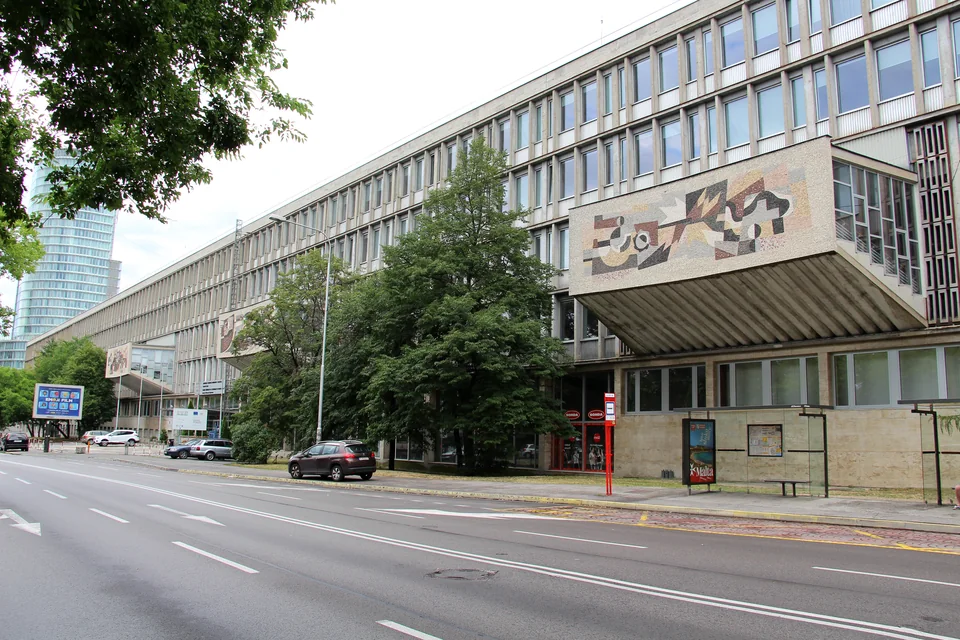
Faculties are spread across Bratislava. The modern campus in Mlynská dolina hosts FEI and FIIT among others and sits next to the Mladosť dormitory. The Faculty of Materials Science and Technology is in Trnava, where STU also has a dormitory. Check your faculty's address before you look for housing.
Rankings
| Ranking | Position |
|---|---|
| QS World University Rankings 2027 | 951–1000 |
| QS World University Rankings 2026 | 1001–1200 |
According to STU, in QS 2027 it scored best among Slovak universities for employer reputation, academic reputation, international research and sustainability.
Work during and after study
Students work in faculty laboratories, and final projects are often linked to company assignments. Faculties hold career fairs, and the university runs a technology incubator (its programmes are in Slovak). With residence for study you may work up to 80 hours a month; after graduation you can extend residence for nine months to look for work or start a business.
FAQ
Can I apply to STU straight after secondary school?
Yes. You need a completed secondary education recognised in Slovakia; a Russian certificate follows the simplified route with a $8 (€7) fee.
How much does STU cost?
Slovak-taught study is free within the standard length. English-taught fees in 2026/27 range from $2,282 (FEI bachelor's) to $7,988 (FIIT master's) a year, with $3,994 at most faculties, fixed for the whole programme.
Does STU teach in English?
Yes. In 2026/27 English-taught bachelor's intakes ran at Civil and Mechanical Engineering, Architecture, FIIT and the Institute of Management, and every faculty recruited English-taught master's students.
Are there entrance exams?
In 2026/27 Civil Engineering, Mechanical Engineering and Materials Science admitted Slovak-taught bachelor's students without an exam. FEI, FIIT and the Institute of Management tested applicants, the chemistry faculty checked Slovak, and architecture held a talent exam.
When should I apply for 2027/28?
Use the last cycle as a guide: English programmes by 31 March, Slovak programmes by 31 March or 30 April, and Slovak-taught architecture by 30 November of the previous year. Exact dates will appear in STU's new admission schedule.
Will I get a dormitory place?
Not automatically: a committee allocates places, usually to first-year students living more than 20 km away. Beds cost $80–171 a month.
Does StudyU help with applications to STU?
Under an agreement with StudyU, we help choose the faculty and programme, check requirements for your intake year, and prepare documents, certificate recognition, the application and the residence permit. At the university, the faculty decides on admission, and the Slovak Foreign Police as the migration authority decides on residence. See other options in our guide to universities in Slovakia.
Sources
- STU: about and history — checked 24.09.2026
- STU: QS World University Rankings 2027 — checked 24.09.2026
- STU: 2026/27 admission schedule (PDF) and admission conditions — checked 24.09.2026
- STU: Rector's Directive 8/2025-SR on 2026/27 fees, annexes 1 and 2 — checked 24.09.2026
- STU: bachelor's programmes 2026/27 — checked 24.09.2026
- STU: why study at STU, dormitories and private housing and student accommodation — checked 24.09.2026
- UPJŠ Faculty of Medicine: certificate recognition, $7.9 (€7) and $45 (€40) fees — checked 24.09.2026
- IOM Migration Information Centre: temporary residence for study and changes from 15.07.2026 — checked 24.09.2026
- Slovak Embassy in Moscow: residence of foreigners — checked 24.09.2026
- EUBA: living costs in Bratislava and DPB: fares — checked 24.09.2026
- Slovak Ministry of Education: scholarships for talented international students and Slov-Lex: Act No. 5/2004, Section 23a (work up to 80 hours a month) — checked 24.09.2026
- Exchange rate: ECB reference rate of 29.09.2026, €1 = $1.1355
For an overview of the education system, other universities and timelines, see studying in Slovakia. To discuss whether STU suits you and which faculty to choose, send us a request.
During the free initial consultation, we clarify your goal, profile, timing, and budget and identify the next realistic step.
Next steps
- Recognition of School Certificates in Slovakia: Recognition Statement, RÚŠS and Timelines
- Slovak Language Preparatory Courses Before University: Options, Costs and Immigration Status
- Cost of Studying in Slovakia: 2026/27 Tuition, Dormitories and a First-Year Budget
- Universities in Slovakia for International Students: Which to Choose, Teaching Languages and Costs
- How to Pay for Studies Abroad from Russia: What Works in 2026
- Studying in Slovakia for international applicants
