
The University of Stuttgart is a TU9 technical research university in the capital of Baden-Württemberg, one of Europe's main industrial regions. Students from outside the EU pay tuition: $1,700 (€1,500) per semester plus a semester contribution of $210 (€184). Everyone applies through the C@MPUS portal, with no application fee. Bachelor's programmes are taught only in German and start only in the winter semester, while about fifteen master's programmes, from Computer Science and INFOTECH to the architecture programme ITECH, are taught in English. The university has no Studienkolleg of its own; school leavers are referred to the colleges at KIT in Karlsruhe or Heidelberg University.
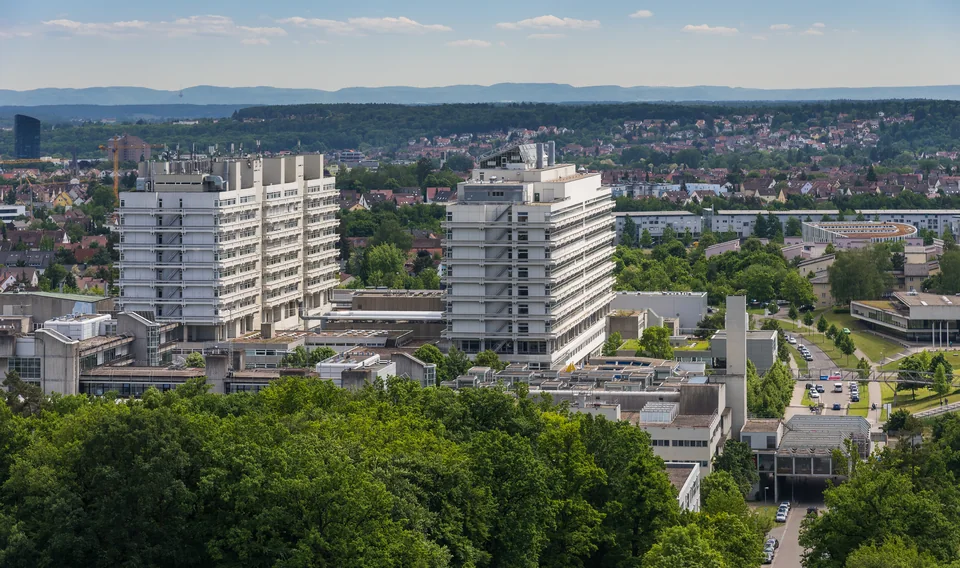
| At a glance | Details |
|---|---|
| Location | Stuttgart, Baden-Württemberg; main campuses Stadtmitte and Vaihingen |
| Students | 20,536 in winter 2025/26 |
| Programmes | more than 60 bachelor's and about 100 master's programmes |
| Tuition for non-EU students | $1,700 (€1,500) per semester in 2026/27 |
| Semester contribution | $210 (€184) in 2026/27; no transport pass included |
| How to apply | C@MPUS portal for all applicants; no fee, no uni-assist |
| Bachelor's | German-taught, winter intake only |
| Studienkolleg | via the university: KIT (T course) or Heidelberg (G, S and W courses) |
| Ranking | THE World University Rankings 2027: 301–325 band |
Who Stuttgart suits
Stuttgart attracts engineers, architects and students of computer science and electrical engineering. It has taken part in the federal and state Excellence Initiative and Strategy since 2007, and its IntCDC cluster on computational design and construction in architecture has been funded for another seven years from 2026. The university highlights the many international companies with headquarters and research centres in the region, which matters for internships and first jobs.
| Stuttgart makes sense if | Weigh alternatives if |
|---|---|
| you want an English-taught engineering or IT master's | $3,410 (€3,000) a year in tuition strains your budget |
| you can reach C1 German for a bachelor's | you need to start a bachelor's in spring: there is no summer intake |
| you are interested in architecture and construction with digital methods | you want a Studienkolleg in the same city |
| you plan an engineering career in Germany | you are looking for a low-rent city |
For a technical university of similar standing without tuition, look at TU Darmstadt or RWTH Aachen. Within Baden-Württemberg the fee is the same at all public universities, including the University of Mannheim and Heidelberg University. Our guide to tuition-free study in Germany explains the state differences.
What a year in Stuttgart really costs
Payments to the university in 2026/27
| Item | Per semester | Per year |
|---|---|---|
| Tuition for non-EU/EEA students | $1,700 (€1,500) | $3,410 (€3,000) |
| Administrative fee | $91 (€80) | $180 (€160) |
| Studierendenwerk Stuttgart fee | $110 (€96.50) | $220 (€193) |
| Student body fee | $9 (€7.50) | $17 (€15) |
| Total | $1,910 (€1,684) | $3,820 (€3,368) |
Baden-Württemberg introduced the fee for international students in winter 2017/18; a second degree costs $740 (€650) per semester instead. The university says exemptions are rare and mostly concern refugees, students with disabilities and sudden financial emergencies; the host university decides. EU/EEA citizens and holders of a German school-leaving certificate do not pay the international fee. Late payment of fees adds $23 (€20).
Living costs
The university calls Stuttgart's living costs rather high and advises budgeting at least $1,130 (€992) a month plus $1,930 (€1,700) per semester for tuition and contribution.
| Item | Per month |
|---|---|
| Room in a shared flat, excluding utilities | $400–680 (€350–600) |
| Health insurance up to age 30 | about $150 (€130) |
| Public transport | about $34 (€30) |
| Broadcasting fee | $21 (€18.36) per household |
| Food, phone, liability insurance, leisure | depends on lifestyle |
At the visa benchmark, year one comes to at least $17,340 (€15,272): $13,520 (€11,904) for living costs plus $3,820 (€3,368) to the university, assuming rates stay the same. Unlike universities whose contribution includes the Deutschland-Semesterticket, here transport is extra. See our blocked account guide.
Applying through C@MPUS
German, EU and non-EU applicants all apply online in C@MPUS; paper applications are not accepted. Non-EU applicants upload:
- the school-leaving certificate that qualifies them for university in their home country, with subject grades;
- university entrance examination results where the home country requires them;
- all previous higher-education certificates and transcripts;
- proof of German;
- for master's programmes, a transcript with grade point average, the bachelor's certificate if issued, a description of the modules studied and any documents required by the programme's admission statutes.
All documents must be translated into German or English by a sworn translator, and both original and translation are uploaded. Enrolment after admission also happens online. The university stresses that a related bachelor's degree is only one of several master's requirements; the rest are on the programme page.
Deadlines
| Programme | Winter semester | Summer semester |
|---|---|---|
| Bachelor's with selection or entrance exam | 15 May to 15 July | no intake |
| Bachelor's without admission limits | 15 May to 15 September | no intake |
| German-taught master's | usually 15 May to 15 July | 1 December to 15 January for some programmes |
| English-taught and international master's | programme-specific | programme-specific |
| Studienkolleg referral | 15 May to 15 July | 15 November to 15 January |
Windows close at midnight on the last day. If any part of a combined degree has selective admission, the 15 July deadline applies.
German: proof is needed at application
Stuttgart does not offer conditional admission pending a language test. Accepted proof for German-taught programmes:
- TestDaF with 4 in all four parts;
- Goethe-Zertifikat C1 or C2;
- DSD II;
- telc Deutsch C1 Hochschule;
- DSH with an overall result of DSH-2 or higher;
- ÖSD C2;
- the German part of a Feststellungsprüfung;
- a degree taught in German.
The university's own courses run from a three-week TestDaF preparation to a two-semester basic and intermediate programme; basic German is required to start, and the course ends with the TestDaF. See our overview of German language tests.
Studienkolleg via Stuttgart
If your school certificate does not give direct access, as is typical for 11-year certificates from Russia, Belarus or Kazakhstan issued since 2015, the university can refer you to a Studienkolleg:
- Apply in C@MPUS between 15 May and 15 July or 15 November and 15 January. Choose the T course for mathematics, science and technical degrees (KIT, Karlsruhe) or the G/S/W course for humanities, languages and economics (Heidelberg University). Upload your certificate with translation and proof of 500 to 800 hours of German, and name the Stuttgart programme you intend to study afterwards.
- Receive the provisional place notice (Vormerkung zum Studienkolleg) in C@MPUS; only then can you sit the entrance test.
- Take the entrance examination in two subjects at Heidelberg or the entrance test at KIT; one retake is allowed. You need a student visa or matching residence permit to be admitted to the college.
- Pass the Feststellungsprüfung within four semesters, including the starting semester, and apply to Stuttgart through C@MPUS.
Alternatively, a successfully completed first year at a university at home in a related subject gives direct access. See our Studienkolleg guide.
English-taught master's programmes
| Field | Programmes |
|---|---|
| Computing and electrical engineering | Computer Science; Electrical Engineering; Information Technology (INFOTECH) |
| Mechanics, materials, mechanical engineering | Computational Mechanics of Materials and Structures (COMMAS); Fundamentals and Applications of Mechanical Engineering (FAME); Materials Science |
| Environment and infrastructure | Air Quality Control, Solid Waste and Waste Water Process Engineering (WASTE); Geomatics for Environmental Monitoring (GEM); Infrastructure Planning (MIP) |
| Architecture and urbanism | Integrative Technologies and Architectural Design Research (ITECH); Integrated Urbanism and Sustainable Design (IUSD) |
| Natural sciences | Chemical Sciences; Physics |
| Philology | English and American Studies / English Linguistics |
There is also a German-English mechanical engineering master's with Georgia Tech. The English-taught Computer Science M.Sc. requires a related bachelor's with qualifying computer science exams and C1 English; other programmes set their own requirements and deadlines. See our guide to English-taught master's degrees in Germany.
Housing
The university runs no residence halls and cannot allocate rooms. The main options:
- Studierendenwerk Stuttgart: more than 5,800 places in 31 halls in the city centre, on the Vaihingen campus and in Ludwigsburg, Esslingen and Göppingen; apply before your studies start, and note that some halls apply age limits and special rules for international students.
- Vereinigung Stuttgarter Studentenwohnheime: 2,578 places in seven halls on the Vaihingen and Stadtmitte campuses.
- Private market and surrounding towns: the university suggests looking beyond Stuttgart and using sublets or hostels for the first weeks.
Housing is scarce and the university warns about scam listings; see our student housing guide.
Working during and after your studies
Non-EU students may work up to 20 hours a week, or 140 full or 280 half days a year; days under four hours count as half days. Student assistant jobs, mandatory internships and study-related research do not count, but university assistant contracts are capped at 85 hours a month and 19.5 hours a week. In the lecture-free period you may work full time on a temporary contract for up to 26 weeks a year, and remote work for foreign employers also counts towards the limits. Graduates can obtain a residence permit of up to 18 months to look for work. See working while studying in Germany.
Notes for applicants from Russia and other CIS countries
- Visa. Residents of Russia apply at the German Embassy in Moscow via RK-Termin; the St Petersburg consulate closed on 18 September 2026. See our student visa guide.
- Proof of funds. Russian bank statements are not accepted; use a blocked account with a provider outside Russia, a formal declaration of commitment or a scholarship.
- Paying $1,910 (€1,684) a semester. Fees go to the university's German account; see how to pay for studies abroad from Russia.
- Scholarships. The university names DAAD as the main scholarship provider for international students and notes that DAAD awards do not cover the $1,700 (€1,500) tuition. Because Russia's Ministry of Justice listed DAAD as undesirable in February 2026, we do not recommend its programmes to Russian citizens; applicants from other CIS countries can apply as usual. The university itself does not fund whole degrees; the Deutschlandstipendium pays $340 (€300) a month for strong performance plus at least one further criterion.
Common mistakes
- Planning a spring start for a bachelor's: all bachelor's programmes start in winter.
- Assuming a tuition exemption is likely: the university says exemptions are rare.
- Applying without a German certificate: there is no conditional admission.
- Looking for a Studienkolleg in Stuttgart: there is none, and without the C@MPUS notice you cannot sit the KIT or Heidelberg entrance test.
- Forgetting transport costs: the pass is not part of the semester contribution.
FAQ
How much does it cost to study at the University of Stuttgart?
In 2026/27 non-EU students pay $1,700 (€1,500) per semester plus a semester contribution of $210 (€184), or $3,820 (€3,368) a year. The university advises budgeting at least $1,130 (€992) a month for living costs on top.
Can I start at Stuttgart straight after school?
Not with a standard 11-year school certificate alone. Through C@MPUS you can be referred to the Studienkolleg at KIT or Heidelberg, pass the Feststellungsprüfung and then apply to Stuttgart, or complete a first year at a university at home first.
Which master's programmes at Stuttgart are taught in English?
About fifteen, including Computer Science, Electrical Engineering, INFOTECH, COMMAS, FAME, Materials Science, Physics, WASTE, ITECH and IUSD. Each sets its own English requirement and application deadline.
Do I need uni-assist for the University of Stuttgart?
No. All applicants apply directly through C@MPUS, and there is no application fee. Documents are uploaded in the original language together with a sworn translation into German or English.
When should I apply for a bachelor's at Stuttgart?
Only for the winter semester: 15 May to 15 July for selective programmes and until 15 September for programmes without admission limits. There is no summer intake for bachelor's degrees.
Does the University of Stuttgart have student housing?
It has no halls of its own. Rooms are offered by Studierendenwerk Stuttgart (over 5,800 places) and Vereinigung Stuttgarter Studentenwohnheime (2,578 places); a shared-flat room costs $400–680 (€350–600) a month before utilities.
How can StudyU help with Stuttgart?
Master's shortlisting, module-requirement checks, C@MPUS document preparation, a Studienkolleg plan and budget calculations are provided under an agreement with StudyU. Admission is decided by the university, Studienkolleg places by KIT or Heidelberg University, and visas by the German embassy.
Sources
- University of Stuttgart: figures, data and facts and Excellence Strategy
- Applying as an international degree-seeking student
- Application deadlines
- Preparatory college referral to KIT and Heidelberg
- German language requirements
- Master's programme catalogue and Computer Science M.Sc.
- Fees and charges
- Finances and work for international students and scholarships
- Housing in Stuttgart
- Baden-Württemberg Ministry of Science: fees for international students and second degrees
- THE World University Rankings 2027: University of Stuttgart
- German Embassy in Russia: national D visa and memo for students and applicants (PDF)
All dollar figures are based on the ECB rate of 29 September 2026, €1 = $1.1355, with sources checked on 30 September 2026. For other universities, see studying in Germany. To check whether Stuttgart's fees pay off for your plans, send us a request.
Next steps
- University of Mannheim (Universität Mannheim)
- Technical University of Darmstadt (TU Darmstadt)
- Studying in Germany for international applicants
- Free University Education in Germany for International Students: Where Tuition Is Zero and What You Still Pay
- Blocked Account in Germany 2026: Amount, Opening Steps and Alternatives
- German Language Tests for German Universities: TestDaF, DSH, Goethe and telc Compared (2026–2027)
