
The University of Strathclyde is a public technological university in central Glasgow with more than 200 years of history, strong in engineering, business, pharmacy and applied science. It sits in the 351–375 band of the THE World University Rankings 2027. A Russian school certificate (attestat) does not give direct entry: school leavers take a foundation year at the on-campus International Study Centre (ISC), after which most move straight into year two of a four-year degree. International bachelor's fees for 2027/28 are $30,700–44,470 (£23,200–33,600) a year; the 2026/27 foundation costs $24,480–25,810 (£18,500–19,500).
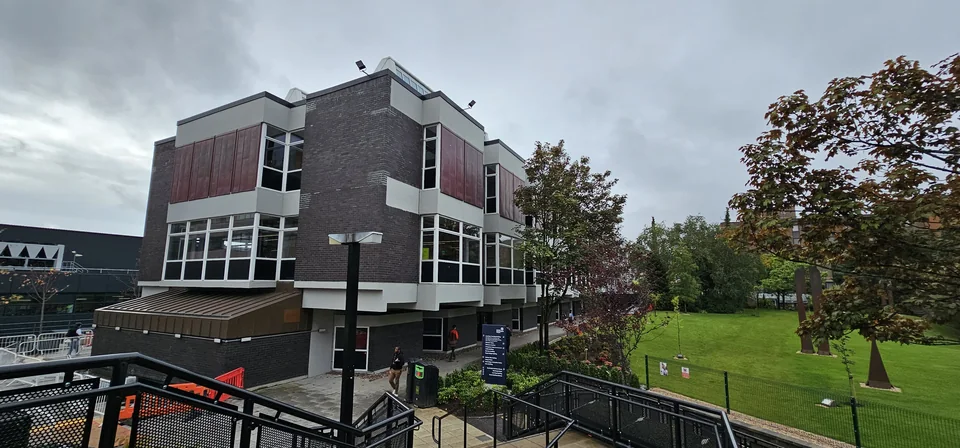
Strathclyde is not the University of Glasgow or Glasgow Caledonian University: these are three separate universities in the same city. Our guide to universities in Scotland compares the main Scottish options.
| At a glance | Details |
|---|---|
| Location | Glasgow city centre campus |
| Students | almost 30,000 from more than 140 countries (university figures) |
| Ranking | THE World University Rankings 2027: 351–375 |
| Route from an 11-year school | ISC Undergraduate Foundation Programme: attestat average 4.0, IELTS for UKVI 5.0 |
| Foundation, 2026/27 | $24,480 (£18,500) business and social sciences; $25,810 (£19,500) engineering and sciences |
| Bachelor's, 2027/28 | from $30,700 (£23,200) in the business school to $44,470 (£33,600) for pharmacy |
| Master's, 2026/27 | e.g. MSc Finance $43,410 (£32,800) |
| Halls, 2026/27 | $180–240 (£133.49–182) a week, 39-week contract |
Who Strathclyde suits
| Strengths | Limits |
|---|---|
| The foundation leads to year two, so the route still takes four years | The foundation needs an attestat average of 4.0 |
| Progression scholarships after the ISC are automatic every year with 60%+ | Engineering and pharmacy fees are among the highest in Scotland |
| International applicants can apply directly, not only via UCAS | Master's entry expects a 4/5 average |
| The university caps annual fee rises at 10% | Undergraduate scholarships for September 2027 are not yet announced |
| Campus in the centre of Scotland's largest city | Halls places are limited |
Strathclyde suits applicants who want engineering, pharmacy, mathematics or business in Glasgow and can budget above the Scottish average. If price matters more for a similarly applied profile, compare it with Edinburgh Napier University. The full list is on our study in the UK page.
After school: the International Study Centre
For Russian applicants, the university lists three routes into a bachelor's degree: an attestat plus a recognised foundation programme, at least one year of a Russian Bakalavr or Specialist degree with an average of 3/4 or 4/5, or A-levels, the IB or the European Baccalaureate. For school leavers, the main route is the International Study Centre on campus. The centre is maintained by the private education company Study Group, so you apply to the ISC separately and the centre decides on pathway places.
| ISC programme | Requirement for Russia | English (IELTS for UKVI) | Fee, 2026/27 | Leads to |
|---|---|---|---|---|
| Undergraduate Foundation Programme | attestat average 4.0 | 5.0, writing 4.5, other skills 4.0 | see above | year two (some exceptions) |
| International Year Two | attestat 4.0 plus one further year of study at GPA 3.0 | 5.5, writing 5.0, other skills 4.0 | $25,010 (£18,900) business, $26,340 (£19,900) computer science | year three |
The foundation lasts two semesters, with intakes in September, November (with a three-week Enhanced Induction) and January; whichever you choose, you join the university in September. There are two routes: business and social sciences, and engineering and sciences. Progression to Pharmacy (MPharm) requires IELTS for UKVI 5.5 with 5.5 in writing and a university interview; Speech and Language Therapy requires IELTS 6.0. The ISC reports that 97% of its 2025 foundation completers were offered progression. Students must be 17 by the start, and under-18s need a UK-based educational guardian, which the centre can help arrange.
Online English preparation costs $4,630 (£3,500) before the foundation and $2,780–7,410 (£2,100–5,600) for 6–16 weeks before International Year Two. Our foundation year guide compares pathway formats.
Payments before the CAS. On confirming your ISC place you pay a $1,320 (£1,000) security deposit and a $340 (£260) non-refundable administration fee, then a $7,940 (£6,000) advance tuition payment before the CAS is requested: $9,610 (£7,260) in total, higher for some territories. The balance for terms one and two is due 28 days before the start. StudyCare insurance costs $600 (£450) for a year.
Progression scholarships after the ISC
Students who progress from the ISC receive a fee reduction for each year of their degree once they achieve 60%. No application is needed.
| Faculty | Bachelor's, per year | Master's, per year |
|---|---|---|
| Engineering | 15% of the fee, typically about $6,150 (£4,650) | $7,940 (£6,000) |
| Humanities and Social Sciences | $6,620 (£5,000) | $7,940–10,590 (£6,000–8,000) |
| Science | $6,620–9,260 (£5,000–7,000) depending on department | £6,000, or £7,000 in Physics |
| Strathclyde Business School | 25% of the fee, typically about $7,530 (£5,687) | $9,260–11,910 (£7,000–9,000) |
The ISC also offers a partial scholarship on the pathway year itself, varying by region and allocated first come, first served. The university can change its scholarship terms and decides on each award.
Bachelor's degrees: fees and applying
A Scottish honours degree normally lasts four years. International fees depend on the course:
| Course | 2026/27 | 2027/28 |
|---|---|---|
| Business, Accounting & Finance (BA) | $30,110 (£22,750) | $30,700 (£23,200) |
| Economics (BA) | $28,520 (£21,550) | $30,700 (£23,200) |
| Psychology, Data Analytics (BSc) | $30,110 (£22,750) | $31,890 (£24,100) |
| Computer Science (BSc) | $37,850 (£28,600) | $40,100 (£30,300) |
| Aero-Mechanical, Civil Engineering (BEng) | $40,960 (£30,950) | $41,160 (£31,100) |
| Pharmacy (MPharm) | $42,150 (£31,850) | $44,470 (£33,600) |
Fees rise every year while you study; the university states that the annual increase will not exceed 10% and publishes new rates each October. Pharmacy year one is cheaper than later years: $38,840 (£29,350) in 2026/27 and $41,160 (£31,100) in 2027/28. Scottish residents have their tuition paid by SAAS, but this does not extend to student-visa holders.
International applicants can use UCAS if they are applying to several UK universities, or the university's Direct Applications service. The UCAS equal-consideration deadline for 2027 entry is 13 January 2027. Computer Science has two entry points: year one with A-levels BBB including Maths, or year two with ABB in Maths and Computer Science; the degree is accredited by BCS, the UK professional body for IT. Our guide to applying to UK universities covers the UCAS form.
Master's degrees
Russian applicants need a Bakalavr, Specialist or Magistr diploma from an accredited institution, averaging 4 on the five-point scale (3 on a four-point one). Kazakh applicants face the same thresholds, and the university also takes work experience into account without requiring it.
| Course | English | International fee, 2026/27 |
|---|---|---|
| MSc Finance | IELTS 6.5, components 5.5+ | $43,410 (£32,800) |
| MSc Business Management | same | same rate |
| MSc Advanced Computer Science with Data Science | see course page | $42,220 (£31,900) |
| MSc Advanced Mechanical Engineering | see course page | $43,410 (£32,800) |
Master's fees for 2027/28 are not yet published. The business school's 2026/27 course pages list an automatic scholarship for every international offer holder: $10,590 (£8,000) on MSc Finance and $11,910 (£9,000) on MSc Business Management, with stronger applications also considered for the larger Dean's Excellence Award. For September 2026 the university set fixed deadlines for international applicants: 14 August 2026, or 31 July for selected countries. A non-refundable tuition deposit is usually a condition of the offer. The Faculty of Engineering offers $7,940 (£6,000) to January 2027 master's entrants and Dean's International Excellence Awards of $11,910–15,880 (£9,000–12,000) to exceptional applicants.
If your grades or English fall short, the ISC Pre-Masters requires a Russian Bakalavr with an average of 4.0 and IELTS for UKVI 5.5 in every skill. The two-term version costs $18,400–18,860 (£13,900–14,250); the 12-week accelerated version is $15,220 (£11,500) with IELTS 6.0.
University scholarships
Strathclyde will announce its international undergraduate scholarships for September 2027 later. As an example from the previous cycle, the Faculty of Science offered up to 25 awards of $7,940–9,260 (£6,000–7,000) a year for the whole degree, subject to progression; applications closed on 31 July 2026 and were assessed on a rolling basis. Students may hold only one Strathclyde scholarship per year. For master's study, Chevening is an external option, but in the 2027/28 cycle it accepts Russian citizens only if they live outside Russia. The university or the funder decides on each award; see our UK scholarships guide.
Halls of residence
| Room type, 2026/27 | Week | Approx. 39 weeks |
|---|---|---|
| Standard room | $180 (£133.49) | $6,890 (£5,206) |
| Room with washbasin | $190 (£141.19) | $7,290 (£5,506) |
| En-suite room | $240 (£182) | $9,390 (£7,098) |
Prices include utilities, contents insurance, Wi-Fi and Strathclyde Sport membership. You can apply for a room with a conditional offer. The university says places are limited: offers go to new students who meet the deadlines and may be in third-party accommodation. New postgraduates who met their offer conditions and applied by 26 June 2026 received a room offer; late applications may not be looked at until 1 September. Halls are for single occupants only. More tips are in our student housing guide.
Visa and costs
The ISC or the university issues the CAS after the advance payment and once conditions are met. The visa fee is $740 (£558) and the Immigration Health Surcharge $1,030 (£776) per visa year. For applications from 30 November 2026, maintenance is £1,203 a month, or $14,330 (£10,827) for nine months, held for 28 days. Residents of Russia and Kazakhstan need a TB test at a GOV.UK-approved clinic. The Graduate visa lasts 18 months for applications from 1 January 2027. UK Visas and Immigration decides on the visa; see our UK student visa guide and Graduate Route guide. Payments from Russia should use lawful routes only: see how to pay for studies abroad from Russia.
Common mistakes
- Confusing Strathclyde with the University of Glasgow or Glasgow Caledonian: entry rules and fees differ.
- Applying to the ISC with an attestat average below 4.0. That is the Russian foundation threshold; International Year Two also needs an extra year of study after school.
- Budgeting the first-year fee for all four years. Fees rise annually, by up to 10%.
- Applying for a master's in late summer. For 2026, the university closed international applications on 14 August.
- Counting on last year's scholarships. The 2027 awards are not announced yet, and their size and number can change.
Plan for September 2027
- October–December 2026: take IELTS for UKVI, check your attestat average (4.0+), choose a foundation route.
- December 2026–spring 2027: apply to the ISC; with A-levels or the IB, apply to the university via UCAS by 13 January 2027 or directly.
- After the offer: pay £7,260 before the CAS request and apply for halls.
- Summer 2027: hold funds for 28 days, take the TB test, get the visa.
- September 2027: start the foundation; year two at the university begins in September 2028.
FAQ
Can I enter the University of Strathclyde straight after school?
Not with an attestat alone. You need the Undergraduate Foundation Programme at the on-campus International Study Centre, with an attestat average of at least 4 and an IELTS for UKVI score of 5.0. After a successful year most students move straight into year two; the university decides on progression.
How much is a Strathclyde bachelor's degree for international students?
In 2027/28, fees range from $30,700 (£23,200) a year in the business school to $40,100 (£30,300) for Computer Science and $44,470 (£33,600) for Pharmacy. BEng engineering costs $41,160 (£31,100). Each later year can rise by up to 10%.
What does the ISC foundation give besides preparation?
After progressing, students receive an automatic fee reduction every year they score 60% or more: 25% in the business school, 15% in engineering, and £5,000–7,000 in humanities and science. The university sets the amount of each reduction.
What degree do I need for a Strathclyde master's?
A Russian diploma averaging "good" (4/5, or 3/4) and usually IELTS 6.5. Applicants who are not there yet can take the ISC's two-term Pre-Masters or a 12-week accelerated version. The university makes the admission decision.
How is Strathclyde different from the University of Glasgow?
Both are in Glasgow but they are separate universities. Strathclyde is a technological university focused on engineering, business and applied science and takes Russian school leavers through its own ISC. The University of Glasgow is a research-intensive Russell Group university with its own entry rules and fees, and each university makes its own admission decisions.
Where do Strathclyde students live?
In university halls: in 2026/27, from $180 (£133.49) a week for a standard room to $240 (£182) for an en-suite room on a 39-week contract, with bills included. There are not enough places for everyone, so apply as soon as you receive an offer of study.
Sources
- University of Strathclyde: entry requirements by country, including Russia and Kazakhstan, international students
- ISC: entry requirements, 2026/27 fees and payments, Undergraduate Foundation, International Year Two, scholarships
- Bachelor's: Computer Science, Business, Accounting & Finance, Economics, Psychology, Data Analytics, Aero-Mechanical Engineering, Civil Engineering, Pharmacy
- Master's: MSc Finance, MSc Business Management, MSc Advanced Computer Science with Data Science, MSc Advanced Mechanical Engineering, deadlines, your offer
- Scholarships: undergraduate, Faculty of Science, Faculty of Engineering
- Accommodation: 2026/27 prices, allocation policy
- THE World University Rankings 2027
- UCAS: 2027 deadlines
- GOV.UK: Student visa, money, HC 584, IHS, Graduate visa, TB testing in Russia
- Chevening: Russia
Amounts are converted at the ECB reference rates of 1 October 2026 (£1 = $1.3234) and rounded to $10. Data checked on 2 October 2026.
If you want to work through your route, send a request: document preparation and submission are provided under an agreement with StudyU, and the university makes the admission decision.
During the free initial consultation, we clarify your goal, profile, timing, and budget and identify the next realistic step.
Next steps
- Edinburgh Napier University: Admission After School, Fees and Housing
- Studying in the UK for international applicants
- Universities in Scotland for International Students: List, Fees, Four-Year Degrees and Admissions
- Foundation Year in the UK: Types, Entry Requirements, Costs and Progression
- Scholarships in the UK in 2026: Chevening, Gates Cambridge, Clarendon and University Awards — What Applicants from Russia, Kazakhstan and Central Asia Can Get
- Student Housing in the UK in 2026: Halls, Private Halls or a Shared House — Prices, Deposits and the New Renting Rules
