
Université Paris-Saclay is a public research university south of Paris and the highest-ranked French institution in the Shanghai ranking, placing 13th worldwide in ARWU 2026. For international students its main draw is the master's level: about 25 first-year (M1) and about 50 second-year (M2) options are taught entirely in English, mostly in physics, computer science and AI, chemistry and the life sciences. The 2026/27 base fee for non-EU students is $3,300 (€2,902) a year for a bachelor's and $4,490 (€3,950) for a master's. Until spring 2026 the university cut this fee to the standard $200–290 (€178–255) for every international student. Decree no. 2026-385 of 19 May 2026 ended such blanket waivers: exemptions are now granted only on individual request, based on the student's financial situation, and to no more than 30% of non-EU students in 2026/27 and 25% in 2027/28.
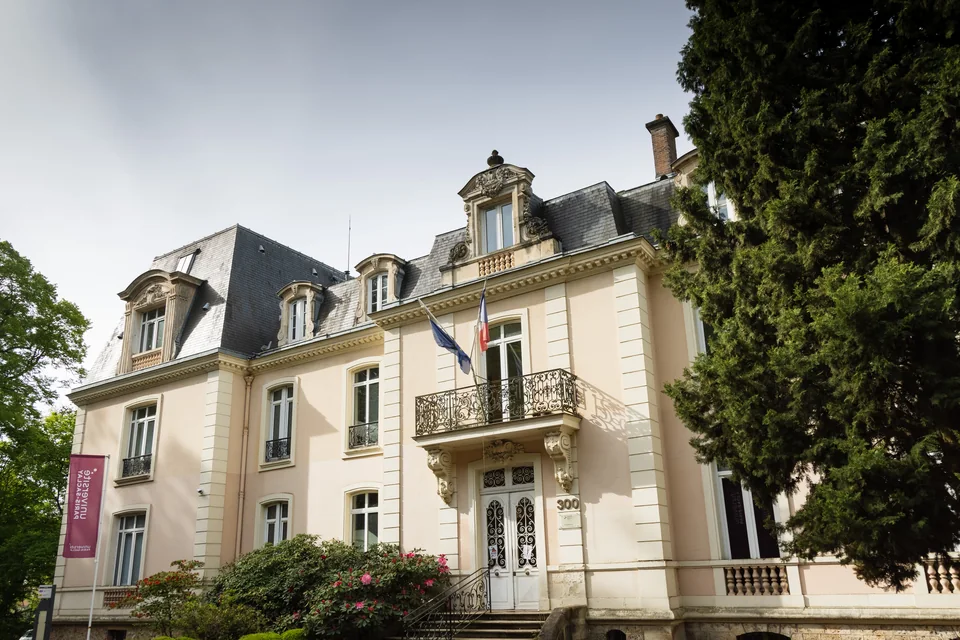
Residents of Russia and other countries covered by the Campus France "Études en France" (EEF) procedure apply for a master's through the university's INCEPTION platform and, once admitted, must open an EEF file under "I am accepted" before applying for a visa. Other international applicants use INCEPTION or the national Mon Master platform, depending on the programme.
| At a glance | Details |
|---|---|
| Location | Southern Paris region: Orsay, Gif-sur-Yvette, Palaiseau, Cachan, Sceaux and other sites |
| Structure | 5 faculties, 3 university institutes of technology (IUT), Polytech engineering school, 4 grandes écoles, 2 associate universities |
| Rankings | ARWU 2026: 13th; QS 2027: 76th; THE 2026: =68th |
| Students | About 50,000, 21% international; 8,100 researchers and academic staff |
| English-taught | about 25 M1 and about 50 M2 options |
| Fees 2026/27 | $200 (€178) / $290 (€255); non-EU base rate $3,300 / $4,490 (€2,902 / €3,950) |
| University scholarship | International Master's Scholarship: $11,360 (€10,000) a year plus up to $1,020 (€900) for travel and visa |
| Master's route | Residents of EEF countries: INCEPTION, then EEF "I am accepted"; others: INCEPTION or Mon Master |
What Paris-Saclay is made of
Created by decree no. 2019-1131 of 5 November 2019, Paris-Saclay replaced Université Paris-Sud (Paris XI) on 1 January 2020 and brought it together with grandes écoles and research bodies on the Saclay plateau. Older directories may still call it "Paris-Sud"; all programmes and application platforms now use the Paris-Saclay name.
- 5 faculties: Law, Economics and Management (Jean Monnet Faculty); Medicine; Pharmacy; Science; Sports Sciences.
- 3 university institutes of technology (IUT): Cachan, Orsay and Sceaux.
- 1 university engineering school: Polytech Paris-Saclay.
- 4 grandes écoles: CentraleSupélec, AgroParisTech, ENS Paris-Saclay, Institut d'Optique Graduate School.
- 2 associate universities: Versailles Saint-Quentin-en-Yvelines (UVSQ) and Évry Paris-Saclay.
- 7 research organisations: CEA, CNRS, IHES, INRAE, Inria, Inserm, ONERA.
Master's and PhD study is organised through 18 graduate schools and 21 doctoral schools. The university has about 50,000 students and 8,100 researchers and academic staff, produces 13% of France's research output across 220 laboratories and more than 350 experimental platforms, and is linked to 9 Nobel laureates and more than ten Fields Medal winners.
A common search trap: ENS Paris-Saclay (formerly ENS Cachan) is not the same school as the École normale supérieure on rue d'Ulm, which belongs to Université PSL. École polytechnique is not part of Paris-Saclay either.
Who Paris-Saclay suits
| Worth considering if you… | Possible drawbacks |
|---|---|
| want a master's in physics, maths, AI, data science, chemistry, biology or neuroscience | bachelor's teaching is almost entirely in French |
| are aiming for a PhD: many M2 tracks are linked to CNRS, CEA or Inria labs | campuses are spread across the suburbs, far from central Paris |
| want a university-funded master's scholarship | scholarship nominations close in March, so you must apply early |
| come from Kazakhstan: the university lists it as a priority country for Eiffel nominations | the fee cut is no longer automatic: only on individual request and within a quota (25% of non-EU students in 2027/28) |
| prefer student housing near campus: CROUS runs many residences around the plateau | several application channels (INCEPTION, Mon Master, EEF), each with its own calendar |
For humanities or central-Paris study, look at Sorbonne University. For economics, management or political science in English, compare PSL (Dauphine) and Sciences Po.
What you can study in English and in French
Bachelor's level (licence, BUT technology degrees, DEUST): taught in French.
Master's level: the university's list of English-taught master's includes, among others:
- AI and computer science: Artificial Intelligence (M2); Data, Knowledge and Hybrid Artificial Intelligence (DKAI); Distributed, Parallel and Quantum Computing; Human Computer Interaction; Optimization;
- physics and engineering: Fundamental Concepts of Physics; Nuclei, Particles, Astroparticles and Cosmology; Physics of Plasmas and Fusion; Nuclear Engineering; Large Scale Accelerators and Lasers (Erasmus Mundus); Smart Aerospace and Autonomous Systems; Technology of Semiconductor Devices;
- chemistry and materials: Chemistry – International Track; Molecular Chemistry and Interfaces; Advanced Materials, Structure and Energy for Sustainable Construction;
- life sciences and health: Systems Neuroscience; Computational Neurosciences and Neuroengineering; Stem Cells, Development, Cancer; Human Genomics in Biotherapies; Development of Drugs and Health Products;
- economics and management: Economics (M2); International Business and Sustainability (MIBS);
- agriculture and food: Biomass Engineering for Bioeconomy; FIPDes (Food Innovation and Product Design); Climate, Land Use and Ecosystem Services.
Many English-taught options exist only as M2 programmes. For M2 entry, the university expects a completed first master's year (M1, 240 ECTS). A four-year Russian bachelor's degree also adds up to about 240 credits, but whether a committee accepts it in place of an M1 is the programme's decision, based on how closely your courses match. If in doubt, apply for M1. See also our guide to master's degrees in France.
How to apply for a master's
For residents of an EEF country, the university describes the following route:
- Apply to the programme through INCEPTION. For residents of EEF countries this applies to both M1 and M2. Applicants from countries outside EEF use Mon Master for M1 programmes that are not on the INCEPTION list. Each programme sets its own dates in the "Application procedures" section of its page, and late applications are not possible.
- Referees. Applicants who have not been enrolled in a French institution in the last two academic years must name two academic referees.
- EEF "I am accepted". After admission, create an EEF file in the "I am accepted" section. The consulate will not process a student visa without it.
- Enrolment. Pay the CVEC (the student and campus life contribution), complete administrative registration and submit your supporting documents.
For M1 the university advises making at least five applications across at least two master's fields and two institutions. In the national Mon Master procedure this is the condition for asking the rector for help if every answer is negative; for INCEPTION applicants it is still sound advice, because a single application is a big risk. For motivation letters and M1/M2 choices, see our guide to master's degrees in France.
Documents and language requirements for a master's
Each programme publishes its own list under "Supporting documents". As an example, M1 Nuclear Engineering (45 places, INCEPTION window 15 January to 16 March 2026) asked for a copy of the latest diploma and passport, a motivation letter, all transcripts since secondary school, a CV and proof of English; GMAT or GRE scores were optional and recommendation letters were an additional document.
- English. There is no single university-wide minimum score: each programme sets the level and the accepted tests. If the page asks for a "certificate of English level", prepare IELTS Academic, TOEFL iBT or another test from its list.
- French. For French-taught programmes, Campus France Russia requires DELF B2, DALF C1/C2 or TCF.
- Translations. For Études en France, school certificates, diplomas and transcripts are translated into French, or into French or English for a fully English-taught programme, and certified by a notary in Russia or France. A certified diploma translation does not expire; other certificates are valid for one month. An English Diploma Supplement replaces only the translation of the transcript, not of the diploma itself.
- Referees. Contact details for two people who know your academic work, if you have not studied in France in the last two years.
The Études en France procedure is running in Russia: Campus France has five offices (Moscow, St Petersburg, Samara, Yekaterinburg, Novosibirsk) and the interview is held online. To gauge your French level, see our guide to DELF, DALF and TCF.
How to apply for a first-year bachelor's
- Residents of Russia: EEF online file. For the 2026/27 intake it was open from 1 November to 15 December 2025, with a maximum of three universities and a French test result due by 27 February 2026.
- Residents of Kazakhstan: paper "white" DAP file (demande d'admission préalable, preliminary admission request), submitted between 1 October and 15 December to Campus France in Astana or Almaty.
- Residents of other countries without EEF: white DAP file through the cultural section of the French embassy.
Applicants who will be under 18 when the course starts need a guardian in France to obtain a long-stay student visa, as Campus France Russia points out. BUT technology degrees, DEUST programmes and double licences follow the rules for selective programmes, so check the platform for each one.
See our guide to bachelor's degrees in France.
What dates to expect for 2027/28
| Step | Date | Note |
|---|---|---|
| EEF first-year file | 1 Nov – 15 Dec | 2027/28 dates not yet published |
| EEF file, other levels | 1 Nov – 30 Jan | for programmes connected to EEF |
| Mon Master (M1) | mid-February – mid-March (2026: 17 Feb – 16 Mar) | for applicants outside EEF; 2027 calendar published in winter |
| INCEPTION | programme-specific | 2026 example: M1 Nuclear Engineering, 15 Jan – 16 Mar |
| Master's scholarship nominations / application | late March (2026: by 25 Mar / by 31 Mar) | results mid-May (as in 2026) |
| Visa | after admission, no earlier than 3 months before the course | EEF file required for residents of Russia |
How much Paris-Saclay costs
| Level | EU and exempted students | Non-EU base rate |
|---|---|---|
| Bachelor's | $200 (€178) | $3,300 (€2,902) |
| Master's | $290 (€255) | $4,490 (€3,950) |
| Doctorate | $450 (€398) | $450 (€398) |
The 2026/27 rates match the national ones, as confirmed by the fee table on the university's French-language page and by Campus France; the English fee page still showed 2025/26 amounts when we checked.
Will you get the fee cut?
Until spring 2026 the answer was simple. Board of Governors resolution CA-2026-013 of 3 February 2026 reduced the differentiated rate to the domestic rate for all non-EU students. Decree no. 2026-385 of 19 May 2026 (in force from 21 May) changed the rules for every public institution:
- blanket waivers for all international students are abolished. According to the ministry, board decisions still apply only to students who had already been granted a waiver before 21 May 2026; fees shown on a university website, Mon Master or Parcoursup do not count as such a decision;
- a new student can obtain a full or partial exemption only on individual request, based on personal circumstances, above all family income;
- the share of exempted students is capped: 30% of non-EU students in 2026/27, 25% in 2027/28 and 20% from 2028;
- French government scholarship holders (including Embassy and Eiffel scholars) and students under exchange agreements with reciprocal waivers are exempted automatically.
As of 24 September 2026, Paris-Saclay had not published its 2026/27 exemption procedure. For a 2027/28 start, budget for the full $4,490 (€3,950) a year for a master's, and apply for an exemption only if your family income is genuinely low, with supporting evidence.
Programmes with their own fees
Some English-taught master's are classed as "international master's" (masters internationaux), which add programme-specific charges to the base fee. Under resolution CA-2026-014, the total for non-EU students in 2026/27 is:
| Programme | Annual fee for non-EU students, 2026/27 |
|---|---|
| Nuclear Engineering, Development of Drugs and Health Products (M1 and M2) | $7,100 (€6,254) |
| CentraleSupélec international master's (e.g. Industrial and Systems Engineering, Mechanics – International track) | $6,810 (€6,000) for all students |
| Chemistry – International Track, Large Scale Accelerators and Lasers (Erasmus Mundus) | $9,080 (€8,000) |
| FIPDes, Biomass Engineering for Bioeconomy (Erasmus Mundus) | $10,220 (€9,000) |
These totals were calculated under the old scheme, in which the base part for international students equalled the domestic rate, so they may change for 2027/28. For Erasmus Mundus scholarship holders the fee is covered by the scholarship. According to Campus France, CentraleSupélec engineering degrees cost $2,980 (€2,620) a year even for EU students. Check the amount on your programme's page before applying.
Other costs:
- CVEC: $120 (€105) a year.
- Visa validation tax: $115 (€100) on arrival.
- Proof of funds for the visa: at least $995 (€877.50) a month, the threshold in force since 1 August 2026.
- Tuition payment: can be split into three online card instalments at no extra cost.
Campus France benchmarks (May 2026) for Paris and Île-de-France, per month:
| Item | Amount |
|---|---|
| CROUS room or studio | $340–740 (€300–650) |
| Private student residence | $625–1,020 (€550–900) |
| Studio from a private landlord | $625–1,480 (€550–1,300) |
| Navigo monthly transport pass | $105 (€90.80) |
| Meal in a university canteen | about $1 (€1) |
| Internet | $23–57 (€20–50) |
A rental deposit is usually one or two months' rent.
Since 1 July 2026, non-EU students on a student residence permit receive APL housing aid only if they hold a CROUS grant, are employed, or are on an apprenticeship. Students may work up to 964 hours a year. For a full budget, see the cost of studying in France.
Which scholarships are available
International Master's Scholarship
- Amount: $11,360 (€10,000) a year, paid monthly from September to June, plus up to $1,020 (€900) a year for travel and visa costs, depending on the country of origin.
- Eligibility: international students under 30 in the year of application, enrolling in France for the first time, with no other funding above $680 (€600) a month.
- Programmes: all master's programmes except apprenticeship tracks. An M1 award renews automatically for M2 at Paris-Saclay once all credits are earned.
- Cannot be combined with Eiffel, France Excellence Europa or Erasmus Mundus scholarships.
- Selection: programme coordinators nominate admitted applicants; the nominee then completes a form, and a graduate-school jury assesses the academic record, the personal project and PhD motivation.
For 2026/27, nominations closed on 25 March 2026 and applications on 31 March, with results in mid-May. The practical lesson: apply to your programme in winter, or you will not be on the nomination list.
Eiffel and other funding
- France Excellence Eiffel: $1,360 (€1,200) a month at master's level and $2,380 (€2,100) at PhD level (January 2026 rates). The university nominates candidates; its internal deadline for the 2026 call was 9 November 2025. Russia is on the programme's country list, but the rules and calendar for the 2027 session had not been published as of 24 September 2026. Master's priority is set by the country of your last degree, and Kazakhstan is named on the priority list.
- French Embassy in Russia master's scholarship: $975 (€860) a month for 2026/27, with a free visa, insurance and exemption from public-university registration fees.
- PhD: funded doctoral contracts through laboratories and doctoral schools.
Where to live: CROUS near campus and the private market
CROUS Versailles and CROUS Créteil run many residences near Paris-Saclay campuses: Les Jardins de Fleming and Eileen Gray in Orsay, Émilie du Châtelet and George Sand in Gif-sur-Yvette, Jean d'Ormesson in Palaiseau, Les Rives de l'Yvette and L'Île in Bures-sur-Yvette, the Cachan campus, and residences in Antony, Bagneux, Fontenay-aux-Roses and Les Ulis. For 2026/27, the steps were:
- Complete the student social file (DSE) by 31 May 2026 and tick the box requesting CROUS housing.
- Submit housing preferences from 5 May.
- Grant holders are housed over three rounds. Other students, including internationals who are not eligible for the DSE, can join the additional phase from 7 July 2026.
- Offers must be confirmed within 48 hours, with a reservation payment.
Alternatives include Lokaviz (the CROUS platform for private rooms and studios), the university's Casa housing platform, faculty housing contacts, and, for master's and PhD students, the Cité internationale universitaire de Paris in central Paris, where September applications are due by April. See student housing in France.
Why Paris-Saclay ranks differently across tables
| Ranking | Position |
|---|---|
| ARWU 2026 | 13 (first in France) |
| QS World University Rankings 2027 | 76 |
| THE World University Rankings 2026 | =68 |
ARWU relies mainly on research indicators such as publications and prizes. QS and THE add reputation surveys, in which a university created in 2020 still trails older brands. For a master's applicant, the lab linked to a track and the M2 internship tell you more than the overall position.
Mistakes to avoid
- Searching for "Paris-Sud". The old name survives mainly in aggregator listings, often next to outdated fees.
- Skipping the second step. Admission through INCEPTION without an EEF "I am accepted" file does not lead to a visa.
- Applying in spring and hoping for the master's scholarship. Nominations are made in March from applications already received.
- Trying to combine Eiffel with the university scholarship. The rules do not allow it.
- Choosing housing before checking the campus. Orsay, Palaiseau and Cachan are far apart; the teaching address is on the programme page.
- Not checking the M1 language. Some programmes switch to English only in the second year.
FAQ
Where is Université Paris-Saclay?
In the southern Paris region. The main sites are in Orsay, Gif-sur-Yvette, Palaiseau, Cachan and Sceaux, and the associate universities are in Versailles/Saint-Quentin-en-Yvelines and Évry.
How much does it cost for non-EU students?
The 2026/27 base rate is $3,300 (€2,902) a year for a bachelor's and $4,490 (€3,950) for a master's; some international master's cost $6,810–10,220 (€6,000–9,000). A reduction to $200–290 (€178–255) is possible only on individual request, based on income, and within the national quota of 25% of non-EU students in 2027/28.
Are there English-taught programmes?
Yes, about 25 M1 and 50 M2 options, mostly in the sciences, AI, engineering, the life sciences and economics.
How do I apply for a master's from Russia?
Apply via INCEPTION within the programme's dates. After admission, complete the EEF "I am accepted" file and then apply for your visa.
What scholarship does the university offer?
The International Master's Scholarship: $11,360 (€10,000) a year plus up to $1,020 (€900) for travel. Programme coordinators nominate candidates; in 2026 the deadline was 25 March.
Can I start a bachelor's straight after Russian school?
Yes, through Études en France (residents of Russia) or the DAP (Kazakhstan), with French at B2. Campus France Russia accepts school leavers without an extra year of study.
Can StudyU help?
Under an agreement with StudyU, we shortlist M1/M2 programmes, check requirements, prepare applications and the EEF file, and support the visa stage. The university decides on admission and scholarships, and the French consulate as the consular authority decides on the visa.
Sources
- About Université Paris-Saclay
- Master's programmes taught in English
- International students: applying for a master's
- Applying for undergraduate programmes
- Tuition fees and 2026/27 rates (FR)
- Resolution CA-2026-014: international master's fees 2026/27
- Ministry of Higher Education: FAQ on Decree 2026-385 on exemptions
- Master's applications and enrolment
- Campus France Russia: embassy scholarships and Campus France Kazakhstan: admission
- International Master's Scholarships 2026
- Eiffel at Paris-Saclay
- Accommodation
- Campus France: tuition fees 2026/27
- Campus France Russia: deadlines, documents and translations and offices in Russia
- Campus France: student cost of living, May 2026
- Example programme page: M1 Nuclear Engineering
- Service-public.fr: student residence permit, APL and working while studying
- ARWU 2026, QS, THE
- Dollar amounts use the ECB rate of 29 September 2026 (€1 = $1.1355), rounded.
For an overview of the French system, see Study in France, and for the visa stage, our guide to the French student visa. Help with your programme choice at Paris-Saclay is provided under an agreement with StudyU; to start, send us a request.
During the free initial consultation, we clarify your goal, profile, timing, and budget and identify the next realistic step.
Next steps
- Bachelor's in France: Licence, Private Bachelor Programmes and Admission After School
- DELF, DALF and TCF: Which French Test You Need to Study in France and Where to Take It
- Master's in France: Master, MSc and Grandes Écoles — How to Apply for 2027
- Scholarships in France: Eiffel, French Embassy Scholarships and University Awards
- Studying in France for international applicants
- Cost of Studying in France in 2026/27: Tuition, Compulsory Fees and a Full-Year Budget
