
The University of Ottawa is a public university in Canada's capital where you can study in English, in French or in both. International school-leavers apply to bachelor's programmes through the OUAC portal, and a Russian or Kazakh secondary school certificate gives direct entry without a foundation year, provided you meet the programme's prerequisites and average. In 2026/27 international tuition runs from $30,550 (CAD 43,335) a year in arts, social sciences and science to $44,530 (CAD 63,164) in engineering and computer science. English-stream students admitted with an average of 80% or more automatically receive $5,290 (CAD 7,500) per term, while French-stream students get a large reduction of the international fee differential.
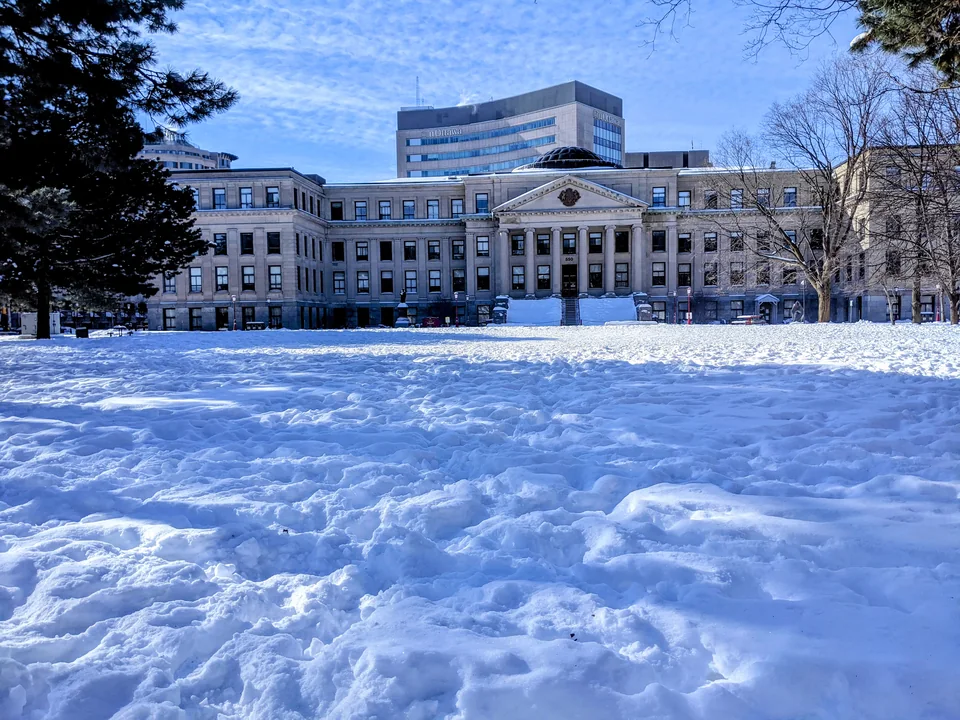
uOttawa is not Carleton University, which is also in Ottawa, nor Ottawa University in Kansas, USA.
| At a glance | 2026/27 details |
|---|---|
| Type and location | Public university, Ottawa, Ontario |
| Language of instruction | English, French or both; French Immersion Stream available |
| Ranking | THE World University Rankings 2027: joint 185th |
| Students | 41,130, 29% international (THE 2027 data) |
| Fall 2027 applications | OUAC open since 17 September 2026; recommended by 15 January 2027 |
| Russian and Kazakh certificates | Accepted for direct entry to a bachelor's degree |
| English | IELTS Academic 6.5 (6.5 in writing), TOEFL 4.5 on the new scale, Duolingo 120 |
| Bachelor's tuition | $30,550–44,530 (CAD 43,335–63,164) a year depending on faculty |
| Automatic scholarship | $5,290 (CAD 7,500) per term with an admission average of 80%+ |
| First-year residence with meals | $11,570–13,210 (CAD 16,403–18,733) for 8 months |
| Study permit | Ontario PAL required; not required for master's and PhD since 2026 |
Who uOttawa suits
uOttawa works well if you want a large research university in a capital city without Toronto prices. Federal ministries are based in Ottawa, which supports strong programmes in political science, law, international affairs and public administration. Business is taught at the Telfer School of Management, and engineering and computer science at the Faculty of Engineering.
French is the distinctive lever. If you can study in French, or take the French Immersion Stream, the university cuts the international fee substantially (details below). Students in English programmes do not need French at all.
For an overview of budgets, visas and institution types, see studying in Canada.
Consider alternatives if:
- your plan is engineering or IT built around repeated paid co-op terms: compare with the University of Waterloo;
- price is your main filter: see the cost of studying in Canada;
- you want an English-language university in Quebec: look at McGill and Concordia.
Entry with a Russian, Kazakh or Uzbek school certificate
uOttawa's country table lists the Russian "Attestat o srednem (polnom) obshchem obrazovanii" as equivalent to a Canadian high school diploma. For Kazakhstan it accepts the attestat or the diploma of specialised secondary education; for Uzbekistan, the certificate of secondary education. No extra year of university study is required for these countries.
The admissions office looks at three things:
- Prerequisites. Each programme has its own list. Engineering and computer science usually need advanced mathematics and physics or chemistry; business needs mathematics. Prerequisites count only if taken in the final year of school or at university.
- Average. The minimum is shown on the programme page under requirements for high schools outside Canada. Meeting it does not mean an offer: competitive programmes (Acting, Visual Arts, Music, Social Work and most programmes in Engineering and Health Sciences) fill with stronger applicants.
- Language. You need a test unless you completed three years of full-time study in English or French in a country where that language is official.
Medicine, Common Law and Education have separate admission routes and deadlines.
For the wider picture, see bachelor's degrees in Canada and studying in Canada after 11 years of school.
Language requirements
English programmes. Scores must be sent electronically by the test provider and be less than two years old at the start of your term.
| Test | Direct admission |
|---|---|
| IELTS Academic (One Skill Retake accepted) | 6.5 overall and 6.5 in writing |
| TOEFL iBT taken before 21 January 2026 | 86, writing 22 |
| TOEFL iBT taken after 21 January 2026 | 4.5, writing 4.5 |
| Duolingo English Test | 120 |
With IELTS 6.0 you can start your programme with extra ESL courses. Lower scores from 4.5 can lead to admission conditional on uOttawa's English Intensive Program, but a 4.0 in any IELTS band rules the application out.
French programmes. Accepted: DALF C1 or C2, DELF B2 with at least 16/25 in written production, TCF B2 (TCF tout public or TCF DAP, all three compulsory sections), or the five-part TEF at B2. Our guide to French tests: DELF, DALF and TCF compares them.
Deadlines and steps for 2027 entry
| Step | Date |
|---|---|
| Applications open for Fall 2027 and Winter 2027 | 17 September 2026 |
| Winter 2027 deadline (selected programmes only) | 17 October 2026 |
| Recommended Fall 2027 application date | by 15 January 2027 |
| Documents and test results | by 15 February 2027 or within 30 days of applying |
| Most programmes close to international applicants | May 2027, unless full earlier |
International students cannot start in the spring-summer term. Programmes close when they reach capacity, so applying soon after the portal opens matters.
- Apply through OUAC, the Ontario universities' portal, where one form covers several Ontario universities. OUAC charges its own fee. Direct applications on uOttawa's form are used only in specific cases (certificates, former uOttawa students) and cost $73 (CAD 104).
- Use uoZone. Within a week you receive a student number. Your personalised document list appears in the Admission file tool.
- Upload translated documents. If admitted conditionally, you later upload the official final transcript through uoDoc.
- Accept and pay the deposit. International students pay a non-refundable admission deposit; the PAL arrives about three business days after payment is received. Payments from abroad can take up to 14 business days.
Make sure your name and date of birth match your passport exactly. They are copied onto the PAL, which cannot be corrected or reissued.
Tuition in 2026/27
Fees are set per term; the bachelor's year has two terms (September to April). First-year international undergraduate fees for 2026/27 are unchanged from 2025/26.
| Programme group | Per term | Per academic year |
|---|---|---|
| Arts, social sciences, science, health sciences, education | $15,280 (CAD 21,667.54) | $30,550 (CAD 43,335) |
| Civil Law | $17,430 (CAD 24,719.50) | $34,860 (CAD 49,439) |
| Commerce, Telfer School of Management | $18,750 (CAD 26,592.19) | $37,500 (CAD 53,184) |
| Biochemistry and Chemical Engineering | $19,630 (CAD 27,841.61) | $39,260 (CAD 55,683) |
| Engineering, computer science, software engineering | $22,270 (CAD 31,582.15) | $44,530 (CAD 63,164) |
Mandatory ancillary fees (U-Pass, sports, health services, student union, UHIP insurance) add about $1,410 (CAD 2,002) a year in uOttawa's worked example. A first-year computer science student therefore pays $45,950 (CAD 65,166) before housing.
For international students admitted from Fall 2022 onwards, annual increases are capped at 7% while you study full time and progress normally. Your exact bill appears on your statement of account about a month before each term.
Master's students in uOttawa's example pay $6,920 (CAD 9,815) per term, or $22,980 (CAD 32,591) for three terms including fees. Some programmes, such as the master's in engineering, charge per unit instead.
Scholarships: English stream versus French stream
English programmes (students admitted from Winter 2026):
| Scholarship | Value | Condition |
|---|---|---|
| International English Admission Scholarship | $5,290 (CAD 7,500) per term, up to 12 instalments, up to $42,300 (CAD 60,000) over 4 years | 80%+ admission average; automatic; renewed while you study full time |
| International English Academic Excellence Scholarship | $7,050 (CAD 10,000), paid CAD 5,000 per term | 95%+ admission average; one-off; combinable with the first |
Both apply to English programmes in Arts, Engineering, Health Sciences, Science, Social Sciences and Telfer, not to the French Immersion Stream. Example: a sociology student with 80% pays about $19,980 (CAD 28,335) a year instead of $30,550.
French programmes and the French Immersion Stream come with the Differential Tuition Fee Exemption Scholarship, which removes most of the international differential:
| Faculty | Reduction per term |
|---|---|
| Arts, Education, Social Sciences, Health Sciences, most Science programmes, Law | $8,810 (CAD 12,500) |
| Telfer School of Management | $11,280 (CAD 16,000) |
| Engineering | $12,690 (CAD 18,000) |
An Arts student in a French programme pays about $6,460 (CAD 9,168) per term rather than $15,280.
International PhD students may receive the International Doctoral Scholarship worth $31,730 (CAD 45,000) over five years. More options are covered in scholarships in Canada.
Residence
Under uOttawa's housing rules, international first-year students are reserved a residence place if they apply for residence, accept their offer and pay the admission deposit by the deadline in the offer; the housing office then assigns the room. The residence deposit is $670 (CAD 950); for 2026 entry it was due on 1 June 2026.
| Type | Agreement | 2026/27 price |
|---|---|---|
| Traditional halls with meal plan (LeBlanc, Stanton, Marchand, Thompson) | 8 months | $11,570–13,210 (CAD 16,403–18,733) |
| Suites and studios | 8 months | $7,080–15,920 (CAD 10,043–22,573) |
| Apartments (Hyman Soloway, Annex, 45 Mann) | 12 months | $11,000–19,250 (CAD 15,601–27,304) |
Prices include electricity, water, laundry, Wi-Fi and residence insurance. The deposit is refundable in full (less a CAD 105 fee) until 15 June and by half until 30 June.
Study permit and the Ontario PAL
Programmes longer than six months need a study permit from IRCC. uOttawa undergraduates need an Ontario PAL; Ontario's 2026 target for PAL-required study permits is 70,074. Master's and PhD applicants at public institutions do not need a PAL for applications submitted from 1 January 2026.
- Funds. From 1 September 2026, IRCC requires first-year tuition, travel and $16,530 (CAD 23,448) in living costs for one person outside Quebec.
- Fees. Study permit $110 (CAD 150); biometrics $60 (CAD 85).
- Applicants in Russia. Since 28 January 2026, Canadian visa application centres in Russia no longer accept passports or documents, according to IRCC's list of centres. When IRCC requests your passport, you submit it at a centre outside Russia, for example in Yerevan, Almaty or Astana. Check the Russian centre's own page for which other services, including biometrics, it still offers.
- Work. Up to 24 hours a week off campus during academic terms.
Our guides to the Canadian study permit and working while studying and the PGWP cover the process in depth.
Master's and PhD
For a master's, uOttawa accepts a Russian bakalavr or specialist diploma of at least four years with an average of 4/5; for a PhD, a magistr, specialist or kandidat nauk diploma with the same grade. The general threshold is 70% (B) over the last 20 courses. English for graduate study: IELTS 6.5 with 6.5 in writing and no band below 6, TOEFL 4.5 (new scale) or 86, PTE 60, CAEL 70, Cambridge 170. Research programmes require a thesis supervisor, sometimes before you apply. See master's degrees in Canada.
uOttawa compared with other Ontario options
| Criterion | uOttawa | University of Toronto | University of Waterloo |
|---|---|---|---|
| City | Capital, bilingual | Canada's largest city | Mid-size tech hub |
| Language | English or French | English | English |
| Fee reduction for studying in French | Yes, up to CAD 18,000 per term | No | No |
| Signature strengths | Law, politics, public policy, business | Breadth of programmes and research | Co-op engineering and computing |
Timeline for Fall 2027
- September–October 2026: choose the programme and language stream; check prerequisites and averages.
- October–December 2026: take your English or French test; translate your certificate and grades.
- By 15 January 2027: apply on OUAC; upload documents in uoZone within 30 days.
- February–May 2027: receive the decision, accept, pay the deposit, receive the PAL.
- May–July 2027: apply for the study permit, give biometrics, apply for residence.
- August 2027: upload your final certificate if your offer was conditional, then travel.
Common mistakes
- Waiting until spring. Competitive programmes close before May, and the study permit takes time.
- Mixing up Carleton and uOttawa. They are separate choices on OUAC.
- Ignoring the IELTS writing band. Direct entry needs 6.5 in writing, not just overall.
- A name that differs from the passport. A wrong PAL cannot be reissued.
- Counting on the French-stream discount in an English programme. It applies only to French programmes and the French Immersion Stream.
FAQ
Can I study at uOttawa entirely in English?
Yes. Most programmes are offered in English and French is not required for them. French matters only if you choose a French-language programme or the French Immersion Stream, which bring a large fee reduction.
How much does a bachelor's degree cost for international students?
In 2026/27, $30,550 (CAD 43,335) a year in arts, social sciences and science, rising to $44,530 (CAD 63,164) in engineering and computer science, plus about CAD 2,000 in mandatory fees. Housing and food are extra.
Do I need a foundation year after 11 years of school?
No. uOttawa treats the Russian and Kazakh attestat as equivalent to a Canadian high school diploma. The decision depends on your prerequisites and your average for the programme.
How do I get the CAD 7,500 per term scholarship?
There is no separate application. If your admission average is 80% or higher and you are admitted to an English programme in one of the six eligible faculties, it is awarded automatically and renewed for up to 12 terms of full-time study.
Do master's students need a PAL for uOttawa?
No, if the study permit application is submitted on or after 1 January 2026 for a master's or PhD. Undergraduates and graduate certificate students still need a PAL, which uOttawa emails after the deposit.
Where do Russian citizens submit their passport?
Not in Russia: since 28 January 2026 Canadian visa application centres there no longer accept passports or documents. Once IRCC asks for the passport, it goes to a centre outside Russia, such as Yerevan, Almaty or Astana. The Russian centre's website lists any services it still provides.
How does StudyU help with uOttawa?
Programme and language-stream selection, budgeting, the OUAC application and study permit documents are provided under an agreement with StudyU. uOttawa decides on admission and scholarships, Ontario issues the PAL and IRCC decides on the study permit.
Sources
- uOttawa: international applicants and country equivalencies, checked 01.10.2026
- uOttawa: how to apply, international deadlines, prerequisites
- uOttawa: language requirements, graduate admission, graduate equivalencies
- uOttawa: international tuition 2026-2027, annual fee examples
- uOttawa: English-stream scholarships, Differential Tuition Fee Exemption Scholarship
- uOttawa: PAL, after admission
- uOttawa: residence dates, Living & Eating on Campus 2026–2027 (PDF)
- IRCC: 2026 allocations under the student cap, PAL/TAL, proof of funds, fees, visa application centres, off-campus work
- THE World University Rankings 2027: University of Ottawa
USD amounts use the ECB reference rate of 30.09.2026 (CAD 1 = $0.7051), rounded to $10. All facts checked on 01.10.2026.
If you want to compare the English and French routes at uOttawa against your budget, send us a request.
During the free initial consultation, we clarify your goal, profile, timing, and budget and identify the next realistic step.
Next steps
- Concordia University (Montreal): Admission, Fees and the CAQ
- Studying in Canada for international applicants
- DELF, DALF and TCF: Which French Test You Need to Study in France and Where to Take It
- How to Pay for Studies Abroad from Russia: What Works in 2026
- Master's Degree in Canada: Admission, Costs and Funding for International Students
- Studying in Canada After 11 Years of School: Five Routes, Requirements and Budget
