
McGill University in Montreal accepts national school certificates, including the Russian attestat, as a basis for admission; the minimum is the equivalent of a B+ average, and most programmes expect more. Applications for fall 2027 go through the McGill Applicant Portal by 15 January 2027, supporting documents by 1 March and the Major Entrance Scholarship application by 21 January. International students entering in 2026 pay from $38,080 (CAD 54,000) a year for a BA to $50,560 (CAD 71,687) for a BCom, and under McGill's Guaranteed Tuition model that rate stays the same until graduation. Because McGill is in Quebec, you also need a CAQ, and the living-cost proof for the study permit is $17,360 (CAD 24,617) a year, higher than in other provinces.
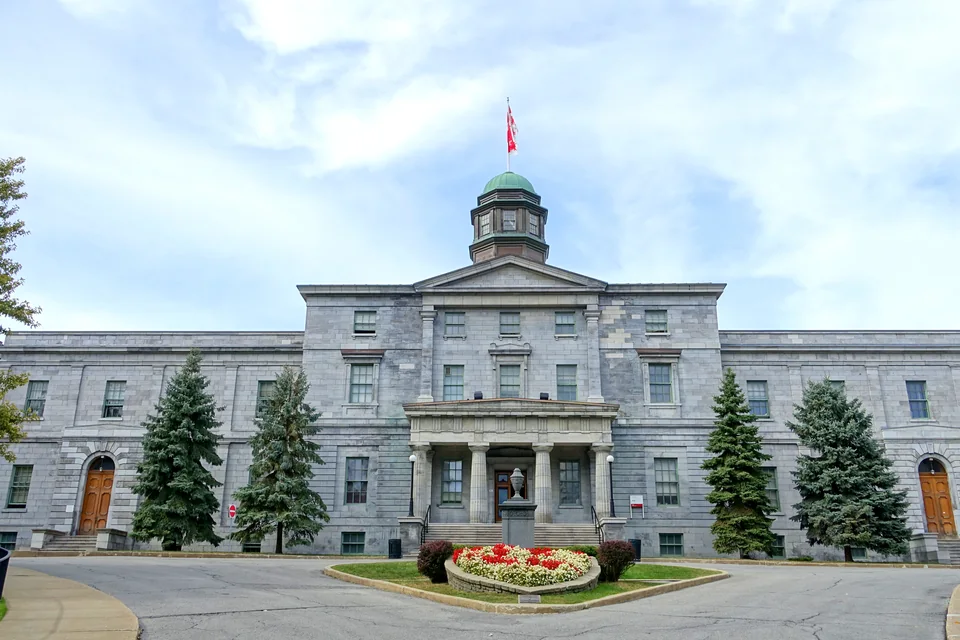
McGill is tied for 41st in the THE World University Rankings 2026. Teaching is in English, and French is not required for most programmes.
| At a glance | Details |
|---|---|
| Location | Montreal, Quebec; downtown campus and Macdonald campus |
| School certificate from Russia or Kazakhstan | listed among accepted credentials; minimum B+ equivalent |
| Fall 2027 application | 1 October 2026 to 15 January 2027; documents by 1 March 2027 |
| Application fee | $100 (CAD 140.16); a second application for the same term is free |
| English | IELTS Academic 6.5 (6.0 per band), TOEFL iBT 90 or 4.5; Management and TESL 100 or 5.0; Duolingo 125 (130 for BCom) |
| 2026/27 fees (2026 entrants) | BA $38,080 (CAD 54,000); BSc $45,690 (CAD 64,786); BEng $45,960 (CAD 65,168); BCom $50,560 (CAD 71,687) |
| Fee guarantee | entry-year rate applies for the whole bachelor's degree |
| Health insurance | compulsory International Health Insurance (IHI): $855 (CAD 1,212) a year |
| Residence | offered to first-year students aged 22 or under who accept their offer and apply by the housing lottery deadline |
| Quebec | CAQ ($95 (CAD 135)) before the study permit; $17,360 (CAD 24,617) a year for living costs |
Can you apply with a school certificate from Russia or the CIS?
Yes. McGill's list of accepted international credentials includes the Russian Attestat o Srednem (Polnom) Obshchem Obrazovanii and the Kazakh Attestat o Srednem Obrazovanii, as well as certificates from Armenia, Azerbaijan, Georgia and Moldova. Uzbekistan is not on that list, so applicants from Uzbek schools should ask the admissions office in advance how their certificate will be assessed. It must be an academic, pre-university diploma; vocational and technical schools are not normally considered.
Assessment. McGill reviews yearly averages and results in prerequisite subjects, which must be completed in the last two years of school. The minimum is the equivalent of a B+ average, but most programmes require more.
| Programme | Prerequisites |
|---|---|
| Arts, Religious Studies (BA) | none |
| Management (BCom) | maths (minimum pre-calculus) |
| Science, Kinesiology, Nursing, B.A. & Sc. | maths and normally two of biology, chemistry, physics |
| Engineering (BEng), including Software Engineering | maths, chemistry and physics |
| Architecture | maths and physics |
The U0 year and a possible three-year degree. Students from outside Quebec's CEGEP system usually start with a 30-credit freshman year (U0), followed by three years in their programme. McGill makes an exception for Bologna-signatory countries (Russia and Kazakhstan are marked as such on its list): qualified applicants to Arts, Education or Management with a Bologna-compliant diploma that leads to a three-year bachelor's in Europe may be admitted directly to a three-year programme; Management students then complete extra maths. There is a caveat: the rule refers to a diploma that leads to a three-year bachelor's in Europe, whereas the Russian attestat leads to a four-year degree, and Russia's participation in the Bologna Process has been suspended since 2022. The admissions office decides whether the rule applies to you, so budget for four years and treat three as a possible saving.
Documents. Upload a copy of your transcript, including mid-year results of the final year. When programme space is limited, applicants who complete their files earlier may be preferred, and incomplete files may be cancelled once a programme fills.
See also studying in Canada and bachelor's degrees in Canada.
How to apply: 2027 timeline
| Step | Date |
|---|---|
| McGill Applicant Portal opens | 1 October 2026 |
| Application (Music and Religious Studies: application and documents) | by 15 January 2027 |
| Major Entrance Scholarship application (opens in the portal on 1 October) | by 21 January 2027 |
| Supporting documents, including English test results | by 1 March 2027 |
| McGill Financial Aid application | within 30 days of admission |
| Confirm your place: $705 (CAD 1,000) deposit | by the date in your offer |
| Residence application | opens March 2027, by the housing lottery deadline |
- Create an account at future.mcgill.ca/apply and declare at least four years of academic history. You cannot change your programme after submitting; you would need a new application.
- Pay the $100 (CAD 140.16) fee by card (it can be a relative's). A second application for the same term and level is free; further ones cost $100 (CAD 140.16) each.
- Apply for a Major Entrance Scholarship separately by 21 January.
- Upload documents and track your checklist. Additional materials (references, statements, CASPer, proof of French) apply only to some programmes: Population & Global Health, Education, Global Engineering, Music, Nursing, Religious Studies, and to scholarship or aid applications.
- Accept and pay the deposit. International students pay a non-refundable $705 (CAD 1,000), credited to tuition. Undergraduates receive the official admission letter needed for the CAQ only after paying it.
English requirements
You are exempt after at least four consecutive years living and studying in a country where English is the primary language, or with certain school English qualifications (IB, A-level and others). Studying at an English-medium school in a non-English-speaking country does not exempt you. Results must come directly from the testing organisation; paper IELTS forms are not accepted.
| Test | Undergraduate minimum |
|---|---|
| IELTS Academic (including UKVI) | 6.5, no band below 6.0; One Skill Retake not accepted |
| TOEFL iBT up to 20 January 2026 | 90 (Management and Education TESL 100), 21 in each section |
| TOEFL iBT from 21 January 2026 | 4.5 (Management and TESL 5.0); reading, listening and writing 4.5, speaking 4.0 |
| Duolingo English Test | 125 (BCom and B.Ed. TESL 130) |
| PTE Academic | 65, 60 per component |
| CAEL | 70, 60 per component |
| Cambridge C1 Advanced / C2 Proficiency | certificate with grade B / C or better |
McGill warns that some IELTS centres deliver results late, so leave time before 1 March.
French is not a general admission or graduation requirement. Medicine, Nursing, Dentistry, Dietetics and Law require or consider it. McGill offers optional French courses and summer immersion.
How much does McGill cost? Guaranteed tuition
Under the Guaranteed Tuition model, international bachelor's students keep their entry-year rate for the whole degree; McGill's tables show 2025 BA entrants paying the same $34,560 (CAD 48,999.90) in 2026/27 as in 2025/26. Annual fees for students entering in fall 2026:
| Programme | Tuition | Total with fees and IHI |
|---|---|---|
| Bachelor of Arts (BA) | $38,080 (CAD 54,000) | $40,650 (CAD 57,647) |
| Bachelor of Science (BSc) | $45,690 (CAD 64,786) | $48,220 (CAD 68,379) |
| Bachelor of Engineering (BEng) | $45,960 (CAD 65,168) | $48,850 (CAD 69,267) |
| Bachelor of Commerce (BCom) | $50,560 (CAD 71,687) | $53,170 (CAD 75,396) |
Figures are for 30 credits over fall and winter. Other fees cover student societies, athletics and services, administration, IT and dental insurance; IHI is $855 (CAD 1,212) a year.
Four years is the default. Starting with U0, a BA costs $152,330 (CAD 216,000) in tuition over four years and a BCom $202,230 (CAD 286,750). A direct three-year admission in Arts or Management removes one year. 2027 entrants will have their own rate, published by Student Accounts.
Compare costs in the cost of studying in Canada; payment routes from Russia are in how to pay for studies abroad from Russia.
Scholarships
McGill's centrally administered entrance scholarships are merit-based, for first-time university students entering a full-time bachelor's.
| Award | Value | How |
|---|---|---|
| One-year Entrance Scholarship | $2,120 (CAD 3,000), one-off | automatic, based on grades submitted by the deadline |
| Major Entrance Scholarship | $2,120, $3,530 or $7,050 (CAD 3,000, 5,000 or 10,000) a year, renewable for 3–4 years | separate application by 21 January; academics and leadership |
| Major Entrance Scholarship $8,460 (CAD 12,000) a year | — | Canadian citizens and permanent residents only |
Unsuccessful Major applicants are automatically considered for the one-year award, and entrance scholarship holders receive one of their top two residence choices if they apply on time. Nationality does not exclude applicants, but awards do not cover full costs.
For graduate study, the McCall MacBain Scholarship fully funds master's and professional programmes at McGill and is open to applicants outside Canada and the US. Applications for the 2027 cohort opened on 1 June 2026 and closed on 19 August 2026 for applicants outside Canadian and US universities; check the programme page for the next cycle. See also scholarships in Canada.
Residence
McGill guarantees residence to new undergraduates who are 22 or under on 1 September, are starting their first year of university, have accepted their offer and applied for residence by the housing lottery deadline. Applications for 2027/28 open in March 2027. You confirm your room with a $1,060 (CAD 1,500) deposit and a $25 (CAD 35) application fee. The lease is a full-year commitment under Quebec law, with penalties for cancellation.
2026/27 first-year options (8.45-month lease, 20 August to 2 May; electricity, heating, internet and laundry included):
| Type | Examples | Cost per academic year |
|---|---|---|
| Traditional and modern halls with mandatory meal plan | Gardner, McConnell, Molson, Royal Victoria College, Carrefour Sherbrooke, La Citadelle, New Residence Hall | $11,270–15,440 (CAD 15,980–21,895) including meals |
| Shared houses and apartments without a meal plan | 3601 and 3653 University, 506 and 510 Ave des Pins | $4,500–6,560 (CAD 6,381–9,297) excluding meals |
| Macdonald campus (about 40 minutes by shuttle to downtown) | Laird Hall | $4,000–4,780 (CAD 5,674–6,773) excluding meals |
The All You Care to Eat meal plan costs $4,340 (CAD 6,150) and is included in the first group's price.
Quebec: CAQ, funds and the study permit
CAQ. The Certificat d'acceptation du Québec is mandatory for all McGill international students; you need it before applying for the study permit, and it is issued for a specific level of study. You apply online through the Arrima portal (currently in French only). The 2026 fee is $95 (CAD 135), non-refundable if refused. Standard processing is 25 business days after Immigration Québec confirms receipt of your documents. Documents not in English or French need certified translations.
Quebec's cap. Quebec limits CAQ applications per institution. McGill says it has managed its allocation so that admitted students are not expected to be refused a CAQ because the allotment is exhausted.
Funds. Quebec sets its own living-cost figure: for applications from 1 January 2026, $17,360 (CAD 24,617) a year for one person, plus tuition and return travel. For residents of Russia and most other countries, the Canadian visa office assesses financial capacity using Quebec's criteria when processing the study permit.
Study permit. In Quebec the CAQ takes the place of the PAL. IRCC fees are $105 (CAD 150) plus $60 (CAD 85) biometrics. Since 28 January 2026, Canadian visa application centres in Russia no longer accept passports or documents; when IRCC requests your passport, submit it at a VAC in another country.
Work and after graduation. During term you may work off campus up to 24 hours a week, and without an hour limit in scheduled breaks. University bachelor's, master's and PhD graduates can apply for a PGWP with no field-of-study restriction but need CLB/NCLC 7; programmes of two years or more can lead to up to three years. Immigration Québec decides on the CAQ and IRCC on permits. See Canada study permit and working while studying and PGWP.
Master's and PhD
Graduate applications go to individual programmes through the same portal, with programme-specific deadlines. McGill's minimums for Russian degrees:
| Level | Degree required | Minimum grade |
|---|---|---|
| Master's | 4-year Diplom Bakalavra or 5-year Diplom Spetsialista | B, i.e. 4 out of 5 |
| PhD | Diplom Magistra or Diplom Kandidata Nauk | B, i.e. 4 out of 5 |
English formats are stricter. IELTS Academic 6.5 (including UKVI); TOEFL iBT 86 with 20 per section, or 4.5 on the new scale (Reading, Listening, Writing 4.5; Speaking 4.0). IELTS Online, Duolingo and PTE Academic are not accepted for graduate programmes. Some programmes set higher scores.
| Programme (international, full time, 2026/27) | Annual tuition | Total with fees and IHI |
|---|---|---|
| Thesis master's | $15,060 (CAD 21,349) | $17,400 (CAD 24,666) |
| PhD | $13,510 (CAD 19,163) | $15,850 (CAD 22,481) |
Non-thesis master's, MBA and management programmes cost more and have separate fee tables. Funding for research students depends on the programme and supervisor. See master's in Canada.
Is McGill the right choice?
| Strengths | Trade-offs |
|---|---|
| National certificates accepted; tuition fixed for the whole degree | Usually four years including U0 |
| Possible three-year degree in Arts, Education and Management for Bologna countries | The admissions office decides; it cannot be counted on in advance |
| English-language teaching in a bilingual city; French optional | French helps a lot for work and life in Quebec |
| Guaranteed first-year residence for students aged 22 or under | Full-year lease under Quebec law, with cancellation penalties |
| Affordable residence options without a meal plan | Quebec's living-cost requirement is higher than elsewhere |
| Thesis master's around $15,060 (CAD 21,349) a year | Graduate programmes do not accept Duolingo, PTE or IELTS Online |
McGill suits applicants who want a leading research university with predictable fees and are ready for Quebec's CAQ step and higher funds requirement. Compare with the University of Toronto, the University of Waterloo and UBC, or browse universities in Canada.
Mistakes to avoid
- Mixing up deadlines: application 15 January, scholarship 21 January, documents 1 March.
- Booking IELTS too late: some centres send results slowly, and paper forms are not accepted.
- Planning to use Duolingo for a master's: it is not accepted at graduate level.
- Delaying the deposit: without it there is no official admission letter and therefore no CAQ.
- Showing funds at the federal $16,540 (CAD 23,448) level instead of Quebec's $17,360 (CAD 24,617).
- Applying for the study permit before receiving the CAQ.
- Planning to submit your passport at a VAC in Russia.
FAQ
Do I need French to study at McGill?
No. Teaching is in English, and French is not a general admission or graduation requirement. Medicine, Nursing, Dentistry, Dietetics and Law are exceptions.
How much is a McGill bachelor's for international students?
For 2026 entrants: BA $38,080 (CAD 54,000) a year, BSc $45,690 (CAD 64,786), BEng $45,960 (CAD 65,168), BCom $50,560 (CAD 71,687), fixed until graduation. Add about $2,540 (CAD 3,600) a year in fees and IHI.
Can I finish in three years?
Applicants from Bologna countries to Arts, Education and Management may be admitted directly to a three-year programme; for the Russian attestat, which leads to a four-year degree at home, this is not guaranteed. Otherwise, international school graduates usually start in U0 and study four years.
What is the CAQ and how much does it cost?
Quebec's acceptance certificate for international students, required before the study permit. The 2026 fee is $95 (CAD 135), with standard processing of 25 business days after documents are confirmed.
How much money do I need for a Quebec study permit?
First-year tuition, return travel and $17,360 (CAD 24,617) for one person for applications from 1 January 2026. For residents of Russia, the Canadian visa office checks this against Quebec's criteria.
What scholarships are available to international undergraduates?
An automatic one-year $2,120 (CAD 3,000) award, and Major Entrance Scholarships of $2,120 (CAD 3,000), 5,000 or 10,000 a year for up to four years by separate application by 21 January.
Is residence guaranteed?
Yes, if you are 22 or under on 1 September, entering university for the first time, have accepted your McGill offer and applied for residence by the lottery deadline. 2027/28 applications open in March 2027.
Can StudyU help with a McGill application?
Under a service agreement, we help choose the programme, prepare the application, documents and scholarship application, and then the CAQ and study-permit files. McGill decides on admission, Immigration Québec on the CAQ and IRCC on the permit.
Sources
- McGill: Other international high schools — credentials, deadlines, minimum grades, prerequisites
- McGill: Apply; Step-by-step guide; Terminology guide; Important updates
- McGill: English language proficiency
- McGill Student Accounts: Undergraduate fees 2026-27; Graduate fees; Tuition increases and Guaranteed Tuition
- McGill: Entrance scholarships; McCall MacBain Scholarship
- McGill Housing: Accommodation guarantee; First-year residence chart 2026-2027 (PDF)
- McGill ISS: CAQ overview; CAQ management rules; Required documents
- Québec.ca: Costs of studies; Temporary selection for studies
- McGill Graduate: Degree equivalency; Graduate English proficiency
- IRCC: PAL/TAL and CAQ; Work off campus; PGWP; Fees; Visa application centres
- THE World University Rankings 2026: McGill University
USD amounts are converted at the ECB reference rate of 29 September 2026 (CAD 1 = $0.7052) and rounded.
If you want to know which McGill programme fits your profile, whether a three-year degree is realistic and how to handle the CAQ, send us a request.
During the free initial consultation, we clarify your goal, profile, timing, and budget and identify the next realistic step.
Next steps
- Master's Degree in Canada: Admission, Costs and Funding for International Students
- Studying in Canada After 11 Years of School: Five Routes, Requirements and Budget
- Working While Studying in Canada and the PGWP: 2026 Rules During and After Your Program
- Scholarships in Canada for International Students: What Is Available in 2026/27 and How to Apply
- How to Pay for Studies Abroad from Russia: What Works in 2026
- Studying in Canada for international applicants
