
An international bachelor's student in Canada pays roughly $23,600–53,100 (CAD 33,350–75,000) a year in tuition: at the low end of our sample is OCAD University including fees, at the high end is engineering at the University of Waterloo. College diplomas cost less — EduCanada gives $11,330–17,710 (CAD 16,000–25,000) a year including mandatory fees and health insurance. On top of tuition, IRCC requires proof of at least $16,610 (CAD 23,448) for first-year living costs if you apply for a study permit on or after September 1, 2026, to study outside Quebec. In practice, a first year of undergraduate study in Toronto with off-campus housing easily exceeds $46,000, while a first PhD year at the University of Toronto's standard rate is about $21,000 before the funding package.
This guide covers 2026/27 prices at specific universities, why the study permit amount is not your real budget, provincial health insurance costs, the payments due before your first term, and legitimate ways to lower the total. Figures come from official university, IRCC and provincial pages; USD conversions use European Central Bank rates of September 24 and 29, 2026 (1 USD ≈ 1.4117 and 1.4180 CAD), rounded. For the wider picture, see studying in Canada.
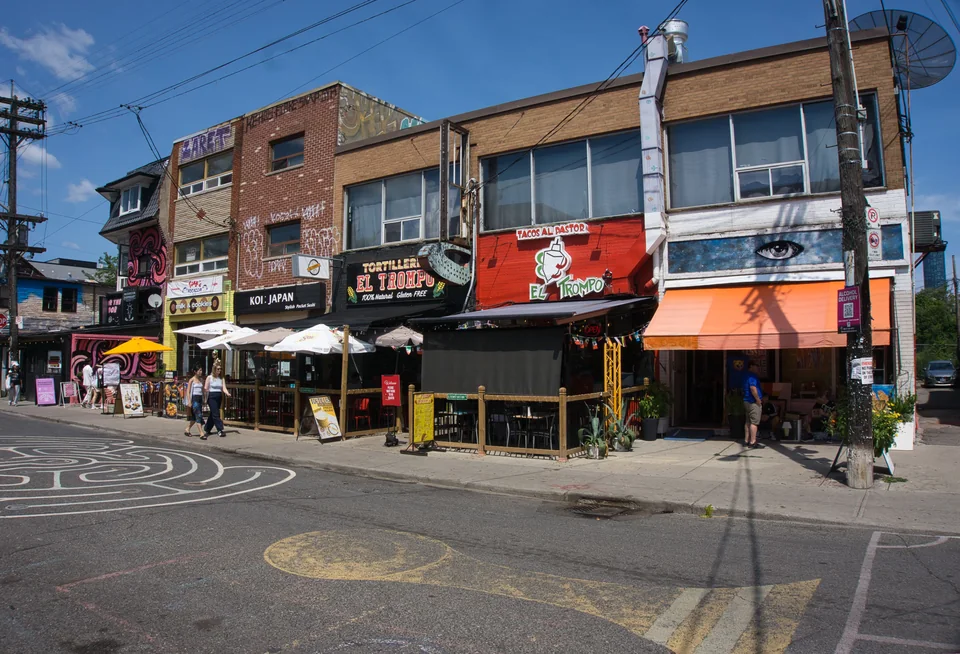
How much a year of study costs by program type
Canadian prices depend first on the type of program, then on province and faculty. International students pay a separate international fee, several times higher than what citizens and permanent residents pay.
| Program | Tuition per year | What is included | Source |
|---|---|---|---|
| College diploma | $11,330–17,710 (CAD 16,000–25,000) | tuition, mandatory fees, college health insurance | EduCanada, 2026 |
| Bachelor's, national average | ≈ $29,570 (CAD 41,746) | tuition only | EduCanada citing Statistics Canada |
| Bachelor's at universities in Ontario and British Columbia | $23,620–53,130 (CAD 33,350–75,000) | see the table below | university websites, 2026/27 |
| Master's, national average | ≈ $17,020 (CAD 24,028) | tuition only | EduCanada citing Statistics Canada |
| Research PhD at U of T | ≈ $4,400 (CAD 6,210) | tuition only | U of T, 2026/27 |
Averages are useful context, but you cannot budget with them: within one university, faculties can differ by more than $15,000 a year. You need the fee for a specific program and entry year.
University tuition for 2026/27
The table shows international fees for students starting in fall 2026. Where a university quotes tuition together with fees, this is noted.
| University | Program | Annual amount | Included |
|---|---|---|---|
| University of Toronto | Arts & Science | $46,830 (CAD 66,110) | tuition |
| University of Toronto | Applied Science & Engineering | $51,610 (CAD 72,860) | tuition |
| University of Toronto | Kinesiology / Music | $36,450 / $35,760 (CAD 51,460 / 50,490) | tuition |
| University of British Columbia | Arts | $36,500 (CAD 51,530) | tuition, full first-year load |
| University of British Columbia | Science, Computer Science | $37,600 (CAD 53,082) | tuition |
| University of British Columbia | Engineering / Commerce (Sauder) | $46,890 / $47,230 (CAD 66,200 / 66,678) | tuition |
| University of Waterloo | Arts / Science | $41,080 / $38,250 (CAD 58,000 / 54,000) | tuition and incidental fees, two terms |
| University of Waterloo | Computer Science / Engineering | $51,710 / $53,130 (CAD 73,000 / 75,000) | tuition and incidental fees, two terms |
| York University | most Arts & Science programs | ≈ $28,330 (≈ CAD 40,000) | university's tuition estimate |
| York University | Engineering | ≈ $33,290 (≈ CAD 47,000) | university's tuition estimate |
| Toronto Metropolitan University | all faculties | $27,410–31,650 (CAD 38,693–44,675) | range by faculty |
| OCAD University | undergraduate, 2.5 credits per term | ≈ $23,620 (≈ CAD 33,350) | tuition, fees and UHIP |
How to read these numbers:
- "Tuition" and "tuition plus fees" are different lines. Waterloo and OCAD quote totals that include incidental fees such as the student union, transit pass, athletics and the student health plan. At U of T, UBC and York, add fees and insurance on top.
- Programs with a premium fee may not charge it in year one. At U of T, Computer Science and Commerce students pay the general Arts & Science fee ($46,830 (CAD 66,110)) in first year and a higher fee from year two; the university's report lists $51,120 (CAD 72,480) and $55,120 (CAD 78,160) for these cohorts in 2027/28.
- Fees rise every year. U of T projects a 4% increase in international undergraduate fees for 2027/28. UBC caps increases at 3% a year for the next four years for students starting in 2026/27.
- Co-op changes the payment schedule. At Waterloo you pay no tuition during paid work terms, but there is a co-op fee of $590 (CAD 836) per term.
For choosing an institution, see our guides to universities in Canada and universities in Toronto.
College or university: what the price difference buys
A college costs roughly half as much as a university, but the two sell different things. A college diploma, advanced diploma or graduate certificate is an applied credential lasting one to three years. Universities award bachelor's, master's and doctoral degrees.
An example from Toronto: for 2026/27, Centennial College lists $12,750 (CAD 18,005) for the first year of a standard program and $13,580 (CAD 19,167) for engineering technology and transportation programs, with ancillary fees charged separately.
The price gap interacts with post-graduation work rules. If you applied for your study permit on or after November 1, 2024, a college graduate needs a program in an eligible field of study to qualify for a post-graduation work permit (PGWP). General business administration, marketing, accounting and hospitality management are not on the list. Bachelor's, master's and doctoral graduates have no field-of-study requirement. A cheap college program outside the list can therefore become an expensive choice if you plan to work in Canada after graduating. Details are in our guides to working while studying and the PGWP and colleges in Canada.
Master's and PhD: where you pay and where you get paid
Graduate programs in Canada fall into two groups with opposite budgets.
| Program type | Example fee 2026/27 (U of T) | Funding |
|---|---|---|
| Professional (course-based) master's: MEng, MBA, MScAC and others | MEng $51,600 (CAD 72,850); MScAC $35,470 (CAD 50,070) | usually no package, only competitive awards |
| Research master's (thesis-based MA, MSc) | $23,700 (CAD 33,460) | often a package: stipend plus assistantship |
| PhD | $4,400 (CAD 6,210) | usually a faculty funding package |
At U of T, international tuition for most PhD programs is aligned with the domestic rate of $4,400 (CAD 6,210) a year. The funding package is stated in the offer letter and varies by department, so compare programs by the amount in the offer.
The federal doctoral award, the Canada Graduate Research Scholarship – Doctoral, is worth $28,330 (CAD 40,000) a year for 36 months. International students can compete only once registered in a Canadian doctoral program, and only through their university; up to 15% of awards go to international applicants. See our guides to scholarships in Canada and master's degrees in Canada.
Study permit funds versus real living costs
IRCC checks that you can pay, without working in Canada, for tuition, living expenses and return transportation. The living amount is fixed and depends on family size.
| Who is coming (outside Quebec) | Application on or after Sept 1, 2026 | Application Jan 1, 2025 – Aug 31, 2026 |
|---|---|---|
| Student alone | $16,610 (CAD 23,448) | $16,220 (CAD 22,895) |
| Student plus one family member | $20,680 (CAD 29,192) | $20,100 (CAD 28,502) |
| Family of three | $25,420 (CAD 35,888) | $24,710 (CAD 35,040) |
| Each additional member beyond seven | $4,480 (CAD 6,318) | $4,350 (CAD 6,170) |
Three details applicants often miss:
- The living amount excludes tuition and travel. You show first-year tuition separately (a receipt or funds in an account) and add transportation.
- For programs longer than one year, the officer expects a plan for the remaining years, such as a multi-year scholarship or evidence of parents' employment.
- Bank statements should cover the last six months and show where the money came from. A large unexplained deposit weakens an application. A GIC — a deposit with a Canadian bank paid out in instalments after arrival — is also accepted.
The IRCC figure is a floor, not a forecast. Toronto Metropolitan University publishes its own 2026/27 estimate of a student's annual costs in Toronto:
| Item | TMU annual estimate |
|---|---|
| On-campus residence | $6,380–10,700+ (CAD 9,000–15,100+) plus meal plan |
| Off-campus rent, 12 months | $10,630–14,880+ (CAD 15,000–21,000+) |
| Food (5- to 7-day meal plans) | $3,940–5,360 (CAD 5,565–7,571) |
| TTC transit pass | from $90 (CAD 128) a month |
| Books and supplies | $1,060–4,750 (CAD 1,500–6,700) |
| Personal expenses | $2,270–3,970 (CAD 3,200–5,600) |
Off-campus rent, food, transit and personal expenses at the low end already add up to about $17,840 (CAD 25,300), more than the IRCC minimum. Quebec runs its own financial check for the Quebec Acceptance Certificate (CAQ), using amounts set by the province's immigration ministry (MIFI).
Health insurance by province
Health coverage for international students is set provincially, so the same budget line looks different depending on where you study.
| Province | How it works | Cost |
|---|---|---|
| Ontario (universities) | University Health Insurance Plan (UHIP), automatic enrolment, charged to your student account | $670 (CAD 948) a year for a September 2026 start |
| British Columbia | provincial MSP, paid by study permit holders after a 3-month wait | $53 (CAD 75) a month; UBC automatically covers most new international students with iMED for the first 3 months |
| Quebec | free RAMQ coverage only for citizens of countries with a Quebec social security agreement; others need the institution's group plan or private insurance | depends on the institution; private cover must be arranged within 5–30 days of arrival or the CAQ may be cancelled |
UHIP covers doctors, diagnostics and hospital care but not prescriptions, dental care or glasses. Those come from a separate student health and dental plan that many universities include in mandatory fees.
One-time costs before your first term
These payments arrive before or alongside tuition. Keep them as a separate line so you do not dip into the funds you show for the permit.
| Payment | Amount | Paid to |
|---|---|---|
| Application fee | set by each institution; Ontario undergraduate applications go through OUAC | institution or OUAC |
| Enrolment deposit after an offer | stated in the offer; at U of T refunded only in exceptional cases such as a study permit refusal | institution |
| Study permit fee | $106 (CAD 150) | IRCC |
| Biometrics | $60 (CAD 85) per person, up to $120 (CAD 170) per family | IRCC, at application |
| Medical exam | clinic's price; only with an IRCC panel physician | clinic |
| Language test | test centre's fee | test provider |
| Document translations | translator's fee | translator |
| Flight and first month's living costs | depends on route and housing | — |
Citizens of Russia should add a trip abroad: biometrics can still be given at a visa application centre in Russia, but since January 28, 2026 Russian centres no longer accept passports or documents, so the passport for the visa goes to a centre outside Russia, for example in Yerevan, Tbilisi, Almaty or Astana. The process is covered in our Canada study permit guide. If you have lived in Russia, Kazakhstan or another listed country for six months or more in a row during the year before you come, you also need an immigration medical exam for a stay longer than six months.
Three sample first-year budgets
These examples show how the total builds up; they are not a calculation for any particular family. Fees are official 2026/27 figures; living costs use the TMU estimate or the IRCC minimum.
| Scenario | Tuition | Living | First-year total |
|---|---|---|---|
| College diploma in Toronto (Centennial, standard program) | $12,750 (CAD 18,005) | IRCC minimum $16,610 (CAD 23,448) | ≈ $29,360 (CAD 41,450) excluding ancillary fees, insurance and flights |
| TMU bachelor's (Arts), off-campus housing | $27,300 (CAD 38,706) | $18,900–26,230 (CAD 26,800–37,200) per TMU estimate: rent, food, transit, $1,060 (CAD 1,500) books, personal | ≈ $46,400–53,770 (CAD 65,500–75,900) excluding UHIP and flights |
| U of T PhD before funding | $4,400 (CAD 6,210) | IRCC minimum $16,610 (CAD 23,448) | ≈ $21,010 (CAD 29,660); a faculty package usually covers most of it |
The gap between the first two scenarios is not only tuition. A college program is shorter, but its PGWP conditions are stricter; a degree costs more but has no field-of-study test for the PGWP.
Legitimate ways to lower the total
- Compare the full program cost, not the first-year fee. Four years of U of T Arts & Science with projected increases cost more than four times $46,830 (CAD 66,110).
- Apply by the main deadline. Many universities automatically consider international applicants for entrance awards: UBC for the International Major Entrance Scholarship and the Outstanding International Student Award; York, for the fall 2026 intake, for first-year awards of $3,530–10,580 (CAD 5,000–15,000) based on your average. At UBC Okanagan every new international undergraduate receives $5,640 (CAD 8,000) a year.
- Look at co-op programs. At Waterloo you pay no tuition during work terms and keep your placement salary. You can spend that income on study, but you cannot count it in the funds shown for the permit.
- At graduate level, compare research and professional programs. At U of T the difference is $23,700 (CAD 33,460) versus $51,600 (CAD 72,850) a year, and a research program may come with funding.
- Do not build the budget on job income. Off-campus work during terms is capped at 24 hours a week, and IRCC explicitly requires funds without Canadian employment.
- Book housing early. University residence is often cheaper than off-campus rent, but places are limited and allocated by application date.
When and how you pay
Most universities bill by term: fall in early September, winter in January. Waterloo states that you pay one term at a time and that the exact amount appears in your account about a month before the term begins. U of T opens fall and winter charges in ACORN from mid-July.
A deposit or part of tuition is usually due before the study permit application: under IRCC rules, a provincial attestation letter (PAL) is generally issued after you accept your offer and pay part or all of your tuition. Plan this payment into the spring and summer before departure.
Paying a Canadian institution from Russia needs separate checking — bank, currency, beneficiary details and a receipt you can use for the permit. Use lawful routes only; see how to pay for studies abroad from Russia.
Common budgeting mistakes
- Counting tuition only. Fees, insurance, books and a housing deposit add several thousand dollars a year.
- Treating the IRCC minimum as a spending plan. In Toronto and Vancouver it is below the real cost of rent and food.
- Mixing fee categories. Ontario and Canadian student rates do not apply to international students.
- Ignoring annual increases. Budget every year of the program with a margin for fee rises.
- Showing money deposited just before applying. Without an explained source, such funds weaken the application.
- Choosing a college program on price alone. For a post-college PGWP, the field of study must be on IRCC's list.
FAQ
Undergraduate tuition at universities in Toronto, Vancouver and Waterloo in 2026/27 is roughly $23,600–53,100 (CAD 33,350–75,000) depending on institution and faculty. A college diploma costs $11,330–17,710 (CAD 16,000–25,000) according to EduCanada. For living costs, IRCC requires proof of at least $16,610 (CAD 23,448) for the first year.
For applications on or after September 1, 2026, outside Quebec: first-year tuition, $16,610 (CAD 23,448) for one student's living costs, and transportation. The living amount rises with each accompanying family member according to IRCC's table. Quebec applies its own provincial rules.
There is no free higher education for international students in Canada. The closest option is a funded PhD: at U of T most PhD programs charge $4,400 (CAD 6,210) a year and the department usually pays a stipend. At undergraduate level, full coverage comes only from rare competitions such as U of T's Lester B. Pearson Scholarship.
It depends on the institution and province. In Ontario, UHIP ($670 (CAD 948) a year from September 2026) is charged separately unless the institution includes it in its quoted total, as OCAD U does. In British Columbia, students pay $53 (CAD 75) a month for MSP after a three-month wait.
Partly, but not at the visa stage. You can work up to 24 hours a week off campus during terms and without a limit during scheduled breaks, yet IRCC requires proof that you can pay without Canadian employment.
Universities revise fees every year, and many sites show old figures or mix domestic and international rates. Check the fees page of your chosen university for the correct academic year and confirm whether fees and insurance are included.
Sources
- IRCC: proof of financial support — checked September 24, 2026
- IRCC: PAL/TAL and required documents — checked September 24, 2026
- IRCC: fees — checked September 24, 2026
- IRCC: visa application centres and medical exam country list — checked September 24, 2026
- IRCC: off-campus work and PGWP eligibility — checked September 24, 2026
- EduCanada: study costs — checked September 24, 2026
- University of Toronto: 2026-27 Tuition Fee Report and fees page — checked September 24, 2026
- UBC: undergraduate tuition 2026/27 and health insurance — checked September 24, 2026
- University of Waterloo: tuition — checked September 24, 2026
- York University: tuition — checked September 24, 2026
- Toronto Metropolitan University: tuition and fees — checked September 24, 2026
- OCAD University: 2026/27 international fee schedule (PDF) — checked September 24, 2026
- Centennial College: tuition 2026-2027 — checked September 24, 2026
- UHIP: 2026/27 rates — checked September 24, 2026
- Québec: conditions for international students — checked September 24, 2026
- NSERC: Canada Graduate Research Scholarship – Doctoral — checked September 24, 2026
- USD conversions use the ECB reference rates of September 24, 2026 (EUR/USD 1.1367, EUR/CAD 1.6047, i.e. 1 USD ≈ 1.4117 CAD) and September 29, 2026 (EUR/USD 1.1355, EUR/CAD 1.6101, i.e. 1 USD ≈ 1.4180 CAD).
Program-specific budgets, requirement checks and study permit documents are provided under an agreement with StudyU. Admission decisions are made by the institution; study permit decisions by IRCC.
Next steps
- Universities in Canada for International Students: Types, Costs and How to Choose
- Universities in Toronto for International Students: 2026/27 Fees, Colleges and Admission
- Working While Studying in Canada and the PGWP: 2026 Rules During and After Your Program
- Colleges in Canada for International Students: Programmes, Costs and Post-Graduation Work Rights
- Studying in Canada for international applicants
- How to Pay for Studies Abroad from Russia: What Works in 2026
