
For most international students, the choice in Toronto comes down to four large public universities: the University of Toronto with three campuses, York University, Toronto Metropolitan University (TMU) and OCAD University. Two smaller ones complete the list: the French-language Université de l'Ontario français and the University of Guelph-Humber. Large colleges operate alongside them — Centennial, George Brown, Humber and Seneca — with Sheridan in the suburbs. Undergraduate tuition in 2026/27 ranges from ≈ $23,620 (OCAD U, including mandatory fees) and $27,410 (TMU) to $51,610 a year (engineering at U of T); the first year of a standard Centennial College program is about $12,750. Applications to Ontario universities for bachelor's programs go through OUAC; U of T accepts applications for 2027 until January 15, 2027. For a study permit, undergraduates need an Ontario PAL and $16,540 (CAD 23,448) for living costs, although TMU estimates off-campus rent alone at $10,580–14,810 (CAD 15,000–21,000) a year.
This guide compares universities and colleges by price and profile, suggests which option fits which goal, explains applications and scholarships, estimates living costs in Toronto, and covers visa and work rules. Fees come from official 2026/27 university pages checked on September 24, 2026; USD conversions use the ECB rate of September 29, 2026 (1 USD ≈ 1.4180 CAD). We do not quote rankings: price, requirements and post-graduation conditions matter more for choosing a program. For the wider picture, see studying in Canada.
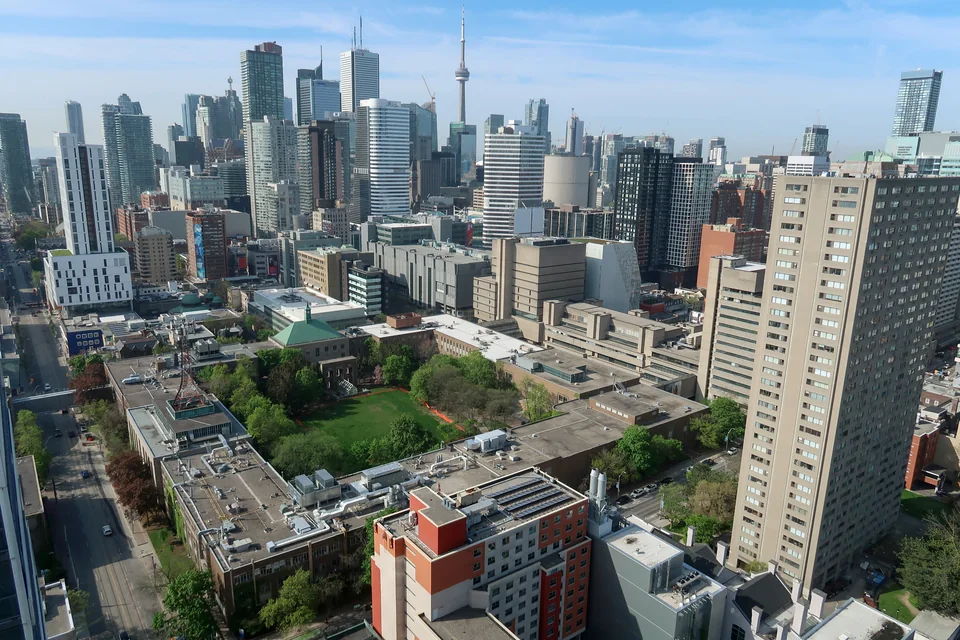
Toronto universities and colleges at a glance
| Institution | Type | Location | International tuition, 2026/27 |
|---|---|---|---|
| University of Toronto | research university | St. George (downtown), Mississauga, Scarborough campuses | $35,610–51,380 (CAD 50,490–72,860) a year for bachelor's programs |
| York University | large university | main Keele campus, Glendon, Markham | ≈ $26,800–33,150 (CAD 38,000–47,000) |
| Toronto Metropolitan University | downtown university (formerly Ryerson University) | downtown Toronto | $27,290–31,510 (CAD 38,693–44,675) |
| OCAD University | art and design university | downtown Toronto | ≈ $23,520 (CAD 33,350) including fees and UHIP |
| Centennial College | college | Toronto | $12,700–13,520 (CAD 18,005–19,167) for the first year of a diploma, excluding ancillary fees |
| George Brown, Humber, Seneca | colleges and polytechnics | Toronto | depends on program — see profiles below |
| Sheridan College | college | Oakville, Brampton, Mississauga | depends on program |
| Université de l'Ontario français, University of Guelph-Humber | smaller universities | downtown (UOF), northwest Toronto (Guelph-Humber) | see the universities' sites |
How to read the table: U of T, York and TMU figures are tuition only; add fees and UHIP insurance ($670 (CAD 948) a year) on top. The OCAD U figure uses the official fee schedule for 2.5 credits per term including mandatory fees. A national cost breakdown is in our guide to the cost of studying in Canada.
University of Toronto: three campuses and the highest fees
U of T is the most expensive university in the city. You choose a campus — St. George downtown, Mississauga or Scarborough — when you apply, and program offerings differ between campuses.
2026/27 fees for international students starting in fall 2026:
| Program | Annual tuition |
|---|---|
| Arts & Science (including Mississauga and Scarborough campuses) | $46,620 (CAD 66,110) |
| Applied Science & Engineering | $51,380 (CAD 72,860) |
| Architecture, Visual Studies | $46,620 (CAD 66,110) |
| Kinesiology | $36,290 (CAD 51,460) |
| Music | $35,610 (CAD 50,490) |
Computer Science and Commerce students pay the general Arts & Science fee in first year and a higher fee from year two: for the 2026 cohort the university lists $51,120 (CAD 72,480) and $55,120 (CAD 78,160) for 2027/28. U of T projects a 4% rise in international undergraduate fees for 2027/28.
Graduate fees vary even more: research MA and MSc programs cost $23,600 (CAD 33,460) a year, the MEng $51,380 (CAD 72,850), and most PhD programs $4,380 (CAD 6,210) — the same as for Canadians.
English requirements for undergraduate admission: IELTS Academic 6.5 with no band below 6.0, or for example the Duolingo English Test at 120 with 120 in Production. TOEFL iBT is now scored on a new scale.
Scholarships: entrance awards are assigned automatically ($7,050 (CAD 10,000) or $10,580 (CAD 15,000) for first year), while the full Lester B. Pearson Scholarship requires a school nomination. See our guide to scholarships in Canada and the University of Toronto profile.
York University: wide choice and automatic scholarships
York is a large university with its main campus in north Toronto. Its Glendon campus offers programs taught in English, French or both, including translation and public and international affairs, and it also has a campus in Markham.
York's approximate international tuition for 2026/27 at a full course load:
| Area | Annual tuition |
|---|---|
| Most Arts & Science programs | ≈ $28,210 (CAD 40,000) |
| Business | ≈ $28,210–31,030 (CAD 40,000–44,000) |
| Computer Science | ≈ $26,800 (CAD 38,000) |
| Design | ≈ $28,210 (CAD 40,000) |
| Engineering | ≈ $33,150 (CAD 47,000) |
Supplementary fees are charged separately. For the fall 2026 intake, York automatically granted international entrance scholarships based on the final average: from a one-time $3,530 (CAD 5,000) at 75–79.9% to $10,580 (CAD 15,000) in first year and $5,290 (CAD 7,500) a year afterwards at 90% and above. A separate competition, the President's International Scholarship of Excellence, pays $31,740 (CAD 45,000) a year for four years.
Toronto Metropolitan University: downtown and career-focused
TMU sits in the heart of downtown Toronto. It publishes international fee ranges by faculty for 2026/27:
| Faculty | Annual tuition |
|---|---|
| Arts | $27,300–27,310 (CAD 38,706–38,731) |
| Community Services | $27,290–29,270 (CAD 38,693–41,506) |
| Engineering and Architectural Science | $31,290–31,510 (CAD 44,375–44,675) |
| Science | $27,290–27,340 (CAD 38,702–38,762) |
| Ted Rogers School of Management (business) | $31,370–31,410 (CAD 44,476–44,532) |
| The Creative School (media, design, communication) | $27,320–27,650 (CAD 38,733–39,209) |
TMU also runs English pathway programs; for example, English Boost costs $6,980 (CAD 9,895) for eight weeks for a fall 2027 start. It is an option if your English is not yet at the direct-entry level.
OCAD University: art and design
OCAD U specializes in art and design. International tuition for 2026/27 is $4,270 (CAD 6,049.64) per 1.0 credit. At 2.5 credits per term, the fall bill is $11,670 (CAD 16,551) and the winter bill $11,850 (CAD 16,796) — about $23,520 (CAD 33,350) a year, already including UHIP, the student health and dental plan, and mandatory fees. For creative programs, check portfolio requirements on the specific program page.
Smaller universities: UOF and Guelph-Humber
The Université de l'Ontario français (UOF) is a public French-language university in downtown Toronto — teaching is in French, so it suits students ready to study in that language. The University of Guelph-Humber is a partnership of the University of Guelph and Humber Polytechnic with a campus in northwest Toronto; every honours degree there includes workplace experience. Check international fees on their websites; they are not part of the price comparison in this guide.
Colleges in Toronto and the suburbs
Colleges award applied credentials (diplomas, advanced diplomas, graduate certificates) and some offer bachelor's degrees. Tuition is roughly half of university fees. For 2026/27, Centennial College lists $12,700 (CAD 18,005) for the first year of a standard program and $13,520 (CAD 19,167) for engineering technology and transportation programs; its honours degree programs cost $12,960–16,080 (CAD 18,375–22,802.50) for the first year.
College profiles with programs and prices on StudyU: George Brown College, Humber Polytechnic and Sheridan College. For an overview of the system, see colleges in Canada.
The key test when choosing a college is PGWP eligibility after graduation. If the study permit application was made on or after November 1, 2024, a college graduate needs a program in a field on IRCC's list. General business administration, marketing, accounting and hospitality management programs are not on it. Check the program's CIP code before you apply. The second condition is language: the PGWP requires an IRCC-approved test at CLB 5 in all four skills after a college diploma or certificate, and CLB 7 after a bachelor's degree, including one earned at a college. See working while studying and the PGWP.
How to choose: matching institutions to goals
| Goal | Consider | Watch out for |
|---|---|---|
| Research career, strong brand | U of T | highest undergraduate fees; PhD at $4,380 (CAD 6,210) with funding packages |
| A university degree for less than U of T | TMU, York | about $17,630–19,750 (CAD 25,000–28,000) a year cheaper than U of T |
| Art and design | OCAD U, TMU's Creative School | portfolio, per-credit pricing |
| French or bilingual study | Glendon (York) | language of instruction for the specific program |
| Short applied program and quick entry to work | colleges | CIP code for the PGWP, CLB 5 language |
| Lowest budget for a university degree | OCAD U or TMU | living costs in Toronto stay high regardless |
If your budget is tight, compare universities outside Toronto too: tuition and rent can be lower, while study permit and PGWP rules are the same nationwide. See our guide to universities in Canada.
Admission: OUAC, deadlines and documents
Undergraduate applications to Ontario universities go through the Ontario Universities' Application Centre (OUAC); applicants not attending an Ontario high school use the 105 application. Colleges take applications through OntarioColleges.ca or their own portal, as each college specifies. Graduate applications go directly to the university or department.
Each institution sets its own deadlines. U of T for a September 2027 start is a useful benchmark:
| What | Deadline |
|---|---|
| School nomination for the Pearson Scholarship | October 9, 2026 |
| OUAC application for Pearson candidates | October 16, 2026 |
| Pearson application form and documents | November 6, 2026 |
| Recommended early application date | November 7, 2026 |
| Final application deadline (most faculties, Mississauga and Scarborough campuses) | January 15, 2027 |
| Documents and supplementary applications (Arts & Science, Computer Science, Rotman Commerce) | February 1, 2027; engineering and music — January 15 |
| Admission decisions | in rounds from January to May 2027 |
The Pearson nomination comes from your school, not from you, so raise it with your school early in your final year. For York, TMU and OCAD U, check the deadline on the page of the program you want. Apply by the main deadline to be considered automatically for entrance awards.
A typical undergraduate package:
- grades for the final years of secondary school and your diploma once issued, with translations;
- an English test if you did not study in English;
- supplementary forms or a portfolio if the program requires them;
- the application fee.
Requirements for foreign secondary school credentials, prerequisite subjects and course load differ by university and program, so check the country-specific admission page of each institution.
Living in Toronto: what to budget
Toronto is one of Canada's most expensive cities for students. TMU publishes a 2026/27 annual estimate:
| Item | TMU annual estimate |
|---|---|
| On-campus residence | $6,350–10,650+ (CAD 9,000–15,100+) plus meal plan |
| Off-campus rent, 12 months | $10,580–14,810+ (CAD 15,000–21,000+) |
| Food (meal plans) | $3,920–5,340 (CAD 5,565–7,571) |
| TTC transit pass | from $90 (CAD 128) a month |
| Books and supplies | $1,060–4,730 (CAD 1,500–6,700) |
| Personal expenses | $2,260–3,950 (CAD 3,200–5,600) |
Even the low-end figures for rent, food, transit and personal expenses add up to about $17,840 (CAD 25,300) — above the IRCC minimum of $16,540 (CAD 23,448). At Ontario universities, add UHIP at $670 (CAD 948) a year for a September 2026 start.
Study permit and work for students in Toronto
- PAL: bachelor's and college students need an Ontario PAL, which the institution requests after you accept the offer and pay. Master's and doctoral students at public universities have not needed a PAL since January 1, 2026.
- Funds: for study permit applications from September 1, 2026, show first-year tuition, $16,540 (CAD 23,448) for living costs and, separately, travel money.
- Visa centres: Russian citizens can give biometrics at a visa application centre in Russia, but since January 28, 2026, Russian centres no longer accept passports, so the passport goes to a centre in another country, such as Yerevan or Almaty. See our Canada study permit guide.
- Work: up to 24 hours a week off campus during terms and without a limit during scheduled breaks. Ontario's minimum wage is $12.66 (CAD 17.95) an hour from October 1, 2026.
Common mistakes
- Comparing U of T with a college on price alone, ignoring that the credentials and PGWP conditions differ.
- Forgetting to add fees and UHIP to U of T, York and TMU tuition.
- Treating U of T's first-year fee for Computer Science or Commerce as the fee for every year.
- Choosing a college program on price without checking its CIP code.
- Applying after the main deadline and missing automatic scholarships.
- Budgeting for Toronto on the IRCC minimum.
FAQ
Four large public universities — the University of Toronto, York University, Toronto Metropolitan University and OCAD University — and two smaller ones: the French-language Université de l'Ontario français and the University of Guelph-Humber. Colleges and polytechnics in the city and suburbs include Centennial, George Brown, Humber, Seneca and Sheridan.
For 2026/27, undergraduate tuition ranges from about $23,520 (CAD 33,350) at OCAD U (including fees) and $27,290 (CAD 38,693) at TMU to $51,380 (CAD 72,860) for engineering at U of T. York estimates $26,800–33,150 (CAD 38,000–47,000) a year depending on the program.
Of the four universities, OCAD U and TMU have the lowest fees, followed by York. Living costs in Toronto are high for everyone, so compare the full budget, not just tuition.
For bachelor's programs, through OUAC; applicants outside Ontario high schools use the 105 application. For master's programs, directly to the university. For colleges, through OntarioColleges.ca or the college's portal.
For undergraduate admission, IELTS Academic 6.5 with no band below 6.0. For a post-graduation work permit you will later need a different test — IELTS General Training or another test on IRCC's list.
For U of T with a September 2027 start, by January 15, 2027, with November 7, 2026 as the recommended early date. Pearson candidates need a school nomination by October 9 and an OUAC application by October 16, 2026. For York, TMU and OCAD U, check each program's page.
Bachelor's and college students do; the institution requests the Ontario PAL. Master's and doctoral students at public universities have not needed one since January 1, 2026.
Sources
- University of Toronto: 2026-27 Tuition Fee Report — checked September 24, 2026
- University of Toronto: English language requirements, scholarships for international students, Pearson, deadlines — checked September 28, 2026
- Université de l'Ontario français, University of Guelph-Humber — checked September 28, 2026
- York University: tuition, international scholarships, Glendon, Markham — checked September 24, 2026
- Toronto Metropolitan University: tuition and fees — checked September 24, 2026
- OCAD University: 2026/27 international fee schedule (PDF) — checked September 24, 2026
- Centennial College: tuition 2026-2027 — checked September 24, 2026
- UHIP: 2026/27 rates — checked September 24, 2026
- IRCC: proof of financial support, PAL/TAL, visa application centres, off-campus work, PGWP eligibility and language, PGWP field of study — checked September 28, 2026
- Government of Canada: visa services in Russia — checked September 28, 2026
- Government of Ontario: minimum wage — checked September 24, 2026
- Ontario Colleges — checked September 24, 2026
- USD conversions use the ECB reference rates of September 29, 2026: EUR/USD 1.1355 and EUR/CAD 1.6101 (1 USD ≈ 1.4180 CAD).
Shortlisting Toronto universities and colleges for your profile and budget, requirement checks and applications are provided under an agreement with StudyU. Admission decisions are made by the institution and study permit decisions by IRCC.
Next steps
- Cost of Studying in Canada in 2026/27: Tuition, Living Costs and Study Permit Funds
- Scholarships in Canada for International Students: What Is Available in 2026/27 and How to Apply
- University of Toronto: Admission, Fees and Scholarships for International Students
- Colleges in Canada for International Students: Programmes, Costs and Post-Graduation Work Rights
- Studying in Canada for international applicants
- George Brown College
